
Loading dispatches...
← Return to Newsroomgeneral
Sabarimala Reference: ‘Constitution entrusts religious reform to legislature not courts’

New DelhiUpdated: May 14, 2026 05:08 AM IST Mehta said he was only arguing that if a practice is directly challenged, the court will ask those challenging it to go to the legislature, but if a law is challenged, the court must examine it. The Constitution “did not create a secular court as the reformatory overlord of the religious traditions of 1.4 billion citizens” and entrusted the mechanism of religious reform to the legislature “to be exercised at the pace at which a democratic society arrives at consensus”, the Centre told the Supreme Court on Wednesday, pitching for denomination status for devotees of the Sabarimala temple deity Lord Ayyappa. “If courts may reform religion in the absence of legislation, whenever they determine that a practice offends the Constitution, there is, in practice, no limit on the judicial reformation of religious traditions. Every denomination’s internal discipline, every temple’s mode of worship, every faith’s institutional arrangements become permanently available for constitutional challenge. This consequence is not hypothetical; it has occurred in the Sabarimala case,” the Centre stated.These submissions are part of Solicitor General Tushar Mehta’s rejoinder to the arguments made by parties defending the SC intervention in allowing women to enter the Sabarimala temple. Mehta, appearing for the Centre before a nine-judge bench hearing the Sabarimala reference, said the Constitution had instead “created fundamental rights on religious freedoms, with a specific and democratic mechanism of reform” vested in the legislature. Courts could intervene when something was contrary to public order, health, or morality, he said, “but not as a part of reform”. The bench presided by Chief Justice of India Surya Kant and also comprising Justices B V Nagarathna, M M Sundresh, Ahsanuddin Amanullah, Aravind Kumar, A G Masih, Prasanna B Varale, R Mahadevan and Joymalya Bagchi, is considering questions arising from petitions seeking review of the SC’s September 28, 2018, judgment striking down age restrictions on entry of women to the Sabarimala temple in Kerala. Mehta argued that Article 25(2)(b), which provides for legislation for social welfare and reform, consciously entrusted reform to the legislature, to ensure that “such reform and welfare emanate from a constitutional body reflecting the will of the people”. Reform and welfare measures, he said, “must emanate from within the people to be acceptable and long-lasting”. During the hearing, Justice Amanullah sought to disagree with the argument and said: “Saying leave it to the legislature may not be tentatively acceptable as it would mean … majoritarianism.”Story continues below this ad Mehta said he was only arguing that if a practice is directly challenged, the court will ask those challenging it to go to the legislature, but if a law is challenged, the court must examine it. CJI Kant also intervened and said that “the question of religious practice has nothing to do with the majoritarian principle or minority principle. Minorities can have their own religious practice, and the majority can have their own. All are protected under Article 25 … We are only examining the extent of that”. Justice Bagchi also raised questions on the Centre’s stand. “It’s not majoritarianism that the court is bothered about. The court is bothered about majoritarianism trumping constitutionalism. And that is the Lakshman rekha. We are committed to a democracy, which is definitely a test of numbers, but we are also a constitutional democracy. So even if a majority feels that a particular thing is to be done, the courts have that role to test that decision from constitutional principles,” he said. Ananthakrishnan G. is a Senior Assistant Editor with The Indian Express. He has been in the field for over 23 years, kicking off his journalism career as a freelancer in the late nineties with bylines in The Hindu. A graduate in law, he practised in the District judiciary in
A special bench comprising Justices Pamidighantam Sri Narasimha and Joymalya Bagchi has been constituted to hear TMC's plea. Supreme Court TMC Plea Hearing Live Updates: The Supreme Court will shortly hear a plea filed by the All India Trinamool Congress (TMC) challenging the Calcutta High Court’s order dismissing its petition against the deployment of central government and PSU employees as vote counting supervisors and assistants in the West Bengal assembly elections. A special bench of Justices Pamidighantam Sri Narasimha and Joymalya Bagchi has been constituted to hear the plea as counting of votes begins on May 4.Story continues below this ad Calcutta HC order: On April 30, Calcutta High Court had rejected TMC’s plea, which had challenged a communication issued by the additional chief electoral officer mandating that at least one among the counting supervisor or counting assistant at each counting table be a central government or central Public Sector Undertaking (PSU) employee. “It is the prerogative of the office of the Election Commission of India to appoint the counting supervisor and counting assistant either from the State Government or the Central Government. This Court does not find any illegality for appointing counting supervisor and counting assistant from the Central Government/Central PSU employee instead of State Government employee,” the high court had said in its order. Live Updates© IE Online Media Services Pvt Ltd Tags: supreme court
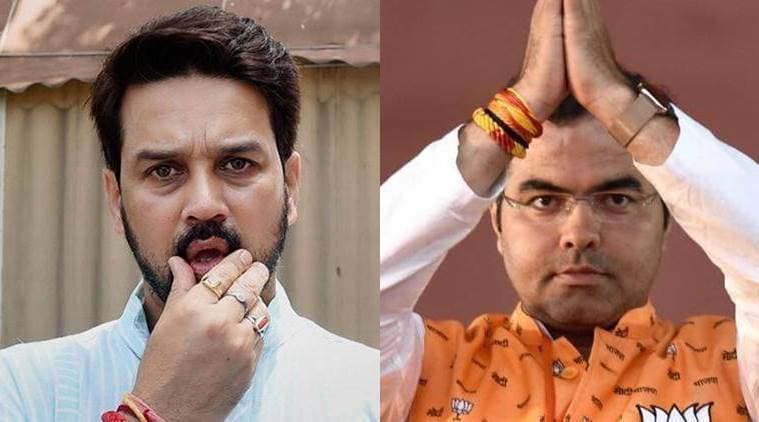
The Supreme Court upheld the findings of the Delhi High Court, which said the BJP leaders' remarks did not incite communal violence or public disorder. File PhotoThe Supreme Court Wednesday cleared Delhi Deputy Chief Minister Parvesh Verma and BJP leader Anurag Thakur over complaints that they delivered hate speeches allegedly targeting those protesting the Citizenship (Amendment) Act in January 2020. Dealing with a plea filed by CPI(M) leaders Brinda Karat and K M Tiwari, a bench of Justices Vikram Nath and Sandeep Mehta upheld the findings of the Delhi High Court, which said the BJP leaders’ remarks did not incite communal violence or public disorder.“Upon a careful consideration of the material placed on record, including the alleged speeches, the status report dated February 26, 2020, submitted before the trial court, and the reasons recorded by the courts below, we are in agreement with the conclusion that no cognizable offence is made out,” the court said in its order. On August 26, 2020, a trial court dismissed their complaint against Verma and Thakur, holding that the same was not maintainable in law in the absence of prior sanction from the competent authority to prosecute the named accused. On June 13, 2022, the Delhi High Court rejected the pleas of Karat and Tiwari for registering First Information Reports (FIRs) against Verma and Thakur for hate speech, observing that “the statements were not directed against any specific community nor did they incite violence or public disorder.” The high court, while dismissing the appeal against this, agreed with this conclusion and said that in respect of offences falling within the ambit of Section 196 of the Code of Criminal Procedure (CrPC), the power under Section 156(3) of CrPC to direct registration of an FIR and investigation could not be exercised in the absence of prior sanction. What Supreme Court said However, the Supreme Court disagreed with the reasoning of the trial court and the high court and said that the requirement of prior sanction arises only at the stage of the magistrate taking cognisance, not before.Story continues below this ad “The scheme of CrPC does not contemplate any embargo on the direction for registration of an FIR or the conduct of investigation at the pre-cognisance stage. To hold otherwise would amount to introducing a restriction not envisaged by the legislature. The process of criminal law is sequential: information of a cognisable offence must first be received; an FIR must then be registered; investigation must follow; a report under Section 173 of CrPC must thereafter be submitted; and it is only at that stage that the question of taking cognisance arises,” the apex court said. “The position of law, as crystallised by this Court, is unequivocal. Where information discloses the commission of a cognizable offence, registration of an FIR is mandatory. The police, in such circumstances, have no discretion in the matter, either under the statutory scheme or by way of interpretative latitude,” the court said. “Investigating agencies, being creatures of statute, are bound by the duties and obligations cast upon them under the law. They cannot evade or dilute these statutory obligations by resorting to provisions which are inapplicable at the stage of investigation. Any such approach undermines the rule of law and erodes public confidence in the administration of criminal justice.” “The criminal process is designed to protect both the rights of the accused and the interests of society. While the requirement of sanction serves as a safeguard against frivolous or vexatious prosecution at the stage of cognisance, it cannot be permitted to operate as a shield to prevent the very initiation of the investigative process where a cognizable offence is disclosed.”Story continues below this ad “Failure on the part of the authorities to perform their statutory duties at the thr
New DelhiApr 29, 2026 11:51 PM IST The court observed that the case involved a romantic relationship that lasted nearly three years, which was given a criminal colour after it ended. (File Photo)A Delhi court Wednesday acquitted a man, who was in a relationship with a woman from another faith, in a rape case lodged in August 2025 while noting that the relationship between the couple was a consensual one. The man was in judicial custody from September to mid-April before his acquittal.The court observed that the case involved a romantic relationship that lasted nearly three years, which was given a criminal colour after it ended. “… it is clear there existed a consensual relation between the prosecutrix and the accused, which perhaps went sour for some reason, which probably triggered the lodging of the present FIR. These facts clearly show that there is considerable unexplained delay in reporting the matter to police and, thus, the false implication of the accused cannot be ruled out,” said Additional Sessions Judge (ASJ) Vishal Pahuja of Tis Hazari Court in his judgment dated April 13 which was recently made public. “All the evidence brought on record by the prosecution shows that the prosecutrix entered into a relationship with the accused due to love and affection. The prosecutrix willingly consented to have sexual intercourse with the accused with whom she was in love, not because he promised to marry her but because she also desired it,” the judge said. “.. the prosecutrix alleged that the accused committed rape upon her in December 2022 and thereafter repeatedly till June 2025 but she did not raise any issue till lodging of the FIR in August 2025. Prosecutrix failed to give any plausible explanation as to why she waited so long to lodge the complaint against the accused… Lodging an FIR after unreasonable delay without any plausible reasons or grounds is very fatal to the case of the prosecution,” he added. As per the complainant’s case, she met the accused in December 2022 after which they became friends. It was alleged that on December 9 that year, the accused established physical relations with her on the “false pretext of marriage”.Story continues below this ad The complainant had further alleged that in May last year, she became pregnant after which the man administered some medicine to her which caused miscarriage. The man was booked on charges of rape, rape repeatedly on the same woman and causing miscarriage without woman’s consent. On the miscarriage charge, the court held that the prosecution provided no medical evidence to support their claim. “… medical documents only prove the pregnancy status of the prosecutrix but nowhere it reflects the name of the accused as the person responsible for the pregnancy of the prosecutrix. PW1, during her cross examination, admitted that no medical document reflects the name of the accused as the father of the baby,” ASJ Pahuja said. “Now if the accused had given the pills to the prosecutrix or caused her abortion, the same would have been stated by the prosecutrix during her medical examination but it is not the case herein… admittedly, no medical evidence has been adduced on record to establish that miscarriage of the prosecutrix happened due to consumption of any medicine. No doctor to this effect has been examined by prosecutrix to corroborate the claim of prosecutrix,” he added.Story continues below this ad “The prosecutrix, being a… matured lady of 27 years, cannot be assumed to be so naive that she was not aware of the probable consequences of the acts [to which] she was giving her consent to establish physical relations. It is not the case of the prosecution that the prosecutrix was blackmailed by the accused through any means or she was under any kind of threat, rather she always willingly entered into friendship and then into physical relationship with the accused,” the Judge said. The court also noted that the prosecution has not examined the mother of th
New DelhiApr 29, 2026 06:27 PM IST On Wednesday, the apex court started to hear the submissions from the respondents in the case. (File Photo)On the 10th day of the Sabarimala case hearing, some interesting remarks, including on gender discrimination, diversity and other notable subjects, came from the nine-judge Constitution bench of the Supreme Court.


Discussion (0)