
Loading dispatches...
← Return to NewsroomWorld
US Supreme Court limits use of race in drawing electoral maps
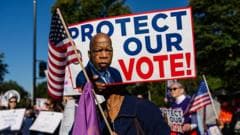
11 minutes agoGetty ImagesThe US Supreme Court limited the ability of lawmakers to take the racial make-up of a state into account when drawing voting maps, in a ruling that could reshape politics across the American south.In a 6-3 decision, the conservative justices sided with a challenge to new districts in Louisiana that were created to comply with a landmark Civil Rights law meant to protect black Americans from racial discrimination.The way courts have previously interpreted Section 2 of the Voting Rights Act, Justice Samuel Alito wrote in the court's majority opinion, has sometimes forced states "to engage in the very race-based discrimination that the Constitution forbids".The group of mainly white voters challenging the law had argued that relying on race to create districts ran afoul of the US Constitution and suggested that the provision of the Voting Rights Act should be found unconstitutional in its entirety. The court majority did not take that position, but its decision will make it significantly more difficult to successfully challenge legislative maps for diluting the voting power of racial minorities.To prove a violation, Alito wrote, litigants will have to prove that legislators intentionally drew the maps to provide less opportunity to racial minority voters."The court's decision will set back the foundational right Congress granted of racial equality in electoral opportunity," Justice Elena Kagan wrote in her dissenting opinion.The fight over voting maps has grown fierce in the last year, as Democrats and Republicans seek to carve out districts that could help them win congressional majorities. Florida is currently in the process of redrawing its legislative maps in an effort to net Republicans more seats in the House of Representatives. This decision could allow the state to further disadvantage incumbent Democrats who represented districts with large minority populations.Other Republican states, such as Tennessee and Mississippi, could also redraw their maps in the weeks ahead.This breaking news story is being updated and more details will be published shortly. Please refresh the page for the fullest version.
The U.S. Supreme Court Kevin Dietsch/Getty Images hide caption toggle caption Kevin Dietsch/Getty Images The U.S. Supreme Court, in a 6-3 decision along partisan lines, ruled that Louisiana's 2024 election map, which created a second majority-Black congressional district, was "an unconstitutional racial gerrymander." Although the court kept Section 2 of the Voting Rights Act intact, Wednesday's decision all but guts the landmark law that came out of the Civil Rights Movement and protected the collective voting power of racial minorities when political maps are redrawn. It isn't yet clear how the decision will affect November's midterms. Primaries are well underway in most states. Once considered the jewel in the crown of the civil rights movement, the Voting Rights Act has been largely dismembered since 2013 by the increasingly conservative Supreme Court. The major exception was a decision just two years ago that upheld the section of the law aimed at ensuring that minority voters are not shut out of the process of drawing new congressional district lines. At issue in the case was the redistricting map drawn by the Louisiana legislature after the decennial Census. Following years of litigation, the state, with a 30% Black population, first fought and then finally agreed to draw a second majority-Black district. Two of the state's six House members are African American. Normally, that would have been the end of the case, but a self-described group of "non-African-American voters" intervened after the new maps were drawn up to object to the legislature's redistricting. The Trump administration supporting them, contending that the Black voters should not have gotten a second majority-minority district. On Friday, the court agreed. "Correctly understood, Section 2 does not impose liability at odds with the Constitution, and it should not have imposed liability on Louisiana for its 2022 map," Justice Alito wrote in the majority opinion. "Compliance with Section 2 thus could not justify the State's use of race-based redistricting here." In her dissent, Justice Elena Kagan wrote that she dissented "because the Court betrays its duty to faithfully implement the great statute Congress wrote. I dissent because the Court's decision will set back the foundational right Congress granted of racial equality in electoral opportunity."



Discussion (0)