
Loading dispatches...
← Return to Newsroomgeneral
Trump shares bizarre AI-generated image of himself lounging in Lincoln Memorial reflecting pool with Cabinet members
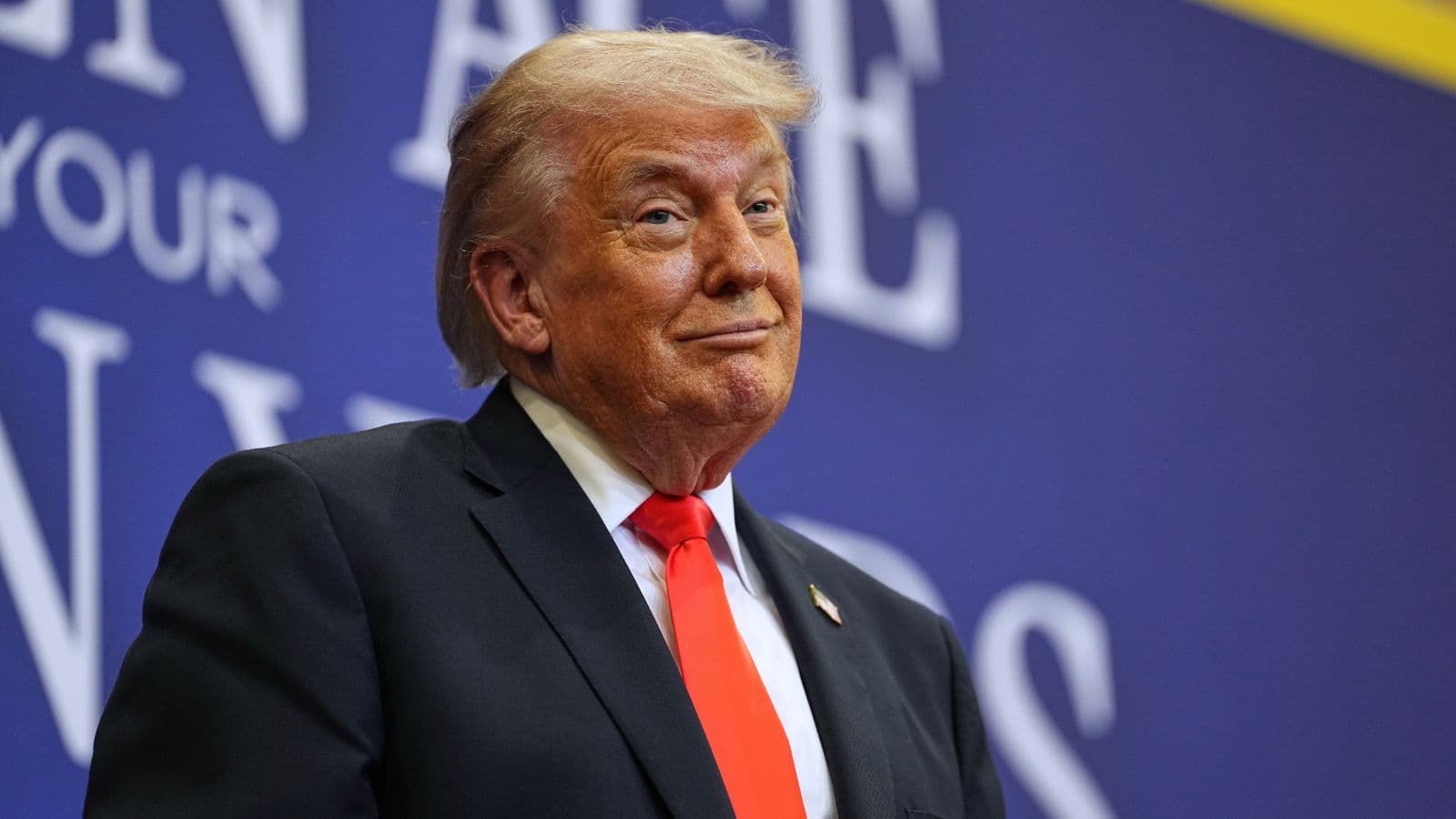
NewsWorldUS NewsTrump shares bizarre AI-generated image of himself lounging in Lincoln Memorial reflecting pool with Cabinet members The image showed Trump reclining on a floating lounger in the historic pool on the National Mall. 2 min readMay 3, 2026 05:49 AM IST First published on: May 3, 2026 at 05:47 AM IST President Donald Trump. (Photo: AP) US President Donald Trump posted an AI-generated image showing himself and senior officials in the Lincoln Memorial Reflecting Pool late on Friday, as part of a series of posts made overnight. The image showed Trump reclining on a floating lounger in the historic pool on the National Mall. Vice President JD Vance, Secretary of State Marco Rubio and Interior Secretary Doug Burgum were also depicted nearby.An unidentified woman, appearing to be AI-generated, was included in the image. She was shown wearing sunglasses and a blue-and-white bikini, floating close to the group. (Photo: @realDonaldTrump) The post did not include a caption and was shared late at night. It was part of a wider set of images Trump released within a short period, including visuals related to ongoing renovation work at the reflecting pool. The site is currently undergoing a $1.5 million repair and upgrade project ordered by Trump and overseen by Burgum. The work aims to address leaks in the structure’s ageing foundation and includes applying a new coating described as “American flag blue”.Story continues below this ad In an earlier post, Trump criticised the previous administration over the condition of the landmark. “Secretary of the Interior Doug Burgum and I are working on fixing the absolutely filthy Reflecting Pool between the Lincoln Memorial and the Washington Monument,” he wrote. “This work was supposed to be done by the Biden Administration, but Sleepy Joe doesn’t know what ‘CLEAN’ or proper maintenance is The President and Secretary do!” he added. The developments came on the same day the site was vandalised with graffiti reading “86 47”, a phrase some interpret as a call to remove the 47th president.Story continues below this ad Authorities secured the area and covered it while arranging cleanup. An investigation into the vandalism is ongoing. The Express Global Desk at The Indian Express delivers authoritative, verified, and context-driven coverage of key international developments shaping global politics, policy, and migration trends. The desk focuses on stories with direct relevance for Indian and global audiences, combining breaking news with in-depth explainers and analysis. A major focus area of the desk is US immigration and visa policy, including developments related to student visas, work permits, permanent residency pathways, executive actions, and court rulings. The Global Desk also closely tracks Canada’s immigration, visa, and study policies, covering changes to study permits, post-study work options, permanent residence programmes, and regulatory updates affecting migrants and international students. All reporting from the Global Desk adheres to The Indian Express’ editorial standards, relying on official data, government notifications, court documents, and on-record sources. The desk prioritises clarity, accuracy, and accountability, ensuring readers can navigate complex global systems with confidence. Core Team The Express Global Desk is led by a team of experienced journalists and editors with deep expertise in international affairs and migration policy: Aniruddha Dhar – Senior Assistant Editor with extensive experience in global affairs, international politics, and editorial leadership. Nischai Vats – Deputy Copy Editor specialising in US politics, US visa and immigration policy, and policy-driven international coverage. Mashkoora Khan – Sub-editor focusing on global developments, with a strong emphasis on Canada visa, immigration, and study-related policy coverage. ... Read More © IE Online Media Services Pvt Ltd # Doanld Trump Loading Recommendations... 0
The US announced on Friday that it would withdraw 5,000 soldiers from Germany, its largest European base, in the latest strain in its relations with Europe amid a rift over the Iran war and tariffs.US President Donald Trump had threatened a drawdown in forces earlier this week after German Chancellor Friedrich Merz accused Washington of entering the war in West Asia without a clear strategy. Merz said Iran was “humiliating” the US in negotiations.The US has stationed tens of thousands of troops across its European bases, using them as logistics and launch sites for its wars. A significant chunk of these troops (around 40,000) is in Germany. This forward deployment (positioning forces close to potential conflict zones) is also a key part of NATO’s defences and its deterrent against traditional foes such as Russia. Here is a look at why the US has military bases in Europe, why so many of its troops are in Germany and how Trump’s threat to wind them down may end up hurting the US — and push Europe away from NATO towards its own defence pact. Why does the US have troops in Germany? The history of US troops in Germany is a direct legacy of World War II. After the Allied victory, US troops stayed back primarily as an occupation force. But as one war gave way to a different kind of conflict — the Cold War — the strategic rationale behind the troop presence evolved. Germany’s geographic positioning within Europe made the country ideal for the US to deter Soviet aggression away from home.Story continues below this ad At the height of the Cold War in 1975, US troops in Europe numbered around 3,20,000. These forces were vital to the US projection of power globally. The collapse of the Soviet Union prompted a steady drawdown of forces in subsequent years and a shift in the role played by these bases — they became vital forward-staging sites and logistical hubs for US military operations, The Guardian wrote. According to a 2021 Naval War College analysis, by 2013, the US had withdrawn its last heavy Brigade Combat Teams (BCTs) and the V-Corps headquarters from Europe. Story continues below this ad Despite these drawdowns, the US still maintained a permanent presence of around 68,000 active personnel across 20 to 40 bases in Europe as of the end of last year, according to the US Defense Manpower Data Center. More than half of these troops — around 40,000 — are stationed in Germany, according to German Defence Minister Boris Pistorius. The US presence in Germany includes the giant Ramstein airbase — the HQ for US air forces in Europe, which houses 8,500 air force personnel — and Landstuhl hospital. Both of these have been used by the US to support its war in Iran, as well as previous conflicts in Iraq and Afghanistan. How Trump has shaken up US overseas deploymentStory continues below this ad This is not the first time Trump has moved to draw down US presence abroad. On June 15, 2020, he announced his intentions to downsize American troops in the region by roughly 10,000. Within weeks of this initial announcement, then defense secretary Mark Esper expanded this figure to 12,000 troops. The plan entailed the complete withdrawal of the US Army’s 2nd Cavalry Regiment (2CR) from the European theatre, bringing 6,400 troops back to the US and relocating another 5,600 to other allies in the region such as Italy and Belgium. Pentagon officials subsequently attempted to frame the decision as a maneuver to enhance strategic flexibility. This did not offset the tremors sent out by Trump’s initial statements where he referred to Germany as “delinquents” while expressing his displeasure at its government’s failure to meet NATO’s defence spending targets — specifically the commitment to spend 2% of GDP on defence and 20% of the defence budget on equipment.Story continues below this ad US bases abroadIn February 2021, the Joe Biden administration halted and reversed the drawdown plan, keeping most US forces in place. But when Trump came back to power, h



Discussion (0)