
Loading dispatches...
← Return to Newsroomgeneral
West Bengal verdict: Healing begins for a state bruised by years of corrosive politics
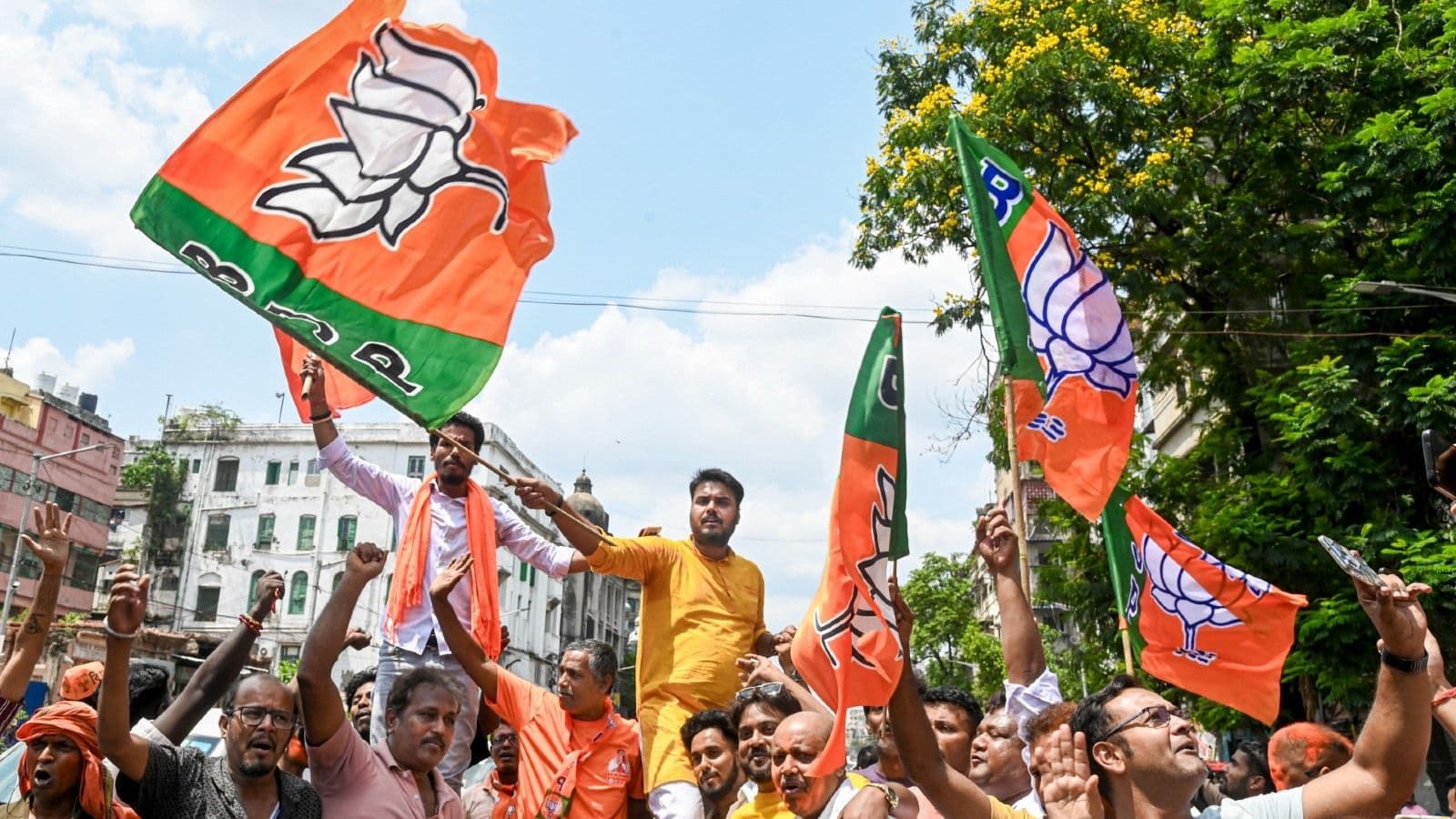
The BJP's victory promises transparent and responsible leadership, encourages people’s participation, and seeks to unleash the aspirations of millions The BJP’s victory in the West Bengal Assembly elections is not just an electoral triumph. It’s a turning of the tide in the state, which has been denied for decades by cynical, power-hungry politics. The election results do not merely mark a change in government; they herald the dawn of a New Bengal, one that rejects crime, corruption, and communalism, and steps confidently into India’s march towards development and growth — in infrastructure, industry, health, education, agriculture, factories, safety, security, and dignity for women Beyond policy and progress, the verdict marks something deeper, the beginning of healing. The soul of Bengal, bruised and diminished by years of corrosive politics, has to be restored. This is a land that once nurtured the idea of Indian nationalism. It was in Bengal’s fertile soil and flowing rivers that Bankim Chandra Chattopadhyay found his inspiration and gave us ‘Vande Mataram’. It was in Bengal that Rabindranath Tagore composed ‘Jana Gana Mana’.It is here that the idea of Bharat Mata took shape in the eponymous 1873 play by Kiran Chandra Banerjee, and was immortalised in an Abanindranath Tagore painting. Then came Sri Aurobindo’s articulation of nationalism in his historic Uttarpara speech, a moment that transformed political thought into spiritual conviction. His words —“Nationalism is not politics but a religion, a creed, a faith… it is the Sanatan Dharma which for us is nationalism” — continue to echo. Bengal is a land of reformers, revolutionaries, saints and scientists. Ishwar Chandra Vidyasagar led pioneering efforts to protect women, a legacy that must now be reclaimed as Bengal confronts the erosion of women’s dignity in recent times. This is the land of spiritual giants like Ramakrishna Paramahansa and Swami Vivekananda. It is the land that gave us scientific minds such as Jagadish Chandra Bose, Prafulla Chandra Ray, Satyendra Nath Bose, Meghnad Saha, and Upendranath Brahmachari, who discovered the cure for kala-azar. It is also the land of sacrifice, of revolutionaries who laid down their lives for India’s freedom: Khudiram Bose, Surya Sen, Pritilata Waddedar, Binoy Basu, Badal Gupta, Dinesh Gupta and Bagha Jatin. With the BJP’s victory, Bengal also witnesses a homecoming — this is the land of Syama Prasad Mookerjee, one of India’s tallest nationalist leaders. He worked to safeguard Bengali Hindus during Partition and stood firm during the horrors unleashed during the Muslim League’s Direct Action Day. As the founder of the Bharatiya Jana Sangh, the ideological forerunner of the BJP, he gave a rallying call that continues to resonate — One Nation, One Flag, One Prime Minister. Bengal was home to revivalist movements within Hinduism. Bankim’s Anandamath must be understood in the context of the Sanyasi Rebellion, a movement that stirred Hindu consciousness. Vande Mataram, born from that work, became the mantra of Indian nationalism. In 1892, Chandranath Basu authored Hindutva, the first formal articulation of the idea. In 1905, Abanindranath Tagore’s Bharat Mata gave a visual soul to the nation. Bengal also gave rise to spiritual movements that strengthened Hindu identity — the Hindu Mela, akin in spirit to Ganesh Chaturthi celebrations; the Bhakti movement, as carried forward by Chaitanya Mahaprabhu. The spiritual renaissance began with Rani Rashmoni through the Dakshineswar temple, where Ramakrishna Paramahansa served, and led to the emergence of Swami Vivekananda’s global vision. That was institutionalised through the Ramakrishna Mission. The tradition extended to times closer to ours, when A C Bhaktivedanta Swami Prabhupada established the International Society for Krishna Consciousness in 1965, taking Bengal’s spiritual legacy to the world. That tradition finds renewed political expression today. The BJP’s victory promises trans

A day after three Indian nationals in the United Arab Emirates (UAE) were injured in a fire caused by an Iranian drone strike in Fujairah, Prime Minister Narendra Modi “strongly condemned the attacks” and said targeting civilians and infrastructure was “unacceptable”. In a statement, the Ministry of External Affairs too called for the “immediate cessation of these hostilities and the targeting of civilian infrastructure and innocent civilians”. This incident at the Fujairah Petroleum Industries Zone (FOIZ) signalled rising tensions in the region along the Strait of Hormuz amid a fragile ceasefire involving the US, Israel and Iran. Mamata refuses to resign as CM A Vijay blockbuster Delhi’s opportunity in the East 🚨 Big Story Frontrunner: Giant-killer Suvendu Adhikari, who spearheaded the Bharatiya Janata Party’s (BJP) offensive in West Bengal, breaching the Trinamool Congress (TMC) citadel to end Mamata Banerjee’s 15-year rule, is now the frontrunner for the post of Chief Minister in the state. Hailing the party’s election victory as “a triumph for every patriotic nationalist and every BJP worker,” Adhikari, who defeated Banerjee in Bhabanipur and won from Nandigram, said that the BJP was committed to “a developed, prosperous and secure West Bengal”. According to party sources, the swearing-in ceremony could be held on May 9. Mamata’s reaction: A day after the BJP swept West Bengal, a defiant Mamata Banerjee said that she would not visit the Lok Bhavan to submit her resignation to the governor. She alleged that TMC candidates, including herself, were assaulted inside counting centres and votes were looted through EVM manipulation. “We have not been defeated. I have not been defeated. I will not resign. There is no question of my going to the Raj Bhawan,” she said, adding, “in this election, the BJP and the Election Commission played a dirty game. They forcefully grabbed votes.” Banerjee lost to the BJP’s Adhikari by more than 15,000 votes in Bhabanipur. BJP’s engineering: According to BJP leaders, the results of the poll results in West Bengal was not a product of a fleeting wave or simple anti-incumbency, but the outcome of a carefully structured campaign that reconfigured long-standing voting patterns across regions. Although internal assessments conducted before the polls suggested that the TMC retained its advantage in constituencies with significant Muslim populations, the BJP held a lead of roughly three percentage points, indicating that its ground-level mobilisation and voter targeting had delivered results. Here’s what BJP did to sweep Bengal polls.Story continues below this ad Exclusive: The Congress’s Lok Sabha whip and Tamil Nadu MP Manickam Tagore, in an interview to The Indian Express, weighs in on the Assembly election results 2026. The outcome, he says, was as much a verdict against the DMK-led government as it was a rejection of “entry of hate into Tamil Nadu”. Actor Vijay, whose TVK emerged as the single-largest party, did not align with the BJP, he says, and that the Congress “should do whatever it takes to protect the secular space of Tamil Nadu”. Here are the excerpts. ⚡ Only in Express “I did not enter homes after launching TVK… I launched TVK only after entering every home through cinema.” In a state where cinema has been a key medium to represent and reinforce Tamil/Dravidian culture and identity politics, Vijay fits into a familiar pattern — as exhibited by C N Annadurai and M Karunanidhi, M G Ramachandran and Jayalalithaa, who commanded both cinematic and political loyalty. Yet, there’s a difference. While MGR came from within the Dravidian movement before launching the AIADMK, Vijay’s politics did not grow out of party apprenticeship or public agitation. It grew from fandom, then welfare activity, then carefully rationed political speech. To understand Vijay’s politics, one must first understand Vijay the screen figure. Here’s what makes him mysterious. 📰 From the Front Page As actor-politician Vi

Discussion (0)