
Loading dispatches...
← Return to NewsroomPolitics
Financial decisions will rest with elected leaders: Sonam Wangchuk on Ladakh’s agreement with Centre
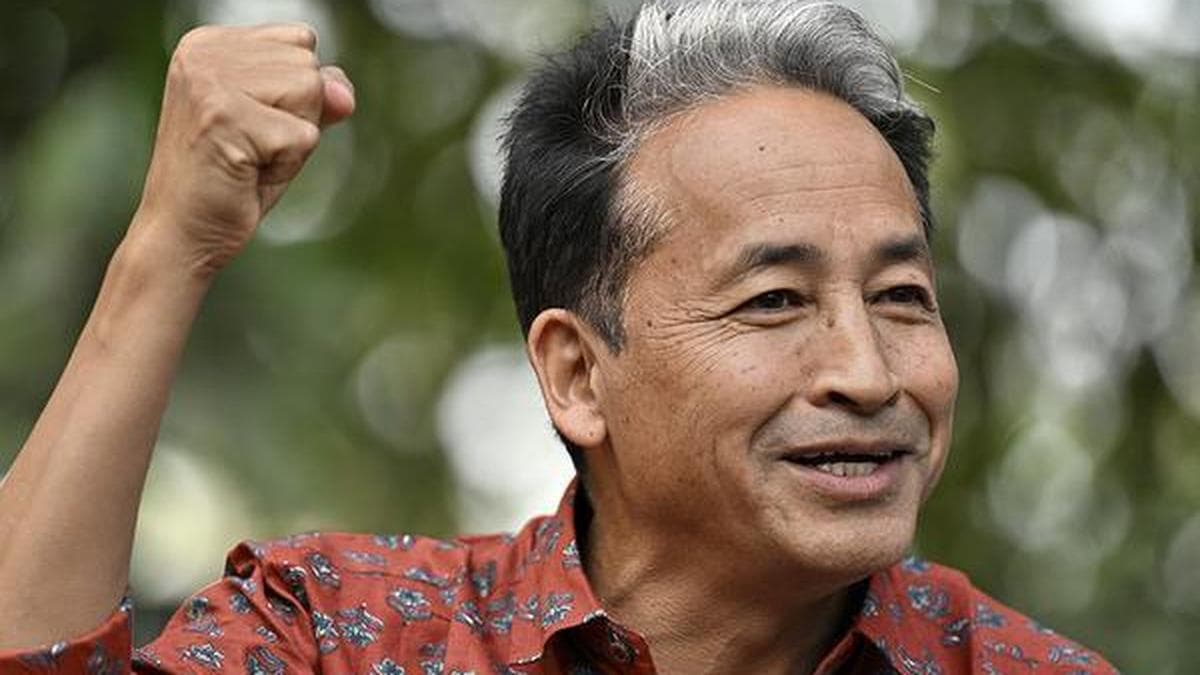
Sonam Wangchuk. File | His reaction comes after the Central government and the representatives of Ladakh Apex Body (LAB) and Kargil Democratic Alliance (KDA) reached an understanding in principle which will give the UT an elected Chief Minister with powers on bureaucracy, a legislative body and protections under Article 371. Wangchuk was also part of the discussions.Speaking to IANS, Mr. Wangchuk said: “The Central government’s argument was that Ladakh does not have the revenues to bear operational expenses like salaries or pensions at this stage. The Centre said that it cannot bear 100 per cent of the budget, and a state has to have its own resources.”Regarding the Centre’s proposal, he said that it has been decided to have a UT-level Assembly or law-making body where elected representatives from Ladakh will make laws for the region, using Article 371 as a measure of safeguard for environment, land, culture and nature.The climate activist highlighted: “Another very important feature, which was not true so far, was that the government accepted that this body, the chief of this body, which may be called the chief minister, will have supremacy or control over the entire bureaucracy, which means the chief secretary and all the bureaucrats, which was not the case earlier.”Mr. Wangchuk underlined that decision over the finances of the UT of Ladakh will be taken by these elected representatives.He noted that earlier 90% of the UT’s budget was decided by the LG who is not an elected representative.“Now in this set-up, 100% of the budget will come to this body and its elected leaders, and they will take the financial decisions,” he said.He also mentioned: “Financial, executive and law-making powers will rest with this legislative body.”The climate activist called the decision “progress in the right direction”.“Details are yet to be worked out,” Mr. Wangchuk said.Further, the social activist said that studies will be conducted to understand if Ladakh truly does not have the resources to support full statehood.“If it does, then these things may change, but if it does not then this is the mechanism that we have worked out,” he asserted. Published - May 23, 2026 04:23 pm IST

It is both sad and ironic that the Union Ministry of Home Affairs, Government of India argues that Ladakh needs more districts rather than a legislature or stronger constitutional safeguards under the Sixth Schedule. It contends that Ladakh’s sparse population, strategic sensitivity and financial dependence on the Centre make a legislature unnecessary, and instead offers administrative decentralisation through additional districts as a practical alternative.This argument is fundamentally flawed and reflects an impoverished understanding of democracy. Not long ago, the British Empire claimed that Indians lacked the maturity and institutional capacity for self-rule — that Indians were too poor, illiterate and divided to govern themselves. It was against such paternalism that Sri Aurobindo championed the idea of Purna Swaraj, or absolute self-governance, as a matter of dignity and national selfhood. History proved the British wrong.Yet, close to 80 years after Independence, the argument that Ladakh should be content with districts instead of a legislature echoes the same colonial logic in the language of nationalism. Must Ladakhis still prove they are sufficiently populous, profitable and capable enough to deserve political representation? Does being geographically vast, sparsely populated and strategically sensitive disqualify a region from having a legislature? Certainly, administrative accessibility matters in a region spread across nearly 59,000 square kilometres of high-altitude terrain. Villages separated by mountain passes and harsh winters do require local administrative presence.But handing out districts is not democracy. Districts cannot legislate on land protection, demographic safeguards, ecological preservation, employment priorities, cultural autonomy, renewable energy negotiations, education policy or the long-term developmental vision of the region. Districts are instruments of administration. Legislatures are instruments of representation. A district magistrate implements policy. A legislature shapes the future of a people. A district reports upward to the bureaucracy. A legislature answers downward to citizens. No amount of administrative decentralisation and convenience can substitute for political agency.Expendable electoral promisesThe most troubling aspect of the present discourse is that the Government of India itself repeatedly promised constitutional safeguards to Ladakh. After the abrogation of Article 370 and the creation of the Union Territory in 2019, assurances regarding Sixth Schedule protections were publicly articulated by leaders of the Bharatiya Janata Party and reflected in their election manifestoes for the MP and Hill Council elections in 2019 and 2020, respectively.Yet, once the elections were over, and the party won based on these very manifestos, it went back on its commitments, raising ethical questions: Can promises made to frontier populations become expendable after elections?The case of the northeastWhat of the objections themselves? Take the first one — that Ladakh is too strategic a border to be trusted with self-government. Arunachal Pradesh shares one of India’s most sensitive borders with China. It is geographically vast, sparsely populated, strategically critical and financially dependent on the Centre. Yet, when it was granted full statehood in 1987, its strategic location was not viewed as a security risk, but as a strategic necessity. India understood that border populations cannot be held merely through bureaucratic administration or military presence. The people who feel politically enfranchised and constitutionally respected defend a nation more fiercely than people who merely live inside its lines. If strategic sensitivity
Sonam Wangchuk. | This is the first such meeting of members of the Leh Apex Body (LAB) and the Kargil Democratic Alliance (KDA), the two bodies representing Leh and Kargil districts respectively, since February 4 when a high-powered committee (HPC) meeting led by Minister of State for Home Affairs Nityanand Rai was held in New Delhi. The meeting had remained inconclusive.On Friday (May 22), a sub-committee comprising Ministry officials will meet the delegation. This will be the first time that Mr. Wangchuk will be attending the meeting with Ministry officials.Recent inducteeThe delegations that had previously met did not include his name as he was recently inducted in the LAB.The KDA and LAB have been demanding constitutional safeguards such as Statehood and inclusion of Ladakh under the Sixth Schedule of the Constitution thus giving it tribal status.Ladakh, which was earlier a part of Jammu and Kashmir, became a Union Territory in 2019 following the reading down of Article 370 of the Constitution.Cherring Dorjay Lakruk, co-convenor of the LAB said they will stick to their demands that they have been raising since 2020, which include Statehood for Ladakh.After the violence on September 24, 2025 in Leh city when four people, including a Kargil war veteran, were killed in police firing, the talks have hit a stalemate. Ministry officials have so far only offered safeguards available under Article 371 of the Constitution and insisted on strengthening the hill councils. Article 371 deals with “Temporary, Transitional and Special Provisions”, and exists in 12 States.On April 26, Ladakh Lieutenant Governor Vinai Kumar Saxena approved the notification of five new districts — Nubra, Sham, Changthang, Zanskar and Drass — that were announced by Union Home Minister Amit Shah in August 2024. Published - May 21, 2026 09:43 pm IST


Discussion (0)