
Loading dispatches...
← Return to NewsroomWorld
Ukraine strikes cargo ships and admits Romania drone blast
Meanwhile, Ukraine has confirmed one of its naval drones exploded off Romania's coast on Friday. No injuries were reported in the blast.
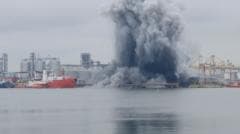
Meanwhile, Ukraine has confirmed one of its naval drones exploded off Romania's coast on Friday. No injuries were reported in the blast.
1 hour agoKathryn ArmstrongObservator Antena1In a separate incident, Ukraine confirmed one of its naval drones exploded off Romania's coast on FridayUkraine says it has struck five ships carrying illegal cargo in the Sea of Azov and in coastal waters of Russian-occupied territories.The Ukrainian drone forces commander said the vessels were involved in "stealing" Ukrainian grain, as well as transferring military cargo and fuel.The strikes come as Russian President Vladimir Putin prepares to speak at a major economic forum in St Petersburg, a day after Ukraine's President Volodymyr Zelensky offered face-to-face talks with the Russian leader on ending the war.Meanwhile, Ukraine has confirmed one of its naval drones exploded off Romania's coast on Friday. No injuries were reported in the blast. Zelensky wrote alongside his latest offer of peace talks that Russians had become tired of Ukrainian drone and missile attacks, petrol shortages and rising prices that the war, now in its fourth year, had brought.Ukraine has repeatedly targeted military and energy infrastructure within Russia in a bid to limit its war-fighting capability.Putin's arrival in St Petersburg comes a day after Kyiv had launched a drone attack on the outskirts of the city.Azerbaijan's foreign ministry confirmed five of its citizens had been killed in attacks on two of the vessels in the Sea of Azov.It did not specify who had been behind the attacks and noted that the ships did not belong to Azerbaijan. Earlier, Robert Brovdi, Ukraine's drone commander, announced that five "illegally loitering vessels" had been struck overnight in the ports of Mariupol, Berdyansk and in the coastal waters of what Ukraine calls the "temporarily occupied territories" - parts of the country that Russia currently controls. He said the names of the five ships, which included cargo vessels and tankers, were painted over and their radars were turned off "with the aim of quietly stealing Ukrainian grain", as well as "transferring military cargo and fuel". The Azeri foreign ministry named two of the ships as the Nastra and the Circon.Brovdi did not mention any deaths. EPA/ShutterstockUkraine's state emergency services posted pictures of the attack on a dairy factory in the Kyiv regionIn Ukraine, at least 13 people have been killed and more than 70 others have been injured in the past day, according to local officials.Among them are four people who died after Russian drones struck a dairy factory outside the Ukrainian capital, Kyiv, according to the regional head, and a 35-year-old woman in a drone attack on a petrol station in Kherson, local officials said.Meanwhile, a naval drone exploded in the Romanian Black Sea port of Constanta on Friday. The country's defence ministry said the drone had self-detonated near an oil terminal without causing any casualties, although authorities have said it caused considerable damage to a ship and warehouses.Adrian Teodor Picoiu, Constanta's top official, told G4Media that "information from the Ukrainian side" was that the drone was part of a group of five, with a second one exploding in Ukraine. Ukraine later confirmed one of its naval drones had been involved, saying it had been knocked off course by Russian electronic interference. Moscow has yet to comment.The remaining three drones were unaccounted for but officials said there was no further risk. No reason has yet been offered for why the drones would be in Romanian waters.Romanian President Nicusor Dan wrote on X that it was the second "significant security incident this week", after a stray mine was discovered on a beach near the village of Vama Veche, more than 50km (31 miles) north of Constanta.It also comes a week after two people were injured when a drone hit a Romanian apartment block in the eastern city of Galati - close to the border with Ukraine.Romanian officials said they had confirmed it was a Russian drone but Moscow said "accusations" of its involvement were "unsubstantiated".Zelensky

Just nowMax MatzaReutersUS agriculture and health officials have outlined a plan to combat a flesh-eating parasite that has been detected in the US for the first time since 1966.The plan to prevent a US outbreak of the New World Screwworm focuses on deploying hundreds of millions of genetically-altered sterile flies. Experts, though, say the supply of sterile flies is too low to immediately impact and halt the growing screwworm population.Other measures include establishing a containment zone around the site of the first US infection along the southern US border, and using sniffer dogs to detect the insects.The threat to humans is low, but cattle ranchers fear an outbreak could have a large impact on beef markets.Screwworms are parasitic flies whose females lay eggs in open wounds and mucous membranes of living warm-blooded animals and people. When the eggs hatch, hundreds of larvae burrow through living flesh with sharp mouths, eventually killing their host if left untreated.On Wednesday, US officials announced that the first case in 60 years was detected in a three-week-old calf, with the larvae found in its umbilical area. The discovery was made in the town of La Pryor, Texas, about 30 miles (48km) from the Mexico border.Officials have set up a 20km-wide "control zone", and are "implementing quarantines, movement controls, and surveillance in this area," according to the US Department of Agriculture (USDA).Screwworm larvae grow into flies which can travel short distances. The primary way that they have travelled long distances is by being brought by humans. There have been a handful of US cases since 1966, when travellers brought the pest back, but no larger outbreaks.Officials in the US and in Latin America have been combating the problem of screwworms for much of the past six decades, with limited success.Getty ImagesScrewworms grow after hatching from flesh, and can grow to be twice as large as the size of regular houseflies One way to fight back is by releasing hundreds of millions of sterile screwworm flies, as the females only mate once in their lifetime, and any eggs they lay will be unfertilised and will not hatch.This method, known as the Sterile Insect Technique, has been in use for many years to control a variety of insect populations, including fruit flies and mosquitos. It works by hatching flies in an enclosed space, and then exposing them to radiation to make them sterile before releasing them into the wild.However, officials say that they will need to breed up to 600 million sterile screwworms flies each week in order to fight back the outbreak.Currently, facilities in the US and Mexico are only capable of producing about 100 million sterile flies per week.US Secretary of Agriculture Brooke Rollins told reporters on Thursday that since the discovery of the infected calf, officials have released four million sterile flies by ground, in addition to another four million that they have been releasing by plane on a weekly basis since February."There is no reason to believe that this incursion will result in any sort of establishment of the pests," said Rollins.But critics, including cattle farmers in Texas, are worried it's not enough and some have accused the Trump administration of not taking the problem seriously. The last outbreak that came close to threatening American cattle was in the 1970s, but at that time no screwworms were ever found inside the US.The use of sterile flies pushed the screwworms south below the Darien Gap, Panama's heavily-forested border region with Colombia. At the time, officials were deploying around 500 to 700 million sterile flies across Central America per week, according to Sonja Swiger, an entomologist for Texas A&M University.But in recent years, the screwworms have rampaged back north. In 2022, Panama reported a large increase in cases, followed by countries across Central America. By 2024, they had been reported in Mexico, and were creeping north towards the US.This latest ou
NEW YORK — One person has died after a fire and two explosions Friday at a New York City shipyard, officials say. Officials said 36 people were injured, most of them firefighters and other first responders, and one civilian died at the scene. A firefighter and a fire marshal were inside the structure when a second explosion happened, and both were seriously injured by the shock wave from the blast. A blast at a shipyard on New York's Staten Island Friday injured several people, fire officials say. Kevin S. Vineys/AP hide caption toggle caption Kevin S. Vineys/AP "This was a complex, fast-developing emergency situation," New York Mayor Zohran Mamdani said during a news conference Friday evening. Multiple people called the fire department around 3:30 p.m., reporting smoke and two workers trapped in the basement of a 150-foot by 150-foot (46 meters by 46 meters) metal structure at the back of the shipyard, Fire Commissioner Lillian Bonsignore said. Firefighting and EMS crews were on the scene within six minutes. But shortly after they arrived, an explosion occurred, causing serious injuries to multiple fire department members and a couple of civilians, Bonsignore said — including one who died at the scene. Five firefighters and rescue paramedics were searching for the trapped workers inside, on top of and next to the structure when the second blast occurred, said Chief of Department John Esposito, causing more injuries. The most serious injuries happened to a fire marshal and a firefighter who were inside and hit by the energy wave from the blast. "Confined spaces are very dangerous operations for any rescuers," Esposito said. The fire marshal is in critical but stable condition with a fractured skull and a small brain bleed, said the fire department's chief medical officer Dr. David Prezant. "We will be watching him very carefully over the next 24 hours to make certain there is not subsequent brain swelling. As long as there is not, he should do well," Prezant said. The firefighter was in serious condition when he arrived at the hospital. But Prezant said he was doing "very well" by Friday evening, and he was being observed to ensure he doesn't have muscle injuries. The fire was still burning but under control Friday night, with more than 200 firefighters still at the scene, Mamdani said. A comprehensive investigation into the cause of the fire will begin as soon as possible, he said. Richard Oviogor, who was in the area, told WABC-TV that he heard two explosions and what seemed like a "big shock wave." The area is home to several businesses, including a coffee roasting company and a self-storage facility. The shipyard used to be owned by the Bethlehem Steel Company, which built ships for the U.S. Navy during World War II.



Discussion (0)