
Loading dispatches...
← Return to NewsroomWorld
Israel hits Lebanese capital in 'targeted strike'
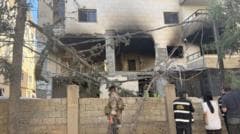
Just nowSamantha Granville,BeirutandPaulin KolaBBCBeirut had until now been spared the intermittent attacks which have occurred despite a ceasefireIsrael has hit the Lebanese capital, Beirut, for only the second time since the start of a ceasefire last month.The Israel Defense Forces (IDF) said the attack at about 14:00 (11:00 GMT) was carried out in a "targeted manner", but gave no details. Israeli media cited unnamed sources as saying the target of the strike had been the head of an Iranian militia.Israel had spared Beirut at the request of the US and the attack came after waves of Israeli strikes aimed at Hezbollah infrastructure in southern Lebanon, according to the IDF.Both Israel and Hezbollah - the powerful Shia group supported by Iran - have accused each other of repeated violations of a ceasefire.Thick smoke was seen billowing across residential buildings in Dahieh, the densely populated Shia suburb that serves as Hezbollah's stronghold in the capital, after the latest Israeli attack.Residents could be heard calling out to neighbours and relatives to check on their safety as rescue crews rushed in.According to Israeli media, the target of the strike was Ali al-Husni, head of the missile force in the Imam Hossein Division - an Iranian militia allied to Hezbollah.The strikes came after Israeli Prime Minister Benjamin Netanyahu announced an expansion of a ground operation following Hezbollah drone attacks on troops occupying part of southern Lebanon and on civilians in northern Israel.On Wednesday, the IDF urged residents to move north of the Zahrani River, about 40km (25 miles) from the Israeli border, saying it would act "with extreme force".At least 11 people were killed in two sets of Israeli strikes which hit Tyre and an area to the city's east early on Thursday, according to the Lebanese health ministry.Social media videos from Tyre, one of Lebanon's biggest cities, showed streets lit orange by flames, smoke-filled roads, and at least one vehicle engulfed in fire. By daylight, a massive fireball was filmed erupting near a cluster of high-rise residential buildings, sending a mushroom-shaped column of smoke rising above the city skyline.Stunned residents looked on as debris spread through surrounding streets.A Hezbollah member in Tyre told the BBC rescue and recovery crews had been forced to stop their work because conditions remain "too dangerous" and workers received calls from the Israeli military warning them to evacuate the area.Wednesday's evacuation order was the largest since the ceasefire took effect, covering about 300 towns and villages - about 14% of Lebanese territory. Many residents, including those already displaced from other parts of southern Lebanon, have nowhere obvious to go.The streets of Saida were oddly busy on Thursday - the marina area filled with beach goers eating lunch, and not a tent for the displaced in sight.But with shelters exceeding capacity, humanitarian workers and city officials told those displaced to keep going north. There is no more room here.Saida is a coastal city north of the Zahrani River, but south of Beirut. It has not been hit as hard as other cities like Tyre or Nabatieh.It was not named in the latest set of evacuation orders, so Hanaa Jamaa, 46, was shocked when she was woken up in the middle of the night to hear an apartment she owned had been hit.She had been renting it out as a source of income.A missile struck the building at approximately 02:40, appearing to hit the roof before tearing downward through the structure.Five people were killed and 21 injured in the attack.The man renting the apartment from Hanaa had been living there for three years. She said he was a civilian. "We aren't with Hezbollah and we aren't with Israel," she said through tears. "We just want peace."Israeli officials have said Hezbollah's attacks are violating the temporary ceasefire deal between the Israeli and Lebanese governments, which has been extended twice since it came into force l

Southern Lebanon empties out under bombardment as Red Cross warns of worsening crisis.At least 16 people have been killed and 58 wounded in Israeli attacks in southern Lebanon, according to Lebanese health authorities, as Israel intensifies its assault and issues mass displacement orders across the region.Lebanon’s state-run National News Agency reported on Thursday that six of the victims belonged to the same family. They were killed in an Israeli drone strike while trying to flee at dawn along the Adloun Highway, a key route linking Sidon and Tyre, it said.Recommended Stories list of 3 itemslist 1 of 3Why is Israel ramping up attacks in Lebanon despite a ceasefire?list 2 of 3What’s happening on Iran war day 90 as US launches new strikeslist 3 of 3Israeli attack on Gaza City kills at least 10, including four childrenend of listThe attack came as Israel expanded its bombardment across southern Lebanon, hitting residential areas, roads and civilian infrastructure.The Lebanese army said one of its soldiers was killed in an Israeli strike in the Nabatieh area, the latest in a string of attacks targeting military personnel. Other soldiers have also been killed in recent days in strikes across southern Lebanon and the western Beqaa Valley.Israel has also issued sweeping displacement orders covering large parts of the south, including Tyre and surrounding areas. Residents were told to evacuate immediately and move north of the Zahrani River, roughly 40km (25 miles) from the Lebanon-Israel border.The orders, shared on social media with marked buildings, have forced thousands of people to flee under threat of attack.‘Things are only going to get worse’In Tyre, Israeli air strikes hit a building and a cafe overnight, setting off fires and leaving emergency crews searching through debris for casualties.The Israeli military said it is targeting what it calls Hezbollah “infrastructure”, but Israeli strikes have repeatedly hit civilian neighbourhoods and populated areas.Al Jazeera’s Obaida Hitto, reporting from Tyre, said the attacks on the city were relentless.“Since midnight, there have been over a dozen strikes on the city of Tyre and its surrounding areas.”“Yesterday, people left the city over the course of the day. It seems like the city, for the most part, is pretty empty,” he added.The International Committee of the Red Cross has warned that Israel’s large-scale forced displacements and continued strikes on urban centres are placing civilians at severe risk and deepening a humanitarian crisis.“The fear is that things are only going to get worse,” Hitto said.Al Jazeera’s Zeina Khodr, reporting from Beirut, said a US-brokered ceasefire that took effect last month had failed to halt the violence.“It was just ink on paper. It remained very much an active warzone.”“But what we have seen over the past three or four days is some of the heaviest Israeli bombardment yet across southern Lebanon since this latest confrontation began in early March,” she added.The escalation came as United States-mediated talks between Israel and Lebanon are due to resume on Thursday, beginning with technical discussions before moving to broader negotiations in early June.However, Israel has significantly intensified its military operations in the past two days, casting doubt over the prospects for diplomacy.“It is unclear how these talks will proceed,” Hitto said.“People here are extremely frustrated and would like to see the Lebanese government take a stronger position at these talks, but that doesn’t look like it’s going to happen,” he added.
Just nowPeter HoskinsBusiness reporterHindustan Times via Getty ImagesThe conflict in the Middle East has pushed up the cost of energy around the world.Oil prices have jumped after the US carried out new attacks on Iran, targeting a military site in Bandar Abbas, a strategic port city.The US Central Command (Centcom) said its forces also shot down four Iranian drones "that posed a threat around the Strait of Hormuz".Global oil benchmark Brent rose by 3.75% to $97.83 (£73.15) a barrel, while US-traded crude was 4% higher at $92.22.The strikes come despite a ceasefire between Tehran and Washington as the two countries hold talks to end the three-month-long conflict that has effectively closed the key Strait of Hormuz waterway, pushing up the cost of energy around the world.Around a fifth of the world's oil and liquefied natural gas (LNG) supplies usually pass through the strait.Shortly after the US and Israel launched airstrikes on Iran on 28 February, Tehran responded by threatening to attack vessels using the shipping route.Global energy prices have swung wildly since the conflict began, with Brent crude briefly surging to around $120 a barrel. Before the war it was trading at closer to $70.The cost of oil had fallen sharply this week on hopes that a deal would soon be reached to reopen the Strait of Hormuz.The latest strikes mark the second time in three days that the US has attacked targets in Iran, with Washington saying they were conducted in self defence.Centcom confirmed strikes on southern Iran earlier this week, in which it targeted Iranian missile sites and boats attempting to lay mines in the strait.It said those strikes were designed "to protect our troops from threats posed by Iranian forces".


Discussion (0)