
Loading dispatches...
← Return to Newsroomgeneral
How a Mohenjo-daro figurine became a dancer — and associated with vulgarity
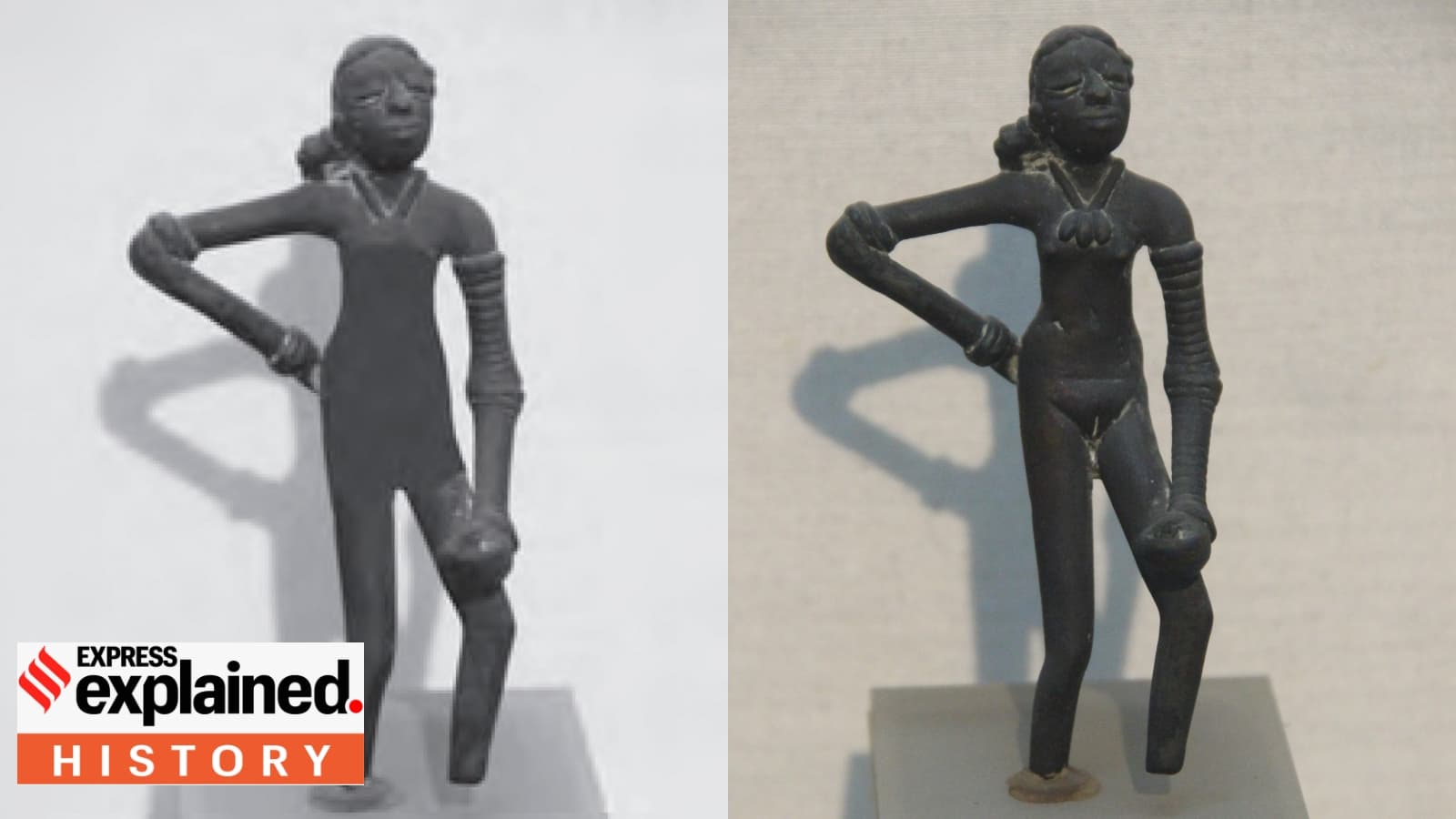
This was not the first time an attempt had been made to cover up the Harappan-era bronze figurine. In 2023, a fully clothed “contemporized version” of the ‘Dancing Girl’ was unveiled as the mascot of the International Museum Expo.The story of “vulgarity” being attached to the bronze statue found at Mohenjo-daro, however, dates back several decades. It is largely associated with archaeologist John Marshall choosing to interpret it as the image of a “nautch girl” or “dancing girl” — an act some scholars believe was done without compelling evidence. Competing claims The government of Pakistan also had similar reservations when it was trying to acquire Harappan artefacts from India in the 1950s, arguing that Mohenjo-daro and Harappa were both in Pakistan. India, however, contended that the legacy of the Harappan civilisation belonged to South Asia and not Pakistan alone. An academic paper by Panjab University historian Ashish Kumar, Sahib’s Nautch Girl, brings out interesting details. Around 12,000 Harappan objects from Mohenjo-daro were in Delhi when Partition took place. These had been brought to the capital from the Lahore Museum by Mortimer Wheeler, who was Director General of the Archeological Survey of India between 1944 and 1948, for an exhibition. “Owing to partition, almost all of the Harappan sites including Mohenjodaro and Harappa went to Pakistan leaving with India only two minor sites (Rangpur in Gujarat and KotlaNihang Khan in East Punjab) of the first urban civilization of the Indian subcontinent,” Kumar writes. “Since the Harappan artifacts had been found in the territory of Pakistan at Mohenjodaro, the Pakistani officials demanded all these artifacts back from India. But the Indian officials refused to entertain this demand and put forth an equal claim over the Harappan civilization.” Finally, India and Pakistan agreed to a 50:50 division of the Harappan artifacts “found at Mohenjodaro and Chanhu-daro with the help of Mortimer Wheeler”. Story continues below this ad While Pakistan wanted both the “Dancing Girl” and the “Priest King”, India was willing to hand over just one of the two. “The Pakistani officials chose the priest king to avoid any backlash at home that a figure of a naked teenager could have invoked from religious quarters,” Kumar writes. “Here the ‘nudity’ of a teenager girl impacted the decision of the Pakistani officials, who considered its sexuality as a threat to their moral beliefs.” However, the clamour to acquire the “dancing girl” statue continued in Pakistan till recently too. In 2016, a writ petition by barrister Javed Iqbal Jaffrey in the Lahore High Court sought directions to the Pakistan government “to bring back the famous ‘Dancing girl’ bronze statue from India”, Kumar states. “Since this bronze girl statue had been discovered from Mohenjo-daro in 1926, Pakistan was held to be the real owner of this five thousand years old Harappan artifact. In Jaffrey’s words, this statue retains the same historic significance for Pakistan that Leonardo da Vinci’s Mona Lisa in Europe has,” the paper goes on. “The same views are endorsed by Jamal Shah (director general of the Pakistan National Museum of Arts), Qasim Ali Qasim (director of the provincial archaeology department), and several others in Pakistan. In response to this Pakistani claim, Vasant Shinde (then Vice-chancellor of Deccan College, Pune) questioned Pakistan’s exclusive claim over the Harappan civilization… since this civilization was considered a common heritage of South Asia.” “Nautch girl”Story continues below this ad Significantly, even the identification of the statue as that of a dancing girl by John Marshall is contested. Marshall wrote about the statue: “The only other sculpture in the round from Mohenjo-daro that claims notice here is the bronze dancing-girl… This is a small figurine of rather rough workmanship with disproportionately long arms and legs. Almost, indeed, it is a caricature, but, like a good caricature, it giv
Madhuri Dixit says Shriram Nene has embraced India very well.It’s been 15 years since Madhuri Dixit relocated back to India with her family for good. The actor, who moved to Denver in 1999, after tying the knot with Shriram Nene, a reputed heart surgeon in the US, she was at the peak of her acting career. Over the next six years, the couple became parents to two sons — Arin and Ryan. While Madhuri slipped back into doing films, shows, and other commitments upon her return, it took Dr Nene some time to warm up to the life in Mumbai. Madhuri on how Nene embraced India “He used to come to India as a kid to meet his grandparents,” recalls Madhuri, in an exclusive interview with SCREEN. “But once you move to the higher echelons of education, it becomes very hard to visit. It’d been a big gap that he hadn’t come to India,” she adds. But Shriram Nene has now completely ingrained himself into the Indian culture, whether it is as a husband or as a content creator, his newfound profession.“He’s amazing. Wherever he goes, he’ll get into the culture. He knows everything about everything. That’s what he did when we came back to India. He completely immersed himself,” says Madhuri, adding, “He loves India. He loves being here. He loves people. As you’ve seen on his Instagram, he’s enthusiastic about everything. He’s a doctor, but he’s also a techie. He loves to travel, cook, and those kinds of things.” After tying the knot with Shriram Madhav Nene in 1999, Madhuri Dixit relocated to Colorado, eventually becoming parents to two sons, Arin and Ryan. (Express archive photo)Madhuri even reveals that Nene has more knowledge about how a camera works than she does. “He knows everything about the camera. When photographers come home to click pictures, he’d ask them, ‘Kaun sa lens hai? Did you try that one?’ Even I don’t know so much about cameras, but he does,” she says, laughing. Nene even turned producer with Madhuri in 2019, when their banner RnM Moving Pictures bankrolled Marathi films 15 August and Panchak (2023). Madhuri admits that before meeting Nene, she spent a good part of her life just running from one film set to another. It’s only after she tied the knot with him that she could realise her dream of having her own family. “A lot of people ask me, ‘How’s life after marriage?’ Before marriage, I was only working. My life started after marriage. That’s when I actually lived. I’m so glad I found him as my life partner, and we have a life together that’s amazing,” she adds, smiling. Madhuri Dixit Nene with Dr Shriram Nene (Photo: Madhuri Dixit/Instagram)Madhuri, Nene’s relocation to India Dr Nene earlier shared a video on his YouTube channel, when he recounted how his parents were initially upset about him abandoning his lucrative and reputed job in the US to move back to India. “My parents certainly weren’t happy that I was leaving the prototypical job of a heart surgeon — kind of every Indian’s dream life — with a perfect situation, lots of friends, and being the head of the hospital. But later, when they saw the work I was doing with startups, they actually wanted to invest in them,” he said. He also revealed the motivation behind quitting clinical surgery in the US and starting a new career in healthcare technology in India. “I could operate on at most three to five patients with open-heart surgery in a day, and maybe 500 patients in a year. It was incredibly rewarding to see patients leave the hospital healthy and to support their families, but when I looked at the world, I thought — there are billions of people. What if healthcare could reach the last mile through media and technology? What if you could put a doctor in everyone’s pocket?,” he added.Story continues below this ad Earlier this year, Madhuri also shared that there were personal reasons behind their relocation to India as well. “My parents were getting older, and they wanted to come back to India. All my life and career, they wer

Discussion (0)