
Loading dispatches...
← Return to NewsroomWorld
'We fear for our lives' - deadline looms for migrants to leave South Africa
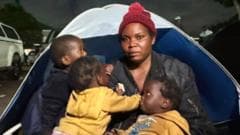
Site search'We fear for our lives' - deadline looms for migrants to leave South AfricaJust nowNomsa Maseko,BBC Africa, DurbanandMarco OriuntoThuthuka Zondi / BBCEsnat Joseph said a gang of men came to her home in Durban to threaten the family - forcing her to flee with her tripletsSouth Africa has become a hostile place for undocumented migrants, as a deadline set by protesters for them to leave the country approaches."I am very scared and traumatised," Esnat Joseph, a 36-year-old Malawian woman, told the BBC as she tried to comfort her crying one-year-old triplets.She fled her home in an informal settlement in the port city of Durban, in KwaZulu-Natal province, seeking refuge in an open field where up to 7,000 foreigners - mainly Malawians - began gathering with their belongings two weeks ago."The people came to my house and told me: 'You must leave. We don't want you people to stay here any longer, so you have to go to your country.' There were 10 and they were carrying weapons," she said, describing how the group of South African men were holding machetes and whips."They cut my husband on his head and his neck. They were holding his neck like they wanted to kill him. Because of God he still survived, but he's in the hospital."Many others at the field, where aid groups have been giving out blankets and food, report such door-to-door intimidation.It follows a series of mainly peaceful protests this year led by the anti-migrant group March and March, opposition party ActionSA and others which have set 30 June as the deadline for undocumented migrants to leave.Sticks in hand, the marchers have been chanting "Mabahambe" - a Zulu phrase meaning "They must go".As the countdown continues, President Cyril Ramaphosa warned South Africans on Tuesday that the "scapegoating of vulnerable people" was not the solution to country's complex economic challenges.The protests so far have been mainly peaceful, but their message is unequivocalJoseph came to South Africa three years ago and was working as a domestic servant before having her children.Ghana, Mozambique, Nigeria and Zimbabwe have also been organising repatriations by air or bus over the last few weeks - with about 3,500 foreigners volunteering to leave so far.The South African authorities said the more than 500 Nigerians recently repatriated had been in the country illegally.Arriving in Lagos last week after nearly nine years in South Africa, Benjamin, a returnee who only gave his first name, told the BBC: "South Africans don't like foreigners, especially Nigerians. South Africa is not a place to be - it's a place you can lose your life at any time."Protest organisers deny their actions are xenophobic. They say they are sick of other Africans abusing the system and, as March and March leader Jacinta Ngobese-Zuma put it, "playing the victim card"."If you come into South Africa with a passport that allows you to stay for 30 days. When it's 50 days, when it's two years, when it's five years, you know you're breaking the law," she told the BBC at one protest in Durban."We can't have South Africa being turned into a refugee site for all failed African states… every country prioritises its citizens and we want the South African government to do the same."Latest figures show South Africa is home to more than three million foreigners, about 5% of the population - most from neighbouring countries in southern Africa.But the statistics do not record the many more migrants believed to be in the country without papers - a bone of contention for the protesters.Their anger is rooted in growing hardship as the country grapples with growing youth unemployment and economic inequality.South Africa has one of the highest rates of unemployment in the world at 32.7%, according to Statistics South Africa, which recorded 350,000 job losses in the first quarter of 2026 - the majority of whom are young people.However, the continent's most-developed economy remains a magnet for citizens of poorer countries w

On the eve of the upcoming week’s Group of Seven (G7) meeting, Canadian Prime Minister Mark Carney has reiterated his vision of a shift away from a world order dominated by superpowers.Carney delivered his remarks on Saturday at the launch of the De Chastelain Public Lecture series at Trinity College in Dublin, Ireland. Attendees included his Irish counterpart, Micheal Martin.Recommended Stories list of 3 itemslist 1 of 3The Take: Could Alberta trigger Canada’s Brexit moment?list 2 of 3Canada seeks USMCA renewal for 16 years, sector tariff discussionslist 3 of 3Canada confirms opening of Gordie Howe Bridge, despite Trump’s threatsend of listAccording to Carney, the world is at a critical juncture, and he appealed to leaders of what he called the “middle powers” to unite and find their collective strength.“Ireland and Canada are navigating a global rupture, not a quiet transition,” Carney said.“The post-Cold War world’s rules-based order is breaking down. Multilateral institutions have weakened. Economic integration, from which we have benefitted is being weaponised. The international trading system, which we’ve relied upon for decades, is under threat.”Carney kept his remarks general. He did not name any countries that were violating the “rules-based” global order, nor did he point a finger at any international counterpart.But his remarks come at a moment of historic friction between Canada and its southern neighbour, the United States.A longtime ally, the US has increasingly pressured Canada to cede its sovereignty since President Donald Trump returned to the White House in Washington, DC, for a second term.Trump has called for Canada to become the US’s “51st state” — a campaign he continued into this month, with a social media post on June 1 — and he has used tariffs to push the country to fall in line with US priorities on trade and immigration.Both Carney and Trump are expected to attend the upcoming G7 summit in Evian-les-Bains, France, held from June 15 to 17.Carney’s calls for more collaboration between “middle powers” have found a receptive audience among some G7 members, particularly in the European Union, which is seeking to lessen its dependence on the US amid heightened tensions.Carney used Saturday’s speech to appeal directly to his European counterparts. He emphasised unity as a response to the go-it-alone mentality some superpowers have adopted.“Canada, Ireland, and Europe are increasingly and more immediately vulnerable to once-distant threats. And I suggest that amidst this change — amidst this disruption — Canada, Ireland, and Europe can be pivotal, powerful and purposeful: a force for good,” Carney said.His Trinity College remarks hewed closely to a speech he gave earlier in the year at the World Economic Forum in Davos, Switzerland, when he debuted his “middle powers” approach.That speech generated shockwaves by questioning the long-term durability of existing global alliances. It cited violations of international law and the use of global economic integration as a “weapon” to coerce smaller countries.The path forward, Carney said at the time, was to “build a new order” among the “intermediate powers” of the world, who together could wield as much power as any single state.In response to that speech, Trump lashed out, using his podium at Davos to denounce Carney for a lack of deference.“Canada gets a lot of freebies from us, by the way. They should be grateful also, but they’re not,” Trump said at one point.“Canada lives because of the United States. Remember that, Mark, the next time you make your statements.”Carney, however, returned to similar themes on Saturday, comparing the might of the Canada-EU alliance to that of the world’s largest economies.“ Together, we are powerful because we have the capacity to act together. Together, we are powerful because we have the capacity to act together. Combined, the population is more than twice that of the United States,” Carney said. “Our collective defence budg
Born in the segregated American South, he refused to fight in Vietnam, defied white supremacy, and became a global symbol of anti-racism and resistance.Published On 3 Jun 2026


Discussion (0)