
Loading dispatches...
← Return to NewsroomWorld
Democrat Xavier Becerra wins the top spot in November's race for California governor

Democratic candidate for governor in California, Xavier Becerra, speaks to supporters during his election night gathering at La Plaza de Cultura y Artes on June 02, 2026 in Los Angeles, California. Mario Tama/Getty Images hide caption toggle caption Mario Tama/Getty Images SAN FRANCISCO — Democrat Xavier Becerra will advance to the November election for California governor, according to a race call by The Associated Press. After days of counting ballots, it remains unclear who will claim the second spot in the fall. In California's unusual primary system, all candidates, regardless of party, appear on a single ballot open to any registered voter. The top two candidates then move on to the general election. An estimated 3.5 million uncounted ballots remain. The state also counts mail-in ballots that arrive up to seven days after Election Day, as long as they are postmarked by Election Day. The state hasn't had a wide-open primary like this one since the late 1990s. The winner in November will lead the country's most populous state, facing a large deficit and other obstacles, including the state's high cost of living, homelessness and wildfire risk. Incumbent Gov. Gavin Newsom, a Democrat, is term limited and is widely thought to be running for president in 2028. Becerra, former Health and Human Services secretary under President Joe Biden, has staged one of the most surprising comebacks in recent state political history. As recently as April, polls were showing Becerra — also a former member of Congress and California attorney general — languishing in single digits in a crowded field. "The people of the great state of California, in the greatest nation on earth, have spoken — loudly and proudly," Becerra said in a written statement. "We will not be bought. We will not be bullied. And we are never backing down. November, here we come." For second place, Republican businessman Steve Hilton still has an edge over billionaire Democratic activist Tom Steyer, but Steyer has been gaining ground as ballots continue to be counted. Hilton was endorsed by President Trump in April, and in later polls, he pulled ahead of Riverside County Sheriff Chad Bianco, the other major Republican in the race. British-born Hilton is a former Fox News commentator who also served as a political adviser to former British Prime Minister David Cameron and has campaigned on the idea that California needs change after 16 years under total Democratic control. Steyer spent more than $213 million of his own money to boost his candidacy, making the race the most expensive gubernatorial election in California. He is currently in third place in the vote tally. In a state where registered Democratic voters far outnumber Republicans, Becerra goes into the general election as the early favorite, but it has already been an election season of unexpected developments. Some of the state's most high-profile Democrats — former Vice President Kamala Harris, U.S. Sen. Alex Padilla and California Attorney General Rob Bonta — all stayed out. The race was disrupted in April when then-U.S. Rep. Eric Swalwell's campaign for governor imploded amid allegations of sexual assault and harassment. Swalwell resigned from Congress shortly after the accusations surfaced and has denied assault allegations. Swalwell had been gaining in polls and racking up high-profile endorsements and his exit seemed to primarily benefit Becerra. The narrowing field also quieted Democrats' fears of splitting their vote to the extent that Bianco and Hilton would win the top spots in the June primary. That would have resulted in a guaranteed Republican governor in a state where Democrats outnumber GOP voters 2 to 1. Instead, though, Becerra surged. He has been aided by political groups operating independently of his campaign.

Mogadishu, Somalia – Mustafa, 33, dreads election time in Somalia. He drives a bajaj — a three-wheeled taxi — and says that when tensions rise, as they always do when polls are near, the whole city feels it, and drivers like him are among the first.On Wednesday, he was passing through the Hawl Wadaag district when heavy gunfire between government and opposition forces erupted all around him.Recommended Stories list of 2 itemslist 1 of 2Gunfire erupts in Mogadishu before protests against Somali president’s rulelist 2 of 2Fighting in Somalia’s capital as anger over election delay eruptsend of list“I couldn’t even think. Everyone was shouting and running for their lives, and we all fled from the bullets,” he told Al Jazeera. “We haven’t seen fighting this bad in years.”The shooting that began that afternoon around the homes of former Prime Minister Hassan Ali Khaire and, later, former President Sheikh Sharif Sheikh Ahmed, came as opposition figures were planning to organise protests against what they describe as an illegal term extension by incumbent President Hassan Sheikh Mohamud.Khaire and Sharif Sheikh Ahmed were among opposition leaders spreadheading the planned protests amid rising tensions with the federal government.The government said the planned protests would undermine security in a city still grappling with persistent armed violence.Hundreds of families fled neighbourhoods near the fighting, and by the next day, many of the capital’s central areas had emptied. The sudden eruption of violence ended a period of improving security in Mogadishu, shattering the perception that the city had begun turning a corner.“The most frustrating thing is that we have nothing to do with it, and it impacts so many of us,” Mustafa said. “We make our living in this city”.Security forces sealed Maka al-Mukarama Road, one of Mogadishu’s main arteries, while Bakara market, the largest commercial hub in the city, was effectively closed for business.Maka al-Mukarama Road, Mogadishu’s main thoroughfare, is usually a bustling commercial hub, but recently, it has been largely empty, with the exception of military vehicles [Faisal Ali/Al Jazeera]“Look, it’s midday, and there’s almost no one here, shops are closed, and usually by this time the place is jammed,” Ahmed, a street vendor at Bakara market, told Al Jazeera, gesturing at shuttered stalls.Ali Wardheere, the deputy central bank governor, estimated the direct cost to businesses and services at $3.8m, though he stressed the figure was a model-based projection, not an official or final tally.Like most Somalis, Mustafa has never voted for a president or a member of parliament. The country has not held a direct election for national leadership since the late 1960s.Since the state was re-established in 2012 after its 1991 collapse, leaders have been selected through an indirect system negotiated by clan elders and political elites.As presidential terms near their end, low trust among political actors often leads to intense competition over power — and at times violence — as disputes over the electoral timetable come to a head.At a press conference in late May, Sharif warned that the political deadlock could turn violent if negotiations failed.“Where do things stand? [We say] Leave, and [you say] I won’t leave. What comes next? Bullets.”The warning echoed events in 2021, when then-President Mohamed Abdullahi Farmaajo remained in office more than a year beyond the end of his term, triggering clashes in Mogadishu before a political agreement was reached.Higher stakes this electionThis time, the political standoff carries higher stakes.President Hassan Sheikh Mohamud says that constitutional amendments approved by parliament extended his mandate by an additional year from May 15. The opposition rejects that and has begun referring to him as a “former president”.Two of Somalia’s most influential federal states also reject the amendments, leaving the country divided over the constitutional framework go
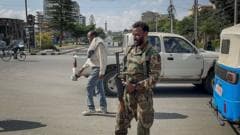
9 minutes agoAbdishukri Haybe,BBC SomaliandBasillioh RukangaAFP via Getty ImagesFighting continued overnight after breaking out on Wednesday eveningGovernment forces and opposition fighters have exchanged heavy gunfire in Somalia's capital, Mogadishu, as a row over delays to elections has escalated.President Hassan Sheikh Mohamud's term in office ended on 15 May but was extended by a year. The opposition said this was unconstitutional and called for protests on Thursday.Gunfire was reported in several neighbourhoods of the capital and persisted throughout the night, according to accounts by residents.Police said they were conducting a "large-scale security operation" against "heavily armed militias who launched mortar attacks" in some areas.Somalia last held a one-person, one-vote election in 1969 and has been ravaged by civil war for more than 30 years. Former Prime Minister Hassan Ali Khaire said he had been attacked by government forces while he and other leaders were preparing for Thursday's "peaceful" demonstrations."The responsibility for any casualties or damage resulting from this incident lies with the president whose term has expired," he said on X."This attack is a grave assault on the constitutional rights of Somali citizens and a deliberate attempt to suppress peaceful assembly," he added.The number of casualties is not yet known and the president has not commented.In statement on X, former President Sharif Sheikh Ahmed, an ally of Khaire, said the opposition would not be intimidated."If the President and his soldiers think that we are afraid or that we will flee, we are not going to run away," he said.The protests have not taken place amid the fighting. The capital is now largely calm, although sporadic gunfire can still be heard in some districts.Somalia's Civil Aviation Authority denied reports that the violence had disrupted flights, assuring passengers that operations at the city's airport remained normal."All scheduled flights today at Aden Adde Airport are operating as planned, with no cancellations," the authority said in a statement.ReutersGunfire was reported in several neighbourhoods of the capitalThe US embassy in Mogadishu has described the violence as "reckless", adding that leaders on all sides "have a responsibility to preserve stability and resolve differences through peaceful means".Regional bloc Igad condemned all acts of violence and urged parties to exercise restraint and pursue dialogue to resolve their differences, while the European Union Delegation in Somalia urged leaders to prioritise national interests and find a "consensus on an election roadmap in the interest of the Somali people".Mohamud was elected by parliament in 2022, defeating then President Mohamed Abdullahi Mohamed, better known by his nickname Farmajo. He had served a previous term as president in 2012-2017, which was dominated by the struggle against al-Shabab jihadists, who still control many parts of the country.Following the expiry of the president's term, the federal government and the opposition started talks but did not reach an agreement.Mohamud has been attempting to move Somalia towards democratic elections, replacing a system in which clan elders choose MPs, who in turn select a president.The opposition disagrees on how direct elections should be conducted and rejects the constitutional amendment in March extending the presidency by a year.They also argue that new laws on political parties and the appointment of electoral commissioners were not inclusive and would therefore undermine fair elections.Additional reporting by Ibrahim Adan in MogadishuMore about Somalia from the BBC:Getty Images/BBCBBC Africa podcasts


Discussion (0)