
Loading dispatches...
← Return to NewsroomWorld
Hegseth renews Nato criticism and says US will review presence in Europe
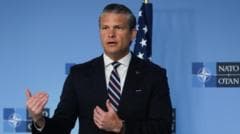
Just nowDan SalesandJessica Parker,at Nato headquarters in BrusselsEPAPete Hegseth warned that while some countries would fail, "others will pass with flying colours"US Defense Secretary Pete Hegseth has severely criticised some of America's Nato allies, while announcing a six-month review of the presence of US forces in Europe."It's a review that some countries will fail, and others will pass with flying colours", he said at a meeting of Nato defence ministers in Brussels, singling out allies that he suggested had been "free-riding".Hegseth was also highly critical of Nato member states that had imposed limits on help to US forces during the war with Iran.The aim of the review, which Hegseth termed Nato 3.0, was to "ensure that Nato is moving fast and irreversibly toward Europe leading" on security on the continent. A US official told the BBC that nothing had yet been predetermined.The US wants Nato members to contribute more to defence spending in Europe and says some countries have not shown how they will reach an agreed target of 5% of national economic output (GDP) which includes 3.5% on core defence and 1.5% on related infrastructure. Nato Secretary-General Mark Rutte said defence spending had already gone up €90bn (£78bn; $103bn) last year - a rise of almost 20% - and Europeans were "already backfilling" resources that the US was cutting back on.Hegseth's announcement of a review follows a US decision to scale back its commitments to a high readiness force within the alliance known as the Nato Force Model (NFM).Details of how the US will reduce its commitments have not been made public but it has been indicated they include air and naval capabilities.Hegseth said Nato's annual dues would be "contingent on other countries meeting their defence spending targets; where other allies do not spend with urgency, our dues contributions will go down"."Some of Nato's largest economies, some of our richest countries, allies that are happiest to go on about the rules-based international order and middle powers banding together, still seem to think the era of free-riding is here," he added.He did not single out which countries he meant.A senior Nato official conceded that "not everything" that the US was withdrawing "can be absolutely replaced" but Rutte said some work had already been done and further efforts were under way. He also revealed that the changes were taking effect immediately."My priority now is to make sure that our armed forces have the resources that they need to do a very difficult job", he said, adding that "the world is a very dangerous place."Jarvis took up the position after his predecessor, John Healey, quit last week, warning in his resignation letter to Sir Keir Starmer that the level of new funding proposed fell "well short" of what was needed to protect the UK.The Nato Force Model is a set of forces that the alliance's Supreme Allied Commander in Europe (Saceur) knows he "can count on" at short notice, the Nato official explained.EPANATO Secretary General Mark Rutte gestures next to US Defence Secretary Pete Hegseth and Britain's Defence Secretary Dan Jarvis in family photo for the meetingIn May the US announced it would withdraw 5,000 troops from Germany after a row between President Donald Trump and German Chancellor Friedrich Merz over the war with Iran.The same month Poland was told 4,000 troops would be pulled out only for Trump to later reverse the plan and promise 5,000 would be deployed.Poland hosts up to 10,000 US troops on a rotational basis, and Defence Minister Władysław Kosiniak-Kamysz said on Thursday that the US was open to Warsaw's offer to provide a permanent base for US troops. He said a final decision would depend on the details of such an agreement.Earlier, Trump threatened to halt all trade with Spain after the government in Madrid refused to allow the use of air bases on its territory for attacks on Iran. The US has two military bases there, Naval Station Rota and Morón Air Base.Rutte

United States Defense Secretary Pete Hegseth speaks during a press statement on arrival for a meeting of NATO defense ministers at NATO headquarters in Brussels, Thursday, June 18, 2026. Virginia Mayo/AP hide caption toggle caption Virginia Mayo/AP BRUSSELS — U.S. Defense Secretary Pete Hegseth lashed out at NATO allies on Thursday, announcing a six-month Pentagon review of American forces in Europe whose outcome will depend on how fast the Europeans take responsibility for their own security. "This will be a real review. It will be designed to ensure that NATO is moving fast and irreversibly toward Europe leading, stepping up to take primary responsibility for the defense of Europe," he told his NATO counterparts in Brussels. Hegseth lambasted European allies for failing to provide U.S. forces access to bases in Europe to launch attacks on Iran, calling it "shameful." "These allies, they put America's sons and daughters, our sons and daughters, at risk by denying them the predictable access, basing and overflight that never should have been in question at all," he said. Taking the microphone at the top of the meeting, Hegseth also railed against migration and gender equality policies in Europe, in remarks reminiscent to those of Vice President JD Vance in February last year that angered many Europeans. "Instead of tanks and fighters and air defenses, the focus has been on gender equity and climate change and defense austerity. Europe's borders flew wide open, welfare states expanded, defense budgets cratered. Along with Europe's belief in itself and its civilization," Hegseth said. Hegseth's comments largely mischaracterized European policies today. On defense, European allies and Canada have launched an unprecedented effort to boost defense spending and expand their armed forces. NATO Secretary-General Mark Rutte noted on Thursday that they spent $90 billion more on defense last year, a 20% increase over 2024. And while Europe accepted large numbers of migrants and asylum seekers more than a decade ago, most countries have tightened their borders since. The Trump administration now wants a reboot of the 32-nation organization to turn it into a "NATO 3.0" capable of deterring any threat, Hegseth said. Hegseth's remarks came a few weeks after the United States told its allies that it would no longer supply certain warships and aircraft if one of them comes under attack. European allies and Canada are trying to work out how to plug the gaps. NATO's supreme allied commander, an American, is working on backup plans to defend Europe after the U.S. signaled on June 3 that it would no longer supply an aircraft carrier and support ships, aerial refueling planes and dozens of fighter jets, among other military assets, in a crisis. The Trump administration insists that it needs to be able to plan for two simultaneous conflicts and wants more military resources at hand should a conflict break out with China in the Indo-Pacific region. Under NATO's collective security guarantee – Article 5 of its founding treaty – the 32 allies pledge that an attack on one of them will be considered an attack on all. It does not oblige them to provide military support, although many likely would. In essence, the United States is scaling back how it might help should an ally trigger Article 5. The U.S. has by far NATO's biggest armed forces. It does not intend to withdraw its nuclear weapons in Europe, which are key to NATO's deterrence. To underscore that point, NATO's Nuclear Planning Group issued its first statement in 19 years after it had assembled at Thursday's meeting. In the statement, it "recalled that the strategic nuclear forces of the Alliance remain the supreme guarantee of Allied security and underpin NATO's extended deterrence architecture." The ministers "agreed to continue enhancing NATO's nuclear deterrence mission by modernizing NATO's nuclear capabilities, strengthening its nuclear planning capacity, and adapting to
Just nowGrace Eliza GoodwinUS Defence Secretary Pete Hegseth has criticised European nations for allowing an "invasion" of migrants on their shores, during a D-Day anniversary speech in France.Hegseth was speaking in Normandy 82 years after allied forces stormed French beaches to liberate Nazi-occupied north-western Europe in 1944."Sadly, today, different European beaches are stormed by different dangerous ideologies," Hegseth said. "Beaches in Spain, in Italy, in Greece and Bulgaria. Boats and men arrive. When will European capitals do something about that invasion?"Migration has become a major political issue across Europe in recent years, with parties supporting hardline immigration policies surging in the polls.Sea arrivals into mainland Europe peaked in 2015, when the UN said more than a million people crossed the Mediterranean. Between April 2025 and March 2026, there were a combined 169,341 sea arrivals to the UK, Greece, Italy, Spain and Cyprus. Crossings to the UK accounted for about 23% of the total.Hegseth said that in the years since D-Day some European capitals have grown too "comfortable" with their hard-fought freedoms, forgetting that "freedom is not free"."The men who fought and died here restored freedom to Europe," Hegseth said. "That freedom must be maintained by this generation of leaders and war fighters or what they fought for was merely temporary."D-Day was the largest seaborne military operation ever attempted and involved the simultaneous landing of tens of thousands of troops from the UK, US and Canada on five separate beaches in Normandy in northern France.Between 1 January and 3 June 2026, a total of 9,142 people crossed the English Channel by small boat to the UK from France. This was down by 38% on the same period the previous year.Hegseth's comments mark a further criticism of European migration policy by senior members of the Trump administration.On Friday, US Vice-President JD Vance blamed the death of the 18-year-old British student Henry Nowak, who was fatally stabbed last year in Southampton by Vickrum Digwa, on the "mass invasion of migrants" and said the "only response" was "righteous anger".After Vance's post on X, a Downing Street spokesman said the Nowak family had "said they do not want his death to be used to create further division".US President Donald Trump has also criticised European immigration policy, telling the UN last year that European countries were "going to hell" due to "uncontrolled migration".In response, UK Prime Minister Keir Starmer said the president's remarks were "not right", while accepting the "challenge" of tackling illegal migration, particularly from people crossing the English Channel in small boats.In December, the Trump administration unveiled its new National Security Strategy, which asserted that if current trends continue Europe would be "unrecognisable in 20 years or less" and its economic issues are "eclipsed by the real and more stark prospect of civilisational erasure".Within the US, the Trump administration has made anti-immigration policy a key tenet of its domestic agenda, with agents from the Immigration and Customs Enforcement agency (ICE) making thousands of arrests since January 2025. More on this story



Discussion (0)