
Loading dispatches...
← Return to NewsroomWorld
FBI thwarted plot targeting White House UFC event, Patel says
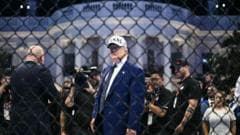
Just nowAna FaguyGetty ImagesThe event was held on Sunday, as US President Donald Trump celebrated his 80th birthday The FBI thwarted a plot targeting Sunday's UFC event at the White House, and has taken multiple suspects into custody, according to the agency's head, Kash Patel.Part of the plan involved striking nearby buildings with explosive-laden drones, according to court documents unsealed on Tuesday.One suspect was arrested in Ohio last week, where investigators obtained access to encrypted messages involving other alleged plotters. He has been charged with conspiracy to commit an offence against the US and attempted murder of a federal officer, according to the documents. "Allegedly planned attacks were stopped cold," Patel said in a social media post on Tuesday about the "multi-state operation".Five people are in custody, CBS News, the BBC's US news partner, reported. The BBC has requested further comment from the FBI.By using the drones, the plotters aimed to spark panic and draw the fleeing crowd toward a sniper team, according to the court documents.. A "second wave" of attackers then allegedly was supposed to storm the White House gate.An estimated 4,300 people were present for the invite-only event on the South Lawn - and another 85,000 were able to watch at a nearby fan zone - as 14 mixed martial arts fighters competed in back-to-back fights on Sunday,The plot was discovered through Tycen Proper, a 19-year-old Ohio man, who was communicating with a group online who "expressed ultra-religious and antigovernment sentiments," federal prosecutors said in the unsealed charges.His mother called local authorities late in the evening on 10 June - just days before the high-profile event - because she was concerned about his large firearms purchases and what she had seen of his online communication. The group allegedly wanted to "jumpstart" a revolution by shooting at "high-value targets" - identified as wealthy people and politicians - attending the fight and had specifically discussed "grievances about government corruption, the handling of the Epstein files, data centers taking up all the water in communities, and other government actions", according to court documents.During an FBI interview on 11 June, Proper admitted to being part of planning the coordinated attack and that the group began communicating with one another around March 2026 through a TikTok group called "Vanguard of the Old". For some in the group, those communications moved to Signal, the encrypted messaging app, where plans for the attack on the White House event were made, according to prosecutors. The BBC has contacted Proper's lawyer. At an unrelated briefing on Tuesday, Secret Service Deputy Director Matt Quinn was asked about the thwarted incident and described it as a "serious threat".He told reporters he could not offer many details as the investigation remains active, but said "there are still suspects at large, and we're going to work it until everyone's been identified".The Secret Service worked "closely with the FBI throughout this investigation," and their "formal comments regarding the specifics of this case will be made available in court filings", Secret Service Director Sean Curran said in a statement.It appears President Donald Trump and Vice President JD Vance were made aware of the possibly thwarted attack around the same time as the general public. When asked about the alleged plot during the G7 summit in France on Tuesday Trump said: "I haven't heard about it." While Vance said in an interview on Fox News "Fox and Friends" that he believed the FBI was informing the public "because the scale of the planned attack is so significant".On Sunday, as part of the celebration of the nation's 250th anniversary, the White House hosted a series of Ultimate Fighting Championship (UFC) matches, after days of preparation that included erecting a massive arena known as The Claw in the open space behind the White House and other events such as a

Washington, DC – There are fisticuffs on the White House lawn, soon to be followed by a high-speed race through the National Mall. What is going on in Washington, DC?The United States capital has been transformed in honour of the country’s 250th anniversary.Recommended Stories list of 3 itemslist 1 of 3Trump booed ‘thunderously’ at NBA Finals: What we knowlist 2 of 3US judge refuses to block Trump’s White House UFC fightlist 3 of 3Oval Office octagon: How Trump turned combat sports into a political weaponend of listEvents all around the country are planned to mark two and a half centuries since the signing of the Declaration of Independence on July 4, 1776.The nationwide bash has been dubbed the “semiquincentennial” — meaning half of 500 — and not just because Congress loves long words. The US has a history of throwing itself a party every 50 years.But US President Donald Trump has promised a particularly noteworthy event this year, though the proceedings have been marred by a cavalcade of controversies.Here’s what to know:What is the history of US semicentennial celebrations?The first 50-year anniversary, in 1826, was a considerably more muted affair than the festivities to come.At the time, some of the original signers of the Declaration of Independence were still alive, so the mayor of Washington, DC, invited them to attend the celebration in the capital.Former Presidents John Adams and Thomas Jefferson both demurred, citing their failing health. They died within hours of each other on the day of the semicentennial.Fifty years later, in 1876, the US would mark its 100th anniversary by hosting its first world’s fair, an exhibition featuring displays of art, culture and technology from around the globe.The fair was held in Philadelphia, where the Declaration of Independence was signed, and the original document was put on temporary display in the city.Another world’s fair arrived in Philadelphia for the country’s 150th anniversary in 1926, but it was not nearly as successful. Variety magazine called it “America’s greatest flop”.Meanwhile, the modern template for having a yearlong, cross-country celebration was set on the 200th anniversary in 1976.A train-mounted museum of documents and historical artefacts toured the lower 48 states for 21 months. Volunteers, meanwhile, used covered wagons to travel the width of the country.The celebrations were generally received positively, although the sale of souvenirs — from umbrella hats to mugs — earned it the pejorative “the buy-centennial”.Anthony Geary of Chicago, Illinois, attends the UFC Freedom 250 Fan Fest on June 13 [Matt McClain/Getty Images via AFP]What is happening this year?While the US capital may be the centre of this year’s celebration, there will be a multitude of events across the country. They include: UFC Freedom 250, a mixed martial arts fight on the White House lawn on June 14 the Great American State Fair, featuring booths representing all 50 states, presented on the National Mall from June 25 to July 10 the Freedom 250 Grand Prix, which will see IndyCars race around capital monuments from August 22 to 23 the World Cup Fan Zone in Washington, DC, from June 11 to July 16 a fireworks display at Mount Rushmore in South Dakota on July 3 concerts and exhibitions in cities like New York, Los Angeles and Boston Mobile museums, known as Freedom Trucks, will also be travelling around the country.Another initiative is America’s Block Party, an effort to encourage communities to engage in charitable works and host their own semiquincentennial parties.So far, however, there appears to be no government programme in the works to tackle the holiday’s most vexing and far-reaching problem: how to make the traditional July 4 potato salad less bland.What is the controversy over the UFC fight?One of the most scrutinised events in the semiquincentennial calendar is UFC Freedom 250, which will take place on the White House lawn on Sunday.The timing of the event is one of the details th
The U.S. Capitol is seen on June 2, 2026. Mariam Zuhaib/AP hide caption toggle caption Mariam Zuhaib/AP Federal agencies responsible for immigration enforcement are set to receive tens of billions more dollars after Congress voted to fund them not just for the year, but through the rest of President Trump's term. The House narrowly voted on Tuesday to direct roughly $70 billion to the Department of Homeland Security for Immigration and Customs Enforcement and Border Patrol, the second multi-billion dollar infusion of money to the agencies in the last year muscled through by Republicans alone. The measure passed by a vote of 214 to 212. The vote marks the end of a 115 day standoff over immigration policy. After federal officers shot and killed two protesters in Minneapolis earlier this year, Democrats refused to back more funding for ICE and Border Patrol, with the goal of forcing changes to immigration enforcement tactics. But as negotiations fell apart, Republicans moved to circumvent Democrats using a special procedure known as reconciliation to fund the agencies without acquiescing to any of the reforms they were demanding. In the Senate last week, one Republican joined all Democrats in an unsuccessful attempt to block the measure. The lopsided votes highlighted a Republican caucus continuing to endorse Trump's immigration agenda as Democrats warn that Congress has ceded its ability to provide oversight by funneling these agencies billions of dollars with few strings attached. ICE gets more than three times its annual funding Through this legislation, Congress is giving ICE more than three times its last annual budget. Though technically this funding is meant to cover three years, unlike a traditional annual funding bill, the money comes with few stipulations on how and when it should be spent. While most annual spending measures provide funds for just that fiscal year, this measure includes lump sums that need to be spent only by the end of fiscal year 2029, including: $38 billion for ICE to hire, pay, train and equip its officers and agents. That includes $7 billion for Homeland Security Investigations and $31 billion for immigration enforcement work like hiring more attorneys, supporting local law enforcement who coordinate with ICE and technology like body cameras;$22 billion for Border Patrol to pay, train, recruit and equip agents and personnel. That includes $13 billion specifically for immigration enforcement work;$5 billion for border security technology and screening, including artificial intelligence;$350 million for enforcement in localities that do not coordinate directly with ICE. Legislation passed in April to fund most of DHS except ICE and Border Patrol did include provisions that would provide funding for the agency to purchase body cameras, stipulate congressional oversight of detention centers and deescalation training for officers and agents. Lawmakers agreed to separate funding for ICE and Border Patrol as Republicans and Democrats struggled to reach a compromise on reforms even as a record-long DHS shutdown dragged on. But now ICE and Border Patrol will be funded without the changes Democrats were demanding, including requiring judicial warrants to enter homes and prohibiting officers from wearing masks. The package also lacks reforms with bipartisan support, such as requiring officers to wear body cameras. Neither measure included funding for internal oversight offices that conduct investigations into detention center conditions; however, the April measure to fund all of the agency included $20 million for the DHS inspector general to specifically conduct oversight of detention facilities. Not only is this standoff ending without Democrats achieving the reforms they pressed for, the agencies will be insulated from additional pressure through the appropriations process for three years. More dollars after an unprecedented boost Both ICE and CBP received a massive influx of funding


Discussion (0)