
Loading dispatches...
← Return to NewsroomTechnology
Vertu wants executives to pay $6,880 for an AI agent — heres how it actually performs

AI has become the smartphone industry’s latest battleground, with manufacturers racing to add AI-powered features to attract mainstream consumers. Vertu is taking a different path: the UK-founded luxury phone maker, known for hand-finished devices often costing tens of thousands of dollars, has built its business selling status symbols to the ultra-wealthy rather than competing on specs. Its Alphafold targets affluent buyers, particularly chief executives, pairing luxury materials with an AI agent designed to automate parts of an executive’s working day. I decided to test that claim on its own terms. Rather than focusing on benchmark scores, camera comparisons, and media consumption — the staples of most smartphone reviews — I spent a few days using the foldable the way Vertu says its customers would: managing documents, analyzing spreadsheets and contracts, planning business trips, automating routine tasks, and relying on its AI agent as a digital companion throughout the working day. The question wasn’t whether it was a good smartphone, but whether it was a good executive smartphone. At the heart of the Alphafold is Hermes Agent, a pre-installed AI agent built on top of the open-source Hermes project, which the company says can analyze files, automate tasks across apps, remember conversations, and hand off requests to a human concierge when needed. Unlike most smartphone AI assistants that largely just respond to prompts, Hermes is designed to execute multi-step workflows on users’ behalf, making it the centerpiece of Vertu’s pitch rather than the foldable hardware itself. Physically, the Alphafold, which starts at $6,880, looks and feels every bit like a luxury device. The review unit I received was wrapped in genuine calfskin leather with titanium accents, setting it apart from mainstream foldables that largely rely on glass or synthetic finishes. It’s clearly built for buyers who see their phone as both a tool and a status symbol. Compared with the Samsung Galaxy Z Fold 7, which I used as a reference device throughout this review, the 264-gram Alphafold feels noticeably heavier than Samsung’s 215-gram foldable. The extra weight is apparent during prolonged use, though it never feels unwieldy. The Alphafold’s curved frame also makes it easier to unfold than the Galaxy Z Fold 7’s flatter edges. Samsung’s design, however, feels sleeker and more comfortable to hold when folded, making it easier to use one-handed. Vertu’s Alphafold with a Calfskin Leather back and Samsung’s Galaxy Z Fold 7 with a Glass BackImage Credits:Jagmeet Singh / TechCrunch The Alphafold also arrives in packaging that feels more akin to a jewelry presentation case than a smartphone box. The oversized box opens to reveal neatly arranged drawers containing bundled accessories, including a leather sleeve and charging cables, reinforcing the sense that Vertu is selling a luxury experience rather than just a handset. Vertu Alphafold’s with a luxury packagingImage Credits:Jagmeet Singh / TechCrunch Beneath the premium materials, however, the Alphafold tells a different story. During the review, I noticed striking similarities between the device and the $1,100 ZTE Nubia Fold — from the hinge design and dimensions to the placement of the speakers, microphones, and the fingerprint reader. The most visible distinction is Vertu’s leather-clad rear panel, though. System information also revealed ZTE identifiers in parts of the software. When asked about these observations, Vertu confirmed to TechCrunch that the Alphafold was developed through a specialist supply-chain partnership involving ZTE/Nubia’s hardware platform, component integration, and production engineering. However, the company said it was responsible for the luxury materials, software experience, quality control, and after-sales service. ZTE did not respond to a request for comments. ZTE Nubia FoldImage Credits:YMobile.jp This isn’t new for Vertu. In a 2023 review of the MetaVertu, Wired rep
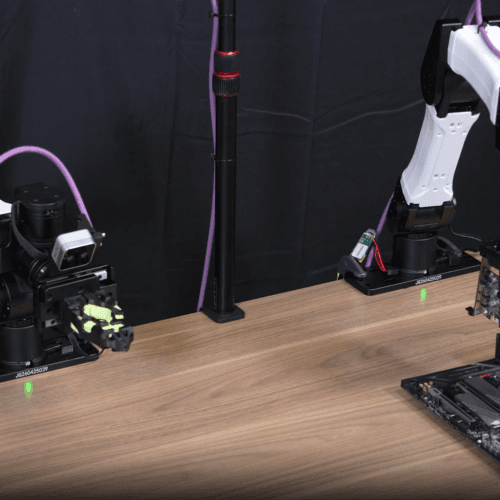
What happens when you give AI coding agents a lab full of robotic arms, some compute resources, and a “generous token budget” for teaching the robots various tasks? The agents can apparently figure out a training regimen that teaches the robots to successfully cut zip ties and even insert GPUs into thin sockets on motherboards. That glimpse into how AI can act in a fully autonomous way to automate robot training was made possible by a new agent harness framework—software that wraps around AI models to enable their use of various tools while also providing capabilities such as memory, context, constraint, and feedback loops. That agentic harness, called ENPIRE, was developed by robotics researchers at the NVIDIA GEAR (Generalist Embodied Agent Research) lab alongside collaborators from Carnegie Mellon University in Pittsburgh and the University of California, Berkeley. “A part of our NVIDIA GEAR lab now self-improves tirelessly overnight,” wrote Jim Fan, director of AI at NVIDIA, in a LinkedIn post. “We just read the reports in the morning.” Fan also jokingly described the goal of such AI-directed robot training, saying, “We all take a holiday and Jensen wouldn’t even notice,” in reference to Nvidia founder and CEO Jensen Huang. But it’s not only Nvidia robotics researchers who could benefit—Fan said the team would be open-sourcing everything so anyone can host their own “self-running robot lab at home.” The ENPIRE harness has four modules that enable AI coding agents to perform automatic reset and verification on tasks, refine policies that guide robotic behavior, evaluate such policies across multiple physical robots working in parallel, and address failures by analyzing logs, ingesting research papers, and improving training infrastructure and algorithm code. More technical details are available in the research paper uploaded on June 16, 2026. The harness was tested with three different AI coding agents, including OpenAI’s Codex with GPT-5.5, Anthropic’s Claude Code with Opus 4.7, and Moonshot AI’s Kimi Code with Kimi K2.6. Teams of the coding agents independently developed different algorithmic approaches to robot training, tested them in real-world experiments, and then retained whatever changes helped raise the overall success rate over repeated cycles of self-directed testing.
As AI agent traffic surpasses human traffic on the internet, companies working in commerce and finance are building tools that allow agents to take action on behalf of users at a rapid pace. Days after trading platform Robinhood introduced agents that can trade for users, Coinbase launched its own agents that can execute trades and pay for premium research. The company said Thursday that users can integrate the agent with their main account and start trading. If users don’t want to give the agent access to their main account, they can choose to have it operate in a separate sandbox. Coinbase noted that the agent can use tools like Coinbase Advanced, the company’s platform for professional traders that includes extra features like TradingView charts, to analyze and execute trades. Users can ask the agent to rebalance their portfolio, ask it to follow an investment thesis and trade on their behalf, or provide advice on a one-time crypto trade. Loading the player… At the moment, the agent can trade in crypto spot markets and derivatives, with support for equities and prediction markets planned for the future. Coinbase added that it will soon add support for custom limits such as maximum trade size, which services the agent can interact with, and how much it can spend. Coinbase is taking advantage of the open x402 payment protocol it launched in collaboration with AWS, Anthropic, Circle, and Near last year. Using this standard, the agent can pay for premium research data APIs, and on-demand compute for trading insights without requiring any login or subscription. This website lists services that the agent can access through the x402 protocol. The trading platform has been actively investing in AI tools for the last few years. It launched AgentKit, which allows developers to integrate automated wallets into their apps in 2024. Last December, it added an AI-powered assistant to the app that provides trading tips and financial advice. The company said that the latest agent launch can also work in ChatGPT or Claude through its MCP server. “Coinbase for Agents is informed by insights gleaned from years of building the agentic economy, and the primary goal is to create agents that can transact. And unlike pure trading platforms, we’re the only one that combines exchange access with a native payments protocol. We’re aiming to build a fundamentally different product for a future where most of the internet is accessed through agents,” Lincoln Murr, Head of AI Product, told TechCrunch via email. AI companies are exploring agentic payments at a rapid pace through new partnerships. Last month, Visa invested in Replit to power agentic payments for developers. The payment network company made a deal with OpenAI this week to explore similar products. The pace of development in the sector has made global financial regulators take notice. The Financial Stability Board (FSB) said that there should be strong safeguards in place to mitigate AI risks. When you purchase through links in our articles, we may earn a small commission. This doesn’t affect our editorial independence. Ivan covers global consumer tech developments at TechCrunch. He is based out of India and has previously worked at publications including Huffington Post and The Next Web. You can contact or verify outreach from Ivan by emailing im@ivanmehta.com or via encrypted message at ivan.42 on Signal. View Bio



Discussion (0)