
Loading dispatches...
← Return to NewsroomTechnology
SpaceX officially closes its Cursor acquisition

In Brief Posted: 9:30 AM PDT · August 15, 2026 Image Credits:Jagmeet Singh / TechCrunch AI coding startup Cursor is now officially a part of SpaceX, according to an announcement on the Cursor blog. Elon Musk’s SpaceX — which also acquired Musk’s xAI earlier this year — announced a deal in April for the companies to develop technology together; the deal also gave SpaceX the option to acquire Cursor for $60 billion. Two months later, as SpaceX became a public company, the companies said they were moving forward with the acquisition. In its announcement that the deal has closed, Cursor repeatedly referenced SpaceX’s computing infrastructure, which the company has been renting out to customers including Anthropic and Google. (SpaceX also faces a lawsuit over the pollution created by its data center gas turbines.) Cursor said that by becoming part of SpaceX, it will have “access to the largest fleet of GPUs in the world.” “SpaceX is building the computing capacity needed to scale intelligence far beyond what exists today,” the company added. “Cursor will be one place where that intelligence becomes useful.” Topics Subscribe for the industry’s biggest tech news Latest in AI

In Brief Posted: 3:12 PM PDT · August 13, 2026 Image Credits:MICHAEL TRAN/AFP / Getty Images Singer and actress Selena Gomez and her mother are being sued over their mental health startup, Wondermind. The plaintiffs in the lawsuit say they invested nearly $1.2 million in the startup, and are accusing Gomez of securities fraud and breach of contract. They allege that the startup failed to deliver on its commitments without informing investors, and Gomez failed to market the startup after promising to do so. The news was first reported by Forbes. Wondermind launched in 2021 and aimed to offer daily mental health resources to users. The lawsuit alleges that investors were unaware of the company’s troubles until a September 2025 story from The Cut uncovered them. “Gomez purported to sign a contract obligating her to perform and then ignored it,” the complaint reads. “The partnerships did not exist. The initiatives never materialized. The app was never built. And for three years, while the Company quietly collapsed around them, not one of its founders, officers, or directors said a word to the investors whose money was funding the collapse.” The investors allege that Gomez and Wondermind misrepresented the company’s finances and overstated the extent of Gomez’s involvement. The plaintiffs are seeking to recover their investments and legal fees. Wondermind did not respond to our request for comment. Topics Subscribe for the industry’s biggest tech news Latest in Startups

Image Credits:SpaceX / 4:25 PM PDT · July 24, 2026 SpaceX successfully deployed the first third-generation Starlink satellites on Friday using an upgraded version of its prototype Starship — the 13th test flight of its mega-rocket to date. But the company suffered another failure with its Super Heavy booster during a planned simulated landing in the Gulf of Mexico. It’s the second time the company has had an issue with the Super Heavy booster on this V3 version of Starship. In May, on the first Starship V3 flight, SpaceX encountered a failure of the Starship’s Super Heavy booster as it separated from the upper stage of the rocket. The launch came a little more than a week after SpaceX tried to conduct the 13th Starship launch. That attempt had to abort immediately after ignition due to a number of rocket engine failures. SpaceX said it replaced six engines ahead of Friday’s flight to fix the problem. During Friday’s launch, the booster made it further into its planned flight, but wasn’t able to properly fire up all of the engines required for its simulated landing burn. The booster exploded after a faster-than-expected impact with the water. This was the first launch of Starship since SpaceX went public in June in the largest IPO in history. In a test of SpaceX’s “fly, fail, fix” approach to Starship development, the company saw its stock decline last week in the day following the launch abort. The dip is part of a larger downward trend since the IPO that has seen the company’s stock drop from a peak of more than $200 per share to $115 at the close of trading on Friday. In after-hours trading, SpaceX shares fell another 2% following the booster failure, before paring some of those losses. SpaceX appears to have had better luck with the Starship V3 upper stage during Friday’s launch. The upper stage lost a rocket engine during the first V3 launch in May. That didn’t happen this time around, as Starship encountered no issues on its way to deploying the new Starlinks. The new Starlink satellites are expected to burn up in the atmosphere roughly 20 minutes after deployment, as Starship still isn’t capable of reaching Earth orbit. This story is developing… Topics When you purchase through links in our articles, we may earn a small commission. This doesn’t affect our editorial independence. Sean O’Kane is a reporter who has spent a decade covering the rapidly-evolving business and technology of the transportation industry, including Tesla and the many startups chasing Elon Musk. Most recently, he was a reporter at Bloomberg News where he helped break stories about some of the most notorious EV SPAC flops. He previously worked at The Verge, where he also covered consumer technology, hosted many short- and long-form videos, performed product and editorial photography, and once nearly passed out in a Red Bull Air Race plane. You can contact or verify outreach from Sean by emailing sean.okane@techcrunch.com or via encrypted message at okane.01 on Signal. View Bio

Elon Musk’s SpaceX has shown investors a prototype of a “handset-like” AI device, reports The Wall Street Journal. The prototype is reportedly sleeker and slimmer than an iPhone, making us wonder if it’s something between a small touchscreen phone and a Rabbit R1. SpaceX reportedly showed the device to investors and stakeholders before it went public, and told them it’s at an early enough stage that the design could still change. Musk has denied the reporting, calling it “utterly false.” SpaceX, alongside sister company Tesla, does have the manufacturing expertise to pull off mass producing a bunch of AI devices — not to mention access to the chips needed to power any on-device compute. SpaceX has also signaled that it’s keen to expand into wireless, with Starlink Mobile as a potential competitor to Verizon and AT&T. One analyst even went as far as to speculate that T-Mobile or AT&T would make fine acquisition targets for the rocket builder, though such a purchase would, undoubtedly, be pricey. It’s also not clear if SpaceX is just throwing spaghetti at the wall or if it will attempt to really mass produce and market such a device. But one thing that seems clearer is that if OpenAI is doing it, Musk would, perhaps, want to try to do it better. As we know, OpenAI is working with Apple’s former chief design officer Jony Ive on an AI device that CEO Sam Altman has claimed will be more peaceful than an iPhone. Reports from last autumn suggest the company has been struggling to get the details right, and OpenAI recently brought on another Apple executive to potentially help move things along. News dropped last week that Paul Meade, Apple’s VP in charge of the Vision Pro headset, has joined OpenAI’s hardware team. Like OpenAI, SpaceX’s prototype is reportedly designed to run on a proprietary operating system and integrate technology from xAI, Musk’s AI company that SpaceX acquired earlier this year. This would prevent these new devices from being trapped inside another company’s platforms (like Google’s Android). But also, the intent appears to also be to create something new, with native AI interfaces. That said, the graveyard is crowded with the unsuccessful launches of AI devices from companies like Humane and Rabbit. A company wanting to sell an AI device, does not equate consumers wanting to buy such a thing. Yet. When you purchase through links in our articles, we may earn a small commission. This doesn’t affect our editorial independence. Rebecca Bellan is a senior reporter at TechCrunch where she covers the business, policy, and emerging trends shaping artificial intelligence. Her work has also appeared in Forbes, Bloomberg, The Atlantic, The Daily Beast, and other publications. You can contact or verify outreach from Rebecca by emailing rebecca.bellan@techcrunch.com or via encrypted message at rebeccabellan.491 on Signal. View Bio
In Brief Posted: 5:38 PM PDT · June 26, 2026 Image Credits:Spencer Platt / Getty Images Elon Musk is eyeing an acquisition of Mesh Optical Technologies, a startup founded by three former SpaceX engineers last year developing hardware for fast data center communications. The potential acquisition, which was revealed in a Federal Trade Commission filing and first reported by Bloomberg, confirmed the agency expedited its antitrust review. Mesh Optical came out of stealth in February when it announced that it raised a $50 million Series A led by Thrive Capital. Before founding Mesh Optical, the startup’s co-founders, Travis Brashears, Cameron Ramos, and Serena Grown-Haeberli, developed the optical communication links that keep thousands of SpaceX’s Starlink satellites interconnected. The Mesh co-founders saw an opportunity to develop optical transceivers for terrestrial data centers, as light-based hardware is faster and more energy-efficient than traditional electrical-based systems. SpaceX has recently entered into agreements with Anthropic, Google, and the open-source AI developer Reflection AI to provide them with compute capacity at its data centers, generating a substantial new revenue stream for the newly public company. Acquiring Mesh could eventually allow SpaceX to improve the efficiency of its data centers, whether they are located on Earth or, in the future, in space. Topics Subscribe for the industry’s biggest tech news Latest in Hardware

SpaceX lifted off on its first day as a public company, immediately jumping to $150 a share after it began trading on the Nasdaq, around 11% higher than the $135 figure at which it officially priced its IPO on Thursday. The stock price reached as high as $176 in midday trading, pushing the company’s market capitalization to nearly $2.3 trillion, before ultimately settling to $159.75 as markets closed. The stock pop isn’t a surprise. The company’s IPO was oversubscribed by 4x, according to Bloomberg, meaning many institutional investors didn’t receive allocations and are likely buying shares on the open market. The demand for SpaceX is also a function of its small float, with only about 4% of shares available for public trading, while early investors and employees hold the rest. SpaceX also successfully lobbied a number of indexes (like the Nasdaq 100) to change their inclusion rules. The company will now join those indexes in a matter of days, not months, increasing demand for SpaceX stock before other large institutions and funds start automatically buying it. Robinhood said it has seen “record-breaking” traffic on its trading platform Friday in the hours after SpaceX’s historic public markets debut. The debut is also one of the largest windfalls in the history of venture capital. The returns to Founders Fund, which invested $600 million in the company and owns a 3% stake, are estimated at more than $50 billion at the IPO price of $135, according to Bloomberg. Meanwhile, Andreessen Horowitz’s stake is worth more than $10 billion, and Sequoia’s is valued at over $20 billion. Debuting at $150 made founder Elon Musk the world’s first trillionaire. The New York Times has reported that around 4,400 current and former SpaceX employees will become millionaires, while around 400 will become centimillionaires. The original version of this article was published at 11 a.m. ET. The article has been updated with a new share price and other information. When you purchase through links in our articles, we may earn a small commission. This doesn’t affect our editorial independence. Marina Temkin is a venture capital and startups reporter at TechCrunch. Prior to joining TechCrunch, she wrote about VC for PitchBook and Venture Capital Journal. Earlier in her career, Marina was a financial analyst and earned a CFA charterholder designation. You can contact or verify outreach from Marina by emailing marina.temkin@techcrunch.com or via encrypted message at +1 347-683-3909 on Signal. View Bio Sean O’Kane is a reporter who has spent a decade covering the rapidly-evolving business and technology of the transportation industry, including Tesla and the many startups chasing Elon Musk. Most recently, he was a reporter at Bloomberg News where he helped break stories about some of the most notorious EV SPAC flops. He previously worked at The Verge, where he also covered consumer technology, hosted many short- and long-form videos, performed product and editorial photography, and once nearly passed out in a Red Bull Air Race plane. You can contact or verify outreach from Sean by emailing sean.okane@techcrunch.com or via encrypted message at okane.01 on Signal. View Bio

In Brief Posted: 12:28 PM PDT · June 12, 2026 Image Credits:Michael Nagle/Bloomberg / Getty Images All eyes might be on the SpaceX IPO — the world’s largest in history — and its CEO Elon Musk. But lest you forget there is another publicly traded company in the Musk universe that many believe will someday merge with SpaceX. We’re talking about Tesla, a company that has a current market cap of about $1.26 trillion. Musk, who also leads the company, has pitched Tesla as an AI and robotics company, even if the bulk of its revenue comes from selling EVs. Some see a merger with SpaceX as a critical step to achieve that mission. And SpaceX president and COO Gwynne Shotwell appears to see some benefits to one. During an interview with CNBC, Shotwell said a merger “might make Elon’s life a little easier.” There is evidence that SpaceX is already preparing for a merger. The company amended its S-1 registration document ahead of its public debut to include new language in its risk factors section about mergers and acquisitions. The sentence, which reads “We may issue a significant amount of equity in connection with future transactions,” is a warning to investors of future dilution. A warning like that wouldn’t be necessary for a small-scale deal; it likely means Tesla. As a reminder, Musk is quite comfortable bringing the disparate pieces of his portfolio together. SpaceX acquired Musk’s AI company xAI earlier this year. And xAI acquired Musk’s social media company X in an all-stock transaction. Topics Subscribe for the industry’s biggest tech news Latest in Transportation
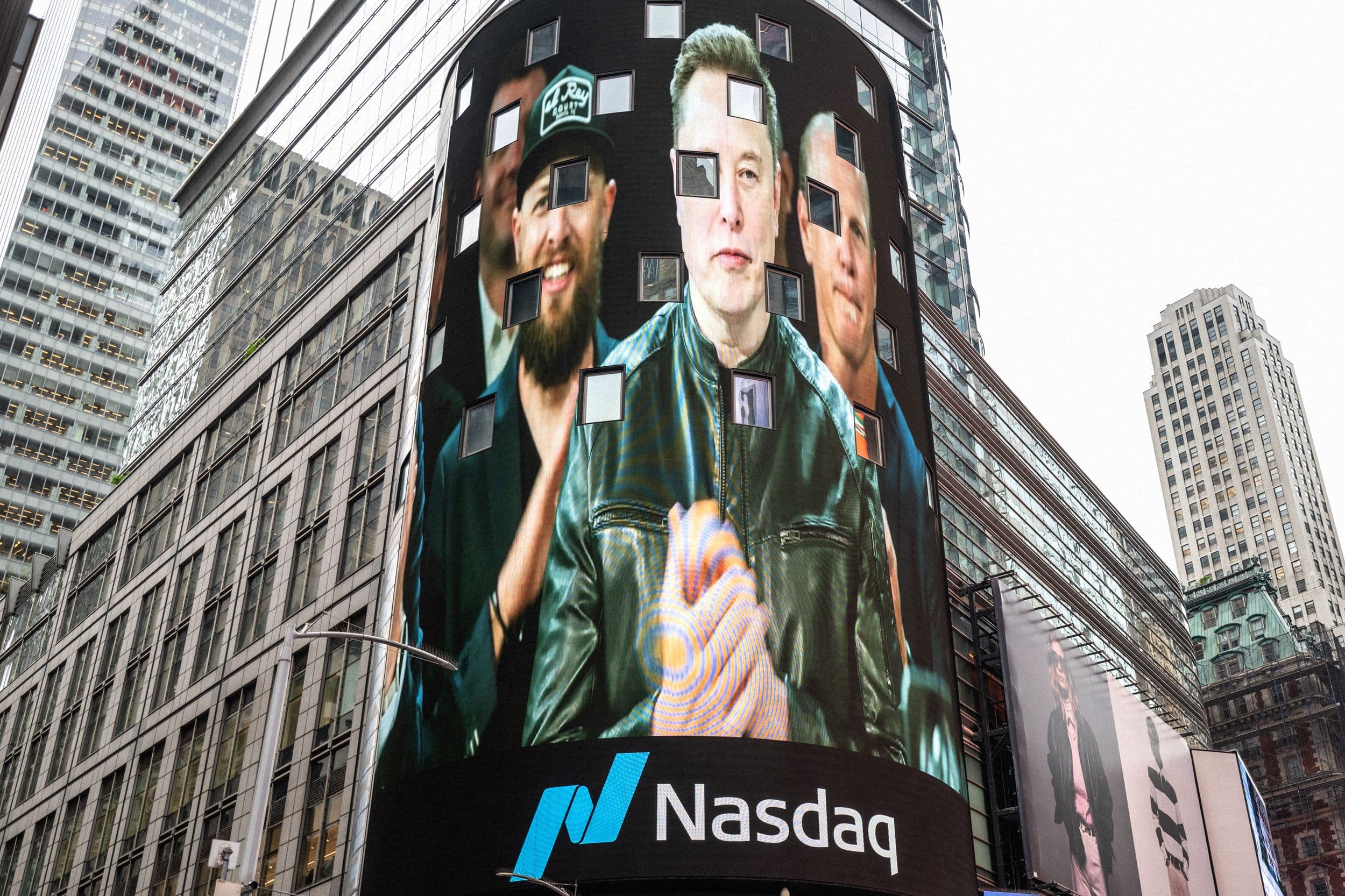
There are thousands of billionaires across the world. But there is only one trillionaire.Elon Musk became the first person to amass a personal fortune of over $1,000,000,000,000—that’s 12 zeros—after shares of his rocket company SpaceX debuted on the Nasdaq stock exchange on Friday.SpaceX’s initial public offering on Thursday valued the company at nearly $1.8 trillion, up from its most recent private valuation of around $1.25 trillion. After shares opened at $150 on Friday morning in New York and kept surging, SpaceX’s market capitalization reached about $2.2 trillion.Between Musk’s significant ownership stakes in SpaceX, his car company Tesla, and several other ventures, his personal coffers expanded enough to propel him into trillionaire territory, according to Bloomberg and Forbes, which conduct extensive research to identify the world’s richest individuals. In 2024, his net worth surpassed $400 billion, per Bloomberg—which means it has nearly tripled in less than two years. (An important caveat: Musk doesn’t have $1 trillion in his bank accounts. Most of his wealth is tied up in shares, some of which he is restricted from selling anytime soon. He has also pledged to donate half his wealth eventually.)He remains a reviled figure in many circles, including for his efforts last year to dismantle parts of the US government and his years of popularizing and allowing hateful rhetoric through his social media presence. To protest the IPO, one activist group inflated a giant effigy of Musk in New York’s Times Square this week.In addition to Musk, Forbes estimates the wealth for 3,350 people it considers to be mere billionaires, from Amazon founder Jeff Bezos near the top to music mogul Dr. Dre at the bottom. Bloomberg, meanwhile, tracks the 500 richest billionaires.Musk is now more than three times richer than his closest competition, the founders of Google, according to the estimates. The potential upcoming IPOs of generative AI labs OpenAI and Anthropic will cement at least several additional billionaires, but they won’t bring anyone close to Musk’s orbit. Retail investors buying SpaceX shares now certainly won’t be getting rich immediately, and neither will the people living near xAI’s dirty data centers.As long as SpaceX continues to successfully ferry people, goods, and data between Earth and space while facing little competition, Musk will remain in a league of his own.
This week on Uncanny Valley, our hosts discuss SpaceX officially going public and who will benefit the most from it, as well as Apple’s WWDC and the brand new release of Siri AI. They also get into how Meta removed a facial recognition feature after a WIRED report exposed it—and later in the show: an investigation into how New York Knicks’ owner James Dolan created an extensive surveillance system inside all of his Madison Square Garden properties.Articles mentioned in this episode:Everything Apple Announced at WWDC 2026Meta Deletes Face-Recognition System From Its Smart Glasses App After WIRED ReportThe Shocking Secrets of Madison Square Garden’s Surveillance MachineYou can follow Brian Barrett on Bluesky at @brbarrett and Zoë Schiffer on Bluesky at @zoeschiffer. Write to us at [email protected].How to ListenYou can always listen to this week's podcast through the audio player on this page, but if you want to subscribe for free to get every episode, here's how:If you're on an iPhone or iPad, open the app called Podcasts, or just tap this link. You can also download an app like Overcast or Pocket Casts and search for “uncanny valley.” We’re on Spotify too.TranscriptNote: This is an automated transcript, which may contain errors.Brian Barrett: Hey, this is Brian. Before we start, two quick things. If you've been enjoying listening to the show, would appreciate it if you took a second to rate it in your app of choice. It really helps us reach more people. Second, if you have any questions related to tech, privacy, or politics that you would like me, Zoë, and Leah to take on, now is the time to submit them to [email protected]. It doesn't matter how big or how small we want to hear from you and get you answers. OK, onto the show. I'm a little tired, but it's because I got to see Lionel Messi play soccer last night and score a goal on a penalty kick.Zoë Schiffer: That's really fun.Brian Barrett: Yeah. It was a friendly of Argentina versus Iceland. You'll never guess who won.Zoë Schiffer: I literally won't. No. No.Brian Barrett: It was Argentina. Zoë.Zoë Schiffer: Got it. OK. Is that an obvious thing?Brian Barrett: They're very good at soccer.Zoë Schiffer: Cool. That's so nice for them. Happy for them. Welcome to WIRED’s Uncanny Valley. I'm Zoë Schiffer, director of business and industry.Brian Barrett: And I'm Brian Barrett, executive editor. On today's show, we're discussing Apple's key releases from their annual developer conference, especially the company's long awaited AI makeover for Siri. It's far from their first attempt, but it's going to stick this time.Zoë Schiffer: We're also taking an early look at the SpaceX IPO this week, which is slated to become the world's largest IPO of all time. We'll get into who is slated to benefit the most. Elon Musk, who is already the world's richest man, but on track to become even richer and why you might find yourself among the investors without even realizing it.Brian Barrett: And in case you missed it, WIRED reporters recently uncovered that Meta had silently embedded code that would power a face recognition system for its smart classes in the Meta AI app on millions of people's phones. A day after we reported that story, Meta removed the code. We'll talk about how all that unfolded.Zoë Schiffer: And later in the show, for all of the basketball fans who've been glued to the NBA finals, we have a special guest who will tell us about his investigation into Madison Square Garden's surveillance system.Brian Barrett: So Zoë, another week that we get to talk about a developer conference.Zoë Schiffer: I know. Leah's away, and wow, have you taken advantage of that situation?Brian Barrett: Oh yeah. No, yeah. I'm pushing it through. You were so thrilled about Google IO. This week we've got WWDC.Zoë Schiffer: I will say slightly more excited because Apple, as you and I have discussed many times, bit of a laggard in the AI race and I feel like this was their opportunity to tell the world what has



Discussion (0)