
Latest
Shots fired at US consulate in Toronto for a second time this year

England's Harry Kane, center, and Jordan Henderson, left, jog with teammates during a training for the national soccer team in Palm Beach Gardens, Fla.
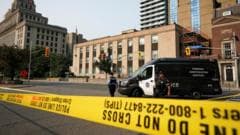
Toronto police said they were investigating the latest attack with the help of the Royal Canadian Mounted Police (RCMP) and international law enforcement partners.Supt Jonathan Ko with the RCMP called it "another troubling incident", while the city's mayor, Olivia Chow, called the attack "brazen". The shooting occurred around 04:45 local time (09:45BST). Officers said they recovered one shell casing at the scene and damage to the building's facade. At least two individuals were inside the consulate at the time, Toronto Police Deputy Chief Frank Barredo said, but he noted the building is "very heavily fortified" and those inside likely did not hear the gun shot.He added that the investigation remains ongoing and that police across the city have been asked to lookout for the potential suspects."We will bring the people responsible to justice," Barredo said.In a post on X, the US Consulate in Toronto thanked the police for their response. Police have been stationed outside the US consulate since March, when shots were fired outside the building in what police at the time called a "national security incident". No one was injured in that attack. In June, police carried out raids in relation to the shooting. One police officer, 43-year-old Const Marc Pinizzotto, was killed during the operation. Police later arrested several suspects aged 18 and 19 for allegedly carrying out a string of shootings, including the March attack outside the consulate, as part of a larger gun-for-hire network.Two Jewish-owned bakeries in the city were also targeted, at least one by gunfire, over the weekend, though police said on Monday there was currently nothing to link the two incidents but they did not rule out a connection. In May, US officials arrested an Iraqi national, 32-year-old Mohammad Baqer Saad Dawood al-Saadi, for allegedly planning more than a dozen attacks in North America and Europe targeting Jewish institutions and US interests, including the one at the US consulate in Toronto.Police in Toronto have not said if al-Saadi is linked to their investigation, and they have not specified a motive for this latest consulate shooting.

Several people have been injured at a Berlin Pride event, police say, after reports that a vehicle drove into a crowd in the city centre.An intensive manhunt is currently under way, police say, as they urged people to avoid the area.The injured are being treated by emergency services near Tiergarten park, where the incident took place, police added.The annual pride event, Christopher Street Day, has been cancelled."We believe that a vehicle entered the Tiergarten park and hit several people and injured them," police posted on social media.Images show a large emergency services presence at the scene, with one person seen entering an ambulance on a stretcher.Earlier on Saturday, huge crowds took part in a parade throughout the city, which ended near the park for a series of events in the evening.This breaking news story is being updated and more details will be published shortly. Please refresh the page for the fullest version.You can receive Breaking News on a smartphone or tablet via the BBC News App. You can also follow @BBCBreaking on X, external to get the latest alerts.

Calling themselves ‘Patriotic Millionaires’, they say ‘wealth and power have been concentrated in a small group for too long’.A group of 120 millionaires in the United Kingdom have asked the new Prime Minister Andy Burnham to increase taxes on the ultra-wealthy, saying they are willing to pay more so that the country can reinvest back into its people.In a “Proud to Pay” letter released on Thursday, the millionaires, including sports broadcaster Gary Lineker and actress Julia Davies, told Burnham: “As millionaires we have a clear message for you, our new Prime Minister: tax us. We are proud to pay and here to stay.”Recommended Stories list of 3 itemslist 1 of 3Burnham pledges devolution and discipline if he becomes UK prime ministerlist 2 of 3‘Where do I get that from?’: UK asylum seekers face hefty repayment billlist 3 of 3Elon Musk poised to make history as world’s first trillionaireend of listCalling themselves “Patriotic Millionaires”, the group said “wealth and power has been concentrated in a small group for too long”, hurting “our country, its people, our democracy and our environment”.“For a better Britain, this has to change,” they said, adding that the money raised from higher taxes on wealth could be used to reduce inequality, support public infrastructure and back small businesses.‘Basic British value’Lineker, a former professional footballer, said Britain’s wealthiest can afford to chip in more, as Brits struggle to get by every day.“Paying your fair share is a basic British value, but so many ordinary people are already paying more than they can afford,” said Lineker.“Our richest people can do more and most want to. To live up to our national values, our new government must raise taxes on extreme levels of wealth for a fairer, better, more hopeful Britain,” he said in the statement.Asked about the letter, Chief Secretary to the Treasury Emma Reynolds on Thursday said she welcomed the initiative, but gave no indication whether the government would consider a policy change.“Well, look, it is day four of this new government, and obviously any major tax changes would be announced at a budget,” Reynolds told Sky News.“I welcome the fact that people of good means are saying that they want to pay more. They can pay more,” she said. “There is a link on gov.uk, but look, we have to look at tax policy in the round, and we only make major tax announcements at budgets.”Burnham, who has sought to address Britain’s rising cost of living, has said his administration may “ask for a little bit more” in taxes and suggested this could include a wealth tax.“I do believe we need a greater sense of fairness and people feeling that things are being done in the right way and a fair way,” Burnham said during a podcast interview on Wednesday.Putting in place a 2 percent minimum annual tax on the Britain’s super wealthy – those with more than 100 million pounds ($133.3m) in assets – could raise about 10 billion pounds ($13.3bn) a year, according to a recent report by Gabriel Zucman, economics professor at the Paris School of Economics, and Ben Tippet, lecturer in economics and wealth inequality at King’s College London.The report recommended such a tax, saying it would “raise meaningful revenues and dampen runaway inequality”.According to Patriotic Millionaires, a 2 percent tax on wealth above 10 million pounds ($13.3m) could raise 24 billion pounds ($32bn) a year for the UK, while reforms to capital gains tax could raise a further 12 billion pounds ($16bn).

Thousands wait to greet the team, who return without captain Messi and a few other players after the World Cup.Thousands of Argentinians lined up to welcome their football team, who returned without iconic captain Lionel Messi and a few other players after their loss to Spain in the World Cup final in the United States.The Argentinian Football Association (AFA) said on Monday that some squad members would not be on the flight, and Messi was not seen descending from the aircraft in images broadcast on local television.Coach Lionel Scaloni and the rest of the team were welcomed with a red carpet outside the aircraft and a military band.Thousands of fans braved the cold and the rain, waiting outside the AFA training complex near the Ezeiza international airport to welcome home the players, draped in flags and holding blue-and-white umbrellas to shield them from the drizzle.It was not the homecoming Argentinians had hoped for, four years after millions filled the streets to celebrate their team’s victory in 2022, but many turned out to thank the team for their performance.A fan waves a flag bearing images of Messi [Luis Robayo/AFP]‘Thank you to Messi’“Argentinians will celebrate anyway,” said Marga Ledezma, 36, who thanked Messi for “all the years he made us happy”, urging him not to quit playing for Argentina.Argentina lost 1-0 to Spain, failing to win back-to-back World Cups in a match that has been criticised for a plethora of fouls and displays of poor sportsmanship from La Albiceleste.“I think they criticise us because we know what it’s like to suffer, that we get up, we fall down again, and we keep going,” said Ledezma.Many fans highlighted that the real victory for Argentina was the 2-1 semifinal win over England, played against the backdrop of a lingering dispute between the countries over the sovereignty of the Falkland Islands.“This team united us all, and we should be grateful for that. We will always be there for them, rain or shine. I would say thank you to Messi, and that he gave it his all,” said Leonardo Barrientos, 36, who works in a textile workshop.Maria Ortiz, 28, came to welcome the team with her two-year-old, and said that Spain “deserved the win” but she was “happy for what the team gave us”.While crestfallen after the loss, thousands of Argentinians headed to the traditional celebration point at the Obelisk in Buenos Aires, where they partied for hours on Sunday evening, with fireworks and gratitude for their team.Late at night, brief clashes broke out at the monument, and police used water cannon, tear gas, and rubber bullets to disperse revellers. Fifteen people were detained, according to police sources.
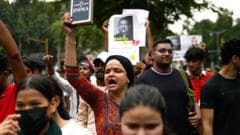
Police block thousands of 'cockroach' protesters marching on India's parliamentImage source, Getty ImagesImage caption, Tens of thousands of people attended Monday's protestsByGeeta PandeyZoya Mateen and Azadeh MoshiriReporting fromDelhiUpdated 3 minutes agoThousands of supporters of the Cockroach Janta Party (CJP), a youth-led protest movement seeking education and employment reforms, defied a police ban and tried to march on parliament to demand India's education minister resign.Police wielding canes used tear gas to disperse crowds in central Delhi. Several demonstrators said they were injured in the cane charges. Police did not comment. Some in the crowd threw stones, reports said. The march followed weeks of protests over alleged exam paper leaks and accusations of a wider education system crisis.The movement has broadened into one of the most visible expressions of public dissent against Prime Minister Narendra Modi in recent years.Image source, Getty ImagesImage caption, Clashes were reported between the police and protesters in some placesIt gathered fresh momentum over the weekend after police forcibly moved activist Sonam Wangchuk into hospital on the 21st day of a hunger strike in support of the movement. His wife says his fast continues. On Monday, Wangchuk appealed to doctors to discharge him so he could join the march but was not allowed.The movement takes its name from a remark by India's chief justice, who drew criticism after comparing sections of unemployed young people to "cockroaches" during a court hearing. Although police had made clear protesters would not be given permission to march to parliament, tens of thousands of students, parents, teachers and professionals gathered from early morning at Jantar Mantar, a 300-year-old observatory in central Delhi, and remained there despite heavy rain.It remains unclear whether the CJP will call off its protest or try to continue the sit-in. By late evening police had completely dismantled the protest site.The contrast between it and the security outside was striking. Young people draped in Indian flags queued for food, painted placards and posed for photographs, while rows of police and paramilitary personnel sealed every road to parliament around them.Volunteers handed out food and water, patriotic songs blared from loudspeakers and organisers repeatedly urged supporters not to confront police if they were stopped.Image source, Getty ImagesImage caption, The protest march began from Jantar Mantar, where thousands have been camping for weeksAs the march began, protesters spilled onto the streets before being halted at successive barricades. Many sat on the road waving flags and shouting slogans. Others broke away in smaller groups, trying to reach parliament through narrow side streets.Inside parliament, meanwhile, the opening day of the monsoon session was repeatedly adjourned as opposition MPs protested over the alleged paper leak and other issues.As police pushed back groups trying to breach the barricades, the first reports of injuries began to emerge.Some protesters returned to Jantar Mantar bleeding from the head or limping, while others were carried back by fellow demonstrators. Authorities also suspended mobile internet services in parts of central Delhi, leaving many without reliable access to messaging apps or social media.Image source, Getty ImagesImage caption, There was heavy police deployment, with barricades and personnel stopping protesters from marching"We've treated at least 10 people," volunteer doctor Gaurish Batra told the BBC while bandaging the head of a man whose shirt collar was soaked in blood. A woman with a suspected broken leg was also brought in for treatment.Both alleged they had been injured in police baton charges. The BBC has contacted Delhi Police for comment.By early afternoon, two CJP representatives met Health Minister JP Nadda after waiting outside his residence for about two hours. According to CJP spokesperson Saurav Das,

Protestors rally for healthcare for transgender people at a march in June 2025 in Manhattan. NPR has learned the Trump administration shelved a plan to cut off all Medicare and Medicaid funding to any hospital that provided gender-affirming care to minors.
Erik McGregor/LightRocket via Getty Images
hide caption
toggle caption
Erik McGregor/LightRocket via Getty Images
The Trump administration is abandoning its most aggressive attempt to end gender-affirming care for youth nationally, according to an official document obtained by NPR.
The document shows that the Department of Health and Human Services will not be finalizing a proposed rule that would have blocked all Medicaid and Medicare funding for hospitals that provide pediatric gender-affirming care. The Centers for Medicare and Medicaid Services and the Department of Health and Human Services did not immediately respond to a request for comment.
The fact that the Trump administration is backing off from this action is "a victory for people who are defending the rights and interests of trans people," says Sam Bagenstos, a professor at Michigan Law who served as general counsel at HHS under the Biden administration. "But I don't think it indicates a more general retreat from the aggressive posture of the Trump administration."
Bagenstos notes that this type of leverage — a "conditions of participation" rule for the Medicare and Medicaid program — has historically been used by HHS to compel states and hospitals to meet basic health and safety standards. Things like "making sure that you have stockpiles of certain kinds of equipment, making sure that you have certain kinds of emergency protocols, making sure that you have certain staffing ratios," he explains.
The proposed rule was unprecedented, Bagenstos says, because it instead would have prohibited certain kinds of treatments for a certain population. He says it seemed unlawful in a variety of ways. For one, "it violates the Medicare Act, which says that Medicare and Medicaid can't be used to control the practice of medicine within the state — states get to regulate the practice of medicine," Bagenstos says.
Normally, HHS would propose a rule, accept public comment for 60 days, and then finalize the rule so that it could take effect. In this case, after proposing the rule in December and receiving more than 30,000 comments, the administration is abandoning the rule. At least in the next year, it will not be finalized and will not take effect.
The American Medical Association and the Children's Hospital Association both submitted comments urging the agency to rescind or withdraw the proposed rule. Major U.S. medical groups say that puberty blockers and sex hormones are safe and can be effective for transgender young people.
Even so, gender-affirming care for youth is banned in 27 states after a flurry of laws passed over the last several years. In the remaining 23 states, many hospital clinics that offer gender-affirming care have continued to operate, while others have shuttered in the past year citing pressure from the Trump administration.
That pressure has come in the form of this proposed rule, another rule that would bar federal Medicaid reimbursement for transgender pediatric patients, and a declaration from Health Secretary Robert F. Kennedy Jr. that aimed to redefine the standard of care. (Interestingly, the press release issued when those actions were unveiled in December is now missing from the HHS website, as is the Kennedy declaration document.)
The Medicaid rule is currently in the final stage of review and appears to be on track to take effect in the coming weeks. A coalition of Democratic-led states sued over the so-called Kennedy declaration and succeeded in blocking it in federal court in Oregon. The Trump administration has not appealed that decision so far.
At the same time, the Department of Justice has issued administrative and criminal subpoenas to hospitals seeking full personal medic

Police respond to an active shooter at the Salsa on St. Clair event in Toronto, Saturday, July 11, 2026.
Keito Newman/The Canadian Press
hide caption
toggle caption
Keito Newman/The Canadian Press
At least two people are dead and at least four people are injured after a shooting at a festival in Toronto on Saturday night.
Toronto Police Service Deputy Chief Frank Barredo said Saturday night that gunfire was exchanged between two people at Salsa on St. Clair festival, an annual two-day event celebrating Latin culture held in Canada's biggest city.
Two firearms were recovered and police are working through at least three crime scenes, Barredo told reporters on Saturday. At least 13,000 people were attending the festival when the shooting occurred and no arrests have been made.
"This seemed to be an exchange of gunfire between individuals targeting each other – obviously, indiscriminately putting vast numbers of people in great danger," Barredo said during a press conference Saturday night.
Organizers of the festival said in a statement they are "shocked and deeply saddened" by the shooting.
"Our thoughts and prayers are with the families of the two people who were killed, those who were injured, and everyone affected by this senseless violence," they said in a statement on their website. "Due to the complex police investigation at the scene, we understand that the festival will not resume today, Sunday, July 12."
Canadian Prime Minister Mark Carney on Saturday said he is "horrified" by the shooting.
"My prayers are with the families grieving their loved ones, those who are in critical condition, and everyone who has been affected by this horrific event," Carney wrote on social media. "Police have my full support as they work to apprehend the perpetrators and bring them to justice."
Fatal shootings are rare for Canada's largest city, which has strict gun laws and historically less gun crime. The city has seen an increase in gun violence in recent years, which has been connected to gang activity. At least 33 shootings have occurred in Toronto this year, according to Toronto police data as of July 5.

Argentina forward Lionel Messi controls the ball during the World Cup quarterfinal between Argentina and Switzerland in Kansas City on Saturday.
Odd Andersen/AFP via Getty Images
hide caption
toggle caption
Odd Andersen/AFP via Getty Images
KANSAS CITY, Mo. — This was not the first time Argentina had come to the brink in this FIFA World Cup.
First, the defending champions needed extra time to escape Cape Verde, the Cinderella story of this tournament. Then, they needed a miraculous comeback to overcome a 0-2 deficit to Egypt in the Round of 16.
In Saturday's quarterfinal in Kansas City, the Albiceleste stood on the edge once again, trapped in a 1-1 tie for much of the second half and extra time against a feisty Switzerland team that would not lie down — even once they were playing down a man and a loss seemed inevitable.
In the end, after 30 minutes of extra time, Argentina prevailed 3-1 to earn a spot in the World Cup semifinals. They will face England (which also needed extra time Saturday to defeat Norway) on Wednesday in Atlanta.
Of the 69,045 people who packed into the stands of Arrowhead Stadium on a hot and humid Missouri night, thousands wore the jersey of the sport's singular star: Lionel Messi, the 39-year-old forward for Argentina.
But it was forward Julián Alvarez who saved the day for his team and his country, sending a right-footed rocket to the far upper corner of the goal in the 112th minute. Then, in the 121st minute, a cherry on top from Lautaro Martínez sealed the game.
Messi contributed only an early-game assist. He had scored a goal in a record nine straight World Cup games — this is his first game in 10 matches in which he did not.
Switzerland's midfielder Remo Freuler (L) and Argentina midfielder Alexis Mac Allister fight for the ball during the World Cup quarterfinal in Kansas City on Saturday.
Juan Mabromata/AFP via Getty Images
hide caption
toggle caption
Juan Mabromata/AFP via Getty Images
Alvarez's goal capped an increasingly desperate effort by Argentina to keep the game from going to penalty kicks. It had taken an early 1-0 lead in the 10th minute, when midfielder Alexis Mac Allister headed a Messi corner kick into the net. (That was Messi's 10th career World Cup assist, all of them to different players.)
Yet Argentina could not add to that lead in the first half, or the second. Instead, a clinical and determined Swiss side found enough gaps in Argentina's defense to threaten repeatedly, before finally forward Dan Ndoye slipped a shot under the leg of Swiss goalkeeper Gregor Kobel to tie the match 1-1.
But soon after Switzerland's equalizer came the game's pivotal development: Swiss forward Breel Embolo was sent off after a video review showed he had faked a fall.
It was Embolo's second yellow card of the game — the first had come late in the first half when he was late to challenge Argentinian midfielder Leandro Paredes — meaning it would be treated as a red card, and Switzerland would have to play the remainder of the game down a man.
The shocked and crying Embolo had to be led off the field, his face crumpled and head in hands, by teammates and into the locker room.
Instantly, the decision sparked debate among analysts and fans. Were both calls fair, and the outcome an acceptable consequence? Or was dooming Switzerland to a shorthanded quarterfinal a punishment that did not match the crime of a single theatrical fall to the ground, something that happens a dozen times a game?
But no debate will keep Argentina from another World Cup semifinal. And for Messi, that means two more chances — the semifinal against England, then either the final or the third-place playoff — to pad his lead in the record for career World Cup goals scored, at 21.

A United States federal court has dismissed the seditious conspiracy cases against four members of the Proud Boys, the far-right group involved in the attack on the US Capitol on January 6, 2021.On Friday, Judge Timothy J Kelly, an appointee of President Donald Trump, granted the government’s motion to dismiss the case with prejudice, meaning it cannot be revived in future.Recommended Stories list of 3 itemslist 1 of 3Trump issues two pardons related to investigation into January 6, 2021 riotlist 2 of 3Witnesses contest the Trump administration’s account of Texas ICE killinglist 3 of 3Trump administration subpoenas New York Times reporters over coverageend of listBut Kelly made it clear that the defendants — Ethan Nordean, Joseph Biggs, Zachary Rehl and Dominic Pezzola — had been “convicted of serious offences”.He wrote in his seven-page ruling that his decision was ultimately rooted in the separation of government powers, not in the merits of the case.“As the Court has said many times, the attack on the Capitol on January 6, 2021 was a perilous event. It was an attack on people, including police officers, many of whom were injured,” Kelly wrote.“It was an attack on the Constitution’s mechanism to facilitate the peaceful transfer of power from one president to the next,” he added.Inside the January 6 riotFriday’s ruling was yet another milestone in Trump’s efforts to end the prosecution of January 6 rioters.The attack on the Capitol came shortly after Trump lost his bid for re-election in 2020 to Democrat Joe Biden. But in the aftermath of his loss, Trump spread false claims that the election had been rigged.January 6, 2021, was the day Congress was scheduled to certify the Electoral College votes, confirming Trump’s defeat.His vice president at the time, Mike Pence, held a ceremonial role overseeing the certification that day. But behind the scenes, Trump reportedly pressured Pence to reject the results of the election.At midday, Trump held a “Save America” rally in front of the White House, repeating to his supporters that he had won “by a landslide”.“If Mike Pence does the right thing, we win the election,” Trump said at one point. At another, he said, “If you don’t fight like hell, you’re not going to have a country anymore.”Afterwards, some of his supporters marched to the Capitol and broke into the building, attacking police officers and causing millions of dollars worth of damage. Participants signalled their aim was to stop the vote certification, with some chanting, “Hang Mike Pence.”The attack proved to be deadly. One rioter was shot by police as she climbed through a broken window to enter the House Speaker’s Lobby. An officer died from a stroke the following day after being beaten. Others died by suicide after the attack. Members of Congress had to be led to safety.Under the Biden administration, the Department of Justice opened criminal cases against nearly 1,600 people involved.But Trump has long defended the rioters and called their prosecution a “national injustice”.Trump himself faced two criminal indictments — one at state level, the other federal — over his alleged attempts to subvert the election results, though the charges were dropped upon his re-election in 2024.Unravelling the prosecutionsCalling the January 6 prosecutions an example of government “weaponisation”, Trump had campaigned during the 2024 race on a promise to pardon the rioters.He followed through with that pledge on the first day of his second term. On January 20, 2025, Trump signed an executive order granting “a full, complete and unconditional pardon” to most of the defendants involved in the Capitol attack.Trump also commuted the sentences of 14 people, including Nordean, Biggs, Rehl and Pezzola. Under his authority, the Department of Justice also proceeded to seek the dismissal of ongoing January 6 cases.Judge Kelly cited that series of events in Friday’s ruling, though he appeared to express a measure of scepticism.“No one should mista

Mirjahan Choudhury receives a free eye screening at the Rangia Post office in India.
Subhamoy Bhattacharjee for NPR
hide caption
toggle caption
Subhamoy Bhattacharjee for NPR
In recent years, Sangita Kalita has watched as her mother and mother-in-law go to the local temple — called a naamghar — in Assam State, India and leave disappointed.
Each visit, their hope was to read the sacred Hindu texts, "but due to vision issues, they faced a lot of problems recognizing the small letters in the book," explains Kalita.
According to the World Health Organization, they are among more than 800 million people worldwide who suffer from presbyopia — age-related loss of close-up vision — for which basic reading glasses would help. Yet, according to WHO, in many lower-income countries, fewer than one in four people who need eyeglasses have them.
Kalita says for her family, getting reading glasses was simply too complicated and expensive. While in many high-income countries, readers are available in all kinds of stores, in lower-resourced settings, getting a pair often requires a trip to the hospital or a specialized optical shop, usually in a big city.
Kalita is trying to change that.
In northeastern India, she's part of a team testing a new effort to address the challenge of getting vision care in remote areas. The idea involves the country's massive network of post offices.
A quick eye test in an unusual place
Kalita used to be a school teacher. Now, she spends her days at a red and white kiosk that's against the bright white walls of the post office in the town of Rangiya.
From that vantage point, she watches as customers come in. Some are there to mail packages while others use a wide variety of services offered in Indian post offices, such as opening and accessing small savings accounts. Kalita notices how they go about their task.
"A lot of old people come in who are not even able to fill out the deposit form," she says.
When she sees them struggling, that's when she steps in. She approaches, asking if they'd like a quick eye test. If so, she invites them to the kiosk where the words "get a free eye-screening and high-quality eye glasses here" are written at the top. After they work through a few simple tests in a spiral bound book, Kalita can tell if they need reading glasses. And if they do, they walk out with a free pair.
Sangita Kalita, an eye screening volunteer, helps clients at the Rangia Post office.
Subhamoy Bhattacharjee for NPR
hide caption
toggle caption
Subhamoy Bhattacharjee for NPR
The idea for this model came from a partnership between WHO and the Universal Postal Union or UPU. "With an estimated 680,000 post offices operating globally, postal services offer a unique opportunity to reach remote and underserved areas," the report explains.
The plan was to tap into the world's largest postal network — India Post has over 150,000 offices.
"The whole thinking was that we look at an established channel, which has a reach, which has infrastructure, which has people," says Shweta Verma, deputy director for programs and operations at VisionSpring India.
Under a pilot program run by VisionSpring, Verma says, between December 2025 and May 2026, more than 5,000 people were screened in five post offices in Assam State.
Verma says 80% of those who received glasses were first time wearers. That "tells us that there was no screening or program for eye health" in the area prior to the pilot, she says.
Convincing skeptics
Getting reading glasses can make a big difference for a person's income, in addition to making every day tasks easier. That's especially true in Assam State, a region known for tea production.
A study published in The Lancet Global Health found that reading glasses increased tea pickers' productivity by almost 22% since they need to see which leaves to pick and are paid based on the quality of their harvest.
Over the course of the post office pilot, Verma says, they've had to earn the suppo


Discussion (0)