
Loading dispatches...
← Return to NewsroomWorld
Kim Jong Un was meant to be their only idol - then North Koreans discovered K-pop

Figure caption, Watch: Songs that changed how some North Koreans saw the worldByHyojung KimBBC KoreanReporting fromSeoulOn a sunny Saturday in June, Lee Yeon-su took the day off from work and hopped on a train from Seoul to Busan for yet another concert by pop supergroup BTS.It was her third time in as many months. She had been in the crowds that poured into central Seoul in March, when the septet launched their comeback - but the stage was too far away. In April, on the first day of their world tour, the rain poured down, drowning out the singers' voices. But this time in Busan, it was "incredible"."Every time I come to a BTS concert, I realise how happy I am that I can like and support someone of my own free will," Yeon-su, which is not her real name, says. "That would have been unimaginable in North Korea."That's where she was born, in the so-called Hermit Kingdom, just north of the heavily fortified border with South Korea. The outside world was out of reach, cut off by a regime built on fear, surveillance and loyalty."You had to be selected to attend events and if you weren't, you had to stay home with your curtains closed."Now in South Korea, she can decide who to cheer for and how. In Busan, alongside a vast fandom, she screamed, jumped and sang at the top of her lungs, especially for her old favourites, the high-octane Fire and hip-hop hit Mic Drop.BTS blew up streaming records when it dropped Dynamite in 2020 - a disco-flecked track to cheer up a Covid-weary world, the band said. It caught North Korea's ear despite being the group's first fully English single."I didn't understand the lyrics, but the melody was so good, it made you feel excited. Everyone followed along," Gyu-ri, 26, says.At that time, she was living in Kyongsong, a coastal county in the North, where families could pick up TV signals across the water with an antenna. When reception was good, they watched weekend shows in which K-pop idols competed, all colourful hair and slick moves."Everything was shocking. I thought they were Korean like us, but they looked very different
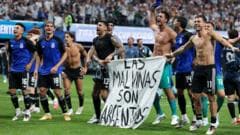
Before the last-four tie, Argentina manager Lionel Scaloni had said he was "not going to mix" football and politics."The reality is that this is a football match. I can't mix things up, especially out of respect for what happened so many years ago," Scaloni had said."It was a very sad period in our history, and there isn't much we can do about it, that's the reality."Things are happening elsewhere in the world, and we criticise the existence of war. We certainly remember those people, of course. But it is a football match - we shouldn't confuse the two."Argentina vice-president Victoria Villarruel, however, cited a chant which the players sang following their dramatic 3-2 win over Egypt in the last 16 which referenced the Falklands and Argentina greats Diego Maradona and Lionel Messi."This is not just another match. I'm not going to be politically correct - against the English, it's always something more," wrote Villarruel in a post on X., external "It's the Malvinas, it's Diego, it's Leo's last one, and it's about putting the invaders in their place."Long live Argentina! Because until our very last breath, we will reclaim what is ours!"The semi-final, which England lost to late goals from Enzo Fernandez and Lautaro Martinez, was held under increased security measures because of the historical tensions between the two nations.

Lionel Messi, Jude Bellingham and Harry Kane will be among the stars on show during Wednesday’s match in Atalanta.The latest chapter in one of world football’s biggest rivalries will be written on Wednesday as England and Argentina clash in the World Cup semifinals in Atlanta.It’s certain to be a hotly contested encounter with the two nations facing each other for the first time in 21 years.Recommended Stories list of 4 itemslist 1 of 4Jude Bellingham Station unveiled ahead of World Cup semi-finallist 2 of 4Mexico: Football Without Fearlist 3 of 4Why the England shirt feels complicated for some fans this World Cuplist 4 of 4FIFA, Infantino, to examine 64-team World Cup for 2030 tournamentend of listSome of the biggest names in world football will be in action, including Lionel Messi, Jude Bellingham and Harry Kane.Here’s a closer look at the key players who could decide Wednesday’s semifinal.England’s Jude Bellingham celebrates after the match as England qualify for the semifinals of the World Cup [Paul Childs/Reuters]Jude BellinghamWorld Cup 2026 statistics: Goals: 6 Assists: 1 Minutes played: 574 The Real Madrid star has been a pivotal player for England at this tournament, scoring several crucial goals to drag the Three Lions to the semifinal stage.He scored twice in Miami on Saturday as England came from behind to beat Norway and also grabbed a brace during a brutal Round of 16 tie against Mexico.Those goals mean he is the first player to score twice in consecutive knockout matches at the World Cup since Diego Maradona in 1986.The 23-year-old is certain to have a big part to play in Wednesday’s crunch encounter.England’s Harry Kane during England’s quarterfinal against Norway in Miami [AFP]Harry KaneWorld Cup 2026 statistics: Goals: 6 Assists: 1 Minutes played: 627 The Russia 2018 Golden Boot winner is in the hunt to win the award for an unprecedented second title after another prolific tournament.Kane scored twice in England’s opening match against Croatia and repeated that feat in their first knockout match against DR Congo. He also scored a crucial penalty against Mexico at the Azteca Stadium.Kane struggled in the Miami heat against Norway on Saturday, but he’s returning to the air conditioned comforts of Atlanta – the venue where he scored a brace against DR Congo.England’s all-time leading World Cup goalscorer will be a real concern for Argentina heading into Wednesday’s tie.England’s Anthony Gordon celebrates their first goal against Norway [Dylan Martinez/Reuters]Anthony GordonWorld Cup 2026 statistics: Goals: 0 Assists: 3 Minutes played: 327 After signing for Barcelona from Newcastle on the eve of the World Cup, there was plenty of focus on Anthony Gordon in England’s early matches.He started the tournament slowly, but the left winger has come alive during the knockout stages and set up Jude Bellingham for England’s opener against Norway on Saturday.He also won a penalty in Mexico City, as England went 3-1 up against cohosts Mexico.Argentina’s Lionel Messi before the Switzerland clash [Agustin Marcarian/Reuters]Lionel MessiWorld Cup 2026 statistics: Goals: 8 Assists: 2 Minutes played: 608 The Argentinian legend has played a vital role for his country at this tournament, scoring eight goals and setting up two more as the defending champions marched into the last four.He started the tournament in fine form, scoring a hat-trick against Algeria in Argentina’s opening game.He’s since netted against Austria, Jordan, Cape Verde and Egypt.Messi has never faced England before and will be desperate to follow in the footsteps of Diego Maradona and knock Argentina’s fierce rivals out.Argentina’s Lautaro Martinez celebrates scoring their third goal against Switzerland [Agustin Marcarian/Reuters]Lautaro MartinezWorld Cup 2026 statistics: Goals: 2 Assists: 1 Minutes played: 347 The Inter Milan forward put the icing on the cake on Saturday, scoring the third goal for Argentina at the end of extra time as the South American giants

Lamine Yamal insists he would take no fear into Spain’s World Cup semifinal against France when both sides meet after he celebrated his 19th birthday.The Barcelona prodigy raised eyebrows following Spain’s 2-1 quarterfinal defeat of Belgium last week after being quoted as saying that France rather than Spain ought to be “afraid” given recent defeats against La Roja.A relaxed-looking Yamal addressed those comments as he spoke to reporters on Monday at a press conference.“I was asked if I was afraid of France, and I said no,” Yamal explained. “We are European champions. It’s simply football,” the teenager explained.Yamal said he had marked his 19th birthday by buying a chunky jewel-encrusted necklace he wore to his press conference. The real birthday present, though, would be a place in Sunday’s World Cup final.“I haven’t received many gifts yet. The best gift would be a win on Tuesday and a trip to New York,” he said.While other stars at this World Cup have been in blistering goal-scoring form, Yamal so far has only found the net once during the tournament – but is ready to add to his tally against France.“I don’t focus on goals, but it’s always special to score in a match like this. I accept the challenge. That’s why I came here,” Yamal said, promising a “beautiful match for the spectators”.“It’s the game everyone was waiting for,” he added.While acknowledging the momentous nature of Tuesday’s game, Yamal remained laid-back in his approach.“There are far more difficult situations in life than a football match, so I’m calm,” he said. “I don’t feel any extra pressure; I’ll go out and play like always and give my all for the team.”Spain’s players formed a guard of honour for Yamal to celebrate his birthday [Maurio Pimentel/AFP]‘We’ve known each other for a while’Spain coach Luis de la Fuente says his team plan to go on the “front foot” against tournament favourites France when they face off in a heavyweight semifinal showdown.De la Fuente’s Spain will attempt to impose their possession-based game on France in what is shaping up as a gripping clash of styles.While France coach Didier Deschamps insists Spain remain favourites for the World Cup, betting markets overwhelmingly back France to clinch a second title in three attempts.Les Bleus have powered into the last four with a scintillating brand of attacking football based around such talents as Kylian Mbappe, Michael Olise and Ousmane Dembele.But De la Fuente, whose team have beaten France in their last two meetings, is quietly plotting another ambush at the AT&T Stadium in Arlington, Texas on Tuesday.“We’ve already analysed France in great detail; we’ve known each other for a while now,” De la Fuente said.“We faced each other for a few years now, and they have great players, but so do we. We have to put all of our virtues on the table and try to counteract the strengths of the opponent.“And that’s what football is about – the team that strikes a better balance is usually closer to getting the victory.“We’ll have to think about their players. We’ll try to win those duels and will try to be on the front foot during the game, imposing our style.”Spain’s players train at Cotton Bowl Stadium, in Dallas, Texas, US on July 13, 2026 [Albert Gea/Reuters]France ‘far better’De la Fuente, though, is under no illusions about the difficulty of the task facing his side.France, he said, have improved significantly since Spain defeated them 5-4 in a hectic UEFA Nations League semifinal in Stuttgart last year, when the Spaniards led 5-1 before a late French rally. That encounter would bear no resemblance to Tuesday’s game, De la Fuente said.“We’re talking about two very different matches,” he admitted.“Tomorrow is another semifinal. I will just try to repeat the positive scenarios, but there were other details where things weren’t that positive.“We were winning 5-1, and in a few minutes they managed to make it 5-4. So we’re trying to repeat what we did well and the opposite of what we didn’t do w

Italy’s Jannik Sinner beats Germany’s Alexander Zverev 6-7 (7-9) 7-6 (7-2) 6-3 6-4 to claim his fifth Grand Slam.Jannik Sinner was at his clinical best as he successfully defended his Wimbledon title with a bruising four-set victory over French Open champion Alexander Zverev in the final.The world number one recovered from losing the first set in a match largely dominated by serve, eventually wearing Zverev down to secure a 6-7 (7/9), 7-6 (7/2), 6-3, 6-4 win on Sunday.Recommended Stories list of 4 itemslist 1 of 4FIFA, Infantino, to examine 64-team World Cup for 2030 tournamentlist 2 of 4Senegal fire coach Pape Thiaw after disappointing World Cuplist 3 of 4FIFA World Cup 2026: Biggest takeaways from the quarterfinalslist 4 of 4Texas shootout: All to know before France-Spain clash in World Cup semiend of listThe Italian was rewarded for his perseverance in the contest with his first Grand Slam title since lifting the trophy at the All England Lawn Tennis and Croquet Club 12 months ago.Sinner’s fifth Grand Slam crown is just two behind the majors tally of his injured rival Carlos Alcaraz after Sinner notched his 100th match win at tennis’s four biggest events.He hit 58 winners against only 25 unforced errors in three hours and 46 minutes on Centre Court, refusing to buckle against an in-form Zverev, who brought a 13-match winning streak at the majors into the final.Sinner has banished the memories of his shock second-round exit from the French Open at the hands of Juan Manuel Cerundolo, when he blew a two-set lead last month.The closest Sinner came to crashing out of Wimbledon was in the first round when he had to come from behind to beat Miomir Kecmanovic in five sets.It was plain sailing from then on for Sinner, who has become a fearsome force on grass.The 24-year-old now boasts a remarkable 44-3 win-loss record this year after winning his sixth title of the season.Zverev had never even reached the quarterfinals in nine previous visits to Wimbledon, but had been a man reborn in London after finally breaking his Grand Slam duck in Paris.He managed to take a first set off Sinner in seven meetings, but could not kick on to snap a now 10-match losing streak against a seemingly unbreakable rival.Zverev, who was bidding to become the first German man to win the trophy since Michael Stich in 1991, will climb above Alcaraz to second in the Association of Tennis Professionals (ATP) rankings on Monday.Jannik Sinner of Italy plays a backhand against Alexander Zverev of Germany during the Wimbledon men’s singles final [Visionhaus/Getty Images]Zverev saved the only break point of a tight first set dominated by serve as it went to a tie-break.The first 15 points of the breaker went with serve, with both men saving set points, before Zverev clinched with a fizzing forehand winner.There were no break points in the second set as the players again efficiently bludgeoned their way to 6-6, but this time Sinner stepped it up in the tie-break to level the match.Zverev finally created his first break point in the seventh game of the third set, but slipped when Sinner dinked over a drop-shot winner.He clutched his knee and Sinner crossed the net to check on his injured opponent as the crowd held its breath, but the German was helped to his feet by the Italian.Sinner made his move in the next game as Zverev’s serve finally broke down.Zverev threw his racquet angrily across the turf after looping a forehand long on a break point which had seen Sinner lying flat on the turf earlier in the rally.The top seed immaculately served it out to love, sealing a two-sets-to-one lead with an ace.Zverev gamely tried to prolong the contest, but his race was run when Sinner broke for a 4-3 advantage in the fourth set.He wrapped up the title on serve despite a dramatic final game featuring arguably the two best rallies of the match, falling to the turf in celebration after slapping away a forehand winner on his first match point.

Four former champions have qualified for the FIFA World Cup semifinals for the first time since 1990. Argentina, England, France and Spain capitalised on the inexperience of lesser-pedigreed foes to reach the final four.For the Albiceleste, it was an unwise Swiss dive.For the Three Lions and La Roja, opposing goalkeepers spilled rebounds.And Les Bleus benefited from an inexplicable, forward-less, Morocco lineup.Here are the key takeaways from the quarterfinals:France too good for Morocco in 2-0 route in BostonWhat we learned: Nothing works against France, so far.Morocco tried a unique approach to unsettling the French. Mohamed Ouahbi went with a striker-less lineup, which, predictably failed to threaten.Post-match, France’s coach Didier Deschamps said what everyone else in the room was thinking: “I was quite surprised by the starting 11. I tried to understand why [Ouahbi] made these choices, no real forwards.”Part of the reason would have been the absence of injured forward Ismael Saibari, who had a breakout tournament, though the Morocco roster included three other forwards, including Soufiane Rahimi, who entered in the 60th minute. That was just after Kylian Mbappe’s dipping right-footer inside the far post the opened the scoring for Les Bleus.Ouahbi’s reasoning remains a mystery.He might have been hoping for a France own goal, which was narrowly avoided as a Dayot Upamecano shank landed on top of the net. Or perhaps the game strategy was that goalkeeper Yassine Bounou would continue to bail out Morocco, as he did earlier in the quarterfinal tie when he saved Mbappe’s first-half penalty kick, following a two-minute-plus VAR review.France’s Kylian Mbappe celebrates after winning the 2026 World Cup quarterfinal against Morocco at Boston Stadium on July 9, 2026 [Franck Fife/AFP]Spain snatch late winner to see off Belgium 2-1 in Los AngelesWhat we learned: Pau Cubarsi is not in over his head.A Barcelona teenager’s shot led to the deciding goal for Spain against Belgium – but no, it wasn’t wonderkid Lamine Yamal, who was held to a single score in the tournament.With the score even, and superb Belgium goalkeeper Thibaut Courtois on the bench injured, Cubarsi advanced and unexpectedly fired from close to 30 metres out.Reserve keeper Senne Lammens could have been taken by surprise – this was Cubarsi’s first attempt since the first half of Spain’s opening 0-0 draw with Cape Verde on June 15.In any case, the shot handcuffed Lammens (actually, Lammens handcuffed himself), leaving the rebound for Mikel Merino, who converted from close range to score the game winner in the 88th minute.So, no, Cubarsi is not there to generate offense. But the fact a 19-year-old is starting on the Spain back line is significant. Few successful World Cup teams have gone with youthful centre backs, an exception being Italy’s Giuseppe Bergomi, who was 18 when he played in 1982, as a substitute for injured Fulvio Collovati.Cubarsi struggled at times against the Belgians, but was not troubled by imposing substitute forward Romelo Lukaku. Belgium became the first team to score against La Roja in the tournament but the key to Spain’s defending is much less battening it down, but rather Barcelona-style keep-away, and that’s where Cubarsi is most comfortable.Meanwhile, substitute forward Merino is providing close to instant offense, scoring two minutes after entering against Belgium, and five minutes in against Portugal in their 1-0 last-16 victory.What we, and France, also learned is that Jeremy Doku’s double-teaming easily shut down 18-year-old Yamal, which means expect more of the same from Desire Doue in the semifinals.Spain’s Mikel Merino, second from right, scores the match winner against Belgium keeper Senne Lammens in the quarterfinal in Inglewood on July 10, 2026 [Paul Ellis/AFP]England defeats Norway 2-1 in MiamiWhat we learned: First off, Norway still has a lot to learn. Also, don’t believe your eyes when it comes to the World Cup “connected” ball, whose

Argentina's Julian Alvarez (9) celebrates after scoring his side's second goal during the World Cup quarterfinal soccer match against Switzerland in Kansas City, Mo., Saturday, July 11, 2026. Charlie Riedel/AP hide caption toggle caption Charlie Riedel/AP KANSAS CITY, Mo. — Julian Alvarez sent defending champion Argentina into the World Cup semifinals with a long-range strike in the 112th minute against Switzerland, while another goal by Lautaro Martinez with seconds left in extra time only served to make the 3-1 victory look a whole lot easier than it was Saturday night. Alexis Mac Allister also scored off a corner kick from Lionel Messi, helping La Albiceleste gut out another down-to-the-wire thriller and advance to play England on Wednesday in Atlanta. The Three Lions beat Norway 2-1 earlier in the day. Messi's nine-game World Cup scoring streak ended, but his pursuit of a second World Cup title continues. The game swung in the second half on a call sure to rile up critics who believe Argentina has been favored in this tournament. The Swiss had just tied the game on Dan Ndoye's goal in the 67th minute when Leandro Paredes was shown a yellow card for a tackle on Breel Embolo. But video showed the Swiss player falling before the Argentina midfielder made contact with him, and since Embolo received a yellow card earlier in the match, he was sent off and Switzerland left to defend with 10 players. It was the second time a yellow card has been overturned using the "mistaken identity" protocol at the World Cup. The rule allows the video assistant referee to intervene when an incorrect player is shown a yellow or red card.



Discussion (0)