
Loading dispatches...
← Return to NewsroomPolitics
Rural Tech Action Group smart village centres opened
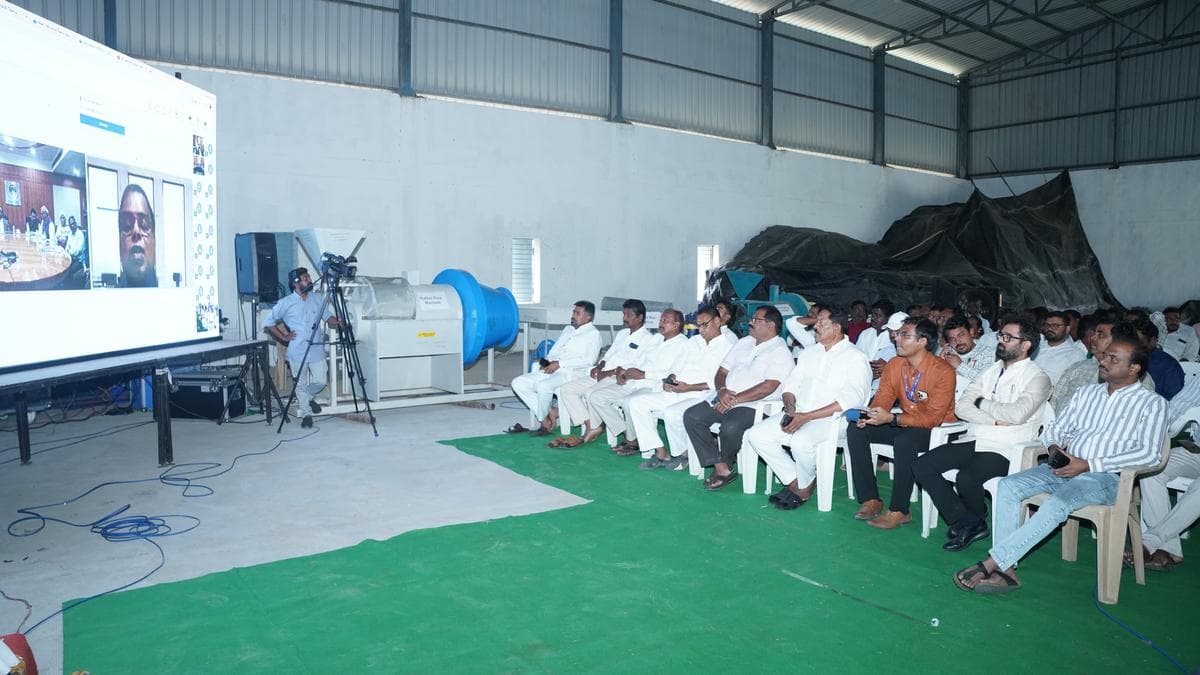
Farmers and rural entrepreneurs participating in the opening of the centres. | While one has been established at the Beerpur Primary Agricultural Cooperative Society (PACS) in Jagtial district, the other one has come up at the Nandanam Farmers Service Cooperative Society (FSCS) in Hanumakonda district.Led by the office of the Principal Scientific Adviser in partnership with NABARD, the initiative aims to convert primary cooperative societies into local technology hubs delivering affordable, need-based solutions for agriculture, value addition and rural entrepreneurship.The RSVC in Beerpur is equipped with agri drones, soil testing device, smart irrigation system, poha and puffed rice processing units, happy seeder and solar sky tubes. The centre in Nandanam features agri drones, cold press oil extraction machinery, smart irrigation device, puffed rice machine, soil testing device and subjee cooler.Together, the centres will serve 20 villages, more than 18,000 hectares of cultivated land and benefit nearly 5,000 farmers and cooperative members. The initiative is poised to generate employment opportunities for rural youth through activities such as drone operations, machinery handling, processing and service delivery.Principal Scientific Adviser to the government of India Ajay Kumar Sood, Secretary (Agriculture and Cooperation) to Telangana government K.Surendra Mohan and NABARD chairman Shaji K.V. participated in the virtual inauguration of the centres, the bank said in a release on Wednesday. Published - June 24, 2026 06:56 pm IST

People staging a protest outside the Deputy Commissioner’s office in Faridabad on Monday. | According to the protesters, the Municipal Corporation of Faridabad (MCF) and the district administration demolished hundreds of homes and places of worship in Nehru Colony, a 70-year-old settlement, on the intervening night of May 29 and 30 while residents were asleep.Led by Centre of Indian Trade Unions (CITU) leaders, the demonstration was part of an ongoing sit-in by the ‘Nehru Colony Bachao Sangharsh Samiti’ outside the Municipal Commissioner’s office since June 15. Organisers said the protest followed a week-long campaign across affected colonies.‘No prior notice’Residents said no prior notice to vacate was issued and thousands of homeowners received verbal threats to move out. Multiple families said they possessed ration cards, Aadhaar cards, electricity meters, voter IDs and family IDs, and that several generations had lived in the colony for decades.The MCF issued a formal notice on June 2, three days after the demolitions began. The notice cited metro railway infrastructure work as the reason for demolition drive and stated that land from “120 feet on the culvert side to 160 feet on the mosque side” must be cleared within a week for a metro station. It added that action would follow the Land Acquisition, Rehabilitation and Resettlement Act, 2013, with compensation and resettlement for affected families.Protesters questioned why the notice was issued after the demolitions and why it mentioned only a specific section while verbal orders allegedly forced the entire colony to vacate. They also raised concerns over the cutting of water and electricity supplies and the imposition of a ban on public gatherings under Section 163 of the Bharatiya Nagarik Suraksha Sanhita.‘Blatant disregard’CITU leaders said land acquisition for any project required timely notices, compensation assessment, and stakeholder dialogue, with rehabilitation arranged before demolition in residential areas. “The demolition of houses and religious sites in Nehru Colony blatantly disregards these legal norms,” said CITU Haryana general secretary Jai Bhagwan, adding that residents in dozens of other colonies faced similar threats.Protesters alleged that the drive aimed to free prime land for “specific ruling party leaders and property dealers”, displacing lakhs of people. “Homes built through the blood, sweat, and toil of thousands of families are being destroyed. Families are living under the open sky or in tents by the roadside, with schools about to reopen,” one of the protesters said, preferring anonymity.Letter to CMAfter the protest march to the Deputy Commissioner’s office, protesters submitted a memorandum to Haryana Chief Minister Nayab Singh Saini demanding the immediate halt of demolitions of houses, shops, and religious places in Nehru Colony and other Faridabad colonies, compensation and in situ rehabilitation for families whose homes and shops were demolished, and compensation and re-establishment of demolished religious sites.The protesters also demanded a judicial inquiry into the bulldozer drive and legal action against those who ordered and executed it, immediate restoration of water and electricity in Nehru Colony, and better public amenities, including paved lanes, sewerage, primary health centres, and government schools in Nehru Colony and other colonies.Municipal Commissioner Dhirendra Khadgata refused to comment on the matter, saying it was “sub judice”. Published - June 22, 2026 11:16 pm IST
A snake-catcher extracts venom from a cobra. | It not only claims lives but also leaves many survivors with long-term health issues and financial hardship. A pioneering study by a team of scientists on the economic burden of snakebites has revealed alarmingly high levels of long-term illness among survivors.The is due to the delays in receiving appropriate treatment, lack of awareness, and, in many cases, ineffective care. While mortality may appear relatively lower either due to improved access to healthcare or under-reporting linked to social taboos, the findings reveal that nearly one in four victims suffers lasting health complications.The community-based retrospective study, conducted in Jagtial district of Telangana by researchers from the Hyderabad-based CSIR-Centre for Cellular and Molecular Biology (CCMB), highlights the deep and lasting impact of snakebites on agrarian households.Based on interviews with 541 individuals across 205 villages between 2010 and 2020, the study found that 24.21% of victims developed morbidities, while 12.75% died. This translates to a mortality rate of 11.72 and a morbidity rate of 22.8 per one lakh population. Nearly 32 Disability-Adjusted Life Years (DALYs) , a measure where one DALY equals one lost year of healthy life, are lost per 1,00,000 people annually, underscoring the scale of the crisis.The economic burden is equally severe. The average annual loss in income due to reduced earning capacity is estimated at ₹26,528.60 per person while mortality-related losses exceed ₹19.83 lakh per individual. These figures reflect not just lost wages, but also the destabilising impact on families dependent on working-age adults, particularly men engaged in farming, said CCMB-LaCONES chief scientist Karthikeyan Vasudevan. Even survivors continue to bear the cost. Many reported long-term physical disabilities, along with psychological effects such as fear, anxiety and insomnia factors not fully captured in economic estimates. The true burden of snakebites is likely much higher than what we have documented, noted Mr. Vasudevan.The study found that most victims were farm workers aged 15 to 59, exposed during routine agricultural activities such as harvesting, irrigation, and manual handling of crops often barefoot or without protective gear. Most bites occurred on the lower limbs, either in fields or around homes where snakes seek shelter.Despite free treatment availability in government hospitals, over 80% of victims sought care in private facilities, incurring high out-of-pocket expenses. Treatment costs varied widely, ranging from negligible amounts to as high as 7 lakh, pushing many households into financial distress.Delayed access to proper treatment remains a critical concern, often caused by long distances to hospitals, lack of transport, and reliance on traditional or faith healers. The study notes that such healers continue to play a significant role in rural healthcare-seeking behaviour. Researchers suggest integrating them into formal reporting systems and encouraging them to refer patients to hospitals promptly.The study also highlights that residents of traditional housing are more vulnerable, and a significant number of victims were unable to identify the snake involved. Among those identified, the Indian cobra (Naja naja) and Russell’s viper (Daboia russelli) were the most common, followed by the common krait and saw-scaled viper.Most bites occurred on the feet and during daytime hours, especially between noon and 7 p.m., often correlating with specific snake species activity patterns. Calling for urgent action, scientists recommend targeted measures such as improved ambulance services and community-level awareness campaigns, stressing the need for a grassroot village-level approach to documenting and addressing snakebite burden.Standardise


Discussion (0)