
Loading dispatches...
← Return to NewsroomPolitics
Debilitating disability: struggles of families of children with chronic disabilities in Kerala

It was a rain-drenched Thursday, and yet there was no let-up in the crowd thronging the corridors of the paediatric outpatient (OP) clinics at Sree Avittom Thirunal (SAT) Hospital, Thiruvananthapuram. Outside one of the clinics sat Vijay*, brooding, scrolling through the picture gallery on his mobile phone.He points to the picture of a young girl, in pigtails, smiling into the camera.“The picture was taken when she was four years old. My little one would hop and skip, hang on to my hand and insist on sitting in front of my bike every time I took her out. Everything changed when she turned five and had to be hospitalised after a seizure,” he says as a lone tear streaks down his cheek.Six-year-old Anusree* is today a ghost of her former self. She is mute, bedridden, on oxygen support at home and is fed through a Ryle’s tube. Last year, she had to be put on ventilator support at the hospital five times. Vijay, her father, who runs a small business, has run up a debt of over ₹50 lakh to treat his only daughter, hoping that someday he can again take her on a bike ride.But her prognosis for cognitive and functional decline due to developmental epileptic encephalopathies with myoclonic seizures is poor.Nilina Jacob*, a Kannur native, has been staying in a rented house in Thiruvananthapuram for two years, alone with her younger daughter aged two years, who suffers from Pompe disease, a rare inherited neuromuscular disorder, and is on continuous oxygen support.She gave up her job, left her eight-year-old son in the care of her family, and came to the city to provide better, more affordable medical care at SAT Hospital. The child requires enzyme replacement therapy, a prohibitively expensive treatment, for survival. She had to be rushed to the paediatric Intensive Care Unit of the hospital several times during the past few months. Yet, Nilina refuses to give up.“It has been financially and emotionally draining. I cannot even sleep at night because I fear that she might stop breathing. My husband is struggling to raise money for the treatment. My son cries over the phone at night because he misses me. The loneliness is terrible at times,” she says, as she breaks into a sob.Lifelong careVijay and Nilina are two representatives of the hundreds of parents who frequent the paediatric palliative clinic at SAT Hospital; people whose lives changed forever when they discovered that their precious child has chronic disabilities requiring lifelong medical care.These parents are exhausted, physically, emotionally and financially. They are caregivers 24×7, sleep-deprived, depressed and for whom a pack of diapers has come to be more valuable than anything else in life.While Kerala takes pride in its low infant mortality rate, one of the lowest in the country, the celebrated Neonatal Intensive Care Unit (NICE) survival rates are now telling the other side of the story — a growing downstream burden of children with neurodevelopmental disabilities, musculoskeletal disorders, congenital deformities and other chronic diseases.Lack of proper follow-upThe rigour of the health system of Kerala in ensuring the survival of every infant has not been matched by investment in ensuring proper follow-up and good developmental outcomes. A child saved in a NICU at 28 or even 24 weeks may go on to live with cerebral palsy, epileptic disorders or genetic conditions for years, while the families bearing that burden remain marginalised and invisible to the system, say medical experts.“Over the years, we managed to bring down infant mortality drastically, but mortality has been replaced by morbidity. The proportion of children with complex, chronic and debilitating conditions has grown exponentially over the decade. Their care requirements are not something families can handle on their own,” observes P. G. Hariprasad, Professor of Paediatrics, SAT Hospital, who runs a speciality OP clinic on Thursdays along with Pallium India, an NGO, which offers palliative care to child
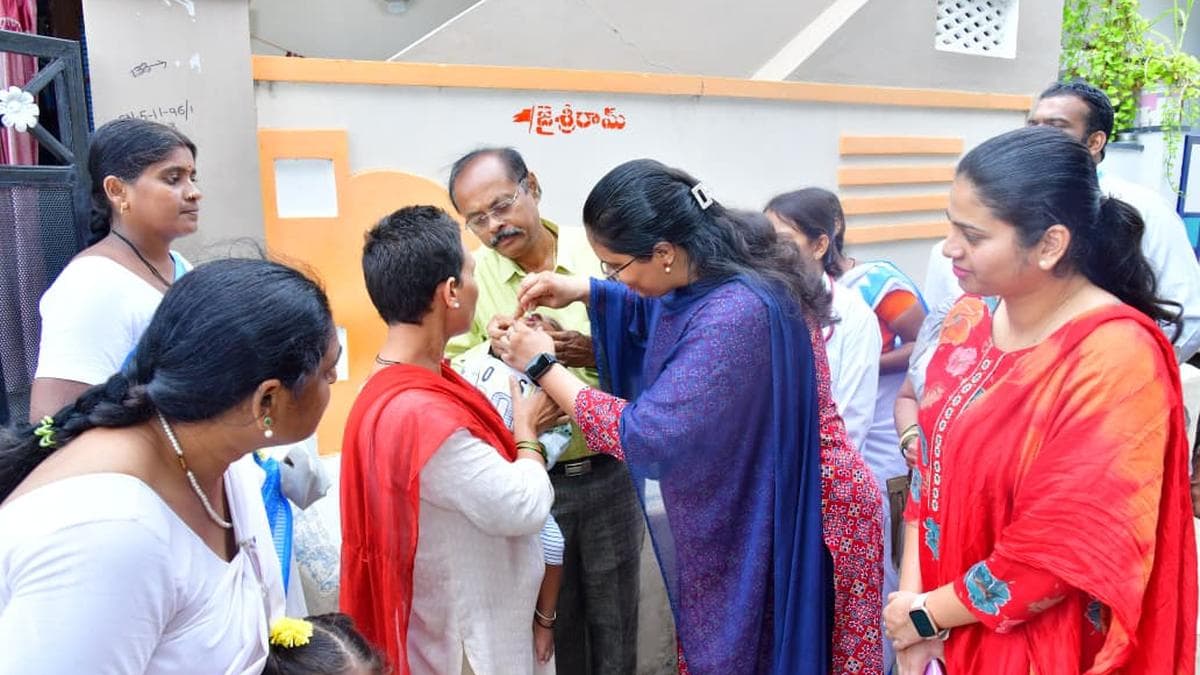
Mahabubnagar District Collector Khushboo Gupta along wioth Health staff participates in door-to-door visits to administer Pulse Polio drops on Monday (June 29, 2026) The Pulse Polio vaccination campaign continued in Telangana on Monday (June 29, 2026) with the State Health department staff conducting door-to-door to administer the vaccine to children below five years who did not receive the drops on Sunday (June 28, 2026). The number of children below five years in the State are estimated to be 40,97,749. On the first day of the campaign, 38,95,550 (95.1%) children were vaccinated, said Sangeetha Satyanarayana, Commissioner of Health and Family Welfare. A total of 22, 979 Pulse Polio booths were set up across the State to administer the vaccine on Sunday, as part of the National Immunisation Day programme.The staff would visit houses to vaccinate the remaining children on Tuesday too, as per a communication from the Health Minister’s office. The Commissioner urged parents to get the pulse polio drops administered to their children. District administrations were engaged in the vaccination programme on Monday. Mahabubnagar District Collector Khushboo Gupta issued directions to administer the polio drops to children between zero to five years of age by conducting house-to-house surveys.“The Pulse Polio Campaign continues across Telangana with dedicated health teams conducting door-to-door visits to ensure that every child below five years receives the life-saving Polio Drops,” as per a post from the Health Minister’s official handle on X.The Pulse Polio Campaign continues across Telangana with dedicated health teams conducting door-to-door visits to ensure that every child below five years receives the life-saving Polio Drops.On Day 1, the State achieved 95.1% coverage, with 3,895,550 children immunized. The… pic.twitter.com/nKi1Josyyf— Office of Minister for Health, Telangana (@TelanganaHealth) June 29, 2026 Published - June 29, 2026 01:52 pm IST
Veteran journalist A. Sajeevan commemorating the Kadalundi rail disaster on its 25th anniversary at Kadalundi on Monday. | In the small coastal village on the Kozhikode-Malappuram border, where the Kadalundipuzha empties into the Arabian Sea, survivors, bereaved families, rescuers and residents came together to mark the 25th anniversary of the Kadalundi train disaster. For many, it was less a commemorative meeting than a reunion of memory.Those who lost loved ones sat alongside those who escaped death. Fishermen who pulled passengers from the river recalled the frantic hours after the accident. Survivors retraced moments they have carried for 25 years.Kadalundi panchayat president O. Bhakthavalsalan inaugurated the remembrance programme. Veteran journalist A. Sajeevan delivered the memorial address. On June 22, 2001, a monsoon Friday evening, the Mangaluru-Chennai Mail crossed Kadalundi station and rolled onto the railway bridge spanning the river. Seconds later, disaster struck.As the train moved across the bridge at around 50 kmph, girders at its southern end gave way. Six coaches plunged into the river below, turning an ordinary journey into one of the country’s most devastating rail accidents. Fifty-two people were killed, and nearly 300 were injured.The screams of passengers echoed across the river as residents rushed towards the bridge. Sand miners working nearby and fishermen from Chaliyam launched their boats into the water within minutes, becoming the first responders long before organised rescue teams arrived. They were later joined by khalasis from Beypore, firefighters and police personnel.Rescue operations continued through the night. Trapped passengers were pulled from twisted coaches after rescuers smashed window bars with crowbars and cut through metal using gas cutters.The images that followed became part of Kerala’s collective memory. Hospitals in Kozhikode and Malappuram overflowed with anxious relatives searching for family members. Many victims were difficult to identify.Among the haunting memories of the disaster is that of an unidentified hand protruding through the window of a partially submerged coach. Visible above the water through changing tides until rescuers cut open the carriage the following day, the image remains etched in the minds of residents.Twenty-five years later, the disaster still raises questions. Railway authorities have never conclusively established what caused the bridge to fail. Competing theories have surfaced over the years, but no explanation has fully resolved the mystery.For Kadalundi, however, the disaster is more than an unresolved investigation. It is a shared memory that continues to bind the village together. On Monday, as survivors, rescuers and families of the victims gathered once again, the tragedy felt less like a chapter from history than a story still being lived. Published - June 22, 2026 11:24 pm IST

Discussion (0)