
Why havent these birds left yet? Thousands of migratory waders are still in Mumbais wetlands | Tentagraph | Tentagraph
Tentagraph
FeedPoliticsTechnologyWorld
Sign In
Breaking
Sacked Ukrainian defence minister calls for presidential election
← Return to Newsroomgeneral

Why havent these birds left yet? Thousands of migratory waders are still in Mumbais wetlands
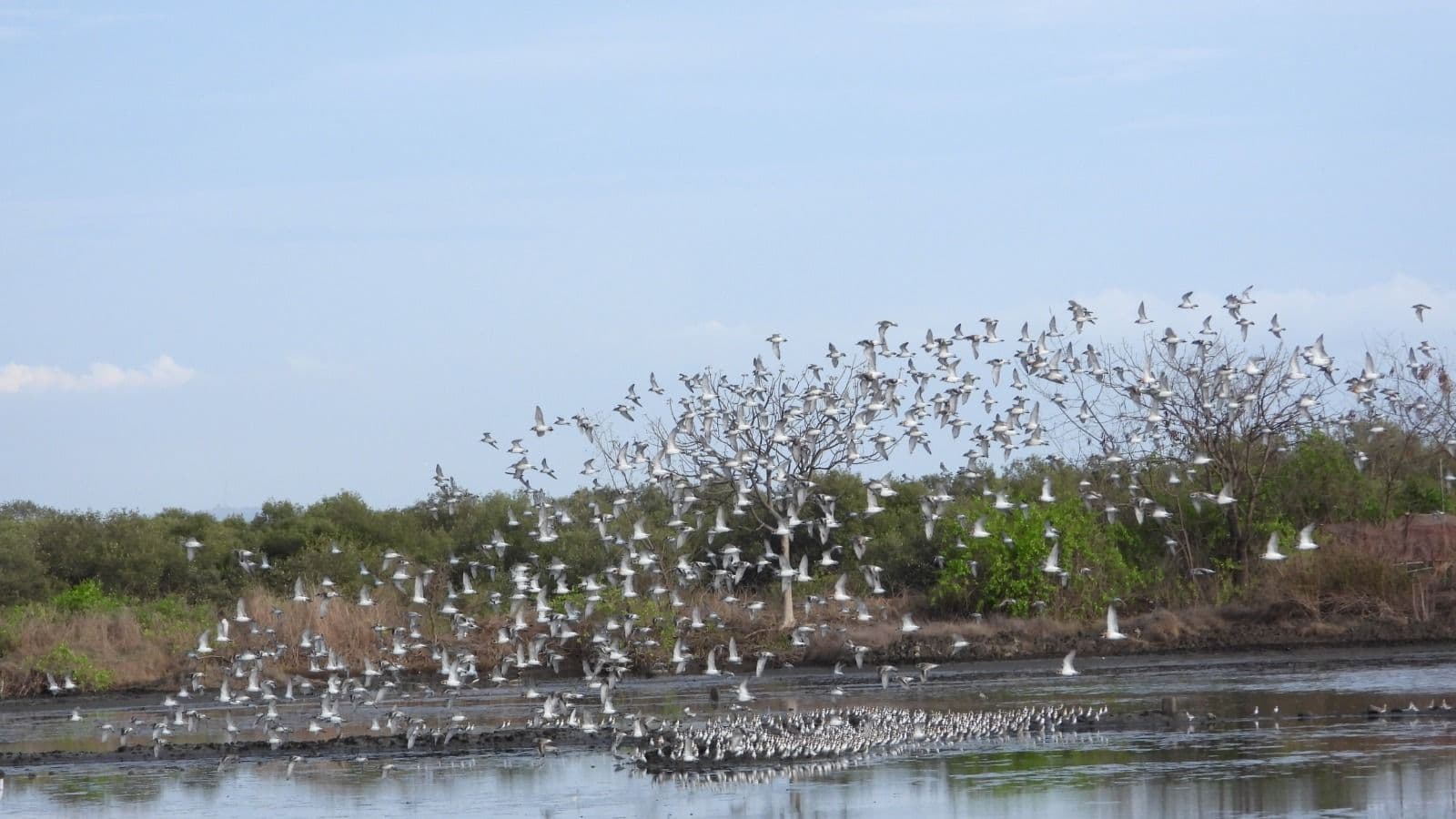
4 min readMumbaiJun 24, 2026 11:25 AM IST Thousands of migratory wader birds are continuing to linger along the Mumbai Metropolitan Region’s coastline well beyond their usual departure window, leaving birders and ornithologists puzzled. Large flocks of Tibetan Sand Plovers, Greater Sand Plovers, Curlew Sandpipers, Ruddy Turnstones and Terek Sandpipers, along with Lesser Flamingoes, were recorded this weekend across the mudflats and wetlands of Thane Creek. Their prolonged stay has coincided with an extended summer and a delayed onset of monsoon conditions.While the presence of flamingoes can be linked to erratic weather patterns, the continued stay of other long-distance migratory waders has surprised experts. “Most of these birds breed in far-flung regions stretching from the Himalayas to the Arctic. By now they should have reached their breeding grounds and many would already be raising chicks,” said Raju Kasambe, ornithologist, Maharashtra state coordinator of the Asian Waterbird Census and founder of Mumbai Bird Katta. During a visit to the TS Chanakya wetland on Sunday, Kasambe counted around 700-800 waders. The majority were Tibetan and Greater Sand Plovers, accompanied by smaller numbers of Curlew Sandpipers, Ruddy Turnstones and Terek Sandpipers. Many of the sand plovers were already in their striking breeding plumage, indicating readiness for courtship and nesting. Adesh Shivkar, founder of the Mumbai Birdwatchers Club, also reported unusually large numbers of migratory waders that appeared to have delayed their departure. Lesser Sand Plovers, Curlew Sandpipers, and a Terek Sandpiper forage in shallow wetland waters. (Photo: Dr Raju Kasambe)According to Kasambe, most waders begin leaving India’s west coast by March, timing their migration with changes in daylight that signal the arrival of spring in their breeding grounds.Story continues below this ad “These birds undertake journeys of several thousand kilometres. The increase in day length acts as a trigger for their return migration. This year, however, many appear to have remained here even after the summer solstice, the longest day of the year,” he said. The birds spend the northern winter in India and begin heading back to breeding grounds across Mongolia, Tibet, China, Central Asia and, for some species, the Arctic regions of Russia, Finland and beyond. The return journey is driven largely by the seasonal availability of insects and other food sources in those regions. Only a small number of old or weakened birds are known to skip migration, Kasambe said, but such individuals do not account for the large numbers being observed this year. The delayed presence of flamingoes is easier to explain, he added. Lesser Flamingoes breed in the Rann of Kutch in Gujarat and their movements are closely linked to water availability.Story continues below this ad “Last year’s monsoon extended well beyond its normal duration, which meant wetlands retained water for longer and the flamingoes stayed back. With the monsoon now arriving, they are likely to begin moving towards their breeding grounds,” Kasambe said. Unlike flamingoes, which can reach Kutch in a single overnight flight, many wader species face far longer journeys that can stretch over weeks. Kasambe believes the delayed monsoon and unusual wind patterns may have played a role in postponing migration, but said the reasons remain unclear. “It is difficult to say why these birds have stayed back for so long. Climatic variations, including delayed monsoon conditions and changes in wind systems that aid migration, may be factors. What we need is long-term data on migration patterns to understand whether climate change is influencing these movements,” he said.Story continues below this ad Ramesh Shenai, India coordinator for Bird Count India, urged caution before treating the sightings as unusual. “Birding activity during the monsoon has increased only in the last couple of years, particularly after the appearance of sev

Reported via Indian Express·June 27, 2026·2 news reports synthesized
Why havent these birds left yet? Thousands of migratory waders are still in Mumbais wetlands
Loading dispatches...
Latest Dispatch
Indian Express·Sat, Jun 27, 2026

Maharashtra bets on AI to solve Konkan’s oldest mystery

Maharashtra bets on AI to solve Konkan’s oldest mystery

The Maharashtra government is making technology meet archaeology by using Artificial Intelligence (AI) to scientifically analyse, classify and interpret the origin and cultural etymology of thousands of prehistoric petroglyphs scattered across the Konkan region, a move that could significantly strengthen India’s bid to secure UNESCO World Heritage status for these ancient sites.The state government has allocated Rs 15 crore for this project, which is estimated to take four years.Petroglyphs are stone carvings of animal figures or humanoids, found in the lateral plateau regions across Ratnagiri and Sindhudurg districts of coastal Maharashtra. The carvings mainly comprise figurines, including turtles, elephants, peacock and rhinoceros. These were discovered throughout a series of expeditions and excavations carried out between 2017 and 2023. According to archaeologists and experts, the origin of these carvings ranges between 20,000 BC and 10,000 BC and is older than the Harappan civilization whose earliest phase dates back to 7,000 BC-5,000 BC. The carvings have an average size of 50 square metres by 20 square metres. Tejas Garge, director at Directorate of Archaeology and Museums, Government of Maharashtra, said that these carvings cover a total area of 150 square kilometres spread across 107 villages in the Konkan region. In 2025, these structures were added to the temporary list of UNESCO world heritage sites in India. However, permanent status is yet to be granted. The state government has now appointed IIT Pravartak — the technology innovation hub of IIT Madras — for carrying out a digital assessment and documentation of these petroglyphs. “These petroglyphs are the earliest evidence of art in the Indian context on such a large canvas. The figurines clearly depict the cognitive ability of human beings to visualise nature and replicate them in the form of these carvings,” Garge told The Indian Express.Story continues below this ad Garge said that among the carvings discovered, there was none depicting horse or bull. It appeared uncanny to the experts initially, since bulls an horses are common in the pre-historic drawings and art forms in the Indian sub-continent where horses arrived between 1,500 and 1,000 BC, while agriculture was introduced during the 9,000 BC, he said.

The petroglyphs were discovered in 2007 by a group of people from Ratnagiri led by local resident Sudhir Risbud (52). (Photo: Directorate of Archaeology and Museums, Maharashtra)“The absence of horse figurines indicated that the carvings were created during the pre-historic era and the absence of bulls established that they were created during the pre-agricultural era. Therefore, it became clear to us that the origin of these carvings dates back to the Mesolithic era or the middle stone age period,” Garge added. Archaeology meets technology The petroglyphs were discovered in 2007 by a group of people from Ratnagiri led by local resident Sudhir Risbud (52). In 2021, Risbud, through a non-profit body Nisarga Yatri, secured funding from the Department of Science and Technology (DST) for documenting these figurines. More than 150 villages were surveyed in the Konkan belt where petroglyphs were found in 107 villages. The initial survey involved photographing the structure and recording the locations and their size. “We started identifying these carvings from 2012 by using our own funds and till date have been able to find out 3,000 such figurines. They are huge in size therefore manual documentation is not possible. High-end drone cameras are needed to carry out proper documentation of these carvings,” Risbud told The Indian Express.Story continues below this ad Now the state has appointed the IITM Pravartak for a scientific assessment of each of these figurines. Speaking with The Indian Express, Shankar Raman, CEO of IITM Pravartak, said that one of the key objectives of the assessment will be to find out the cultural etymology of these carvings. Usually, the

Source:Indian ExpressView original report ↗

Discussion (0)

0/5000

Coverage #1
Indian Express·Wed, Jun 24, 2026

4 min readMumbaiJun 24, 2026 11:25 AM IST

Thousands of migratory wader birds are continuing to linger along the Mumbai Metropolitan Region’s coastline well beyond their usual departure window, leaving birders and ornithologists puzzled. Large flocks of Tibetan Sand Plovers, Greater Sand Plovers, Curlew Sandpipers, Ruddy Turnstones and Terek Sandpipers, along with Lesser Flamingoes, were recorded this weekend across the mudflats and wetlands of Thane Creek. Their prolonged stay has coincided with an extended summer and a delayed onset of monsoon conditions.While the presence of flamingoes can be linked to erratic weather patterns, the continued stay of other long-distance migratory waders has surprised experts. “Most of these birds breed in far-flung regions stretching from the Himalayas to the Arctic. By now they should have reached their breeding grounds and many would already be raising chicks,” said Raju Kasambe, ornithologist, Maharashtra state coordinator of the Asian Waterbird Census and founder of Mumbai Bird Katta. During a visit to the TS Chanakya wetland on Sunday, Kasambe counted around 700-800 waders. The majority were Tibetan and Greater Sand Plovers, accompanied by smaller numbers of Curlew Sandpipers, Ruddy Turnstones and Terek Sandpipers. Many of the sand plovers were already in their striking breeding plumage, indicating readiness for courtship and nesting. Adesh Shivkar, founder of the Mumbai Birdwatchers Club, also reported unusually large numbers of migratory waders that appeared to have delayed their departure.

Lesser Sand Plovers, Curlew Sandpipers, and a Terek Sandpiper forage in shallow wetland waters. (Photo: Dr Raju Kasambe)According to Kasambe, most waders begin leaving India’s west coast by March, timing their migration with changes in daylight that signal the arrival of spring in their breeding grounds.Story continues below this ad “These birds undertake journeys of several thousand kilometres. The increase in day length acts as a trigger for their return migration. This year, however, many appear to have remained here even after the summer solstice, the longest day of the year,” he said. The birds spend the northern winter in India and begin heading back to breeding grounds across Mongolia, Tibet, China, Central Asia and, for some species, the Arctic regions of Russia, Finland and beyond. The return journey is driven largely by the seasonal availability of insects and other food sources in those regions.

Only a small number of old or weakened birds are known to skip migration, Kasambe said, but such individuals do not account for the large numbers being observed this year. The delayed presence of flamingoes is easier to explain, he added. Lesser Flamingoes breed in the Rann of Kutch in Gujarat and their movements are closely linked to water availability.Story continues below this ad “Last year’s monsoon extended well beyond its normal duration, which meant wetlands retained water for longer and the flamingoes stayed back. With the monsoon now arriving, they are likely to begin moving towards their breeding grounds,” Kasambe said. Unlike flamingoes, which can reach Kutch in a single overnight flight, many wader species face far longer journeys that can stretch over weeks. Kasambe believes the delayed monsoon and unusual wind patterns may have played a role in postponing migration, but said the reasons remain unclear. “It is difficult to say why these birds have stayed back for so long. Climatic variations, including delayed monsoon conditions and changes in wind systems that aid migration, may be factors. What we need is long-term data on migration patterns to understand whether climate change is influencing these movements,” he said.Story continues below this ad Ramesh Shenai, India coordinator for Bird Count India, urged caution before treating the sightings as unusual. “Birding activity during the monsoon has increased only in the last couple of years, particularly after the appearance of sev

Source:Indian ExpressView original report ↗

More in general

Top 10 medical universities in Georgia for international students in 2026
Editorial

Top 10 medical universities in Georgia for international students in 2026

India increased LNG imports by 28% in June
تسنیم

India increased LNG imports by 28% in June

Suriyas Vishwanath and Sons cant surpass Karuppu after 5 days, earns Rs 128.60 cr worldwide
Indian Express

Suriyas Vishwanath and Sons cant surpass Karuppu after 5 days, earns Rs 128.60 cr worldwide