
Loading dispatches...
← Return to NewsroomWorld
‘All we see is decay’: Covering the human toll of Venezuela’s earthquakes

La Guaira, Venezuela – The smell of death grows stronger as we climb to the top of a collapsed building on the seafront of Venezuela’s La Guaira, a state that has been decimated by back-to-back earthquakes in June.Al Jazeera correspondent Zein Basravi and I have flown in with the Qatar International Search and Rescue Group to document the fallout from this devastating natural disaster.Recommended Stories list of 3 itemslist 1 of 3‘A nightmare’: Struggling with the aftermath of Venezuela’s earthquakeslist 2 of 3How a son rescued his father from the rubble of Venezuela’s earthquakeslist 3 of 3A quest for closure: In search of the missing after Venezuela’s earthquakesend of listThe fetid smell hangs heavily as the Qatari team, alongside the Syrian White Helmets, attempt to separate a body from a tangle of concrete and tiles, their toil made harder by the intense midday sun.As the buried person is unearthed, stale waves of decay emanate outward, and despite my face mask, I’m forced to suppress a gag and the urgent need to turn away.Since the earthquakes struck on June 24, the death toll has been steadily climbing, currently standing at more than 4,300.As we travelled along the coast of La Guaira to the city of Catia La Mar, that number felt low.Our car picked its way slowly around the debris littering the road. All around us, the surrounding buildings are in unrecognisable states.There are pancaked low-rise houses where roofs now sit directly on top of their ground floors. Taller buildings have collapsed on their sides like slain giants. One large housing complex had its exterior stripped away, displaying the domestic settings once hidden inside. It teetered perilously on buckled columns.An aerial drone shows the collapsed skeleton of a high-rise apartment in La Guaira, Venezuela, on July 4 [Ricardo Arduengo/Reuters]The United Nations has estimated that 50,000 Venezuelans are missing in the wastelands of rubble.Janet Viana, a 72-year-old resident who survived the quakes, is hoping to recover her son. When I met her, she was gazing up at a tower atop a hill by the coast. Its walls had collapsed, and twisted metal, encased in chunks of concrete, had spilt out of its sides.Viana told us that the government hasn’t supplied any assistance or heavy machinery to help recover the bodies inside, including her son. The government informed residents that the building would be demolished in a few days.“I hope I can get my son’s body back before they tear it all down,” she said. “That’s all I hope for. What else can we hope for when there’s been no response?”While the earthquakes have prompted a public backlash against Venezuela’s socialist-run government, supporters have pointed to efforts officials have taken to address the crisis.The Venezuelan military has secured a number of sites in La Guaira, and the government set up an aid station, offering not only food and water, but also medical supplies and hardware, such as helmets, spades, saws, etc.The governor of La Guaira, Jose Alejandro Teran, told us that the government’s response to the earthquakes was immediate and that workers were responsible for rescuing more than 6,000 people from the ruins.But many Venezuelans told us they had to take rescue efforts into their own hands, without the help of the government.When we met 30-year-old Javier Villegas, he was working his way in and out of a building that is leaning as though it could come crashing down at any moment.He said there are about 38 bodies trapped inside, but that the government “won’t send anyone in because they will be at risk”.“Yes, I know they will be at risk, but there are people still in there, and I just don’t understand the humanity of this government,” he said, adding that he has been searching for his aunt every day since the earthquake struck.“I haven’t lost hope that she will be rescued alive. It’s been nine days now, and we still haven’t heard anything,” he said. “All we see is decay, but we’re still fighting to get o
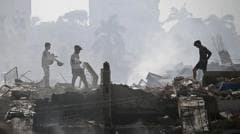
Rescuers are searching through rubble in a rush to save lives after two powerful earthquakes struck Venezuela near the capital, killing at least 235 people and injuring more than 1,500.In Caracas and the nearby coastal city of La Guaira, people could be heard calling for help from under the debris of collapsed buildings.The first 7.2-magnitude quake was followed seconds later by an even stronger 7.5-magnitude one, according to the US Geological Survey (USGS), with both occurring close to the surface, making destruction more severe.Many more people are feared dead, with others left homeless or too afraid to stay in damaged, unsafe buildings sleeping in the streets after the disaster.The earthquakes struck at 18:04 local time (22:04 GMT) on Wednesday - a national holiday in Venezuela, meaning more people would have been at home than on a normal weekday.Both quakes were shallow - the first centred 20.3km below the surface and the second at a depth of 10km, according to USGS.Jorge Rodríguez, the president of Venezuela's National Assembly, reported on Thursday that the death toll had risen, after the country's interim President Delcy Rodríguez declared a state of emergency. Several countries have pledged to help the rescue efforts, with the US promising $150m (£113m) in aid. The US military is sending transport ships and aircraft to support search and rescue teams and "rapid relief operations", it said in a statement.Jorge Rodríguez said 250 buildings had been damaged or lost, mostly in La Guaira, where the BBC verified footage of a 10-storey hotel reduced to rubble. On Thursday, people were searching for loved ones there.Juan Ortiz told the BBC one of his close friends had been confirmed dead, another was believed to be under the rubble, and around 20 people he knew who live in the coastal area were missing."I'm in shock and confusion, and frustrated that I can't help," the medical student in Caracas said.Buildings were also brought down in the capital, Interior Minister Diosdado Cabello said, with Trujillo, Yaracuy, Carabobo, Aragua and Miranda also affected.Mayor Gustavo Duque of Chacao, which forms part of the greater metropolitan area of Caracas, said outside one ruined building on Thursday that 11 people had died there and 23 had been rescued.In a video update posted on social media, he said the team was trying to clear the rubble so that specialists could go in "to reach people who are hopefully still alive"."We're trying to rescue as many people alive as possible," he said.Venezuela's main international airport in Maiquetía on the outskirts of Caracas has been closed due to serious damage, the country's interim president said. Video from inside the terminal showed dust and debris falling from the ceiling.About 250km (155 miles) northwest of Caracas, another verified video showed a multi-storey building, reportedly a hotel, collapsed in Tucacas on the coast.Aftershocks have continued to ripple through the area, with at least 30 recorded after the two earthquakes, Delcy Rodríguez told state-run television channel Venezolana de Televisión.It is likely the death toll will rise further. The USGS said: "High casualties and extensive damage are probable and the disaster is likely widespread."It estimated there was a 42% chance of more than 10,000 deaths and a 33% chance of more than 100,000 as a result of the earthquakes, based on a range of factors including previous, similar quakes and the size of the nearby population.These figures were issued to help the emergency response and are not an exact prediction. They were calculated based on previous earthquakes with similar characteristics, as well and other factors such as the size and depth of each quake.Other elements play into the potential injuries and deaths, including the quality of the buildings and the time of day the quakes hit.Venezuela lies over the meeting point of two tectonic plates and the earthquakes were likely caused by the sudden release of friction between them.
Speaking to Al Jazeera, UN spokesperson Stéphane Dujarric said hundreds of UN staff are supporting the response, adding that recovery efforts are expected to continue for months.Published On 25 Jun 2026



Discussion (0)