
Loading dispatches...
← Return to Newsroomgeneral
Beijing comments on free and open Indo-Pacific, critical minerals

New DelhiUpdated: Jul 4, 2026 01:29 AM IST Japanese Prime Minister Sanae Takaichi waves before departing for Japan after concluding her India visit, at the airport in New Delhi. (@MEAIndia/X via PTI Photo) As Japanese Prime Minister Sanae Takaichi wound up her three-day India visit where New Delhi and Tokyo discussed and advocated a free and open Indo-Pacific, Beijing has said that the concept goes against the shared aspirations of regional countries. On Friday, China’s spokesperson in India, Yu Jing, highlighted the statement made by the spokesperson of China’s Ministry of Foreign Affairs, Guo Jiakun, a day earlier, when talks between Prime Minister Narendra Modi and PM Takaichi were held.“The so-called concept of ‘Free and Open Indo-Pacific’ goes against the regional countries’ shared aspirations for peace, development and cooperation, and will never win genuine recognition,” Guo said in response to a question on Takaichi statement. “Safeguarding post-war international order and purposes and principles of the UN Charter is the foundation of the prosperity and stability in the Asia Pacific, as well as the shared responsibility of regional countries,” he said. Guo added, “It is more imperative than ever for regional countries to uphold the right course of Asia-Pacific cooperation, work together to build an Asia Pacific that is prosperous, stable, open, interconnected, universally beneficial, inclusive, united and mutually supportive.” Meanwhile, in response to Prime Minister Modi’s remarks that India and Japan will strengthen cooperation in the area of critical minerals, Guo said on Friday that such cooperation should not target any third party or undermine its interests. “Still less should such cooperation be used to create exclusive ‘small blocs’ or stoke confrontation under the pretext of cooperation,” Guo said, as per the Chinese State Council Information office.Story continues below this ad He said cooperation between countries should help enhance understanding and trust among regional nations and safeguard regional peace and stability. Maintaining the stability and security of global industrial and supply chains is a shared responsibility of all countries, he noted, adding that all parties should embrace an open and cooperative mindset and play a constructive role to this end. In the joint statement released by India and Japan on Thursday, the two sides had also expressed concern over the situation in the South China Sea and East China Sea. Without making any direct mention of China, they reiterated “strong opposition to any unilateral actions that endanger the safety as well as freedom of navigation and to change the status quo by force or coercion”.Story continues below this ad They shared their serious concerns over the growing militarisation of disputed features, in an oblique reference to China growing military dominance in the region. In another initiative that is aimed at countering China’s growing footprint in Africa, India and Japan discussed the formulation of the Strategic Outlook for Expanding Japan-India Cooperation in Africa. © The Indian Express Pvt Ltd Divya A reports on travel, tourism, culture and social issues - not necessarily in that order - for The Indian Express. She's been a journalist for over a decade now, working with Khaleej Times and The Times of India, before settling down at Express. Besides writing/ editing news reports, she indulges her pen to write short stories. As Sanskriti Prabha Dutt Fellow for Excellence in Journalism, she is researching on the lives of the children of sex workers in India. ... Read More Tags: Beijing Japan
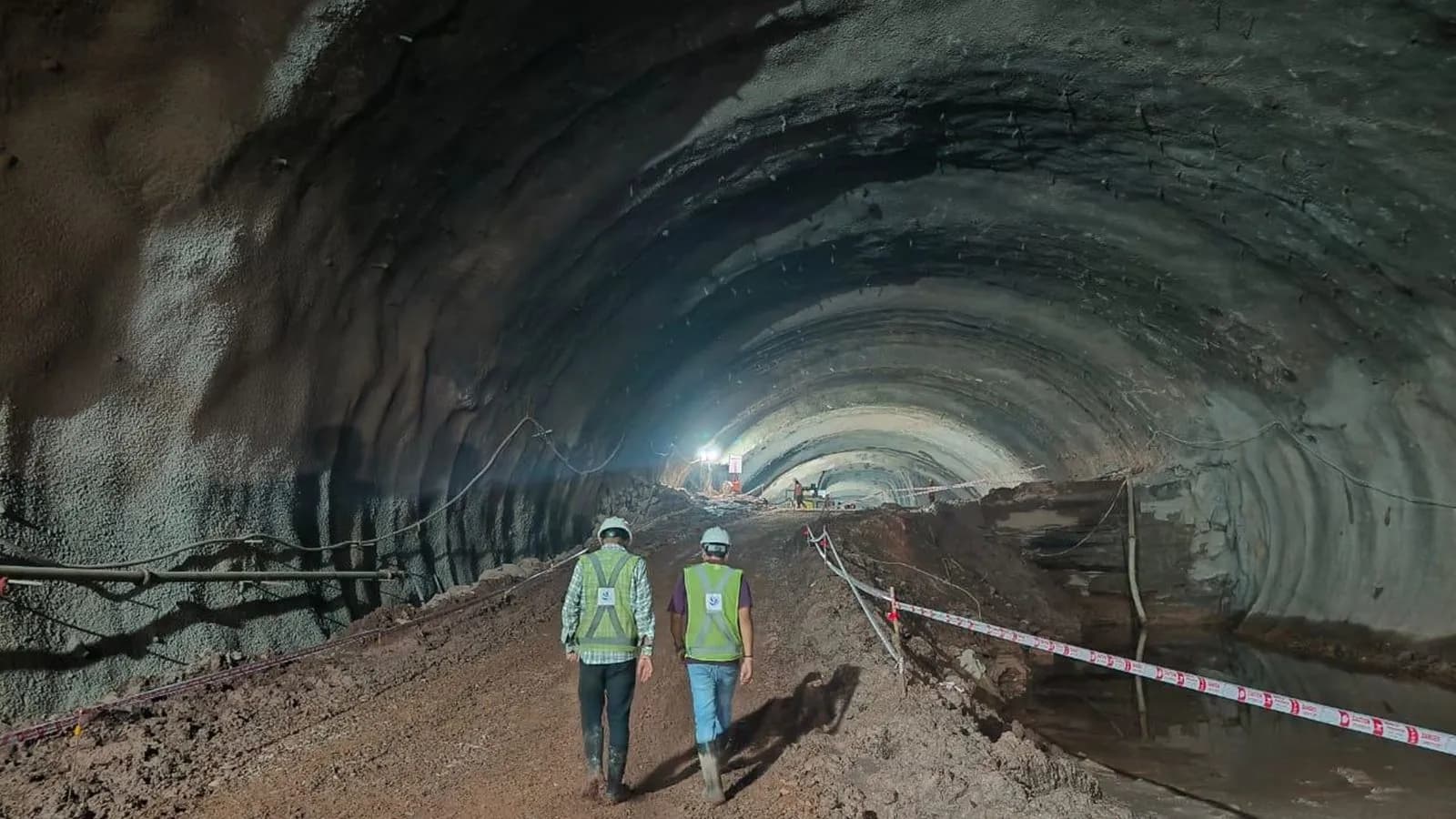
New DelhiUpdated: Jun 30, 2026 10:59 PM IST The tunnel, part of an 8.3-km section passing through the Mukundra Hills and a tiger habitat, is one of the most critical links in the 1,386-km expressway project. The 4.89-km-long eight lane tunnel on Delhi-Mumbai expressway in Rajasthan’s Kota district is set to open by the end of July, a senior official of the National Highways Authority of India (NHAI) said on Tuesday. The tunnel, part of an 8.3-km section passing through the Mukundra Hills and a tiger habitat, is one of the most critical links in the 1,386-km expressway project. With a width and height of 22 metres and 11 metres, respectively, it is also one of the widest tunnels in the country. It passes through different rock masses and substrates that include sandstone, shale, siltstone, mudstone and limestone.Apart from the tunnel section, another 26-km section from Sawai Madhopur to Laban in Rajasthan will open for traffic by July end. The entire Delhi, Rajasthan, and Madhya Pradesh section of the expressway will become operational when the tunnel opens, said the officials. Another 148-km stretch from MP-Gujarat border to Vadodara is scheduled to open by October, 2026. This will take the operational length of the expressway to 912 km, connecting Delhi with Vadodara. Apart from the tunnel section, another 26-km section from Sawai Madhopur to Laban in Rajasthan will open for traffic by July end. (Express Photo)The official added that the tunnel is operationally ready, and is currently undergoing a few safety works. The tunnel falls between Kota’s Ummedpura and Nayagaon villages, and has been constructed by a joint venture of Dilip Buildcon Ltd and Altis-Holding Corporation. It was originally a 30-month project slated for completion in January 2024, but was delayed due to heavy water ingress and heavy rainfall during excavation. It had even submerged in 2022, 2023 and 2024, necessitating design modifications to account for the eco-sensitive nature of the region. The project cost was also revised to Rs 1,250 crore from Rs 1,000 crore, the NHAI official said.Story continues below this ad The 8.3-km project involves the construction of the highway, an open ramp, a covered tunnel and an underground or a mountain tunnel. On either side of the tunnel are 480-metre and 1,084-metre cut-and-cover sections, designed to allow wildlife, including tigers, to move freely across the corridor without disturbance. Once completed, the Delhi-Mumbai expressway will be the country’s longest expressway at a cost of over Rs 1 lakh crore. It is expected to reduce travel time between Delhi and Mumbai to about 12 hours from 24 hours. The first 246-km Delhi-Dausa-Lalsot stretch in Rajasthan was opened on February 12, 2023. This was followed by the opening of 100-km Laban-Gopalpura, 25-km Chechat-Jhalawar, 224-km Jhalwar-Ratlam-MP and Gujarat border and 67-km Bandikui-Jaipur sections. © The Indian Express Pvt Ltd Dheeraj Mishra is a Principal Correspondent with the Business Bureau of The Indian Express. He plays a critical role in covering India's massive infrastructure sectors, providing in-depth reporting on the connectivity lifelines of the nation. Expertise & Focus Areas: Mishra’s journalism is focused on two of the country's most capital-intensive and public-facing ministries: Ministry of Railways: Tracking the operations, safety, and development of India's vast railway network. Ministry of Road Transport & Highways: Covering policy decisions, infrastructure projects, and highway development. What sets Mishra apart is his rigorous use of the Right to Information (RTI) Actas a primary tool for news gathering. By relying on official data and government records, he ensures a high degree of accuracy and trustworthiness in his reporting. This data-driven approach has resulted in numerous impactful reports that hold public institutions accountable and bring transparency to government operations. Find all stories by Dheeraj Mishra here
A 10-year-old girl who lived with her family on a Delhi footpath was allegedly kidnapped, raped and murdered on Monday, bringing renewed attention to the dangers faced by children growing up on the streets.The child was reportedly sleeping beside her parents in Mehrauli, Delhi when she was taken away. Her body was later recovered and the accused was arrested by the police. This case has just uncovered a prolonged concern in the country. The question still is how safe are these children living on streets?More than 20,000 children were identified as living on the streets in both 2021-22 and 2022-23, according to the National Commission for Protection of Child Rights. And the number declined sharply in 2023-24, falling to 3,466 children.Most of these children were not living alone. In 2022-23, as many as 12,084 children were living on the streets with their families, while another 9,850 spent their days on the streets and returned at night to nearby slums or temporary settlements. Only around 1,000 children were found to be living on the streets without any family support.But these statistics changed significantly in 2023-24. 1,558 children were identified as living on the streets with their families, 1,736 were spending their days on the streets and returning home at night, and 172 were living on the streets alone, taking the total to 3,466 children.Older teenage girls account for most rape victimsNational Crime Records Bureau (NCRB) data shows that adolescent girls are particularly vulnerable to sexual violence. Among girl victims of rape, those aged 16-17 consistently accounted for the highest number of cases between 2020 and 2024.In 2020, 1,471 victims belonged to this age group. The number increased to 1,772 in 2021 before declining in subsequent years. Even in 2024, 473 girls aged 16-17 were recorded as rape victims, compared with 252 girls aged 12-15, 52 girls aged 6-11 and 15 girls below six years.Across all the five years, the 16-17 age group remained the largest category of victims, suggesting that older adolescent girls face a disproportionate share of sexual crimes against children.Young children most affected by murderThe pattern is different when it comes to murder. Data on girl child murder victims show that the youngest children are often the most vulnerable. Girls below six years accounted for the highest number of murder victims in four of the five years between 2020 and 2024.In 2024, 178 girls under six were murdered, compared with 169 girls aged 6-11, 153 girls aged 12-15 and 135 girls aged 16-17. Similar trends were visible in previous years, with the under-six age group consistently recording the highest number of victims.Government's stepsTo identify and support vulnerable children, the National Commission for Protection of Child Rights (NCPCR) operates the Baal Swaraj-Children in Street Situations portal. The platform is used to identify children living on streets and connect them with rehabilitation services.The government also provides support through open shelters, Child Care Institutions, sponsorship programmes and outreach services under child protection schemes. In addition, the SMILE scheme aims to rehabilitate vulnerable populations, including people living on the streets. How may i help you today


Discussion (0)