A day after Alito's testy response to Sotomayor's dissent, court says it was a 'misunderstanding'

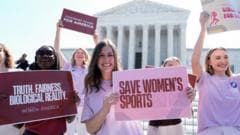
Image source, ReutersImage caption, Women hold placards as they celebrate the US Supreme Court's rulingUpdated 5 minutes agoThe US Supreme Court has ruled that states can ban transgender women from competing in female school and college sports.The court considered cases from students in two different states who had challenged bans on participation. The two states, Idaho and West Virginia, enacted laws that required public school and college sports teams to compete in accordance with their sex recorded at birth.One of the two challenges said the ban violates equal rights protections in the US Constitution. The other said it contradicts civil rights laws.More than two dozen states have enacted bans since Idaho did so in 2020. President Donald Trump celebrated the decision in a social media post as a "BIG WIN". Under those state bans, a transgender woman - a biological male who identifies as a woman - is not permitted to compete in female sports at schools and colleges.All nine justices on the court decided the state bans do not violate a civil rights law called Title IX that prohibits sex-based discrimination in schools.But the judges were split along ideological lines on whether the bans contravene the Constitution's 14th Amendment guarantee of equal protection under the law.The six conservative justices said it did not violate the constitution, while the three liberal justices disagreed."The Constitution and Title IX do not require an overhaul of women's and girls' sports throughout America," wrote Justice Brett Kavanaugh, who wrote the ruling.In her partial dissent, Justice Sonia Sotomayor said the majority opinion had applied "a diminished view of equal protection" to sports.Image source, Getty ImagesImage caption, Transgender plaintiff Becky Pepper-Jackson outside the Supreme Court in JanuaryThe challenge launched in Idaho came from a transgender woman, Lindsay Hecox, a long-distance runner, who lodged it shortly after the law was enacted. She was later granted an injunction by both a district court and an appeals court.State lawmaker Barbara Ehardt, who introduced the law, said at the time of its passing that it would ensure "boys and men will not be able to take the place of girls and women in sports because it's not fair".But in the appeals ruling, a panel of three judges found that the Idaho law violated constitutional rights. They said the state had failed to provide evidence that its ban protects "sex equality and opportunity for women athletes".The plaintiff in West Virginia was 16-year-old Becky Pepper-Jackson, who challenged that state ban on equal-protection grounds.West Virginia Attorney General JB McCuskey said Tuesday's ruling was a victory for common sense and would give all states "the clarity and confidence to ensure fairness and safety for female athletes today and for generations to come".But the Human Rights Campaign (HRC), which advocates for the LGBT community, criticised the decision."This ruling is heartbreaking for transgender student athletes who are being forced to sit on the sidelines simply for who they are," said HRC president Kelley Robinson.President Trump made the issue of transgender athletes in women's sports a focus of his 2024 election campaign. Image source, EPAImage caption, First Lady Melania Trump also weighed in on the rulingLast year, he signed an executive order that aimed to ban transgender women from competing on female sports teams in schools and colleges.Following that decision, the NCAA, the governing body for US college sports, banned transgender women from competing in women's sports.US First Lady Melania Trump celebrated Tuesday's ruling by the Supreme Court as a victory for women in sports, while adding that she supported the rights of gay and transgender Americans."America, we can support the rights of the LGBTQIA+ community and also protect opportunities for female athletes. Respect everyone and keep girls' sports fair," she wrote on social media. "Both ideals are essent


A day after Alito's testy response to Sotomayor's dissent, court says it was a 'misunderstanding'
News dispatch documentation · Source: BBC News

Narrative Evolution & Timeline

Trace how this story developed across dispatches and source updates.

📌Update

Story Begins

The first development in this ongoing narrative has been documented.

Discussion (0)