
Loading dispatches...
← Return to NewsroomWorld
Hope of finding more Venezuela quake survivors fades despite late rescues

A handful of late rescues have been reported across Venezuela, as hope for finding more survivors four days after devastating twin earthquakes has begun to fade.No new death toll was released on Sunday, with officials saying on Saturday that 1,430 people were confirmed dead, following the back-to-back 7.2 and 7.5 magnitude earthquakes which hit near the coastal area of La Guiara on Wednesday.Recommended Stories list of 3 itemslist 1 of 3Venezuelans dig for earthquake survivors as death toll rises to 1,430list 2 of 3Another powerful magnitude 4.8 earthquake hits near Venezuelalist 3 of 3Anger grows in Venezuela as citizens blocked from aiding earthquake rescueend of listLate Saturday marked 72 hours since the devastating quakes, the period when authorities said trapped people were expected to survive. More than 50,000 have been reported missing.A handful of rescues on Sunday offered glimmers of hope.They included a 60-year-old woman saved from the rubble of a building in the coastal area of Carabayida. She had been trapped for 86 hours.In a post on X, El Salvador’s President Nayib Bukele said rescue teams deployed by his country and by Peru worked for eleven hours to rescue the woman.She had been taken to a hospital in Caracas for treatment, where her condition remained “delicate”, he said.“This achievement was made possible thanks to the effort and perseverance of our rescuers, who worked tirelessly throughout the night and early morning hours, with the support of Peruvian USAR rescuers,” Bukele said.A US rescue team from Virginia pulled a man and his son from the ruins on Sunday morning and carried them on a black tarpaulin into an ambulance, according to the Associated Press news agency.US officials reported late Saturday that an infant had been rescued from a collapsed building, with Colombian and Mexican officials saying two 11-year-old boys had been rescued in separate operations.‘Still under the rubble’Venezuela’s interim president, Delcy Rodriguez, said Sunday that at least 33 people had been rescued over the weekend, as the UN said 2,200 members of foreign rescue teams were working across the country.More than 14,000 members of the military and police were patrolling La Guaira state, where access was now blocked and special permits required to enter, Rodriguez said.Criticism over the Venezuelan government’s response has mounted.In one instance, residents blocked an excavator from leaving the site of a collapsed building and pulled the operator from its cabin shortly after state workers took selfies in front of flattened buildings, then left without helping, reported Associated Press.Standing outside a collapsed building in the Los Palos Grandes neighbourhood of Caracas, Al Jazeera’s Noris Soto said a Mexican rescue team was still hoping to find survivors as volunteers helped gather personal belongings scattered within the destruction.“Here, at least 20 people are still under the rubble,” Soto said.“You can see here how the rescuers, the international rescuers and the civilian volunteers are the ones who are doing the job and facing this crisis,” she added.Reporting from Catia La Mar in La Guaira, Al Jazeera’s Teresa Bo said family members had marked several collapsed homes where they have been unable to recover the bodies of their loved ones.“The relatives are waiting for them outside for their bodies to be retrieved,” Bo said.She added that aid, including water and food distributions, had only just started to reach the hard-hit area, where many residents continue to camp outside.“What’s happening here is a major test for the international community,” Bo said.She also described the disaster as a “big test” for the government of Delcy Rodriguez, who assumed the presidency following the US military abduction of President Nicolas Maduro in January.Rodriguez has vowed to be an agent of change in a country that has long contended with overlapping economic and humanitarian crises. She has cooperated closely with the administ
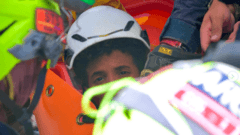
Two 11-year-old boys have separately been rescued from the rubble of collapsed buildings within hours of each other, after powerful earthquakes struck Venezuela.Video footage of the first boy, named as Moises, showed him being pulled from the twisted debris - his eyes covered to protect them from the sun - to the applause of rescuers.Hours later, interim President Delcy Rodríquez announced another 11-year-old boy had been rescued, and posted a video of him on X, being carried down a huge mound of wreckage on a stretcher.Since the magnitude 7.2 and 7.5 quakes on Wednesday, officials have confirmed at least 1,450 deaths. Tens of thousands of people are still missing.More than three days after the quakes, rescuers had not given up hope, saying people could still be alive, especially if they had access to food and water under the rubble.The two earthquakes, which struck within 39 seconds, caused hundreds of buildings to collapse and many people remain trapped inside. Desperate families have been digging through the debris by hand, trying to find their loved ones. Some have told the BBC that they can hear people under the rubble, but cannot move the heavy slabs of concrete, and are waiting anxiously for heavy machinery to arrive.Colombia's National Unit for Disaster Risk Management (UNGRD) said Moises was buried under about 3m (9.8ft) of debris, and the rescue team spent six hours conducting "high-precision work" on Saturday to reach him.Reuters reported that a rescuer was overheard on a walkie-talkie saying the young boy was found near his sister and mother, who had both died.Hours later, Delcy Rodríguez posted a video on X, purportedly showing the rescue of the second 11-year-old boy in the town of Caraballeda."In these hours, every life is hope for Venezuela," she wrote.Officials said the coastal region of La Guaira, where Caraballeda is located, has been hit the hardest.Rescuers' efforts have been hampered by aftershocks, which are in turn terrifying residents. "To be honest, it makes you feel kind of nervous. Any little noise... horrible," Jesús Andueza, a 64-year-old bus driver told BBC Mundo.Thousands of people are living in their cars or camping at places like the airport and golf course, away from buildings that could collapse.The golf course in Caraballeda has become an epicentre for the emergency response. Its green lawn, which used to be perfectly manicured, is now a makeshift hospital and donation centre, where residents who have lost everything are sifting through piles of donated clothing and boxes of humanitarian aid.In another part of the golf course, next to a small lagoon, a strip of land has been set up as a landing pad for helicopters arriving with supplies and emergency personnel from within Venezuela and abroad.In the area surrounding the golf course, Caraballeda's streets – cracked and covered in rubble – are marked by dust and silence, interrupted only by heavy machinery and those searching among the remains.In a separate video message on Sunday, Rodríquez said the José María Vargas sports complex in La Guaira was also serving as an emergency response centre.Pointing out that the armed forces were sorting clothes, medicine and food, Rodríguez said "everything is functioning as well as possible during these terrible moments, these terrible hours, that our people are enduring"."Let them know that no one here is alone, not a single family or individual need [to] feel alone. Our people and our state are here, the social protection system is here, and international solidarity is here." But frustration has grown, with some saying the government's response is too slow and inefficient. In some of the worst areas, such as Caribe and Tanaguarena, there are entire areas where debris removal has not yet started.In recent days, international rescue teams from Mexico, Spain, Qatar, the US, and the UK have arrived to reinforce the search efforts.The UN's Tom Fletcher said on Saturday that 39 search and rescue teams had be

Venezuelan firefighters and volunteers search for possible victims atop a collapsed building in Caraballeda, La Guaira state, Venezuela, on Saturday, June 27, 2026. Miguel Medina/AFP via AP hide caption toggle caption Miguel Medina/AFP via AP CARACAS, Venezuela — You can hear backhoes digging through concrete and twisted metal, as rescue workers call out into the wreckage. "We are the rescue team. If you are alive please make any noise." A middle-aged man in a blue shirt looks on in desperation. He still has hope someone he knows on the sixth floor will be alive. Across the street from another shattered building, Junior Laya and Jesus Gallardo sit on the shade, covered in dust. "I have family members missing… my brother and some cousins," Gallardo says. "We don't know anything about them. We've been looking for them for four days." It is now four days since powerful twin earthquakes left parts of Venezuela in ruins. Damaged buildings are seen three days after earthquakes struck in La Guaira, Venezuela, Saturday, June 27, 2026. Matias Delacroix/AP hide caption toggle caption Matias Delacroix/AP On Saturday, the government said the death toll had reached 1,430, with nearly 3,500 injured. Those figures are expected to rise. Authorities say thousands remain missing, as the critical window to find survivors continues to narrow. Cargo planes carrying emergency aid for earthquake victims are now beginning to land in Venezuela, after the main airport in the capital Caracas partially reopened to relief flights. On the ground in La Guaira, a coastal state just north of Caracas, one of the areas closest to the earthquake's epicenter, it's utter devastation. Buildings are pancaked, their floors stacked like decks of cards. Dozens of people are digging through the rubble with whatever they can find—mostly small shovels and their bare hands. They are told someone is still inside, though it is not clear whether that person is alive or dead, or even who they are. Only their feet are visible. Helicopters buzz in the sky. People wait next to damaged structures, hoping to hear news of anyone who might get pulled from the rubble. Andrea Peña is a 34-year-old resident of La Guaira, whose home was destroyed. She's under a tent, outside the debris of her 7-floor building, guarding shovels and hand saws to give to rescue workers when they shout for them. "My dad and my nephew are trapped there, she says. The day the earthquake hit was a holiday in Venezuela, so she was out in the street celebrating. That's how she survived. A youth rescued from the debris is taken away on a motorcycle two days after earthquakes struck La Guaira, Venezuela, Friday, June 26, 2026. Matias Delacroix/AP hide caption toggle caption Matias Delacroix/AP "My nephew was sleeping and my dad was watching the World Cup," she says. Window closing to find survivors These are the kinds of scenes playing out across La Guaira state, with people milling around in the streets after being left homeless, uncertain of what to do next. Nearly every building here shows damage. In some places there are deep cracks running through structures. In others, buildings lean like sinking ships. High-rises remain standing but have lost entire facades, exposing interiors where life appears frozen in place—childhood bedrooms with Mickey Mouse sheets still on the bed, teddy bears still in place. The first 72 hours are crucial, when the chances of finding survivors are highest. That window is now closing. Residents transport a man rescued from the rubble three days after earthquakes struck, in La Guaira, Venezuela, Saturday, June 27, 2026. Matias Delacroix/AP hide caption toggle caption Matias Delacroix/AP One of the immediate concerns is sanitation. The weather is humid and in some areas, there is already a strong smell of decay, raising fears of a growing public health crisis. Areas are being cordoned off to control access, while shelters are being opened for th

NewsFeedAnger is mounting in Venezuela after the military barred citizens from entering zones devastated by Wednesday’s twin earthquakes. As Teresa Bo explains, thousands of people have travelled to help rescue victims, not trusting the government to save survivors in time.Published On 28 Jun 2026
NewsFeedRescue workers in one Caracas neighbourhood say no help has arrived, two days after twin quakes tore through the city. Al Jazeera’s Noris Soto says aftershocks are making the search for survivors harder and rescue efforts are turning to the recovery of bodies.Published On 27 Jun 2026


Discussion (0)