
Loading dispatches...
← Return to NewsroomWorld
How deep-rooted medical bias creates deadly consequences for addiction patients

In bodycam footage released by the Milwaukie Police Department, 26-year-old Jean Descamps can be seen in a hospital bed at the Providence Milwaukie Hospital emergency room in Milwaukie, Ore., in December 2023. Soon after he was discharged by the hospital, Descamps died from drugs already in his system. Milwaukie Police Department/Screenshot by NPR hide caption toggle caption Milwaukie Police Department/Screenshot by NPR On a cold December night in 2023, the staff at Providence Milwaukie Hospital in Milwaukie, Ore., called local police. They wanted help getting one of their patients, a 26-year-old man named Jean Descamps, out of the emergency room. "He's been evaluated medically. There's no medical problems for him," a member of the hospital team, who NPR has not been able to identify, told police. The moment was captured on an officer's body camera. Records show the hospital's medical staff believed Descamps — emaciated, covered in feces, and often unresponsive — was experiencing symptoms of chronic street drug use, a leading cause of death for young Americans. After Descamps arrived in an ambulance earlier that day, hospital staff cleaned him up and administered naloxone, a medication that reverses opioid overdoses. But now they wanted him gone. "He's not thriving chronically, but there's no medical reason for him to be here anymore," one hospital staffer can be heard saying. Video released by the Milwaukie Police Department shows Descamps sprawled in a hospital bed, his body limp, moaning and drooling, while medical staff stood nearby. After determining Descamps was too unwell to spend the night in jail, police officers challenged the hospital's decision to discharge him. "He can't be on his own," one officer said. "Why is he being released? We have no place to take him." "A bus station is fine," a hospital worker replied. Another member of the hospital staff told police Descamps was faking the severity of his illness: "It's not really a medical problem, it's malingering." Officers eventually complied, rolling Descamps' limp body in a wheelchair into the dark parking lot, where they covered him with a blanket against the winter cold. Police who gathered around Descamps can be heard voicing fear for his safety. In video footage released by the Milwaukie Police Department, an officer can be seen rolling Descamps in a wheelchair to exit the hospital emergency room. "Do you feel at all comfortable with anything that's going on right now?" one police officer asked. Another officer answered, "No." Milwaukie Police Department/Screenshot by NPR hide caption toggle caption Milwaukie Police Department/Screenshot by NPR "Do you feel at all comfortable with anything that's going on right now?" one police officer asked. Another officer answered, "No." Their fears proved justified. A short time after being discharged, Descamps would be dead of an overdose from street drugs already in his system. A spokesman for Providence Milwaukie Hospital declined NPR's repeated requests for an interview about Descamps' case and didn't respond to detailed questions about his treatment. In a statement issued to the media after Descamps' death, the hospital expressed regret and acknowledged the care he received was inadequate. "In this case, we fell short of our goal of providing safe, reliable, compassionate care to our patient," it said. But in interviews with more than a dozen doctors, scientists, federal officials and addiction activists, along with a review of research and government data, NPR found that what happened that night in Oregon is part of a troubling national pattern. People with serious alcohol or drug addiction in the U.S. regularly go to doctor's offices, clinics and hospitals, only to leave after receiving insufficient or no treatment, often with devastating consequences. "I think we should be outraged every single time someone dies from any condition that has treatment available that someone isn't getting," said
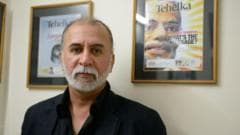
An Indian court has found former Tehelka magazine editor Tarun Tejpal guilty of raping a former colleague, overturning his 2021 acquittal in a decade-old case.The Goa bench of the Bombay High Court said it was convicting Tejpal under sections of Indian law pertaining to rape and sexual harassment, legal website LiveLaw reported. This means Tejpal faces a minimum punishment of 10 years in jail and a maximum of life imprisonment.He will be sentenced later on Thursday.Tejpal, who has consistently denied the accusations against him, can appeal against the verdict in a higher court.The allegations against Tejpal, one of India's best-known editors, had made national headlines in 2013. A year before that, thousands of Indians had participated in protests after a brutal gang rape and murder of a woman in Delhi, leading to a larger conversation on sexual violence.Tejpal's accuser, who cannot be identified under Indian law, alleged that he sexually assaulted her in a lift during Tehelka's high-profile international conference in Goa in November 2013, an event attended by, among others, Hollywood star Robert De Niro.Tejpal initially blamed it on "a lapse of judgement" and "a misreading of the situation" which had "led to an unfortunate incident that rails against all we believe in and fight for".But as the case escalated, he issued a statement urging authorities to examine the CCTV footage "so the accurate version of events stands clearly revealed". He also alleged that the case against him was part of a "political vendetta" by the Bharatiya Janata Party (BJP) government in Goa.Tehelka, the magazine Tejpal co-founded in 2000, had published a number of scoops, many of them based on sting operations.Some of these stories - including Operation West End in which some of its journalists posed as arms dealers, secretly filming senior army officials, bureaucrats and even the president of the then ruling BJP taking bribes to push through a fake deal - created national and international ripples.Tejpal was arrested in 2013 and spent seven months in jail until the Supreme Court granted him bail.In 2021, a sessions court in Goa threw out all the charges against him. But the judge's observations in the 527-page order had sparked criticism after she questioned the behaviour of the survivor..In photographs taken shortly after the assault, the judge wrote, the young woman was "smiling and looked happy, normal, in [a] good mood"."She did not look disturbed, reserved, terrified or traumatised in any way even though this was immediately after she claims to have been sexually assaulted," the order said. Some lawyers told the BBC that the judgment itself seemed like "an assault on the survivor".In Tarun Tejpal acquittal, judge questions 'appropriate' behaviour for rape victimsThe Goa government had appealed against this judgment in the high court. Appearing for the Goa government, Solicitor General Tushar Mehta urged the high court to impose the maximum sentence on Tejpal."This court must give a clear message to society that when a girl says no, it means no. A no means a no," Livelaw quoted him as saying."All I can say is I am 62. I believe I am a political victim. I am a father of two daughters. I have a wife. All we can say is we will go up and appeal. My lawyer wants me to request you to be lenient," legal website Bar and Bench quoted Tejpal as telling the court.The court said it found Tejpal guilty under legal sections including 376(2)(f), which pertains to rape committed by "a relative, guardian or teacher of, or a person in a position of trust or authority towards the woman".

Her great-grandfather Hawa Singh was one of Indian boxing's early giants. A heavyweight, he won successive Asian Games gold medals in 1966 and 1970 and was among those who established the famed Bhiwani Boxing Club, which would later produce boxers including Olympic medallist Vijender Singh.Even so, it is not Hawa's medals that feature most prominently in the stories Lamboria remembers hearing about him at home. "He was powerful, but there was also so much humility in him," she says.Her earliest

Nairobi, Kenya – The death toll from the latest Ebola outbreak in the Democratic Republic of Congo has surged above 1,309, an extraordinary rise of more than 40 percent in just five days, government figures show, as a leading public health consultant says the virus is “spreading like a wildfire”.Updated data released by the government on Saturday showed that as of Thursday, the total number of confirmed cases, including deaths, had climbed to 2,973. This was a 27 percent rise from the figure last Saturday.Recommended Stories list of 3 itemslist 1 of 3‘There’s no salary’: DRC health workers tell of hardship as Ebola spreadslist 2 of 3Ebola death toll in the Democratic Republic of the Congo surges above 1,000list 3 of 3Ebola death toll in DR Congo surpasses 1,000end of listThe unprecedented rate at which cases are increasing and deaths are mounting has made the DRC epidemic the fastest-spreading Ebola outbreak ever documented.Compounding the danger, the virus spreading in the DRC is Bundibugyo, which is the rarest of the four variants of Ebola known to affect humans and currently has no approved vaccines or treatments.Abdulsalami Nasidi, a public health consultant who helped establish the Africa Centres for Disease Control and Prevention (Africa CDC), the African Union’s public health agency, told Al Jazeera the lack of a proven vaccine meant the virus was “spreading like a wildfire.”Nasidi said the epidemic was unfolding in an area of active hostilities, compounding the shortage of public health resources common to African governments confronting outbreaks.Scientists are racing to find a way to slow the epidemic, and the University of Oxford’s Oxford Vaccine Group said a volunteer had received the first dose of a rapidly developed experimental vaccine on Friday.“This is an important milestone for the trial, and marks the next phase in our multinational collaborative journey to develop a Bundibugyo ebolavirus vaccine,” said the Oxford team’s chief investigator, Katrina Pollock.The largest and deadliest Ebola outbreak in history killed more than 11,000 people out of at least 28,000 cases between 2013 and 2016, primarily in West Africa across Guinea, Liberia and Sierra Leone.That outbreak took about eight months to reach the first 1,000 deaths. The latest epidemic in the DRC has done so in less than 10 weeks.“We must act now,” Africa CDC Director-General Jean Kaseya wrote in a post on X last week. “If we do not stop it today, this will become the worst outbreak the world has ever documented.”Al Jazeera’s Alain Uaykani, reporting from the DRC city of Goma, said the government’s response had lacked coordination and urgency, leaving medical personnel overstretched and working in poor conditions.He said the death toll among health workers continued to climb on Saturday, with a doctor and a health worker among the latest victims.More than 100 health workers have been infected since the outbreak was declared in May, and around 35 have died, a toll compounded by shortages of protective equipment and, in some communities, hostility from residents who question whether the disease is real.An increasing number of healthcare workers at several medical facilities in the northeastern province of Ituri, the epicentre of the outbreak, have gone on strike over unpaid wages and unsafe working conditions.Last week, dozens of workers at Rwampara General Hospital near Bunia went on strike. The hospital operates a major Ebola treatment centre, parts of which were set ablaze in May by angry residents who also chased after health workers fleeing in trucks.The latest strike began on Saturday at the Elikya Ebola Treatment Centre in the provincial capital of Bunia. Activities were largely paralysed as doctors, nurses and security staff stopped work.Approximately 100 workers held a protest outside the centre, saying unpaid bonuses were undermining morale and disrupting patient care.“We need to be paid, because in the meantime the disease is spreading at the
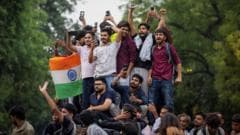
Pradhan announced his resignation on X in a post in Hindi saying he "respected the aspirations, dreams, and expectations of the youth" and was "pained by the events" of the past few days."Considering the situation at Jantar Mantar and across the country - with the aim of preventing anti-national forces from exploiting it, preserving national unity, ensuring that not a single Indian student's future gets entangled in legal complexities, and allowing our children to devote their time to studies and focus on building their careers - I have submitted my resignation to the prime minister," he wrote.As news of Pradhan's resignation broke, a visibly emotional Abhijeet Dipke, CJP's founder, screamed from the makeshift stage at Jantar Mantar: "We have done it." A loud cheer went up and huge celebrations erupted with the protesters singing, dancing, shouting slogans and handing out sweets.Several hours since the CJP announced the end of their protest and its leaders left the site, crowds were still gathered at the venue into the night.Many told the BBC they had waited for this day for weeks, and were not in the mood to leave without celebrating.The site is increasingly looking like the centre of a party, with volunteers doing their best to manage the crowds. A large number of police are deployed around the area, but they say they will intervene only if they see breaches of the law.The CJP was formed after the chief justice of India described some unemployed young people turning to journalism and activism as "cockroaches". He later said he was referring specifically to people with "fake and bogus degrees", but by then, the term had taken a life on its own.The movement is led by Abhijeet Dipke, a 30-year-old political communications strategist and former student at Boston University.The CJP quickly gained a huge following online, turning one of the most reviled insects into a symbol of defiance and resilience with 26 million followers on Instagram.It called for reforms to India's education system, greater accountability over exam paper leaks and the resignation of Pradhan.The protests gained global attention after activist and educationist Sonam Wangchuk joined them on 28 June and began an indefinite hunger strike in support of their demands.As his health deteriorated, the crowds began to swell and Wangchuk was forcibly removed from the protest site by the police last Saturday and taken to hospital where he continued to fast. He finally called it off early Friday morning following assurances from the government that his demands would be looked into.Over the course of the protest, most of India's major opposition political parties, activists and many celebrities turned up to show solidarity. On Saturday, opposition leaders welcomed Pradhan's resignation, with many calling it a victory for the youth-led movement.Since coming to power in 2014, PM Modi's government has rarely tolerated dissent and cracked down heavily on protests, which is why Pradhan's resignation is being seen as a big deal in India.But this isn't the first time they have faced big protests - and it's not the first time they been forced into a climbdown either. Back in 2021, the government repealed agriculture laws after a year-long protest by farmers. The students' protest has resonated with a large section of middle-class India, cutting across identities of religion, caste or sectors, with people voicing anger about the lack of educational opportunities and jobs in India.Pressure grew on the government after Monday's violent crackdown when police and paramilitary forces used batons and wooden sticks to beat up young men and women, firing tear gas cans at them.About 300 people were taken to hospital. Police said at least half of the injured were security personnel and also arrested about 70 protesters - most of them have since been released on bail.After ignoring the protesters for nearly five weeks, Modi finally broke his silence on Thursday to say they had "decided to se

A reclining protestor covers himself with a banner printed with a portrait of Sonam Wangchuk, a prominent activist who was forcefully transferred to a hospital by the police as he staged a hunger strike in support of a movement led by Cockroach Janta Party, at a protest in New Delhi, India, Wednesday, July 22, 2026. Vipin/AP hide caption toggle caption Vipin/AP NEW DELHI — Indian activist Sonam Wangchuk ended a 26-day hunger strike on Friday that helped galvanize a youth movement that's become one of India's largest protests in recent years, but demonstrators vowed to continue until the education minister resigns. Wangchuk's fast became a rallying point for India's "Cockroach" protests, which began more than a month ago demanding education reforms after alleged leaks in some of the country's most competitive entrance exams. Since then, the movement has tapped into broader public anger over unemployment, government accountability and economic opportunity, drawing professionals, families and activists to demonstrations in New Delhi and cities across the country. The demonstrations have become one of the most sustained waves of public dissent against Modi's government in recent years, with thousands returning to the streets even after police used tear gas and batons this week to disperse marchers trying to reach Parliament. In a post on X, Wangchuk said he ended his fast in the presence of two federal ministers after appeals from dozens of members of parliament and following "a long negotiation on various conditions and in view of possible violence in the country." He did not elaborate on the talks. Protest organizers said demonstrations would continue until Education Minister Dharmendra Pradhan resigned. They have called for demonstrations across the country on Friday in solidarity with students who were beaten by police during a march to Parliament on Monday that drew thousands of people. "We won't let Sonam sir's sacrifice go in vain," said Abhijeet Dipke, the founder of Cockroach Janta Party, a satirical group that has spearheaded the movement, named in reference to a remark by the country's supreme court chief justice that compared some unemployed young people to cockroaches. The nationwide protests come a day after Modi publicly addressed the protests for the first time, announcing fast-track courts to prosecute cases involving examination paper leaks. In a separate video message, Modi also said his government would introduce a legislation in Parliament to crack down on exam paper leaks. The announcements did little to calm the movement, as protesters said they failed to address their demands for government accountability, examination reforms and compensation for the families of students who died by suicide after exam paper leaks.
Indian activist and educationist Sonam Wangchuk, on hunger strike for the past 20 days in Delhi, has been forcibly removed from his protest site.The 59-year-old had been protesting in support of an online satirical movement called the Cockroach Janta Party (CJP) who are seeking educational reforms. The protesters had planned a march to India's parliament on Monday.CJP founder Abhijeet Dipke told the BBC he had gone to a friend's house in the morning to freshen up when policemen turned up and refused to let him leave.Wangchuk was sitting on hunger strike in the scorching summer, consuming nothing but salt and water. He had lost more than 9kg and was in a lot of pain. Videos from the protest site on Saturday showed chaos erupting just before 07:30 local time (02:00 GMT) when dozens of police and paramilitary personnel swooped in on the stage where the activist was lying down. Protesters who tried to stop them were pushed away.They covered him with curtains of bedsheets before removing him from the stage. Minutes later, an ambulance was seen speeding away.Dipke, who had been by Wangchuk's side throughout the protest, said he had not been told where Wangchuk was taken.A top police official told reporters that Wangchuk had been moved "in compliance with [a court] order, and based on health conditions and medical advice"."Sonam Wangchuk has been moved to a government hospital for much-needed medical intervention and is currently under medical supervision," said Sachin Sharma, Deputy Commissioner of Police.He was referring to a Delhi High Court order from Thursday asking the federal government to monitor Wangchuk's health regularly and provide necessary treatment if needed.Wangchuk had refused to end his indefinite hunger strike despite growing calls for him to do so. Despite his frail health, he had been insisting that he would participate in Monday's march to the parliament. "I've grown weak from the outside but I'm strong from within," Wangchuk told the crowd gathered at the protest venue, Jantar Mantar, a 300-year-old observatory, a couple of days back. His statement was met with cheers and applause."Together, we will march peacefully to the parliament and put forward our petitions at the altar of democracy," he said.The activist then joked that if he died before the march, his "ghost would join the march".It's not clear if the CJP will still attempt to march to parliament, but it's unlikely that the activist will be able to participate.Why Indians still turn to the hunger strikeThe CJP began in May as an online satirical movement to protest against paper leaks and other irregularities in India's top exams and has gained a massive following on social media.The protesters, who call themselves cockroaches, have been protesting for a month now. Members of some student organisations have also joined Wangchuk in his fast.The protesters are demanding the resignation of Education Minister Dharmendra Pradhan after a key entrance exam for aspiring doctors was cancelled in early May following a paper leak. They say the minister must take moral responsibility and quit.Pradhan has dismissed the CJP and its supporters as "the B-team of disruptive elements". And the government of Prime Minister Narendra Modi has not engaged with the protesters yet.But there was growing pressure from the opposition and civil society leaders for the government to do so.On Thursday, former Delhi chief minister and leader of the Aam Aadmi Party Arvind Kejriwal visited Wangchuk. In a video shared by CJP, Kejriwal is seen greeting the activist with folded hands before shaking his hand. He appealed to the government to engage with the protesters."Every year, exam papers get leaked and youth pay the price," he said. "I appeal to the government to listen to students and Wangchuk."He added that "Pradhan should be removed from his post and replaced by Wangchuk".


Discussion (0)