
Loading dispatches...
← Return to NewsroomEconomy
India's first electric air taxi takes wings, preps for a 2028 launch
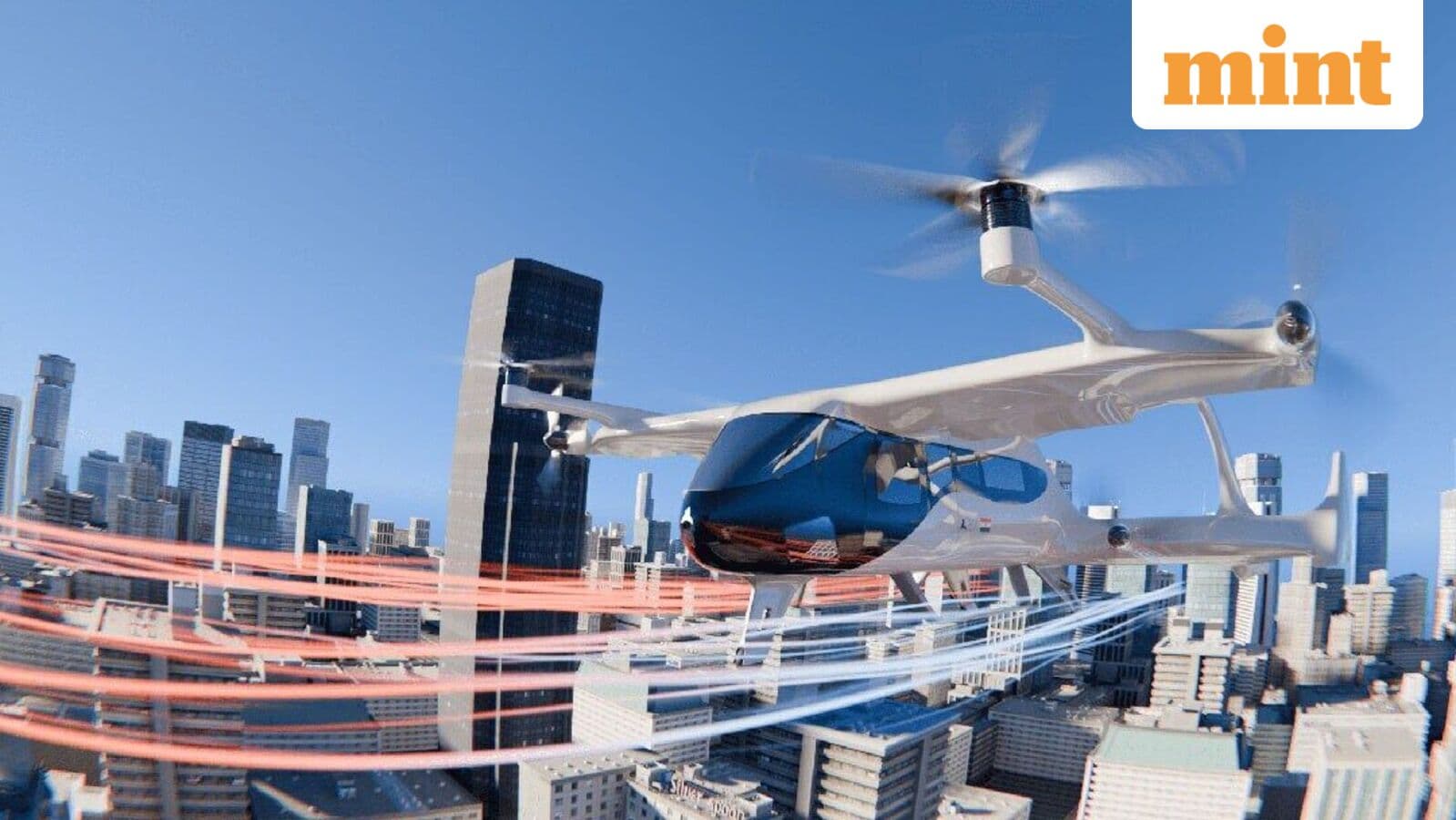
At 8 by 11 metres, roughly the size of half a badminton court, ePlane Company's product claims to be the most compact air taxi of its kind in the world.SummarySeven years in the making, India's electric flying taxi has moved from the lab to a full-scale prototype. Chennai-based ePlane Company says, its flying taxi, aiming for a 2028 launch, can fly 100 km on a charge, and will cost just about 2.5 times an Uber ride.Bengaluru and Mumbai: Seven years after the project first took shape in an IIT Madras laboratory, India now has its own electric air-taxi prototype. Backed by $20 million in funding, the venture is among the half-dozen-odd companies globally at the forefront of a technology that could reshape urban mobility.Last week, Chennai-based ePlane Company, operated by Ubifly Technologies Pvt Ltd (UTPL), unveiled a 2,000-kg aircraft that takes off like a helicopter, carries one pilot and two passengers, and flies 100 km on a single charge. It is expected to cost no more than two-and-a-half times an Uber fare when it starts operations in 2028."It is our conviction that it is fewer than a dozen companies we are grouped with, perhaps half-a-dozen," said Satya Chakravarthy, co-founder, chief technology officer, and a professor at IIT Madras.EHang in China is certified only for “autonomous loops” or pre-programmed flight trips over a single tourist site, said Chakravarthy, while California-based Joby Aviation started flying certification tests under US Federal Aviation Administration (FAA) rules last November. A second California-headquartered air taxi firm, Archer Aviation, expects to begin operations later this year, under the US Government’s Electric Vertical Take-Off and Landing (eVTOL) Program.At 8 by 11 metres, roughly the size of half a badminton court, ePlane Company's product claims to be the most compact air taxi of its kind in the world. The start-up expects to complete flight testing through the end of 2027 and begin operations in 2028."We are not creating the next brand of ice cream," Aditya Ghosh, board member of ePlane Company said, adding that ePlane's segment is compact urban mobility on a single charge, and that focus dictates what it refuses to build. "We are not going to be the 400 or 500 km range vehicle," Ghosh said. "In business, as in life, it is important to know what not to do."Chakravarthy and Ghosh, two of the four-member board of the company, have an unusual pairing: a technologist and an airline operator. The former describes himself as the tech builder, while Ghosh, the former IndiGo and OYO chief and co-founder of Akasa Air, sits on the startup’s board through his investment entity, Homage."This has nothing to do with Akasa. Zero," said Ghosh, listing his other interests, from a London restaurant to an early stake in Blue Tokai coffee through Homage.Ghosh owns 0.56% in ePlane Company, while Chakravarthy owns 30%, according to the privately held company’s shareholding pattern at the end of March 2025, filed with the corporate affairs ministry. Speciale Invest, a Bengaluru-based venture capital firm, is the second-largest shareholder, with a nearly 14% stake. Infosys Ltd co-founder S.D. Shibulal’s son, Shreyas Shibulal, owns 4.65%, and IITM Incubation Cell owns 2.54%. More than five dozen wealthy investors and a few funds own the remaining shares."The reason we go for pilot plus two is the ambulance variant, which needs the patient and a paramedic alongside the pilot," said Chakravarthy.So, is all of this enough for ePlane Company, which was set up in 2019, to succeed?“For ePlane to succeed, it must avoid the pitfalls that affected several global eVTOL startups,” said Jitamitra Desai, a professor at Indian Institute of Management Bangalore. He said the startup’s success will depend on focusing on “niche markets first (air ambulance, airport connectivity, defence, industrial logistics) rather than mass-market air taxis.”Desai said electric air taxis such as those of ePlane need strategic partnerships w



Discussion (0)