Delhi Confidential: Lead by Example


Urban development ministry split, Delhi gets own department The Indian Express
As digital technologies shape, mediate, and challenge the identity, dignity and reputation of individuals, the “right to be forgotten” as a component of informational privacy under Article 21 of the Constitution has come into focus. The right to be forgotten allows a person to ask a court to remove, mask or limit access to personal information available online when it no longer serves a public purpose and continues to harm their privacy or reputation.In its May 29 judgement, the Delhi High Court directed search engine operators and legal database platforms to de-index, de-list or mask name-based search functionality and personal identifiers. It held that no law allows Google or other search engines to show court records for cases that have ended in an acquittal, discharge, quashing or settlement or private in nature, subject to appropriate conditions. Similar relief has also been granted by the Bombay, Delhi and Kerala High Courts in individual cases. Such judgements seek to protect individuals from the enduring consequences of digital permanence and affirm that the dignity and reputation of individuals deserve protection even after legal vindication. But is this right to erasure merely a facet of the right to privacy under Article 21? Does it undermine the public’s right to information, freedom of press, and open justice? Or does this signify the evolution of a new generation of digital or fourth-generation human rights? The fourth-generation human rights To address the ethical and legal challenges arising from the rapid advancement of technology and the internet, new claims of human rights evolved. While the traditional framework of civil-political, socio-economic, and community rights remains relevant, the digital age demands a new set of rights that are essential to guard the dignity of individuals in cyberspace. Scholars describe this new set of rights as fourth generation human rights. These include the right to internet access, protection from cyberattacks, deepfakes, algorithm bias, manipulation, and abuses, protection of minors, recognition of intellectual property, the right to privacy and protection of personal data, and rights to anonymity and encryption. Among these, informational privacy is being considered as an alarming concern in which control over personal data and safeguards from the theft of credentials and misappropriation are guaranteed. Consequently, the right to delete/erasure or the right to be forgotten emerged as an important subset of informational privacy. Story continues below this ad What is the right to be forgotten? The right to be forgotten, also referred to as the right to erasure/delete, is the legal and moral claim of individuals to remove their personal information and personal identifiers from internet searches, platforms, and databases when it no longer serves legitimate public interests or infringes privacy. It also encompasses de-indexing, de-listing, or masking of personal identifiers from databases. The removal of digital footprint means a person can ask for their personal data to be deleted when they withdraw their consent. The right ensures an individual’s meaningful control over the information on digital and internet platforms. It enables people to seek relief from enduring harm to one’s reputation associated with outdated allegations or resolved cases. How Europe shaped the right to be forgotten The right to be forgotten is recognised abroad, especially in the European Union. In 2010, Spanish national Costeja González brought a complaint before the country’s Data Protection Agency against La Vanguardia newspaper, Google Spain, and Google Inc., demanding the removal of the record of his 1998 attachment and garnishment proceedings from internet search engines. Garnishment is a judicial proceeding by which a monetary judgement is satisfied against a defendant by ordering a third party to pay a plaintiff the money that the third party owes to the defendant.Story continues be

New DelhiJul 23, 2026 04:26 PM IST Holding the coaching institute guilty of deficiency in service, the Delhi consumer commission directed it to refund the student's fee with interest. (Image generated using AI)A Delhi consumer commission has directed Allen Career Institute to pay Rs 75,000 to a student who withdrew from its coaching programme after securing admission to an engineering college through JEE Main 2023, holding that the institute illegally withheld the refund despite its own policy allowing it. The West Delhi District Consumer Disputes Redressal Commission-III president Sonica Mehrotra and members Richa Jindal and Anil Kumar Koushal were hearing a consumer complaint filed by Aryan Rajyan under the Consumer Protection Act, 2019 against Allen Career Institute over the non-refund of coaching fees.“The opposite party (Allen Career Institute) is grossly deficient in service. The present complaint deserves to be allowed against the opposite party…The opposite party has failed to provide the promised services regarding refund to the complainant despite receiving the various requests and reminders,” the commission said on July 3, directing the institute to refund the amount with interest and pay compensation. The dispute stemmed from the student‘s admission to Allen in April 2023. However, after qualifying JEE Main 2023, he secured admission to the B Tech Mechanical Engineering programme at Thapar Institute of Engineering and Technology, Patiala. Since he no longer required coaching, he sought a refund under Allen’s published refund policy. Still, despite repeated requests and a legal notice, the institute failed to return the money, prompting him to approach the consumer commission. Student joined engineering college soon after enrolling According to the complaint, Aryan Rajyan, a student enrolled with Allen Career Institute on April 18, 2023 and paid Rs 1.10 lakh as coaching fees. Soon, he secured admission to Thapar Institute of Engineering and Technology in Patiala for the 2023-27 B Tech mechanical engineering programme through JEE Main 2023. Since he had already obtained admission to an engineering college, the coaching programme became unnecessary. The student, through his father, approached Allen and sought a refund of the fees deposited with the institute. Refund was permitted The commission noted that the institute itself had supplied a prospectus containing its refund policy. Under the policy, students who secured admission to engineering or medical colleges in India through competitive examinations such as JEE were eligible for a refund of Rs 50,000 after deduction of Rs 60,000, provided the claim was made within the prescribed period.Story continues below this ad The student submitted his admission confirmation letter from Thapar Institute to establish his eligibility and requested the institute to process the refund. However, despite several reminders, the amount was never released. A legal notice dated September 2, 2024, also failed to evoke any response. Allen failed to contest After the complaint was instituted on October 14, 2024, the commission issued notice to Allen. The institute, however, neither filed a written statement nor appeared before the commission despite repeated opportunities. Finding that the notices had been duly served, the commission proceeded ex parte against Allen on September 1, 2025. It also referred to Supreme Court judgments holding that parties cannot avoid legal proceedings merely by remaining unavailable after service of notice. Deficiency in service Examining the material placed on record, the commission observed that the complainant’s testimony and documentary evidence remained unrebutted because Allen chose not to contest the proceedings. It further noted that the institute had itself framed the refund policy and was therefore obligated to honour it.Story continues below this ad “As per the evidence… OP committed to refund as per their rules and regulations as well

New DelhiUpdated: Jul 23, 2026 08:26 AM IST Sixteen Delhi Metro stations remain shut on Thursday.Sixteen Metro stations in Central Delhi, including Rajiv Chowk, Central Secretariat, Mandi House, ITO and Khan Market, were closed on Thursday due to security reasons, the Delhi Metro Rail Corporation (DMRC) said. The fresh curbs came after similar restrictions were announced for the 16 metro stations on Wednesday.“Lok Kalyan Marg, Rajiv Chowk, Patel Chowk, Ramakrishna Ashram Marg, Barakhamba Road, Supreme Court, Seva Teerth, Janpath, Mandi House, Central Secretariat, ITO, Delhi Gate, Indraprastha, Khan Market, Jor Bagh and Shivaji Stadium metro stations have been closed till further instructions,” the DMRC said in a post on X. Service Update Below mentioned Metro stations will be closed from 07:30 AM till further instructions. However, Interchange facility shall remain available at Rajiv Chowk, Mandi House and Central Secretariat. 1. Lok Kalyan Marg 2. Rajiv Chowk 3. Patel Chowk 4. Ramakrishna… Delhi Metro Rail Corporation (@OfficialDMRC) July 23, 2026 The Metro authorities, however, announced that the interchange facility was available at Rajiv Chowk, Mandi House and Central Secretariat.

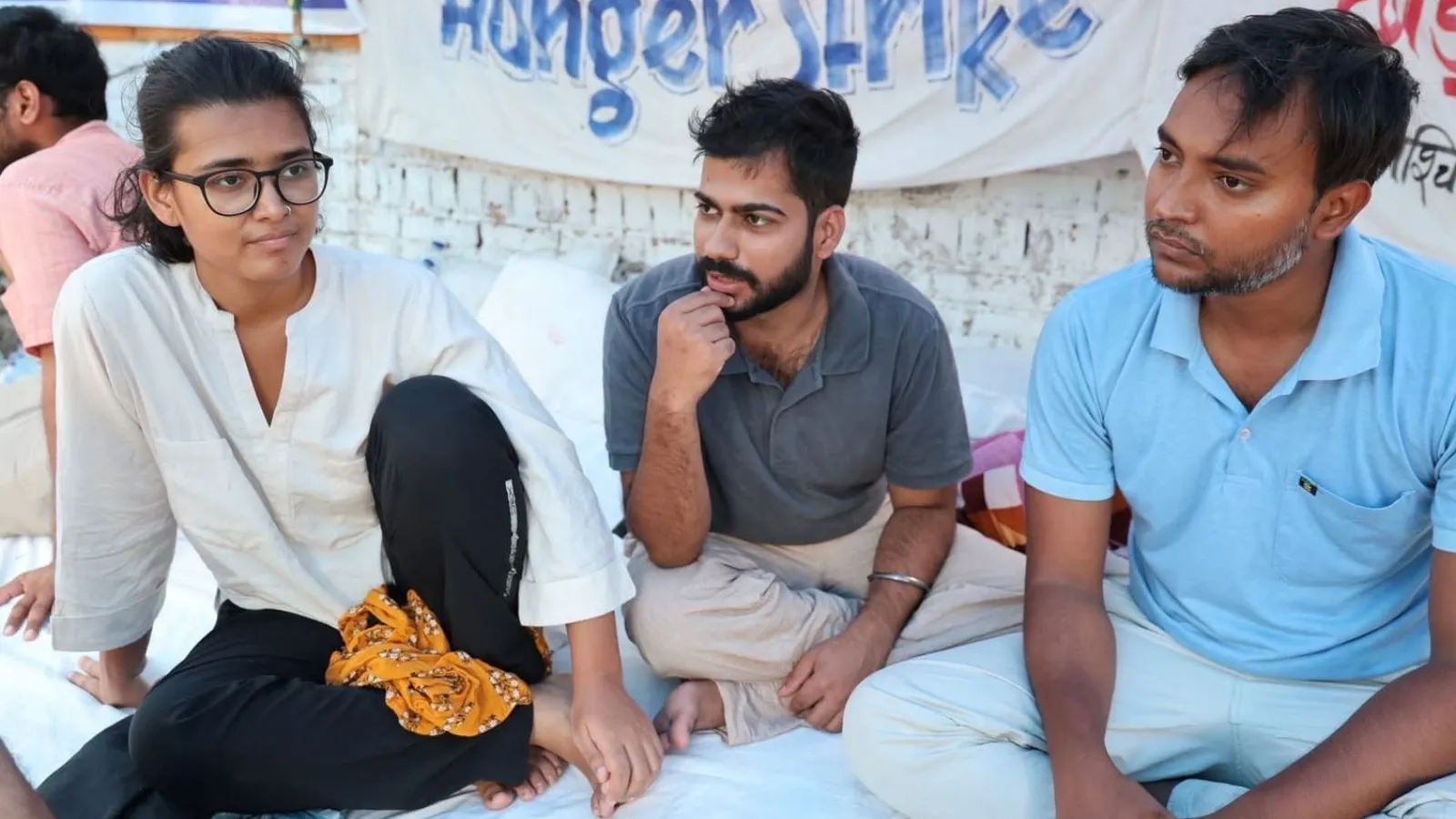
LudhianaUpdated: Jul 22, 2026 09:56 AM IST Aameen (centre) with Neha (left) and Maneesh (right) during 23-day hunger strike at Jantar Mantar, Delhi. (Source: Express Photo)A Punjab-born PhD scholar is among the student leaders spearheading the ongoing agitation in Delhi over the alleged NEET paper leak, accusing the BJP-led Centre of suppressing peaceful protests instead of addressing students’ concerns. Aameen, 28, a PhD student at Dr B R Ambedkar University, Delhi, and joint secretary of the All India Students Association (AISA) university chapter, ended his 23-day hunger strike at Jantar Mantar on Monday along with fellow protesters Neha and Manish.The student-led agitation, organised by the Cockroach Janta Party (CJP), has intensified its demand for accountability in the alleged NEET paper leak and the resignation of Union Education Minister Dharmendra Pradhan. The protests reached a flashpoint on July 18 when educationist and climate activist Sonam Wangchuk, who had been on an indefinite hunger strike for 21 days at Jantar Mantar, was detained by Delhi Police and taken to hospital. Hours after Aameen and the two others ended their fast, Delhi Police allegedly used tear gas shells and lathi-charged protesters marching from Jantar Mantar towards Parliament. Speaking to The Indian Express, Aameen alleged that the police action was intended to injure protesters rather than disperse them. “It is amply clear that they were trying to harm us intentionally. The way tear gas shells were being thrown at the protesters, the intention was to harm, not to control or disperse the crowds. This is not how you treat the youth of your country which is just trying to wake you up to the reality,” he said.Story continues below this ad Aameen is the son of Prof Surjit Singh of Punjabi University, Patiala, and Dr Jagdish Kaur, who teaches at Punjab Agricultural University (PAU), Ludhiana. Describing the police action as “lethal”, Aameen claimed that tear gas shells were fired directly at students in violation of protocol. “The police reaction to our peaceful protest was lethal. It was evident from the brutality they displayed that they were not even trying to dissuade or control the crowd. They were hellbent on harming us. AISA is receiving testimonies and reports from hospitals where injured students are undergoing treatment and they are gut-wrenching. Some protesters were pushed against walls and beaten black and blue. Many times, tear gas shells were fired directly at students even though protocol clearly says they are meant to disperse crowds, not injure people,” he alleged. He further claimed that tear gas shells were fired even while protesters were peacefully sitting at Jantar Mantar.Story continues below this ad “Police was intentionally trying to create a stampede-like situation where there was none and whenever they found students isolated, they were beaten black and blue. We are documenting details of injured protesters and at least 300 were treated at RML Hospital alone,” he said. Aameen also criticised the BJP leadership, alleging that it had chosen to vilify students instead of engaging with them. “They are calling us cockroaches, viruses. Instead of listening to us, they are vilifying students. It is the students who have suffered, not them. BJP leadership, including Nitin Nabin and others, are openly mocking students and saying BJP workers will teach us a lesson. Instead of admitting there was a blunder in the paper leak and discussing it seriously, they are suppressing our voices,” he said. Referring to reports of student suicides linked to the controversy, he added: “Many families have already lost their children to suicide due to the paper leak and still this government is not waking up.”Story continues below this ad On June 29, BJP national president Nitin Nabin, while addressing party workers in Telangana, had criticised the protests, describing the organising groups as “virus and cockroach-like outfits” belongin
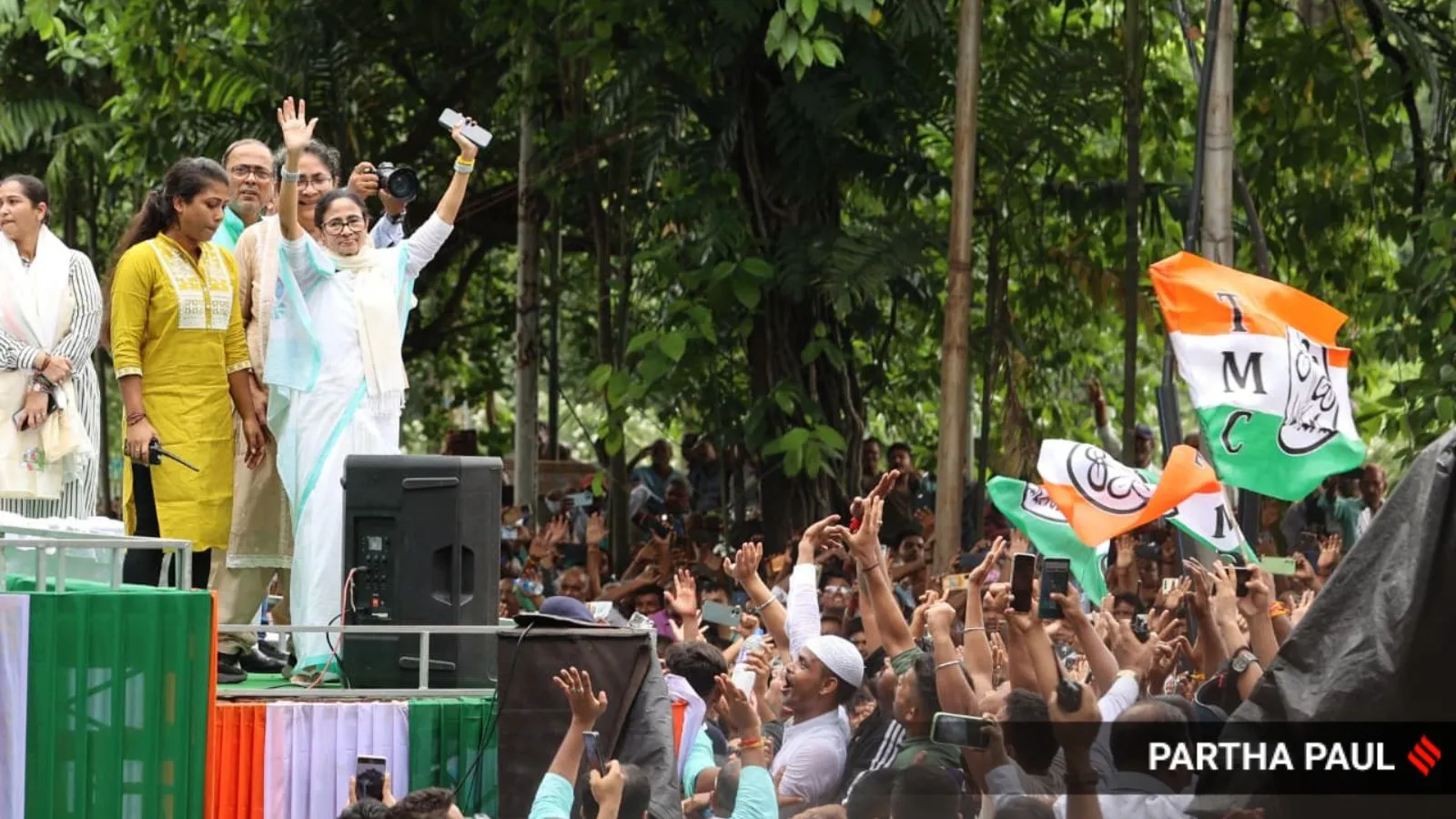
KolkataUpdated: Jul 21, 2026 05:31 PM IST “Running a government requires discipline and adherence to democratic norms. Recent events in Delhi have shown how quickly situations can escalate during political confrontations," Mamata Banerjee said. (Express photo by Partha Paul) Former West Bengal chief minister Mamata Banerjee has said that, if needed, she will personally take part in the protest organised by the Cockroach Janta Party in the national capital. She was speaking at the 21 July Martyrs’ Day event, observed annually to commemorate the 13 Youth Congress workers who were killed in police firing in Kolkata in 1993 during a protest led by Banerjee against the Left Front government.Due to the Kolkata police imposing prohibitory orders in the Esplanade area, the Trinamool Congress had to organise the rally near Birla Planetarium following an order of the Calcutta High Court. “If need be, I will go to Delhi and take part in the protest. Our support to them was there from the beginning, and it will remain so. If we all hit the streets, BJP leaders will run away, as they ran away from here,” she said. “Running a government requires discipline and adherence to democratic norms. Recent events in Delhi have shown how quickly situations can escalate during political confrontations. I have heard reports from Parliament that the circumstances became so tense that even the Prime Minister had to alter his plans. These developments remind us that stability and democratic conduct must always be protected. I want to make one thing clear: If injustice and intimidation continue, our movement will remain on the streets,” she said. “People from Delhi to Kolkata have witnessed what happens when fear and intimidation become political tools. If they cannot win through democratic means, they try to silence voices through threats. But I ask them, how long can fear be used as a weapon? How many people can they continue to intimidate? Our leaders and workers have faced repeated harassment across different parts of the state,” she said. In a message to the opposition parties, she said, “On Rabindra Jayanti, I made it clear that I have no personal ego or bitterness towards anyone. Across India, we fight together as part of the INDIA alliance, and we do the same in Bengal. My priority has never been personal rivalry; it has always been the protection of democracy and constitutional values.”Story continues below this ad “I also want to caution those who believe they are safe simply because they can hold meetings or operate party offices today under political patronage. If democratic institutions continue to weaken, the consequences will not stop with one political party. I do not want democracy to be destroyed or undermined. If there is still a living conscience in society, then this is the time for everyone who believes in democratic principles to stand together,” Banerjee said. She also took aim at TMC rebels: “I want to tell those who have spent years in the Trinamool Congress and later changed their stand that, one day, every mask will come off. The truth cannot remain hidden forever. People will ultimately recognise who stood with them during difficult times and who chose a different path when pressure mounted. Many have left because of fear – fear of the Enforcement Directorate, the Central Bureau of Investigation, or the Criminal Investigation Department (CID). I have never seen the CID so active in my political life. Through different levels of the administration, thousands of cases have been filed against our leaders and workers. Around 40,000 cases have been registered against our party workers. It is almost unprecedented in scale.” © The Indian Express Pvt Ltd Ravik Bhattacharya is a highly experienced and award-winning journalist currently serving as the Chief of Bureau of The Indian Express, Kolkata. With over 20 years of experience in the media industry, Ravik possesses deep expertise across a wide range of critical subject

New Delhi: A 20-year-old woman injured during police action at the Cockroach Janta Party's (CJP) protest in Delhi has been admitted to the intentive care unit (ICU) at the Ram Manohar Lohia (RML) Hospital, sources said on Tuesday.According to sources, a total of 90 students were injured during Monday's protests in the national capital.Sources said that the woman collided with a barricade during police crackdown on protesters at Jantar Mantar. By Tuesday morning, 79 injured students had been discharged from hospitals. Chaos erupted during the CJP's 'Sansad Chalo' march, which drew thousands of supporters and students who attempted to march from Jantar Mantar to Parliament. Protesters demanded the resignation of Union Education Minister Dharmendra Pradhan over alleged irregularities in examinations, including the NEET-UG paper leak controversy. The force also said more than 20 police vehicles were damaged.Union Health Minister JP Nadda visited both Ram Manohar Lohia Hospital and Lady Hardinge Hospital on Tuesday. During the visits, he met injured protesters, enquired about their condition and held discussions with doctors at RML Hospital regarding their treatment.The hospital visits came a day after widespread clashes broke out as protesters attempted to reach Parliament. The march centred on demands for accountability the recent NEET-UG paper leak.CJP Delegation Meets NaddaTwo representatives of the CJP held talks with Nadda on Monday. The delegation, represented by party spokespersons Saurav Das and Ashutosh Ranka, sought three measures -- the unconditional release of activist Sonam Wangchuk, the resignation of Union Education Minister Dharmendra Pradhan, and compensation of Rs 1 crore for the families of NEET aspirants who allegedly died by suicide following the NEET 2026 paper leak controversy.Nadda appealed to the protesters to withdraw their month-long sit-in at Jantar Mantar and cooperate with authorities in restoring normalcy in the high-security zone surrounding Parliament.Nadda said the discussions with the CJP delegation had gone well. Nadda posted on X that the discussions had taken place in a cordial atmosphere. He said the CJP had itself sought dialogue with the government and confirmed that the written memorandum had been submitted after extensive discussions.Protest ContinuesDespite Monday's clashes, protesters returned to Jantar Mantar on Tuesday morning.Police had dismantled the protest stage and tents but demonstrators reoccupied the site following the CJP's call to continue the agitation. A heavy deployment of Delhi Police personnel and Rapid Action Force (RAF) units remained in place throughout the area.The agitation has increasingly drawn wider political attention.Seeking to intensify pressure on the government, Congress leaders Rahul Gandhi, Mallikarjun Kharge and Priyanka Gandhi led a protest march towards Prime Minister Narendra Modi's residence on Tuesday.Congress workers assembled outside Kharge's residence at 10 Rajaji Marg before marching towards the Prime Minister's residence at 7 Lok Kalyan Marg, located a little over a kilometre away.
New DelhiJul 21, 2026 05:55 AM IST SAMAJWADI PARTY MP Dimple Yadav won the hearts of students as well as her party MPs with her caring approach towards the injured protesters at Jantar Mantar. The SP MPs accompanying her to the protest site were in awe of the way Dimple cared for the injured, giving them water and offering a helping hand. Some SP MPs were of the opinion that the party delegation had done its job and should return to Parliament, but Dimple was adamant on marching with the protesters. Some of the MPs were heard praising how she had won the respect of all by showing great resolve and taking the situation “head on”. Purnea MP Pappu Yadav on Parliament premises. (ANI)Clad in CauseWHILE THE Opposition sought to raise multiple issues, ranging from the plight of farmers in southern India to the NEET paper leak, in the Lok Sabha on the first day of the Monsoon Session, Independent Lok Sabha MP Pappu Yadav alias Rajesh Ranjan managed to convey his concerns without raising his voice as his outfit did the talking for him. The Purnea MP wore an overall with questions on the alleged donation theft at the Ram Temple and the paper leak issue. With statements such as “Chanda Chori Par Sarkar Kyun Maun?” and “NTA Ka Brashtachar Band Karo”, Yadav demanded accountability from the government. Fresh Start AS MPs made their way to their seats in Rajya Sabha for Monday morning’s proceedings, ministers and BJP MPs were seen welcoming ex-AAP and TMC members who joined the ruling party since the last session. From Opposition rows, these MPs were moved to the Treasury Benches. Former AAP MP Raghav Chadha, now seated in the third row of the Treasury Benches, could be seen shaking hands with Petroleum Minister Hardeep Puri. Ex-TMC MP Sushmita Dev, re-elected to Rajya Sabha on BJP ticket three days ago, was also welcomed to her new seat by her colleagues.
Discussion (0)