
Loading dispatches...
← Return to NewsroomPolitics
Living by the sun, losing to the rain: life in Marakkanam’s salt pans in T.N.
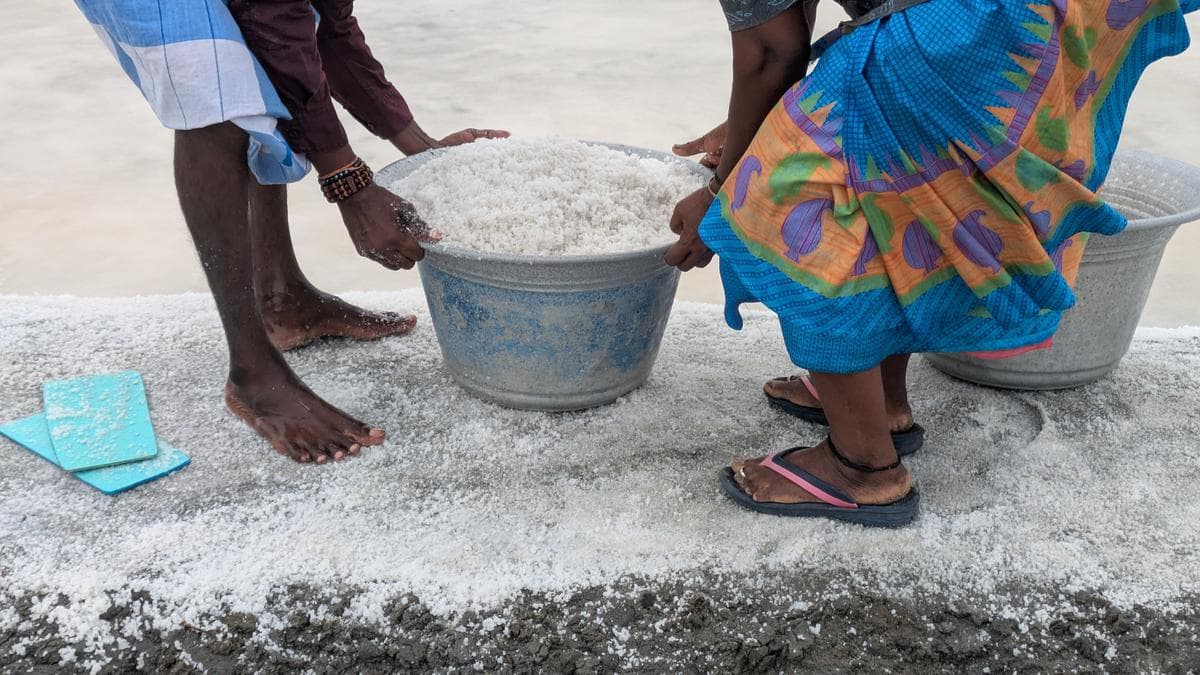
As Tamil Nadu swelters through one of its harshest summers in recent years, many look to the sky hoping for relief in the form of an afternoon shower. But in the salt pans of Marakkanam, rain is the one thing workers cannot afford to wish for. Every spell of rainfall stalls salt production for days and costs them wages. So, even as they endure hours under a relentless sun that reflects off the white salt fields with blinding intensity, they hope for the heat to continue. It is a cruel irony that the weather which leaves workers dizzy, dehydrated, and exhausted is also what keeps their livelihoods alive. This year, temperatures crossed the 40°C mark across several districts well into June, while high humidity made conditions feel even more oppressive. According to the Regional Meteorological Centre (RMC), the State recorded its second-highest average minimum temperature for June since 2015. Nights remained nearly one degree Celsius warmer than normal, offering little relief to workers after a long day of manual labour. The lack of overnight cooling, coupled with prolonged daytime heat, left much of Tamil Nadu reeling under persistent heat stress. Even by mid-July, weak southwest monsoon conditions delayed widespread rainfall, extending heatwave-like conditions across many parts of the State.Livelihoods from salt Salt work is typically available from January to August in Tamil Nadu. Women earn between ₹400 and ₹500 a day, while men are paid ₹700 to ₹750. Workers usually begin around 6 a.m. and finish by 10 a.m., or until whenever the work is done, and come back around 3 p.m. when the volume of harvested salt is high. Harvested salt is piled into heaps and covered with tarpaulin sheets until traders arrive to purchase it. | Seawater is channelled into evaporation pans and left to evaporate for several days until salt crystals form. The crystallised salt is then raked into piles, left to dry further, scraped into baskets and carried to large heaps, where it is covered with tarpaulin sheets until traders arrive to purchase it. Every change in the weather is closely watched, for even a brief drizzle can ruin an entire day’s harvest. A woman works in a salt pan in Karipalayam, Marakkanam, on an overcast day. Instead of finding relief from the cloud cover, workers hurry to harvest as much salt as possible before an impending drizzle can bring production, and their wages, to a halt. | “I always have boils on my feet,” she says. After four hours in the salt pans, Naveneetham shows the boils and blisters on her feet. The day’s work is far from over as she still has cooking and household chores waiting at home. | “We can’t pay anyone else, so we handle everything,” she says. The work is seasonal, which means the family has to manage without an income for nearly six months every year. Naveneetham and her husband, who have leased a small section of the salt pan, return in the afternoon to continue work and check on the salt. Unable to afford hired labour, they do all the work themselves. | That’s how we’ve been eating,” she says. Their son, who completed a B.Com degree, briefly joined them in the salt pans but left for Chennai because he could not bear the heat.Tamil Nadu provides a ₹5,000 annual monsoon relief assistance to registered salt pan workers to help sustain their families during the rainy months (October to December) when production halts. The aid is distributed to families registered under the Tamil Nadu Manual Workers Social Security and Welfar



Discussion (0)