
Loading dispatches...
← Return to NewsroomPolitics
Pidari Ekaveeri: a fierce Goddess, a captivating smile, and Raja Raja’s mother-in-law’s grant
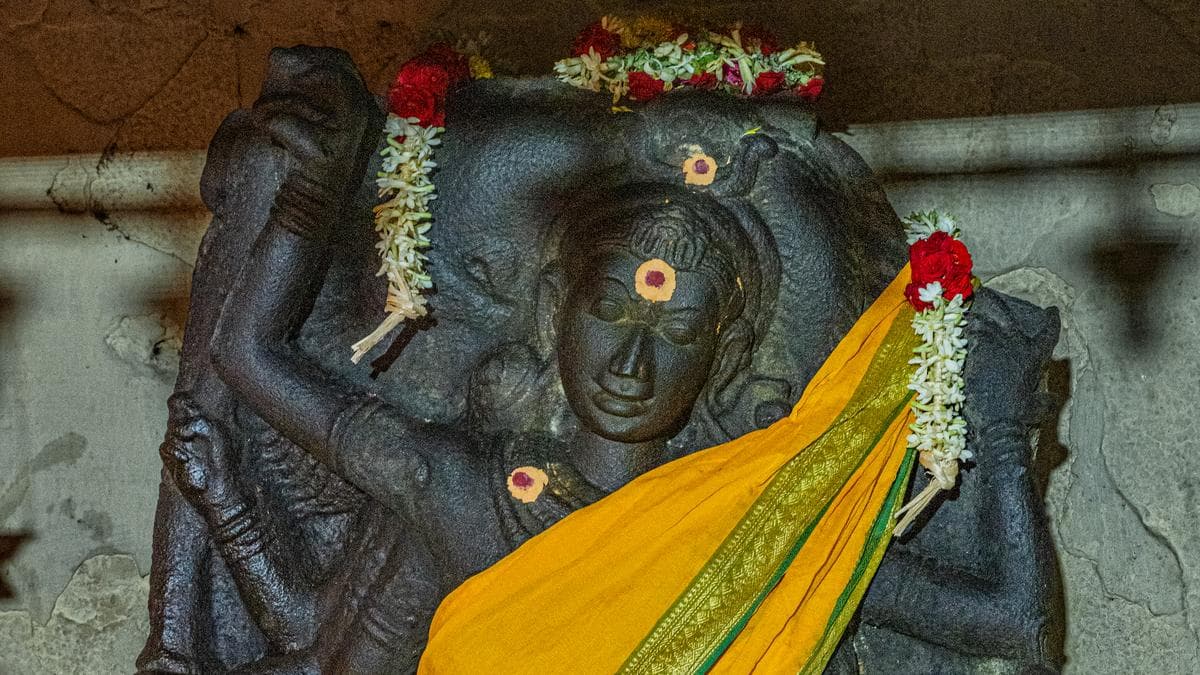
The idol of Pidari Ekaveeri at the Sadaimudinathar Temple at Tiruvalanchuzhi near Kumbakonam. | Vengadesh Within the precincts of the ancient Sadaimudinathar Temple at Tiruvalanchuzhi, near Kumbakonam, stands a remarkable image of Pidari Ekaveeri, a deity whose significance is illuminated by the temple’s inscriptions. The temple, celebrated in the hymns of the Shaivite saints and renowned as an architectural marvel of the Chola period, is also home to inscriptions that reveal an equally fascinating chapter in its religious history.According to the inscriptions, the endowment for the worship of Pidari Ekaveeri was made by Kunthanan Amuthavalliyar, the mother of Queen Thanthisathi Vidankiyar and the mother-in-law of the Chola emperor Raja Raja I. The inscription records that she donated 40 gold coins to six Brahmins — Thalaisenan Valanchuzhian, Ezhuvan Thalaisenan, Sathan Patta Somasi, Patta Somasi Selvan, Aramudhu Tiruvikraman, and Nakkan Pandithan — for conducting Avapala Anjanai, a special ritual of worship.R. Kalaikovan of the Dr. Rajamanickanar Centre for Historical Research, who identified the dilapidated shrine hidden underneath dense vegetation within the Tiruvalanchuzhi temple complex and studied its inscriptions, said the annual interest from this endowment amounted to 30 kalam of paddy. This income was earmarked for performing the Avapala Anjanai, during which food and betel were offered to the deity while a perpetual lamp was kept burning.Dr. Kalaikovan further noted that when temple endowments were resettled during the reign of Rajendra II, an annual allocation of 15 kalam of paddy continued to be earmarked for the worship of Pidari Ekaveeri, demonstrating the continuity of the cult across successive Chola reigns.Today, Pidari Ekaveeri is identified as Ashtapuja Durgai, because she is depicted with eight arms and now stands outside the sanctum of the Vandarkuzhali shrine. The remnants of the old shrine that used to house the idol of Pidari Ekaveeri. | Vengadesh Originally, the deity was inside the dilapidated shrine. After that shrine collapsed, the image was relocated to its present position. The overgrown remnants of the old shrine, still concealed beneath thorny bushes within the temple complex, silently testifies to its forgotten past.Chola artistryThe sculpture itself is a masterpiece of Chola artistry. The goddess is seated gracefully in utkuti asana, her face adorned with a serene and captivating smile that contrasts strikingly with her fierce iconographic features. Her matted locks spread majestically, crowned by a skull embraced by two serpents. An owl forms the ornament of her right ear, while a tiny human figure hangs from her left ear as an earring. Across her torso she wears a garland of skulls in place of the sacred thread, combining beauty, power, and esoteric symbolism into a single compelling image.Dr. Kalaikovan pointed out that although several inscriptions from the Chola period refer to Pidari deities, the corresponding images have rarely been identified. “Even in temples where Pidari images survive, there are no inscriptions to establish their antiquity. At Tiruvalanchuzhi, however, we are able to directly connect the inscriptions with the deity still enshrined in the temple. Pidari Ekaveeri is probably the oldest identifiable Pidari image in Tamil Nadu,” he said.The image of Pidari Ekaveeri is therefore much more than an exquisite work of Chola sculpture. Together with the inscriptions documenting its royal patronage and ritual traditions, it stands as an invaluable historical record, preserving one of the earliest identifiable traditions of Pidari worship in Tamil Nadu and offering a rare window into the religious life of the Chola age. Published - July 05, 2026 11:35 pm IST


Discussion (0)