
Loading dispatches...
← Return to NewsroomPolitics
Telangana physiotherapy student secures job in Germany through TOMCOM; starting monthly salary ₹3.5 lakh

Labour, Employment, Training & Factories and Mines and Geology Minister G Vivek Venkatswamy handing over appointment letter to P. Aishwaryarani | 5 lakh after completing German language training, Telangana Overseas Manpower Company said in a statementP. Aishwaryarani contacted TOMCOM to find employment. As a next step, she took a course in German language and completed its B2. Thus, achieving a requirement for placement in Germany’s healthcare sector.Labour, Employment, Training & Factories and Mines and Geology Minister G Vivek Venkatswamy handed over her appointment letter and congratulated her.Mr. Vivek said that the Telangana government was committed to creating overseas employment opportunities by equipping youth with skills and foreign language proficiency. He said TOMCOM was helping prepare young professionals for global careers through skill development, language training and placement support.Ms. Aishwaryarani’s remuneration is expected to increase after completing the mandatory professional training and certification requirements. Director of Employment and Training Kanthi Wesley also congratulated her and encouraged Telangana youth to utilise TOMCOM’s training programmes. Published - August 07, 2026 01:49 pm IST
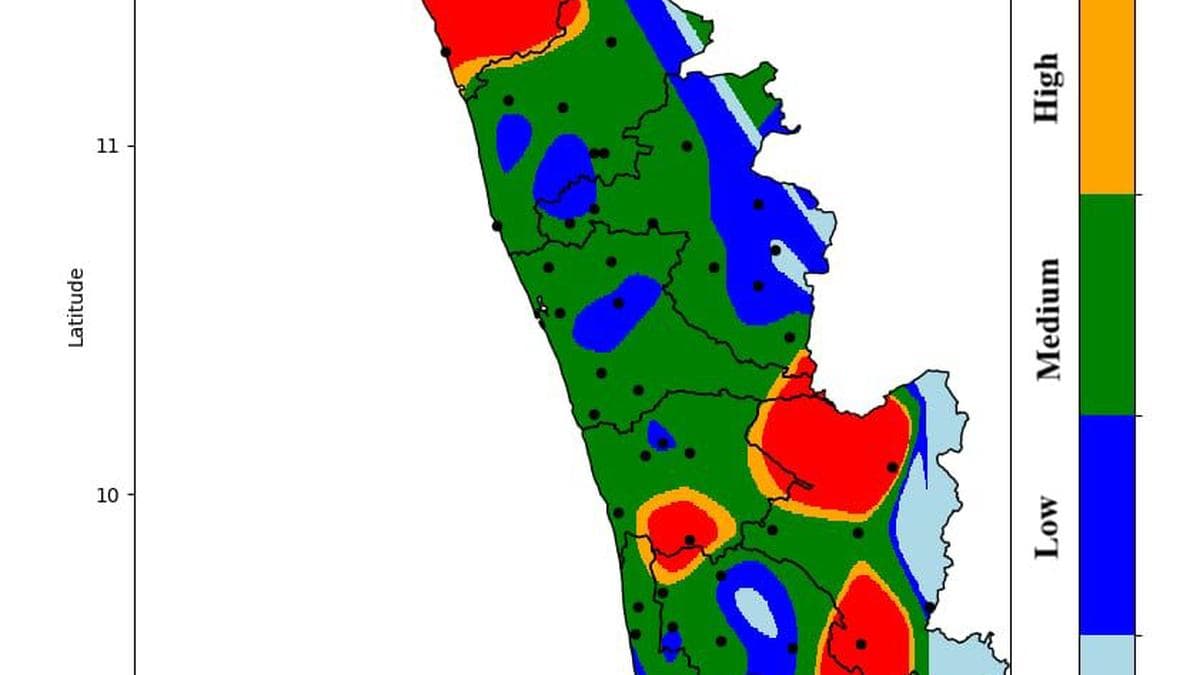
A map prepared by the scientists at the India Meteorological Department using the rainfall data from 1901 to 2025 shows the areas vulnerable to extreme rainfall events in Kerala during monsoon. Under fire for the sluggish response to the rain-related calamities in the State over the last few days, the State government on Monday sought to blame the India Meteorological Department (IMD) for a delay in relaying the weather forecast. But experts say it also unravels the absence of long-term mitigation plans to tackle increasingly frequent rain-induced calamities in the State.Chief Minister V.D. Satheesan on Monday said the flooding was triggered by extremely heavy rainfall, with some places receiving more than 350 mm of rain. He said the State received the IMD’s warning of an extreme rainfall event only around midnight, leaving little time for authorities to carry out large-scale evacuations.However, the IMD’s 125-year rainfall dataset, covering 110 weather stations across Kerala from 1901 to 2025, shed enough light on the State’s most vulnerable regions during the monsoon, including areas prone to extreme rainfall. Using this historical dataset with machine learning and Geographic Information System (GIS) techniques, weather scientists have prepared a rainfall vulnerability map that highlights several disaster-prone regions.Colour-coded zonesThe map shows that many parts of north Kerala, Idukki and Pathanamthitta, particularly areas along the Western Ghats, are highly susceptible to extreme rainfall events. The map categorises the State into different colour-coded zones based on rainfall intensity. Areas marked in red have experienced extreme rainfall events repeatedly over the past 125 years, while orange zones receive heavy rainfall of lower intensity. Green, blue and light blue represent progressively lower rainfall categories.Notably, the recent weather events in Idukki, Pathanamthitta and Kottayam, as well as the debris slip in Wayanad last month that claimed eight lives, occurred in areas classified as red zones. According to weather experts, these regions become particularly vulnerable whenever the offshore trough extends up to Kerala along India’s west coast. Their geographical characteristics, combined with prevailing monsoon conditions, make them highly susceptible to heavy and very heavy rainfall, they say. The State need not wait for weather alerts to be upgraded before initiating preparedness measures.The challengesAccording to Thara K.G., a geologist and disaster management expert, rainfall warnings are only one component of disaster preparedness. Kerala’s biggest challenge is the absence of a long-term disaster mitigation strategy. “The State cannot evacuate an entire population solely based on rainfall alerts,” she said. “What Kerala lacks is a comprehensive long-term plan to reduce the impact of extreme weather events. This problem is further aggravated by the absence of effective land-use planning,” said Ms. Thara.A senior official associated with the Kerala State Disaster Management Authority said implementing major policy reforms remains difficult in a densely populated State like Kerala. Measures such as enforcing land-use regulations or removing accumulated silt, sand and soil from rivers and other waterbodies often face significant resistance. “Strong policy-level intervention is essential to bring about meaningful reforms in the sector,” the official said. Published - August 04, 2026 05:45 am IST

At the Kawal Tiger Reserve, conservation efforts have been overshadowed by a disturbing pattern of tiger disappearances and rampant poaching. | While the southern forests have emerged as a model of successful conservation, the northern landscape continues to grapple with tiger disappearances and poaching.In the south, it is a resounding success, with the tiger population growing phenomenally in less than a decade in the Amrabad Tiger Reserve. According to the All India Tiger Estimate, the number of tigers in the reserve has increased from 14 in 2018 to 42 now, excluding cubs less than a year old.The picture is starkly different in northern Telangana, which includes the Kawal Tiger Reserve. Here, conservation efforts have been overshadowed by a disturbing pattern of tiger disappearances and rampant poaching. Very recently, a tiger that had roamed the non-forest districts of northern Telangana for several months vanished under mysterious circumstances soon after entering the forests of Nizamabad.While the contrast between north and south is routinely attributed to habitat fragmentation and failure in habitat management by Forest department officials, the actual reason lies elsewhere, say experts.Amrabad Tiger Reserve is predominantly inhabited by the Chenchu tribe, who do not view land primarily as a means of economic advancement. Under the Forest Rights Act settlements, most families received less than five acres of land, reflecting their limited dependence on agriculture. As a result, they have relatively little interaction with outsiders or political interests.This changes for northern Telangana where majority of the population depends on agriculture as its main source of income, is politically well connected and hence, has regular interaction with non-forest dwellers. The drive for economic uplift defines their behaviour towards nature, which is marked by frequent forest felling for agricultural expansion, violent confrontations with forest officials, and widespread poaching.“Only by promoting Tiger Economy can we address this issue sufficiently,” says a Forest official under the condition of anonymity. “Tigers could be conserved effectively countrywide only where eco-tourism activities were promoted in tiger reserves.”He terms the oft-stated reasons such as habitat fragmentation as excuses, and shows the example of Tipeshwar which has a sizeable tiger population despite it being a fraction of Kawal in size. Unless poaching is countered with a strategy that includes the inhabitants of the villages as economic beneficiaries, tiger numbers will not go up in north Telangana, he says.Telangana’s Principal Chief Conservator of Forests (Head of Forest Force) cum Chief Wildlife Warden Vinay Kumar is in agreement about the role of Chenchu community in tiger numbers of Amrabad.“The most inspiring aspect of Amrabad’s recovery is the partnership with the indigenous Chenchu community, the members of which serve as wildlife watchers, assist in fire prevention, support habitat protection, participate in monitoring activities and contribute significantly to safeguarding the reserve,” Mr.Vinay Kumar says.When responsibly managed, ecotourism transforms wildlife into a source of local pride and economic opportunity, which creates strong public support for conservation, he says, and adds that the road ahead leads to creating greater livelihood opportunities for local communities through conservation-linked enterprises and responsible ecotourism. Published - July 29, 2026 12:28 am IST
The State-level expert committee constituted to assess the impact of El Nino in Telangana has finalised its recommendations to mitigate the likely effects of the weather phenomenon. The committee, headed by Planning Board Vice-Chairman G. Chinna Reddy is expected to submit its report to Chief Minister A. Revanth Reddy on Monday.Mr. Chinna Reddy said the committee had prepared contingency plans at the village, mandal and district levels, including measures such as crop diversification and the cultivation of alternative crops. The recommendations were finalised following a meeting held on July 22.The committee is expected to recommend the supply of pulse and cereal seeds, along with drip irrigation units, to farmers at subsidised prices. It is also likely to suggest ensuring timely access to crop loans for eligible farmers and considering a moratorium on the repayment of existing farm loans, sources said.The district-level plans include expanding micro-irrigation, undertaking groundwater recharge measures and ensuring the advance availability of contingency crop plans and seeds. The proposals also seek to reduce farmers’ dependence on water-intensive crops and strengthen coordination among various government departments.The committee has further recommended village-level awareness programmes on the possible impact of El Nino, drought management, water conservation and climate-resilient agricultural practices. The district-wise contingency plans are aimed at strengthening preparedness and minimising the impact of adverse weather conditions on agriculture and rural livelihoods. Published - July 25, 2026 08:25 pm IST



Discussion (0)