
Loading dispatches...
← Return to NewsroomPolitics
Govt. gives nod to acquire land to lay new broad gauge railway line between Mannargudi and Pattukottai
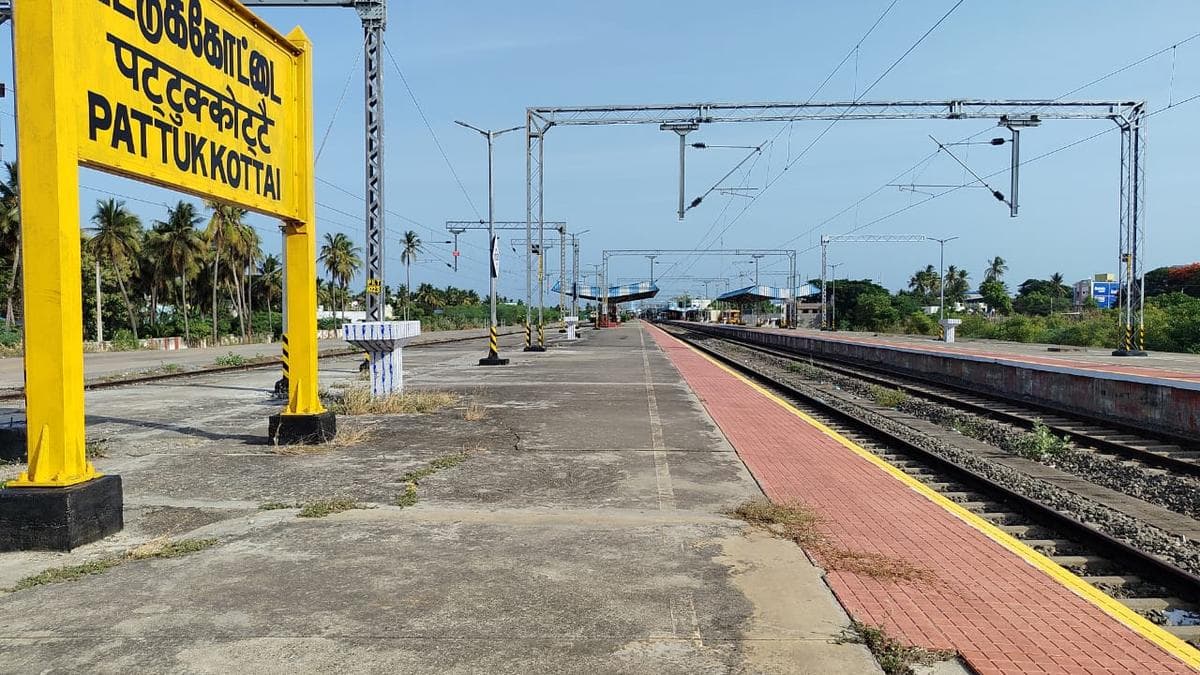
A view of the Pattukottai railway station | The move gives a thrust to the 41-km railway line project, which has remained on paper for nearly 14 years after its announcement by the Railway Ministry in 2012. An order according sanction for the acquisition of private and government poromboke land was issued a few days ago based on the proposal of the District Collectors of Thanjavur and Tiruvarur and the recommendation of the Commissioner of Land Administrative Reforms. A copy of the government order has been forwarded to the Chief Engineer, Construction, Southern Railway.The government has sanctioned the creation of 13 posts of special staff each in Thanjavur and Tiruvarur districts for the land acquisition work in Thanjavur and Tiruvarur districts.Wet, dry, manavari and government poromboke lands are to be acquired in the two districts. In Thanjavur district, 89.49 hectares of patta lands and 17.63 hectares of government poromboke lands in Nadiyammalpuram and 14 other villages in Pattukottai taluk are to be acquired.Officials appointedIn Tiruvarur district, 87.53 hectares of patta lands and 8.92 hectares of government poromboke lands in Ramapuram and 14 other villages in Mannargudi taluk are to be acquired under the Tamil Nadu Acquisition of Land for Industrial Purposes Act. The District Revenue Officers of Thanjavur and Tiruvarur have been appointed as Land Acquisition Officers in their respective districts.“The Mannargudi-Pattukottai BG line project was announced in 2012-13 by the Railway Ministry during the Congress-led United Progressive Alliance regime. It was brought as an extension of the Mayiladuthurai-Tiruvarur-Karaikudi and Thiruthuraipoondi-Agasthiyampalli gauge conversion projects. Tenders were initially floated for the construction of a bridge across Bamini river in Tiruvarur district. The bridge work started with construction of a few pillars and subsequently stopped. The bridge work across Kannanaru and Nasuvani river never took off and the project remained only on paper due to delay in land acquisition,” said D. Manoharan, a former railway employee and a former office-bearer of a trade union based in Mannargudi.Cost escalationThe estimated cost of the project was initially pegged at over ₹200 crore but now it had risen by over 300%, said Mr. Manoharan. Vexed over the inordinate delay in its implementation, various associations staged a rally in Mannargudi a couple of days ago demanding early implementation of the project which will have two block railway stations enroute: Paravakottai and Madukkur.“The sanction for land acquisition after a long time is a definitely welcome move as it would finally give a big push to the project which has faced inordinate delay. The railway administration should no longer delay releasing funds and sanction at least ₹50 crore initially towards payment for land acquisition so that the project takes off,” said Mr. Manoharan. The project once implemented would enhance rail connectivity not only in the delta region but also in the southern districts, he added. Published - July 27, 2026 07:42 pm IST
The project will initially be implemented on a pilot basis by establishing several small shelters at different locations, each capable of accommodating at least 10 street dogs. | RAGESH Animal welfare organisations have welcomed the Kozhikode Corporation’s decision to invite expressions of interest (EOIs) from individuals and organisations willing to establish and operate shelters for street dogs as part of its efforts to find a lasting solution to the stray dog menace within the city limits. However, they cautioned that identifying suitable land for the shelters would be the biggest challenge.The decision was taken at a meeting of officials, public representatives and members of animal welfare organisations convened by Mayor O. Sadasivan recently. The meeting discussed a series of scientific and humane measures to address the issue.Officials said the project would initially be implemented on a pilot basis by establishing several small shelters at different locations, each capable of accommodating at least 10 street dogs. Individuals and organisations from outside the Corporation limits would also be eligible to submit proposals.A three-member committee will be constituted to identify aggressive stray dogs and facilitate their relocation to the shelters.“NGOs have assured the Corporation that they can take care of feeding the dogs shifted to these shelters. If required, the Corporation will also extend the necessary support. We believe this collaborative approach will make the project more practical and sustainable,” an official said.In a statement, Mr. Sadasivan said the meeting had also decided to identify a suitable site for a larger shelter capable of accommodating more animals in the future.“The Corporation is focussing on developing sustainable, long-term solutions rather than temporary measures to address the stray dog menace. The initiatives seek to ensure public safety while safeguarding animal welfare and will be implemented with public cooperation,” he said.A recent survey by National Service Scheme (NSS) volunteers from the College of Veterinary and Animal Sciences, Pookode, estimated that there are 28,510 street dogs within the Corporation limits.Representatives of animal welfare organisations said they supported the civic body’s initiative but stressed that finding appropriate locations remained the biggest hurdle.“I attended the meeting. It witnessed fruitful discussions, and we welcome the decisions taken. Everyone is willing to establish and operate shelters for stray dogs. However, the biggest challenge is finding suitable land. Even if land is identified and a shelter is proposed, residents are likely to object. To a certain extent, their concerns are understandable. The success of the initiative will depend on identifying suitable sites,” said Sudina Anuraj Varma, a member of People For Animals.Ms. Varma said relocating all stray dogs within the Corporation limits to shelters was neither feasible nor desirable. “Instead, the shelters should primarily accommodate abandoned pet dogs, particularly aggressive animals, those showing symptoms of rabies, dogs suffering from diseases such as distemper, severely debilitated animals, and dogs injured in accidents,” she added.The Corporation also decided to organise special ward-level camps to streamline the licensing and microchipping of pet dogs. Published - July 27, 2026 01:16 am IST

Discussion (0)