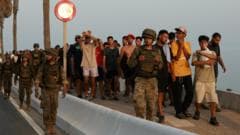
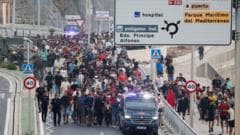
Hundreds of migrants arrested near Ceuta border in latest crackdown
Moroccan state broadcaster Medi 1 TV said 294 migrants from sub-Saharan Africa were arrested on Saturday while attempting to enter Ceuta.

Moroccan state broadcaster Medi 1 TV said 294 migrants from sub-Saharan Africa were arrested on Saturday while attempting to enter Ceuta.


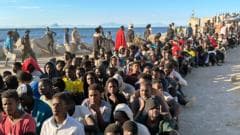
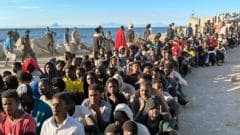
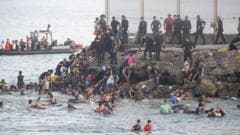
Nearly 300 migrants and 61 alleged facilitators detained during mass migration attempt.Moroccan security forces have arrested hundreds of migrants trying to reach the Spanish exclave of Ceuta by land and sea as authorities tightened security along the border following calls for a new mass crossing.Moroccan state broadcaster Medi 1 TV said 294 migrants from sub-Saharan Africa were arrested on Saturday while attempting to enter Ceuta. Authorities also arrested 61 Moroccans accused of facilitating the migration attempts, the broadcaster reported.Recommended Stories list of 4 itemslist 1 of 4Morocco boosts Ceuta security amid calls for mass migrant crossinglist 2 of 4Moroccan police arrest over 100 migrants trying to reach Spanish enclavelist 3 of 4Moroccan police intercept migrants heading for Ceuta enclavelist 4 of 4Moroccan migrants stage sit-in as thousands remain stranded in Ceutaend of listThe latest attempt comes two weeks after more than 72,000 would-be migrants, driven by poverty and misinformation, rushed towards Ceuta in one of the deadliest migration crises to hit the region. At least 90 people died on both sides of the border, according to official numbers, while human rights groups reported higher figures.The attempted crossings followed a surge in social media posts calling on people to make their way to Ceuta, a Spanish city on Morocco’s northern coast.In response, Moroccan and Spanish authorities beefed up security presence in the area.‘We don’t want to go back to Morocco’On Sunday, hundreds of migrants staged a protest on a popular urban beach, urging Spanish authorities to grant them asylum instead of sending them back to Morocco.They were among the estimated 5,000 to 8,000 who remained in Ceuta after the mass border crossing two weeks ago.With the city’s resources overstretched, most migrants were living in precarious conditions on Trampolin beach or the city’s outskirts while awaiting a chance to journey on to continental Europe.“We’re sleeping next to the sea, with cold and bad smells. We’re suffering a lot,” Ayoub Elarroud from Morocco’s Tetouan told the Reuters news agency, adding that police were blocking them from going to the city centre.The protesters held up Spanish flags and banners reading, “We don’t want to go back to Morocco” and “We are also human”, while chanting slogans such as “We’re tired” or “We need a solution”.Earlier this week, Interior Minister Fernando Grande-Marlaska said migrants who had entered irregularly would not be allowed to stay in the exclave, travel to mainland Spain or obtain legal status, except in rare cases involving extreme vulnerability.A senior Moroccan diplomat previously told The Associated Press news agency that more than 20,000 Moroccan security personnel are deployed along the border with Ceuta each day, at a cost of hundreds of millions of dollars.Thousands of migrants from across Africa and beyond travel to Morocco each year, fleeing conflict, poverty and instability, and seeking a route into Europe.Many attempt to reach Ceuta or Melilla, another Spanish exclave on Morocco’s northern coast, hoping eventually to make their way to mainland Spain for better economic opportunities.

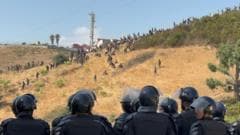
Moroccan authorities intercepted dozens of migrants seeking to cross into the Spanish North African exclave of Ceuta on Saturday.More than 100 people were blocked trying to make their way to the border on the outskirts of the town of Fnideq, according to Moroccan security sources cited by Spanish media and the Reuters news agency.It comes a fortnight after roughly 78,000 migrants arrived in the exclave by sea in a matter of hours - 100 of whom died, according to the city's mayor.Both Spanish and Moroccan authorities had reinforced security in the area after the influx, and amid suggestions on social media that a second mass crossing attempt would take place this weekend.The security sources said 111 people had been detained in or around Fnideq - known in Spanish as Castillejos - about 3km (1.8 miles) from the border, the majority of whom were from sub-Saharan Africa.Moroccan police - including some in riot gear - reportedly used tear gas to disperse groups of migrants gathered on nearby hills.Earlier this week, Rabat said it was monitoring "the circulation of social media posts and messages of unknown origin" calling for a mass crossing Saturday, warning it would prosecute organisers and participants.

Spain has threatened to impose counter-measures on Italy if it fails to lift border controls introduced following the mass crossing of migrants into the Spanish exclave of Ceuta.Roughly 78,000 migrants from neighbouring Morocco arrived in Ceuta by sea in a matter of hours on Thursday and Friday last week.In the wake of the crossings, which saw around 100 people die, Italy partially suspended its Schengen arrangement with Spain, which included the closure of maritime and air entry points as well as the reinforcement of land border controls.On Friday, Spain called the move "unjustified" and "discriminatory against the Spanish population" and demanded it be reversed by Sunday 9 August.It added it would introduce "proportionate measures to protect the interests and dignity of its citizens" if Italy failed to reverse its decision.The statement did not specify what these reprisals would be.Italy promptly responded to Spain's warning, saying it would not accept "ultimatums or impositions" from Madrid and that it plans to keep border checks in place until at least 15 August - when it said Spain "expected a new wave of migration" to hit Ceuta.It remains unclear exactly why tens of thousands of migrants attempted to cross into Ceuta, but the EU's Migration Commissioner Magnus Brunner has suggested criminal networks spreading disinformation were to blame - an assertion the Spanish government has agreed with.The crossings came after Spain's Supreme Court ruled that migrants stopped at sea while trying to reach Ceuta or Melilla cannot be summarily returned to Morocco.The two exclaves have long been a bone of diplomatic contention between Spain and Morocco, which does not recognise Spanish sovereignty over them.The number of people swimming to Ceuta at once has raised questions about why Morocco's border guards did not attempt to stop themThe Ceuta crossings have also caused a diplomatic rift among EU nations that share open borders as part of the Schengen area.Italy's decision to suspend its agreement was backed by Finland and Denmark, while the Czech Republic called for Spain's membership to be temporarily suspended.Morocco, for its part, has laid blame for the crisis on Spain's Supreme Court, with an unnamed government source briefing local outlets that "the deterrent element of the system collapsed and the dam gave way, not under the weight of the criminals, but of a judge's decision".Meanwhile, Moroccan media is reporting fresh online calls to co-ordinate another mass border-crossing attempt, similar to what was seen before the influx last week.Nearly 1,400 minors, some of them "very young boys and girls", still remain in Ceuta following last week's crossings, Spanish Youth Minister Sira Rego said on Friday.She added: "There was a situation in which the system was overwhelmed, but it is now being brought under control. It is true that there are many boys and girls, and the procedure takes time."We wanted to make clear that we have prioritized the most vulnerable cases."

Around 72,000 migrants crossed into the Spanish territory in North Africa between 30 and 31 July, Spain's Interior Minister Fernando Grande-Marlaska said. He added that an estimated 70,000 have since been returned to Morocco.At least 75 people died on the Spanish side of the border, while 11 deaths were reported in Morocco.Tuesday's meeting was called after several EU members expressed concern over Spain's handling of the crisis, with Italy describing images from Ceuta as "shocking" and suspending its Schengen agreement with Spain.Irish Justice Minister Jim O'Callaghan, who chaired Tuesday's meeting, said the EU stood in solidarity with Spain and that migration required "a united European response".The meeting had been expected to draw some tension, following earlier criticism of Spain from some EU nations.On Thursday, Italy's right-wing Prime Minister Giorgia Meloni said such "uncontrolled immigration" was a security threat to Europe.Italy suspended its Schengen zone agreement with Spain on free movement on Friday, but since the two countries do not share a land border, this would only apply, effectively, to flights - which appears simply to mean extra checks for passengers.The Schengen agreement eliminates border checks and now encompasses more than 450 million people and 29 countries in Europe.Figure caption, Watch: Migrants started to return to Morocco after thousands entered Spain's Ceuta on 30 JulyFinland and Denmark backed Italy's move, while Czech Prime Minister Andrej Babiš urged a temporary suspension of Spain's Schengen membership.Italy, along with Denmark and 20 other nations, later sent a letter expressing their concern over the Ceuta migrant crisis.In response, Spanish Prime Minister Pedro Sánchez said he had "serious concerns" about some European governments and pointed out that Ceuta was not part of the Schengen area.While most had shown "support and solidarity", he said other European governments had chosen to attack Spain, "driven by prejudice, fake news, ignorance, or political interest".Speaking after the meeting on Tuesday, Grande-Marlaska said the Schengen zone had not been compromised and that he hoped Italy would lift any added controls "as soon as possible".Denmark's immigration minister Morten Bødskov said he was "very satisfied" with Spain's quick response, but added that the incident showed "it is absolutely crucial that we have control over the EU's borders".Speaking afterwards, EU commissioner Magnus Brunner said the incident had been a "test" of European resilience and border security - which he said it had successfully "passed".Brunner added that the EU had offered Spain emergency financial support to strengthen its borders and manage the crisis.It is unknown exactly what led the tens of thousands of migrants to cross from Morocco into Ceuta in a span of just a few hours last week.Brunner said it is thought that the influx was fuelled by criminal networks and social media disinformation.Ayoub, a 23-year-old administrative assistant from Casablanca in Morocco, said he decided to swim across to Ceuta after seeing the situation unfold on social media.Speaking to BBC World Service Newshour programme, he described it as "the most traumatic experience I've ever had in my life".Ayoub said he wanted to reach Europe for a better quality of life."I haven't risked my life for nothing, I want to be free, I want to pursue my studies and I want a chance in life," he said.The crossings came after Spain's Supreme Court ruled that migrants stopped at sea while trying to reach Ceuta or Melilla, another Spanish exclave, cannot be summarily returned to Morocco.Moroccan authorities later said that it had

European Commission President Ursula von der Leyen has called for "united action" on border security after the chaotic influx of tens of thousands of migrants from Morocco into the Spanish exclave of Ceuta last week.Spain estimates that about 69,500 migrants have now returned to Morocco, exceeding initial estimates of 50,000. The official death toll on the Spanish side of the border stands at 72, with 11 deaths on the Moroccan side.On Tuesday, EU interior ministers will have emergency talks by video conference to discuss the issue.The scenes in Ceuta have strained relations among some of the EU's 27 member states.In a letter to Spanish Prime Minister Pedro Sánchez, von der Leyen praised his "swift handling" of the crisis.But she added: "From this incident, it is clear that we must do more to further strengthen our borders at critical points."In response to the Ceuta crossings, Italy temporarily suspended the Schengen arrangement with Spain.The Schengen agreement eliminates border checks and now encompasses more than 450 million people and 29 countries in Europe.Finland and Denmark backed Italy's move, while Czech Prime Minister Andrej Babiš urged a temporary suspension of Spain's Schengen membership.In response, Sánchez said he had "serious concerns" about some European governments and pointed out that Ceuta was not part of the Schengen area.While most had shown "support and solidarity", he said other European governments had chosen to attack Spain, "driven by prejudice, fake news, ignorance, or political interest".In her letter to the Spanish PM, von der Leyen warned that "the protection of all our external borders is a shared European responsibility", while calling for "vigilant monitoring and the use of physical barriers where needed".Tuesday's video conference will be a chance to draw "lessons" from the Ceuta episode, von der Leyen said, warning the challenges of illegal immigration require "a common European response, united action and solidarity".She urged the EU to "double down" in five areas: preventing irregular migration in the first place via cooperation with partner states; strengthening external borders; implementing early warning systems; dismantling smuggling networks and reinforcing returns.Sánchez has accused migrant traffickers of exploiting a decision recently made by the country's supreme court which constrained the government's right to immediately deport people who had arrived by sea.The country's Interior Minister, Fernando Grande-Marlaska, said on Saturday that the situation had almost returned to normal and the country was working on an inflatable barrier to prevent illegal migration via the water.

Whatever the cause, Spain's socialist prime minister is angry with the response.Pedro Sanchez has hit out at some in the EU for "attacking" Spain in this crisis, playing politics instead of showing support.He meant Italy, above all.Fratelli d'Italia, the hard-right party of Prime Minister Giorgia Meloni, had been quick to post images of migrants racing through the streets of Ceuta."This is the Sanchez model the Italian left wing likes so much," the caption crowed.Meloni then announced she was suspending Italy's Schengen agreement with Spain that allows for the free movement of people, citing a security threat.Madrid is fuming.The way Spain sees it, the crisis has been contained and Ceuta is not in the Schengen zone so Moroccan migrants were never going to head for mainland Europe, unchecked.Meloni knows that.But she faces elections next year with her coalition losing ground to a new and virulently anti-immigrant party. This was a chance to sound tough herself and claw back votes and she leaped on it.Italy is not the only country to see Spain as soft on migration, though.Meloni's call for an urgent meeting of interior ministers to be held on Tuesday was signed by almost two dozen EU heads of state, calling for the elimination of all policies that could be "pull factors" to Europe.Above all, they mean Spain's controversial move to allow hundreds of thousands of undocumented migrants apply for residence and work permits and "regularise" their status.The government's pragmatic: Spain is ageing and needs workers.But those who flocked to the beaches of Ceuta this week were not heading to sign up for a campaign that's already closed.Sanchez himself points instead to a recent ruling by Spain's Supreme Court: it said those who enter by sea cannot be pushed back immediately.The prime minister argues that was misrepresented by smugglers to promise an easy path to Europe.The crowd heading for Ceuta didn't need to pay smugglers, though, because most were Moroccan and the route is well known.The message was actually spread online.Migrants have shown social media posts to reporters with people shouting that "Spain is Open" and jumping into the sea.Multiple accounts we've checked ourselves show young people in wetsuits and flippers, or filming themselves already swimming, mixed with pictures from inside Ceuta itself.Some have only been active for weeks. Several have tens of thousands of likes.All their promises were false.The crowds who made it to kiss the shore in Ceuta with joy were met with nothing. Without food or shelter, and with no way on to continental Europe, most quickly turned back.So have migrants been "weaponised" as happened a few years back in Belarus, for example?If so, who did it?For now we only see those enjoying the results.The global right wing are "hyperventilating with happiness", as journalist Andrea Rizzi wrote in Spain's El Pais newspaper.US President Donald Trump, angry at Spain for opposing his war on Iran, has talked of a "catastrophe" and an "invasion". Like Meloni, he has an election looming.Russia has been gloating, too: it loves chaos and division in Europe. Anything to weaken Ukraine's allies.As for Morocco, it's blaming "criminal organisations". But its border guards must have seen the crowds building.The last time something similar happened, albeit smaller, Spain and Morocco were at loggerheads over Western Sahara, a former colony.There are new tensions, right now.Sanchez is emphatically not blaming Morocco for what happened, calling Rabat a "good ally".But his critics call that appeasement and say he should be "showing teeth".
com Spain Says Most Immigrants Who Overran Its African Enclave Have Left WSJ Spain pushes migrants home as Ceuta vents over ‘invasion’ Financial Times Socialist Spanish PM blasts Meloni over restored border controls after Ceuta surge, demands emergency meeting Fox News The Supreme Court ruling at the center of Spain’s Ceuta migrant crisis CNN

NewsFeedSpain says “virtually all” of the estimated 60,000 migrants who stormed its North African enclave of Ceuta by land and sea in recent days have already left voluntarily. Al Jazeera’s Jonah Hull is in Ceuta and filed the following report.Published On 1 Aug 2026

Spain has condemned the "selfish, polarising and unlawful" reaction of some EU countries to the influx of about 60,000 migrants from Morocco to Ceuta. Officials say almost all those who reached the enclave on 30 July have returned, while Spain's Interior Minister Fernando Grande-Marlaska said on Saturday that the death toll had risen to at least 67. It comes after Italy temporarily suspended the EU's border-free Schengen arrangement with Spain, as Prime Minister Giorgia Meloni called the scenes "shocking".Finland and Denmark backed Italy's move, while Czech Prime Minister Andrej Babiš urged a temporary suspension of Spain's Schengen membership.In a letter to European Commission President Ursula von der Leyen, Spanish Prime Minister Pedro Sánchez said he had "serious concerns" about some European governments.He said the Spanish government had fully restored control over the border and prevented any "unauthorised onward movement towards continental Europe" in less than 48 hours.While most had shown "support and solidarity", Sanchez said other European governments had chosen to attack Spain, "driven by prejudice, fake news, ignorance, or political interest", and pointed out that Ceuta was not part of the Schengen area. "The European Union cannot afford this kind of selfish, polarising and unlawful reaction," he said.The Spanish leader called for an urgent meeting with EU interior ministers to "reaffirm that the security of our external borders is a shared responsibility of all Member States".Meanwhile, 22 of the EU's 27 countries also called for emergency talks in an open letter, citing "serious concerns" regarding the developments in Ceuta.The nations "welcome that Spain and Morocco are cooperating closely to ensure the swift return of migrants", but said a video conference of EU interior ministers would help reach agreement on mobilising EU instruments and support for Spain to restore "effective control" of the border and prevent further uncontrolled crossings.But while the situation on the ground is easing, political and diplomatic fallout is rippling through Madrid and other capitals. On Thursday, Italy's Prime Minister Giorgia Meloni wrote on social media that such "uncontrolled immigration" was a threat to national security, before suspending the Schengen zone agreement with Spain for a month.The Schengen Area is a system of open borders spanning 29 European countries that have abolished controls at their common borders.Spain responded by summoning the Italian ambassador to Madrid, while its foreign minister said he expected "European solidarity and not partisan demagoguery".Finland's Interior Minister Mari Rantanen said she had started preparations for restoring internal border checks "if the need arises". She also urged "all European countries" to support Meloni's move.Danish Prime Minister Mette Frederiksen also urged the EU to "consider all options, including a suspension of Schengen co-operation".France has tightened checks on its border with Spain and said it would increase its police presence by Saturday.Portuguese PM Luis Montenegro said he was considering reinforcing border checks.Von der Leyen said the images from Ceuta were "unacceptable". "We cannot allow anyone to come to our Union without abiding by our rules," she said on social media.German Chancellor Friedrich Merz said he "supports Spain's intention not to allow illegal migrants onto the European continent", and demanded that Morocco "take back illegal migrants immediately".In the US, the State Department said the incident was a direct result of Spain's migration policies. President Donald Trump called the situation a "catastrophe" and said "it looks like an invasion of a country by hundreds of thousands of people".Spain has defended its handling of the migrant surge. Madrid has sent troops, more police, drones, divers and boats to Ceuta. The country has also deployed its armed forces to bolster security in another Spanish enclave, Melilla, where hundreds
com Migrants overrun a Spanish outpost, stirring White House outrage The Washington Post
Discussion (0)