
Loading dispatches...
← Return to NewsroomEconomy
21 TN MPs oppose proposed delimitation at CM Vijay's meet; DMK, AIADMK stay away
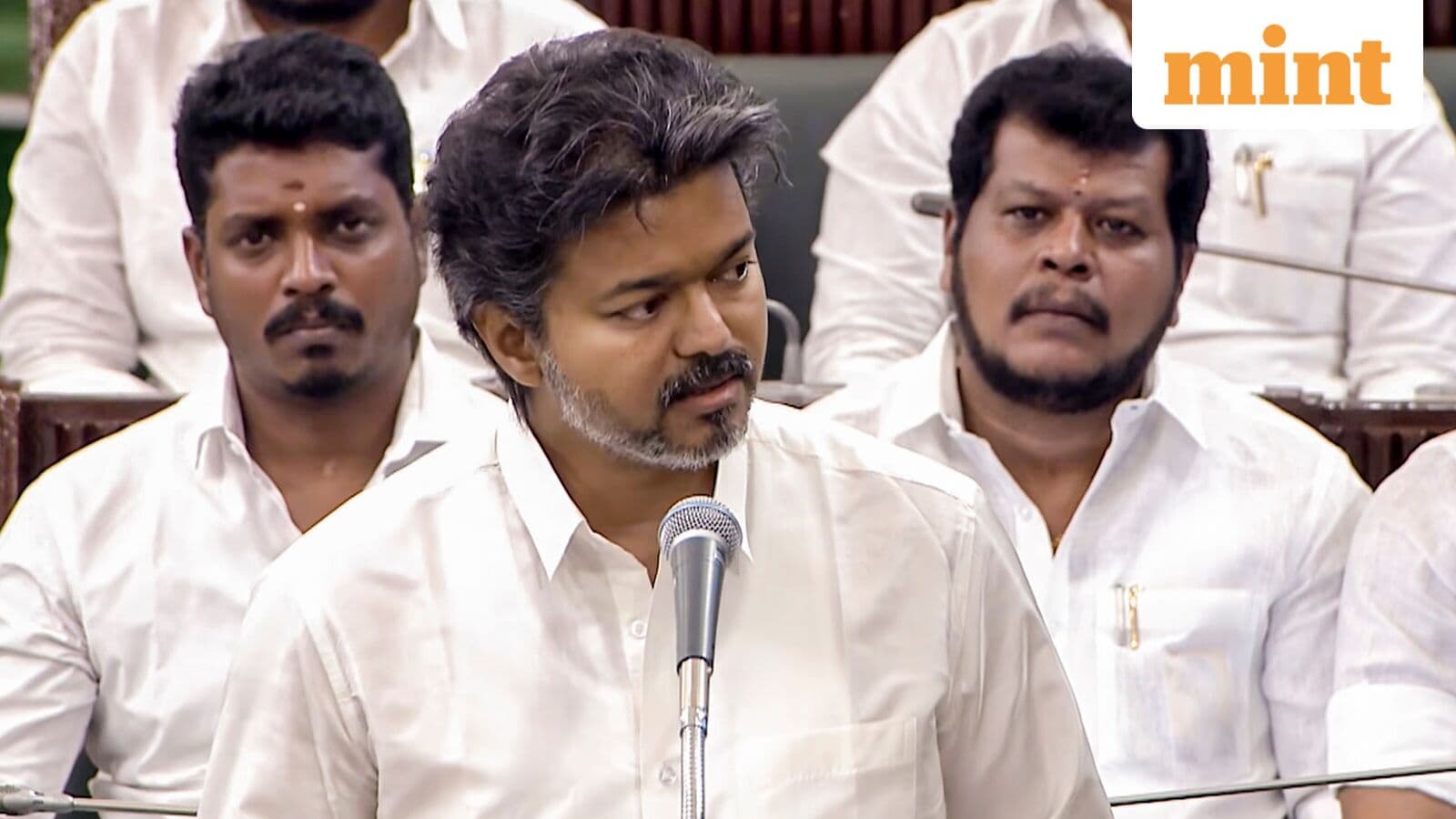
Tamil Nadu Chief Minister C Joseph Vijay's meeting on delimitation saw 21 of the state's 57 MPs oppose any reduction in the state's parliamentary representation. The DMK and AIADMK stayed away, exposing divisions over the Centre's proposed exercise.DMK and AIADMK stayed away from CM Vijay's meet on delimitation(PTI)Tamil Nadu Chief Minister C Joseph Vijay on Saturday convened a meeting of the state's MPs to discuss the Centre's proposed delimitation exercise, even as major regional parties DMK and AIADMK did not attend it.Around 21 MPs from the Congress, VCK, CPI, CPI(M), MDMK and IUML attended the meeting at Kalaivanar Arangam, according to ANI. Those present agreed that Tamil Nadu's parliamentary representation should not be reduced under any future delimitation formula.Congress MP Karti Chidambaram said the issue should be viewed beyond party politics, arguing that Tamil Nadu's representation in Parliament must be protected.'Our representation in the parliament can't be diminished'"The Chief Minister of Tamil Nadu had called for a meeting for all the MPs from Tamil Nadu from both the Lok Sabha and the Rajya Sabha. About 21 of us attended the meeting, and there was absolute unanimity that Tamil Nadu's rights must be preserved. Our representation in the parliament can't be diminished," he told reporters.He added that any alteration and delimitation, either on the basis of population or on a proportionate increase, will be resisted by the parties in Tamil Nadu adding that any formula based on population or a proportionate increase in seats could dilute the state's political influence."We want the Parliament to be frozen at 543, and the distribution among the states to be preserved as it is, which means Tamil Nadu will have 39 members in a house of 543. We are clear in our unanimous opinion that a larger Parliament will be an ineffective Parliament, and Tamil Nadu will not be well served by a larger Parliament. So we want the Parliament to be preserved at 543 with the same representation of 39 Lok Sabha MPs for Tamil Nadu," he said.Congress MP Jyothimani also urged all political parties to come together, saying the proposed exercise could have wider implications for Tamil Nadu and India, ANI reported. She expressed hope that the DMK and AIADMK would eventually join the campaign.Congress MP Praveen Chakraborty criticised both parties for staying away from the meeting, saying it was disappointing that two parties that have governed Tamil Nadu for several terms did not participate in a discussion on the state's representation."Our demand is very clear: we do not want any change either in the total number of seats or in the share of Tamil Nadu's seats," Chakraborty said.Why is Tamil Nadu opposing delimitation?The proposed delimitation exercise has triggered concerns among several southern states over the possibility of their parliamentary influence being diluted.Southern states have argued that they could be disadvantaged because they have historically recorded slower population growth after implementing family-planning and population-control measures.Under a strictly population-based allocation of Lok Sabha seats, states with faster population growth could gain a larger share of parliamentary seats, while states such as Tamil Nadu could see their relative representation decline.Tamil Nadu's political parties have therefore demanded that the existing allocation of Lok Sabha seats be protected and that the House's current strength of 543 be maintained.DMK, AIADMK stay awayThe meeting also highlighted the political divide over how Tamil Nadu should respond to the proposed delimitation.The DMK and AIADMK did not attend the meeting, while PMK and DMDK also stayed away.The absence of the DMK is particularly significant as it has a substantial representation in both Houses of Parliament.About the AuthorPrabhakar JhaPrabhakar Jha is a journalist and digital news editor with nearly a decade of experience in online media, specialising in br
Various countries, including the United States, enforce regulations on foreign monetary inflows, the Ministry of External Affairs (MEA) said.New Delhi, Aug 07 (ANI): Ministry of External Affairs (MEA) Spokesperson Randhir Jaiswal addresses a press briefing, in New Delhi on Friday. (ANI Video Grab) (ANI Video Grab)India on Friday responded to a remark made by a US lawmaker on the proposed Foreign Contribution (Regulation) Amendment (FCRA) Bill, stating that the matter is India's 'internal affair.'Various countries including the United States, enforce regulations on foreign monetary inflows, the Ministry of External Affairs (MEA) said."Regarding the issue you are referring to, we have seen it, and several comments have been made on it. As far as legislative matters are concerned, and particularly matters relating to India's own legislation, this is an internal matter for us, on which our Parliament takes the decision," MEA spokesperson Randhir Jaiswal said on Friday, addressing a bi-weekly media briefing.Quick answers to key questions•5 QUESTIONSThe Foreign Contribution (Regulation) Amendment Bill, 2026 seeks to regulate foreign donations by establishing a Designated Authority to oversee foreign contributions, particularly when an entity's FCRA registration is cancelled, surrendered, or lapsed.India's Ministry of External Affairs stated that the proposed amendments to the FCRA are an internal matter and emphasized that several countries, including the US, regulate foreign monetary inflows.The Bill mandates that if foreign contributions are linked to places of worship, their religious character must be maintained by the Designated Authority, addressing concerns of government takeovers of churches and charities.Yes, opposition parties have expressed concerns that the amendments could harm NGOs, particularly those operated by minority communities, due to potential excessive government control over foreign funding.The FCRA Amendment proposes to reduce the maximum penalty for statutory violations from five years' imprisonment to one year, thereby making it less severe for NGOs caught in infractions."I would also like to tell you that there are several countries in the world, including the United States, that regulate foreign funds and foreign financing," he added.US lawmaker Riley Moore's criticismThe response comes following remarks from US lawmaker Riley Moore, who raised objections to proposed modifications to India's Foreign Contribution (Regulation) Act (FCRA), claiming the provisions could enable state control over churches and philanthropic institutions, while cautioning that the development might strain bilateral ties.The Republican Congressman from West Virginia acknowledged that Christianity holds deep historic roots in India, tracing back to the arrival of St Thomas the Apostle on the Malabar Coast."But despite this long Christian history, India's Parliament is considering amending the Foreign Contribution (Regulation) Act to permit government takeovers of churches and religious charities," Moore wrote on X earlier this week."This is a clear attack against Christians. If this bill proceeds in this way, it would be a point of major concern in our bilateral relationship with India," he added.What is FCRA Amendment?The Foreign Contribution (Regulation) Amendment Bill, 2026, seeks to establish a Designated Authority tasked with overseeing foreign contributions and assets acquired through such capital in instances where an entity's FCRA registration stands cancelled, surrendered or lapsed.The proposed legislation explicitly mandates that if such assets comprise a place of worship, the Designated Authority is required to maintain its religious character intact. Furthermore, it seeks to scale down the maximum penalty for statutory violations from five years' imprisonment to one year.The FCRA framework governs the intake and utilisation of overseas funding across non-governmental organisations, charitable entities, academic insti


Discussion (0)