
Loading dispatches...
← Return to NewsroomTechnology
A Cray-1 supercomputer replica from 30 "obsolete" Mac Minis
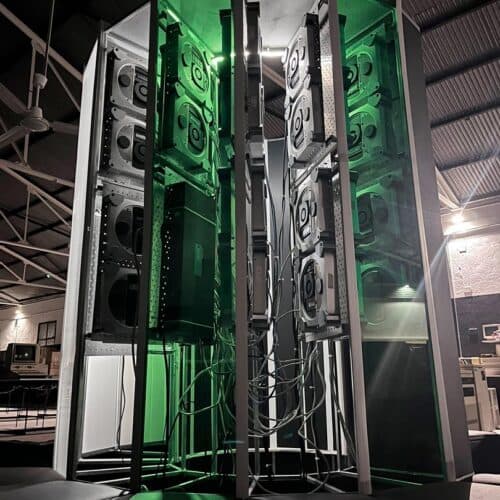
The Museo de Historia de la Computación in Spain has unveiled a 1:1 scale visual replica of the famous Cray-1 supercomputer from 1976. Instead of sourcing expensive, cutting-edge tech to run the system, the creative team powered the project with 30 2012-era Mac Minis. Developed over 18 months, the project serves as a 50th-anniversary tribute to the Cray-1 and Apple’s founding. 3 teraflops of performance in their most recent tests. 5 teraflops previously using all 70 available cores, prior to one node going offline. Benchmarks were obtained using a custom matrix-multiplication Python script. Five PCs are quad-core i7s, and the remaining 25 are dual-core i5 models. Except for two units from 2014, the rest of the array dates to 2012. The replica is a valuable tool for museum-goers to understand the shifts in computer architecture since 1976. The original Cray-1 used vector processing, applying a single instruction to multiple data elements simultaneously, whereas the replica distributes work across independent processors in a parallel cluster. The peak theoretical performance of the original Cray-1 was approximately 160 megaflops. What was originally a purpose-built research machine has been re-created with consumer hardware that’s vastly more capable than the machine that inspired it. 14) met their project needs by harnessing macOS’s built-in support for MPI (Message Passing Interface), the software layer that allows all the nodes in the cluster to pass tasks to one another. The Cray-1 replica, complete with iconic padded bench seating. The only thing missing is Robert Redford and Ben Kingsley having a discussion on SECTEC Astronomy. Credit: Museo de Historia de la Computación Credit: Museo de Historia de la Computación The Cray-1 replica, complete with iconic padded bench seating. The only thing missing is Robert Redford and Ben Kingsley having a discussion on SECTEC Astronomy. Credit: Museo de Historia de la Computación Credit: Museo de Historia de la Computación Guests at the Museo de Historia de la Computación can watch in real time as the system runs matrix algorithms, mapping the scale of system performance from a single core to the full suite running in parallel. Stealth supercomputing Combining 30 consumer PCs into an operational cluster wasn’t the only engineering challenge the team faced. If you’ve ever stepped inside a server room, or, like me, foolishly installed one in your own basement, you know that fan cooling can be loud. The museum team used passive convection cooling via a steel rack chassis and aluminum tray mounts for each Mac Mini. Compared to the roaring thunder of a modern data center, this cluster is nearly inaudible.
Other impacted Russian services included a dating app, a real estate aggregator, a self-publishing book platform and the website of the most successful professional soccer club in the Russian Premier League, according to Reuters. Targeting data centers is just the latest example of them becoming wartime targets in 2026. After the United States and Israel attacked Iran in February, Iranian drones knocked out multiple Amazon data centers in Bahrain and the United Arab Emirates. But Russia has been regularly launching mass missile and drone attacks against Ukraine’s cities, targeting power grid infrastructure, transportation hubs and even residential apartment buildings since Russian President Vladimir Putin first launched his full-scale invasion of Ukraine in February 2022. Ukraine has recently been grappling with a shortage of interceptor weapons capable of shooting down Russian missiles and jet-powered drones. But the Ukrainian military has also gradually ramped up its own medium-range and long-range drone strike campaign in response to Russian attacks. Ukraine’s drone strikes have focused on Russian military bases and supply lines, Russian-linked shipping in the Sea of Azov and Black Sea, and Russian energy infrastructure such as oil refineries. In the summer of 2026, Ukraine also targeted multiple warehouses belonging to the Russian companies Wildberries and Ozon, which are Russia’s Amazon equivalents. In a sign of the potentially widening war, coordinated aerial and sea drone strikes sank two commercial ships in the Black Sea within the exclusive economic zones of NATO member countries Romania and Bulgaria on October 5 and October 6. Ukraine’s president Zelenskyy attributed those attacks to Russia.



Discussion (0)