
Loading dispatches...
← Return to NewsroomScience
An off-the-shelf camera could help us find more black holes smashing together
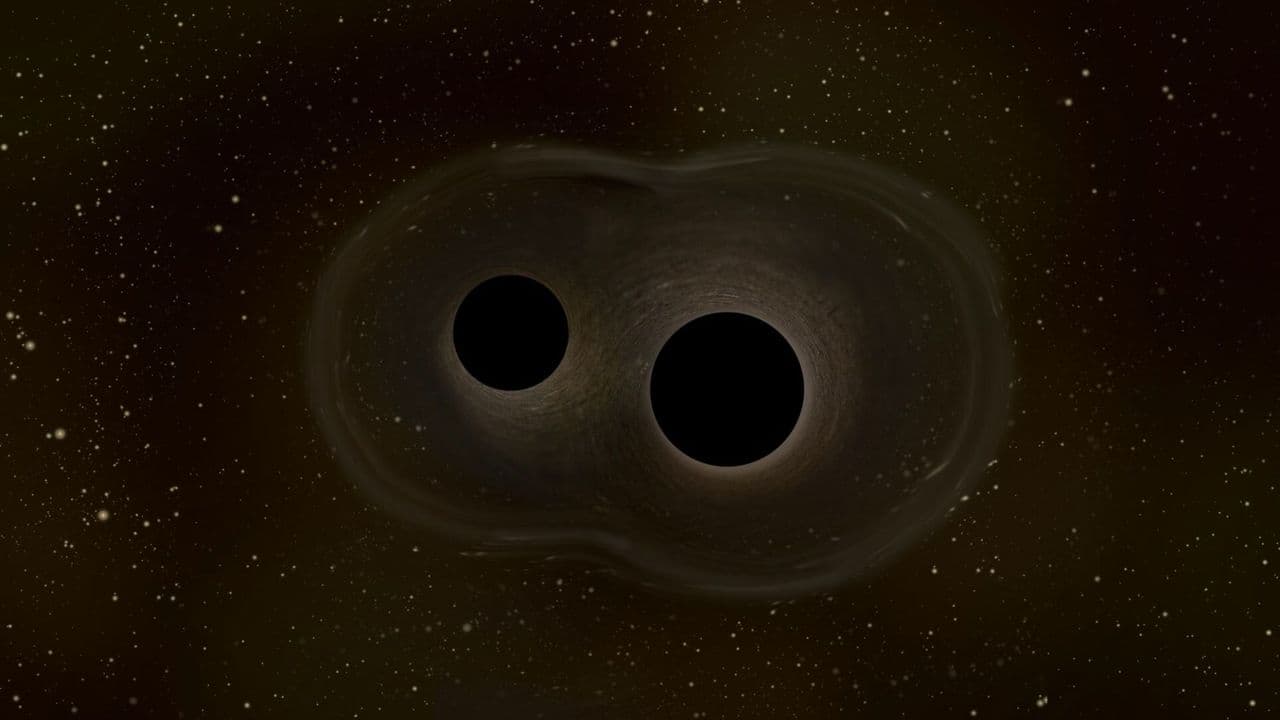
Fixing a problem inside one of the world's most sophisticated scientific observatories might seem like the kind of challenge that demands a multimillion-dollar upgrade or revolutionary new technology.But for scientists working on the Laser Interferometer Gravitational-Wave Observatory (LIGO), which listens for ripples in spacetime generated by cosmic collisions like merging black holes, the solution to a mild but persistent engineering challenge turns out to be as simple as an off-the-shelf camera.By pairing commercially available thermal imaging cameras with computer models, a team led by Jonathan Richardson at the University of California, Riverside, has developed a technique that corrects tiny, heat-induced distortions in the observatory's mirrors — an elusive flaw that scientists say currently limits how far into deep space the facility can look."It doesn't require any new technology development, which is almost unheard of for solving a LIGO instrumentation problem," Richardson said in a statement.Once incorporated into LIGO's upcoming upgrade, Richardson and his team estimate the fix would extend the observatory's reach by roughly 33 million light-years.That gain might sound like a drop in the ocean against the unimaginably vast scale of the universe, but because space expands in three dimensions, pushing a detector's reach even slightly opens up an exponentially larger window of space. Being able to look further into the universe will allow astronomers to "hear" many more cosmic ripples, in turn increasing the potential for discovering the universe’s most violent collisions that lie beyond LIGO's reach today.LIGO detects these cosmic ripples, known as gravitational waves, using twin L-shaped facilities in the U.S. — in the states of Washington and Louisiana. Inside each detector, a laser beam shoots down two 2.5-mile-long (4-kilometer-long) tunnels, bouncing off pristine mirrors at each end. When a gravitational wave passes through Earth, it subtly stretches one tunnel and squeezes the other. That microscopic shift alters the laser beams ever so slightly, producing a tiny flicker of light that alerts scientists to a distant cosmic event. Researchers in Richardson's group testing a novel adaptive optics device designed to precisely reshape the surfaces of LIGO's main mirrors. ( To accomplish this, LIGO relies on mirrors polished to reflect 99.9999%t of the laser light that strikes them, ranking them among the purest optical components ever built.Yet even these near-perfect mirrors have had one unavoidable flaw. The mirrors still absorb a tiny fraction of that intense laser light. That energy turns into heat, warping the mirror's surface by just a few nanometers, enough to distort the laser beam and reduce the observatory's overall sensitivity.Physicists already knew they could counteract these distortions by applying targeted heat to the back of the mirrors. The difficult part was measuring the distortions accurately enough such that the correcting heat could be applied with exact precision. An aerial view of LIGO Hanford Observatory in the state of Washington. ("You can think of it like taking an infrared picture of a car engine," Richardson said in the statement. "An engineer can look at the temperature pattern on the outside and infer what's happening inside the engine. We're doing the same thing with LIGO's mirrors."And the technique isn't just a fix for LIGO. It is also expected to become part of the foundational design for Cosmic Explorer, a proposed next-generation U.S. gravitational-wave observatory targeted for the mid-2030s.With 25-mile-long (40-km-long) arms — 10 times larger than LIG
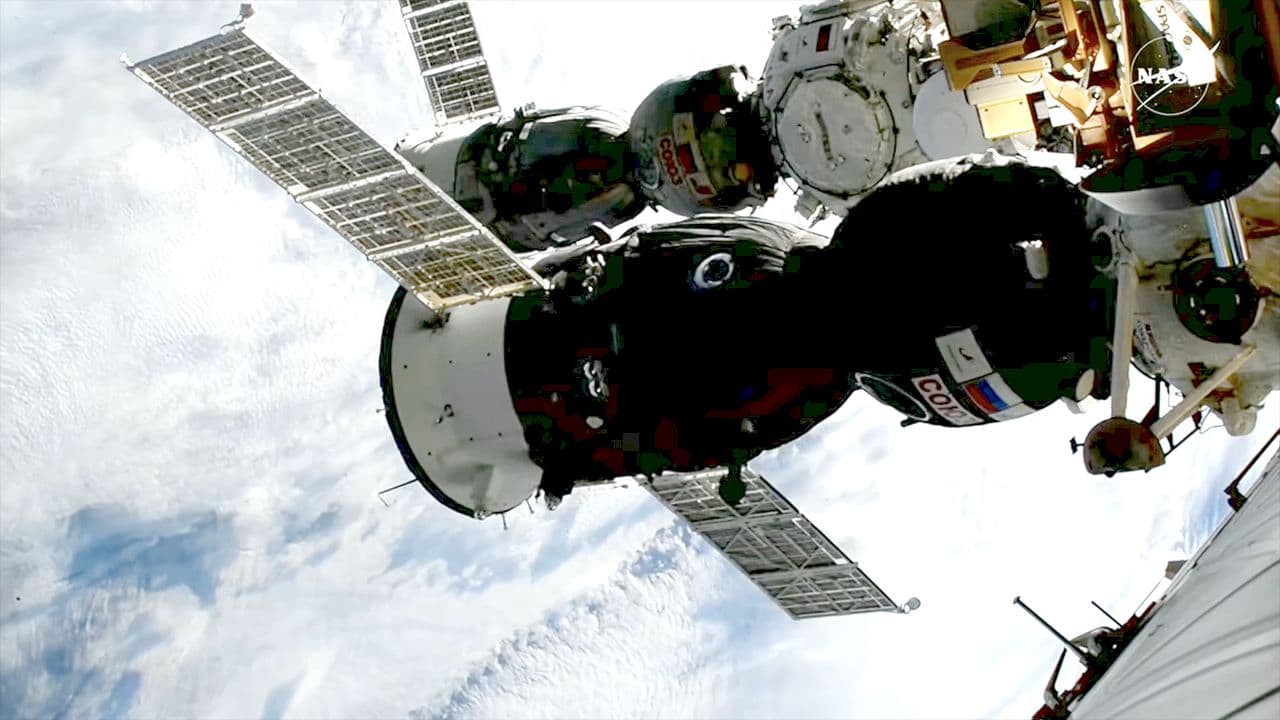
NASA Astronaut Chris Williams Soyuz MS-28 Undocking - YouTube Watch On A U.S.-Russian crew will return to Earth from the International Space Station early Sunday morning (July 26), and you can watch their homecoming live.A Soyuz spacecraft carrying NASA astronaut Chris Williams and Sergey Kud-Sverchkov and Sergei Mikaev of the Russian space agency Roscosmos is scheduled to undock from the orbiting lab on Sunday at 3:02 a.m. EDT (0702 GMT).The Soyuz, known as MS-28, will land on the steppe of Kazakhstan about 3.5 hours later, at 6:26 a.m. EDT (1026 GMT). You can watch these milestones here at Space.com, courtesy of NASA. Russia's Soyuz MS-28 spacecraft is seen docked to the International Space Station shortly after its arrival on Nov. 27, 2026. (m. EDT (1340 GMT) ahead of a change-of-command ceremony aboard the International Space Station (ISS). Kud‑Sverchkov will hand over the reins of the orbiting lab to NASA astronaut Jessica Meir, part of the transition from ISS Expedition 74 to Expedition 75 (which officially begins when Soyuz MS‑28 undocks). You can watch that live via NASA.NASA will resume its webcast tonight at 11:10 p.m. EDT (0310 GMT on July 26) to cover crew farewells and the closing of the hatches between the ISS and Soyuz MS-28, which is expected at 11:30 p.m. EDT (0330 GMT).Undocking coverage begins Sunday at 2:30 a.m. EDT (0630 GMT). The stream will pick up again at 5:15 a.m. EDT (0915 GMT) for deorbit and landing activities. Touchdown will occur southeast of the Kazakh city of Dzhezkazgan, according to NASA. The Soyuz MS-28 crew pose on Nov. 26, 2025, a day before their launch. From left: Chris Williams of NASA and Roscosmos cosmonauts Sergey Kud-Sverchkov and Sergei Mikaev. ( 27, which was Thanksgiving Day. That liftoff kicked off the first space mission for Williams and Mikaev and the second for Kud‑Sverchkov.When it's all said and done, the trio will have spent 241 days in space on their current flight. They will have orbited Earth 3,856 times and traveled a total of more than 102 million miles (164 million kilometers).After touchdown, the three spaceflyers "will fly by helicopter to Karaganda, Kazakhstan, where recovery teams are based," NASA officials wrote in a media advisory. "Williams then will return to NASA's Johnson Space Center in Houston, while Kud‑Sverchkov and Mikaev head back to their training base in Star City, Russia." Michael Wall is the Spaceflight and Tech Editor for Space.com and joined the team in 2010. He primarily covers human and robotic spaceflight, military space, and exoplanets, but has been known to dabble in the space art beat. His book about the search for alien life, "Out There," was published on Nov. 13, 2018. Before becoming a science writer, Michael worked as a herpetologist and wildlife biologist. He has a Ph.D. in evolutionary biology from the University of Sydney, Australia, a bachelor's degree from the University of Arizona, and a graduate certificate in science writing from the University of California, Santa Cruz. To find out what his latest project is, you can follow Michael on Twitter.
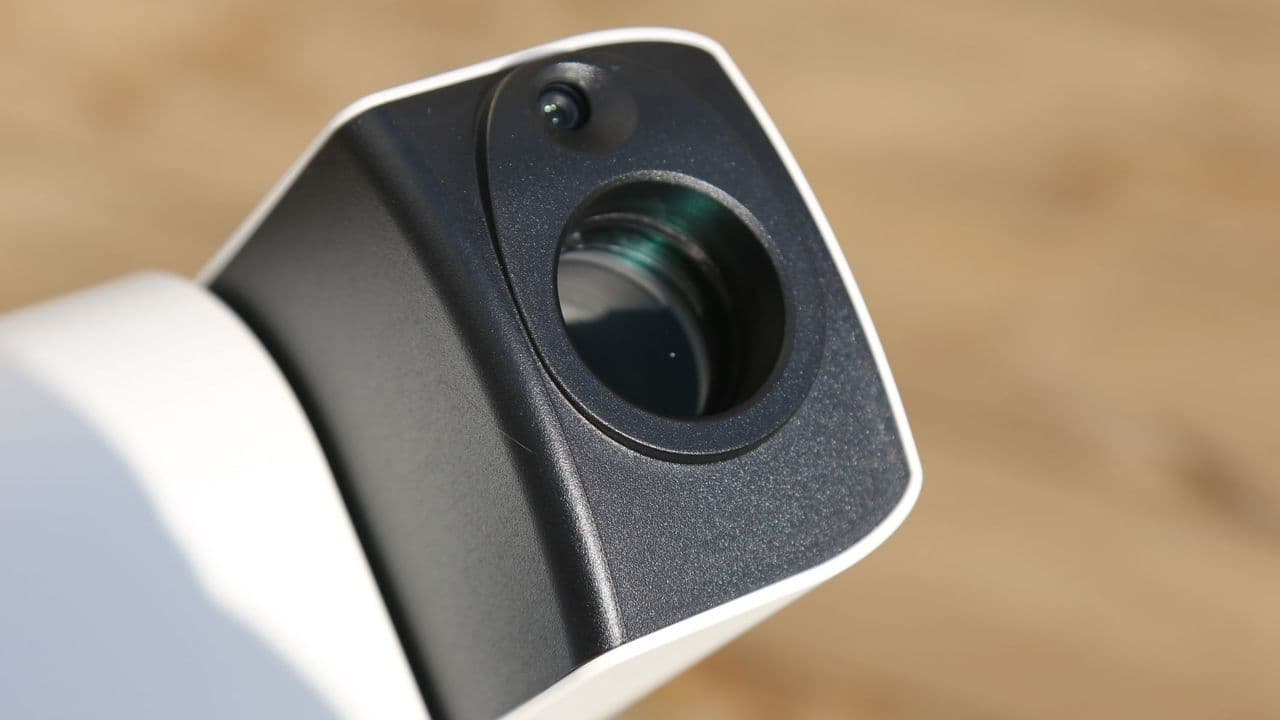
The ZWO Seestar S30 Pro is a self-contained astrophotography system, compact enough to fit in a camera bag yet capable of producing detailed, 8.3-megapixel images of galaxies and nebulas, it's an accessible and portable entry point into deep-sky imaging. Pros +Small and lightweight +Performs well under light-polluted skies +8.3MP resolution with FITS export Cons -Limited manual control over imaging -Weak planetary performance -Internal storage fills quickly Why you can trust Space.com Our expert reviewers spend hours testing and comparing products and services so you can choose the best for you. Find out more about how we test and review products. Smart telescopes like the Seestar S30 Pro have changed astrophotography and, arguably, urban astronomy. The Seestar S30 Pro takes that concept further than most. Small enough to fit inside a camera backpack, it combines a refractor telescope, motorized mount, dual cameras and image-processing software into a compact unit controlled entirely from a smartphone. Within minutes of powering on, it can align itself to the night sky, slew to a specified target and begin stacking exposures to reveal galaxies, nebulas and star clusters — even from light-polluted locations. The Pro version of the S30 adds a higher resolution sensor, advanced optics and upgraded software functionality. ( Instead of actively operating a telescope, users watch a digital image build in real time. Sure, your eyes don’t see the photons coming from distant galaxies, but that misses the point — urban astronomers can’t see much of those galaxies anyway when using an optical telescope. (3MP imaging, equatorial tracking support and expanded imaging modes aimed at more advanced users.Designed for beginners, urban astronomers and astrophotographers of any level who are looking for a portable rig, the Seestar S30 Pro is about convenience, capability and a different way to explore the night sky.ZWO Seestar S30 Pro smart telescope reviewZWO Seestar S30 Pro: Design The Seestar S30 Pro features four lens elements in an optical design called an apochromatic quadruplet refractor. ( That portability is one of its defining strengths — this is a telescope you can realistically take anywhere, whether into a backyard, onto a balcony or on a dark-sky trip. You could even take it as hand luggage on a trip to see a total solar eclipse in a distant land. Image 1 of 2 When packed away the Seestar S30 Pro is very compact and highly portable. ( Aside from a power button and USB-C slot, there are no physical controls. Everything — from slewing and focusing to image capture and processing — is handled through the Seestar app. Once connected to a phone via its own WiFi network, the system operates entirely offline, connecting directly to your phone without requiring an internet connection in the field. Image 1 of 2 Apart from the power button and USB-C slot on the S30 Pro, there are no physical controls as everything is controlled by the app. (18 inchesFocal length: 160mm / 6.3 inchesFocal ratio: f/5.3Sensor: Sony IMX585 (tele) / Sony IMX586 (wide)Resolution: 8.3MP (3,840 x 2,160)Field of view: 4.6 degrees (tele) / 63 degrees (wide)Mount
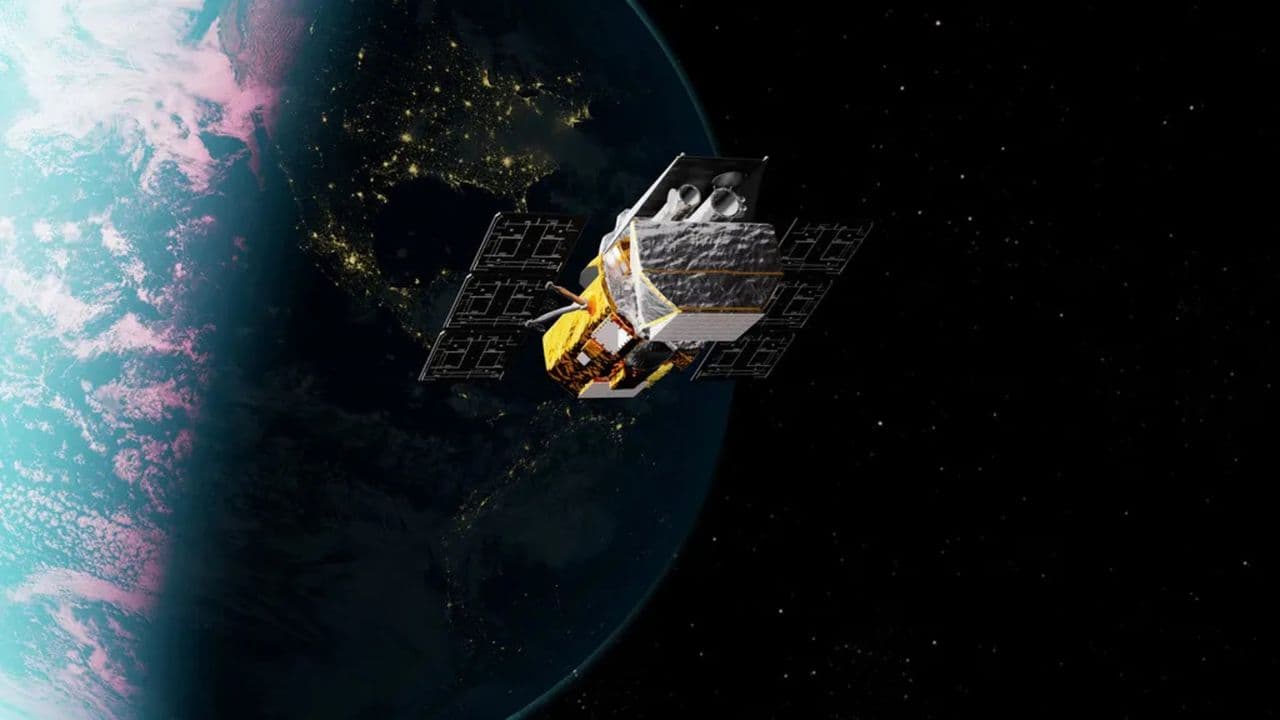
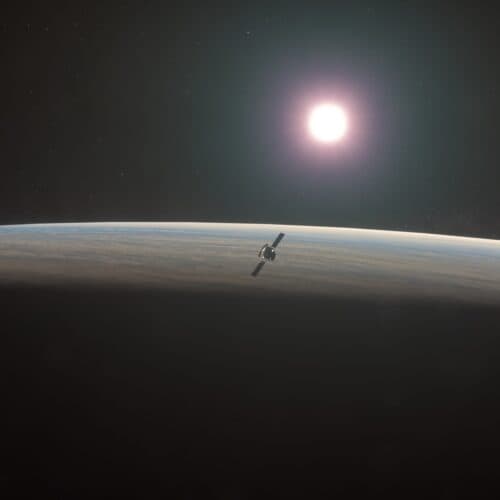
Artist's illustration of NASA’s Neil Gehrels Swift Observatory orbiting Earth. (That mission will be conducted by Link, a robotic servicing spacecraft built and operated by the Arizona-based company Katalyst Space Technologies. Link will meet up with NASA's Neil Gehrels Swift Observatory in the final frontier, raising the telescope's orbit to give it more time to study the heavens.NASA and Katalyst representatives will discuss the plan today, during a press conference that starts at 11 a.m. EDT (1500 GMT). You can listen live via NASA. Space.com will stream the feed as well, if the space agency makes it available. Katalyst Space's Link spacecraft is seen mated with its Pegasus XL rocket. ( The telescope is still perfectly capable of doing this important job, but Earth's atmosphere is dragging it down toward a fiery death.Swift doesn't have a propulsion system to fight this downward pull, so it needs some help — which is where Katalyst comes in. Last fall, NASA announced it had tapped the company to raise Swift's orbit.It's an unprecedented ask: No private spacecraft has ever linked up with a robotic U.S. government satellite. And time is of the essence; some models predicted the observatory could come back to Earth as soon as this summer.Katalyst has acted fast, getting Link ready for a launch later this month from the Marshall Islands in the Pacific. (NASA has not yet announced a target date). Link will fly aboard a Northrop Grumman Pegasus XL rocket, an air-launched vehicle that will be carried aloft by a plane. Michael Wall is the Spaceflight and Tech Editor for Space.com and joined the team in 2010. He primarily covers human and robotic spaceflight, military space, and exoplanets, but has been known to dabble in the space art beat. His book about the search for alien life, "Out There," was published on Nov. 13, 2018. Before becoming a science writer, Michael worked as a herpetologist and wildlife biologist. He has a Ph.D. in evolutionary biology from the University of Sydney, Australia, a bachelor's degree from the University of Arizona, and a graduate certificate in science writing from the University of California, Santa Cruz. To find out what his latest project is, you can follow Michael on Twitter.
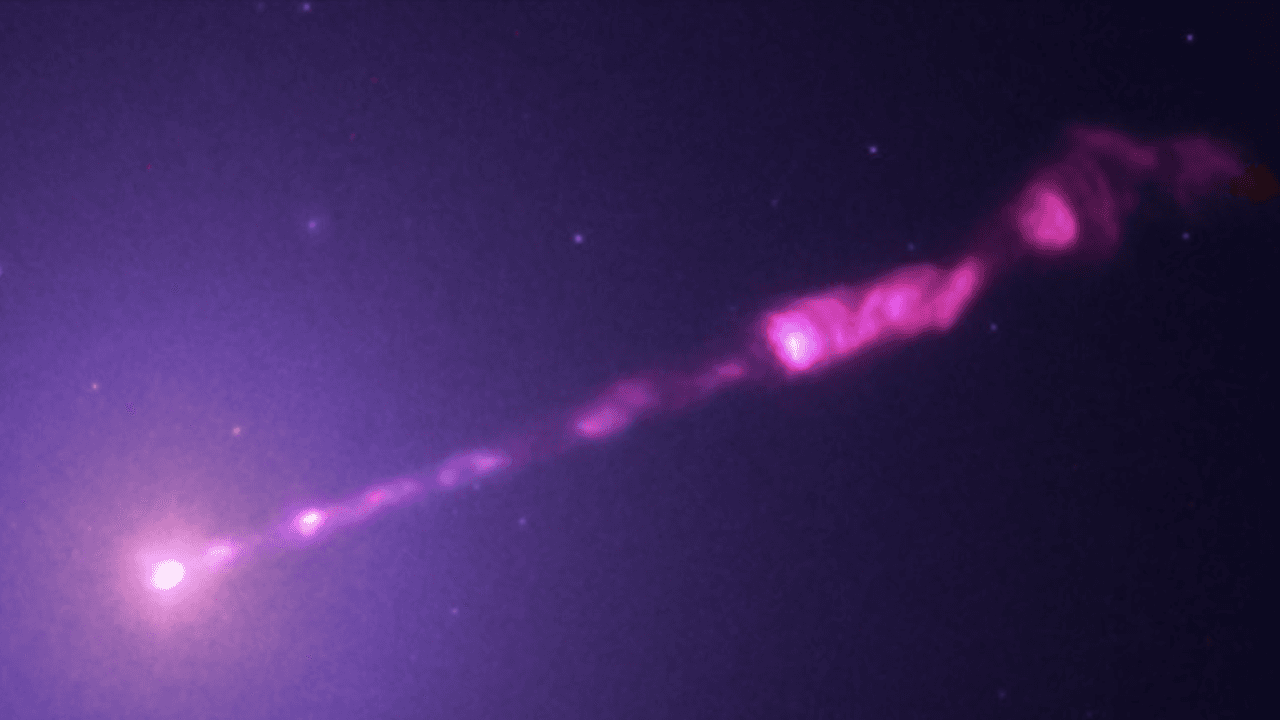
A jet erupts from M87*, the first black hole imaged by humanity. ( Laval/C. Poitras et al.; IR: NASA/CSA/STScI; Radio:NSF/NRAO/VLA; Optical: NASA/ESA/STScI; Image Processing: NASA/CXC/SAO/L. Frattare) Astronomers using NASA's Chandra X-ray spacecraft have obtained the most detailed image yet of the jet erupting from the supermassive black hole at the heart of the galaxy Messier 87 (M87).If this black hole sounds familiar, that is because it made history in 2019 when it was revealed as the first black hole to be imaged by humanity.M87* is located around 55 million light-years from Earth and is ravenously feeding on infalling gas and dust. As it does so, matter is channeled to the poles of this black hole, which has a mass 6.5 billion times that of the sun. This matter is blasted out at speeds approaching the speed of light as powerful jets that stretch out for thousands of light-years.Jets of M87* have been imaged before in other wavelengths of light, such as optical light and infrared, but this is our most detailed look at these jets in X-rays. And the X-rays revealed a complex flow of material through the jets that's more dynamic than previously seen."We could already see changes in the jet, but never with this level of detail in X-rays," Camille Poitras, a Ph.D. student in the Faculty of Science and Engineering at Laval University and lead of the study, said in a statement. "Structures that previously appeared blended together can now be distinguished, allowing us to better follow the jet's evolution over more than a decade of observations."Some structures in the jets appeared to be moving at speeds five times faster than the speed of light. Of course, that isn't possible; according to Albert Einstein's theory of special relativity, nothing with mass can move at the speed of light or faster. This so-called superluminal motion isn't a universe-breaking discovery, but rather an optical illusion created when matter moves at near-light speed directly toward Earth. The Event Horizon Telescope captured this image of the supermassive black hole in the center of the galaxy M87 and its shadow. ( Additionally, because these jets are how supermassive black holes pour energy back into their surroundings, the observations could also help build a better picture of how these cosmic titans influence the evolution of their home galaxies."These results demonstrate how uniquely powerful Chandra remains for tracking the evolution of extreme phenomena over long timescales," team member Gerrit Schellenberger, an astrophysicist at the Center for Astrophysics | Harvard & Smithsonian (CfA), said in the statement. "They help us better understand how energy released near a supermassive black hole is carried through its jet and deposited into the surrounding galaxy."The team's research was presented at the 248th meeting of the American Astronomical Society. The study is also available as a preprint on arXiv. Robert Lea is a science journalist in the U.K. whose articles have been published in Physics World, New Scientist, Astronomy Magazine, All About Space, Newsweek and ZME Science. He also writes about science communication for Elsevier and the European Journal of Physics. Rob holds a bachelor of science degree in physics and astronomy from the U.K.’s Open University. Follow him on Twitter @sciencef1rst.
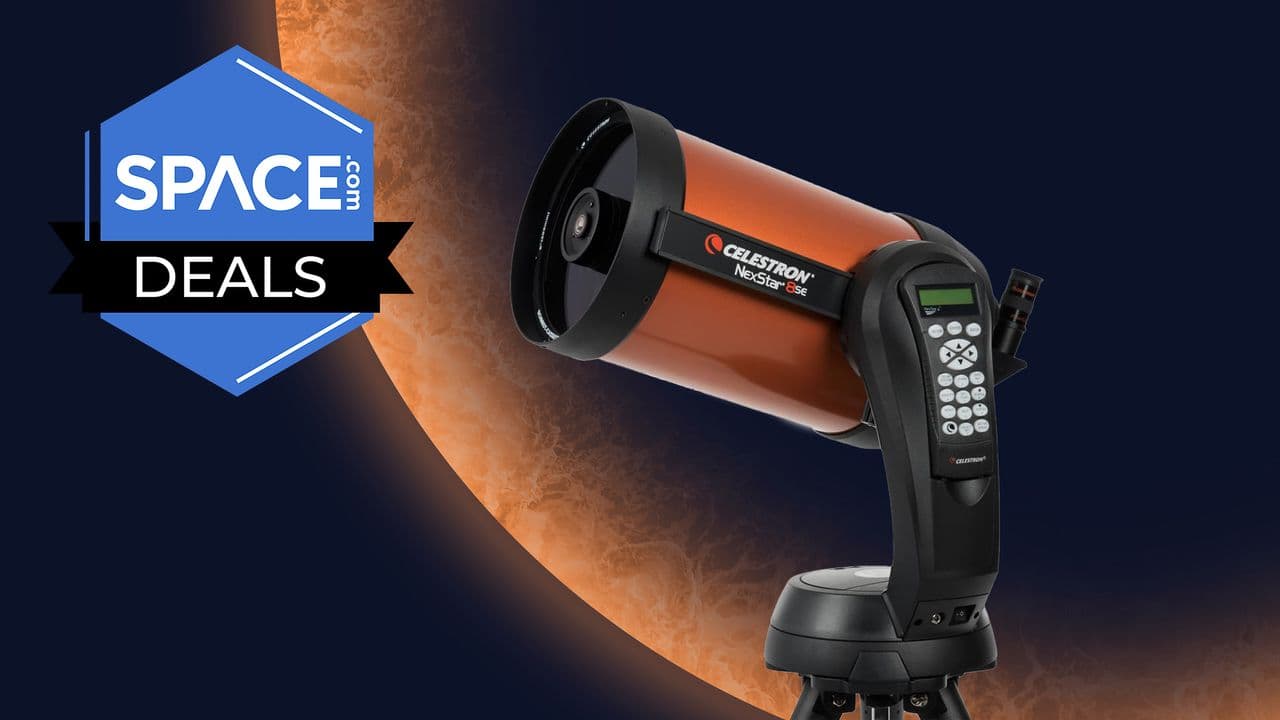
( It's hailed by Celestron as the 'world's most beloved telescope', and it tops many of our buying advice on the best telescopes, including the top-overall choice as the best telescopes for deep space and the best telescopes for seeing planets guides.The unmistakable orange-colored Celestron NexStar 8SE is without doubt a brilliantly performing telescope, and such performance is rarely discounted. It makes this Amazon telescope deal one to highlight. The Celestron NexStar 8SE has $200 off and is down to $1,499, its lowest price of the year. Even with Amazon Prime Day coming in June, we think it's unlikely to go any lower.Save $200 on the Celestron NexStar 8SE, its best price of the year at Amazon.In our review, our expert tester Jase Parnell-Brookes awarded it an impressive 4.5 out of 5-star score. Although they noted it comes in with an MSRP that might put new stargazers off, Jase reckoned it was a worthy investment and a fantastic scope. It's not only suitable for a beginner but has plenty to offer the intermediate or advanced sky watcher.Amazon has the NexStar 8SE marked as limited stock and at this price it could sell out fast. However, Walmart is price-matching the Amazon deal along with Adorama, should you wish to purchase your it elsewhere.Paul Brett is a deals writer at Space, Live Science, and across the Sports and Knowledge titles at Future. Paul is an award-winning photographer, having won the Mountain Photographer of the Year title at Trail Magazine. A huge fan of photography and cameras, he can be found on top of Scotland's mountains, wild camping, waiting to capture the Northern Lights or a cloud inversion.We've got you covered with reviews and rankings of the best telescopes, binoculars, star projectors, cameras, drones, Lego, streaming and more.Image 1 of 3The Celestron NexStar 8 SE looks stunning with its iconic Orange optical tube.( It's ideal for viewing both planets and distant objects like galaxies, nebulas and star clusters. Plus, it lets in 78% more light than its NexStar 6SE sibling thanks to its large 8-inch aperture.Although for a beginner it is a considerable investment, it suits all abilities. Features like the motorized single fork arm and handheld remote control functionality mean it's easy to set up and start stargazing even for those unfamiliar with the night sky.Parnell-Brookes also noted the smoothness of the motor, and with the help of the Celestron SkyAlign app, you can align the scope using three bright stars and enjoy automated viewing almost instantly in your stargazing journey.Smaller aperture versions are available at 4, 5 and 6 inches with graduating costs. Of course, the smaller you go, the less light captured, thus making your views less awe-inspiring with each drop in aperture.Key features: 8-inch (203.2mm) aperture, 80-inch (2032mm) focal length, f/10 focal ratio, 180x highest useful magnification, 32 lbs (14.48 kg) weight, two-year warranty.Launched: June 2005Price history: Before today's telescope deal, the best price we've seen on the Celestron NexStar 8 SE telescope was $1,299 during the Black Friday sales of 2024. The MSRP is $1,699, which makes the current on-sale price of $1,499 a significant saving on what is a seldom-discounted model.Price comparison: Amazon: $1,499 | Adorama: $1,499 | Walmart: $1,499Reviews consensus: There is no doubt that the Celestron NexStar 8 SE is a fantastic telescope; it pairs Celestron’s legendary orange tube with a fully computerized GoTo system—ideal for those ready to step up from manual scopes and explore more o
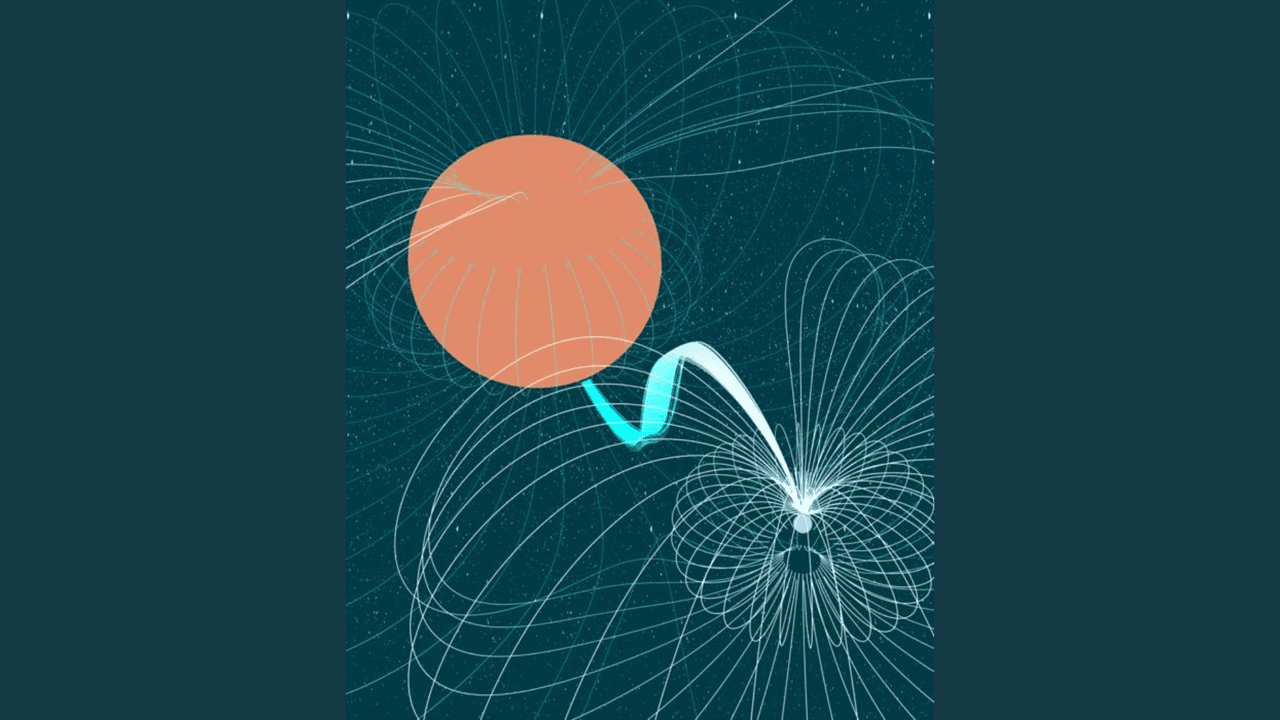
A schematic of the ASKAP J1745-5051 showing the compact white dwarf at the heart of a nest of magnetic-field lines, and a stream of matter flowing onto it from its companion red dwarf, which also has a magnetic field. (The signals, or long-period radio transients, are a class of celestial radio emissions discovered in 2005. Most radio-producing objects release bursts that last for mere seconds or less, but long-period radio transients, about a dozen of which are known, produce radio waves in bursts lasting from minutes to over an hour.Speculation had focused on highly magnetic pulsars called magnetars as the origin of these radio bursts, but now new research led by Kovi Rose of the University of Sydney, using the Australian SKA Pathfinder (ASKAP) radio telescope, has shown that symbiotic binaries are to blame for at least some long-period radio transients.Symbiotic binaries feature a compact object — usually a white dwarf, which is the core remains of a sun-like star — stealing matter from a close companion star. This scenario often leads to a nova explosion when too much material accretes onto the surface of the white dwarf."Long-period radio transients have puzzled astronomers for years," said Rose, who is a postgrad student, in a statement. "Now we've been able to show that the source for one of these transients comes from a white dwarf actively pulling material from a companion star."The system in question has been catalogued as ASKAP J1745-5051, and features a white dwarf that is about the diameter of Earth but a mass similar to that of our sun, accreting matter from a red dwarf star with a mass just a tenth of our sun's mass.What makes ASKAP J1745-5051 stand out is that not only does it produce these long-period radio bursts, but it also produces blasts of X-rays."These emissions are all tied to the orbital motion of the system," said Rose. "But interestingly, the radio and X-ray signals don't peak at the same time, which tells us they're being produced in different regions of the system." The ASKAP radio telescope at Inyarrimanha Ilgari Bundara, the CSIRO Murchison Radio-astronomy Observatory on Wajarri Yamaji Country in Western Australia. ( As it gets closer to the white dwarf, gravity causes it to bunch up, friction increasing the temperature to hundreds of thousands, or even millions, of degrees, which is hot enough to emit X-rays. Exactly where it bunches depends on the relative positions of the white dwarf and red dwarf.The origin of the radio waves is more complex. Both the white dwarf and the red dwarf have their own intrinsic magnetic fields. Their orbit around each other, which takes just 1.4 hours to complete, is not circular but strongly elliptical, meaning that at times the two objects are closer together than at other times. When they are close their magnetic fields clash, stripping charged particles from each other's surface. These charged particles then spiral around the magnetic-field lines and release a form of radio waves known as synchrotron radiation. The radio bursts last for the duration that the magnetic fields are in contact, every 1.4 hours.While this explains ASKAP J1745-5051, it does not necessarily explain all long-period radio transients. For instance, only one other has been shown to produce X-rays. It is therefore possible that some other long-period radio transients have a different origin. However, Rose hopes that this new research will help distinguish between the different types."This system gives us a way to decode these signals," he said. "It could help us determine whether

The heat wave spreading across Europe, as seen in Sentinel-3 satellite data. (In new data from Europe's Sentinel-3 mission, we can see the scorching temperatures spreading across the continent.What is it? Severe weather alerts are in effect across Western Europe as millions cope with extreme temperatures. This new image uses data from the Sentinel-3 mission to show in vibrant color just how extreme and far-reaching this heat has been.The Northern Hemisphere hasn't yet made it to summer, but temperatures in Southern Europe are already reaching up to 104 degrees Fahrenheit (40 degrees Celsius), and temperatures as far north as London are soaring above 95 degrees F (35 degrees C). Scorching heat has been recorded across the continent, in Hungary, Spain, Italy, Germany, Switzerland and a range of other countries.To clarify just how unusual these temperatures are, temperatures in London for the month of May typically average between 50 and 66 degrees F (10 to 19 degrees C). And these middling temperatures are often coupled with rain.Sentinel-3, which launched in 2018, is a European satellite that was developed as part of the Copernicus Earth-observation program, a project run by the European Commission with support from the European Space Agency. It's part of a series of Earth-observing satellites that look down at our planet to study changes across the seas and land.Why is it incredible? This latest heat wave is yet another reminder that climate change is having impacts around the planet.“We know beyond a shadow of a doubt that heat wave events such as this have been made more likely and more severe due to climate change,” Peter Thorne, director of the ICARUS Climate Research Centre at Maynooth University in Ireland, told CNN. “But nevertheless many of the records being set, particularly in the U.K. and France, are mind-bogglingly crazy."And while the term "space mission" usually conjures up images of astronauts on the moon or telescopes looking at far-off worlds, it also applies to a variety of projects like Sentinel-3, which look back at us here on Earth. Space is an incredible vantage point from which we can better understand how our planet is changing, and how it will continue to change. Chelsea Gohd served as a Senior Writer for Space.com from 2018 to 2022 before returning in 2026, covering everything from climate change to planetary science and human spaceflight in both articles and on-camera in videos. With a M.S. in Biology, Chelsea has written and worked for institutions including NASA JPL, the American Museum of Natural History, Scientific American, Discover Magazine Blog, Astronomy Magazine, and Live Science. When not writing, editing or filming something space-y, Gohd is writing music and performing as Foxanne, even launching a song to space in 2021 with Inspiration4. You can follow her online @chelsea.gohd and @foxanne.music

An image from NIRCam on NASA’s James Webb Space Telescope shows Little Red Dot Abell2744-QSO1, magnified and triply imaged by galaxy cluster Abell 2744 (Pandora’s Cluster). ( It turns out that the answer isn't what scientists expected and could thus represent a complete paradigm shift in our understanding of how black holes grow.Little Red Dots were first spotted in 2022 by the JWST, immediately presenting themselves to astronomers as something completely new, perhaps a type of galaxy never seen before. The mystery of these objects deepened when scientists discovered that they are remarkably common in the infant universe but seem to disappear around 1.5 billion years after the Big Bang. But Little Red Dots are far from the only cosmic mystery that the JWST has dropped into the lap of scientists. The $10 billion space telescope has also discovered a wealth of supermassive black holes with masses millions to billions of times that of the sun prior to the universe being 1 billion years old. That is problematic because the feeding and merging processes that allow black holes to grow to supermassive status had always been thought to take longer than 1 billion years.This new study of Little Red Dots by the JWST indicates that maybe supermassive black holes were born directly without needing a massive star to live for millions of years before collapsing to birth a stellar-mass black hole. It also means that these early supermassive black holes would not need to gorge on copious amounts of gas and dust from their host galaxies to grow. That means these black holes could form before the galaxies that will eventually host them come together."This is a remarkable finding," team member Roberto Maiolino of the University of Cambridge in the United Kingdom, said in a statement. "It's a paradigm shift, a total revisiting of the classical scenarios of how black holes form and grow." The team's research was published on Wednesday (May 27) in the journals Nature and the Monthly Notices of the Royal Astronomical SocietyLittle Red Dots put black holes on the spot with help from EinsteinTo reach their conclusion, scientists focused on the Little Red Dot designated Abell2744-QSO1 (QSO1), which existed 700 million years after the Big Bang. This means that the light from this ancient galaxy, which is just 1,300 light-years wide, has been travelling to Earth for just over 13 billion years. QSO1 is easier to study than other Little Red Dots because of a phenomenon called gravitational lensing.First suggested by Einstein in 1915, gravitational lensing occurs when an object of great mass sits between a more distant background object and Earth. As light passes this middle or "lensing" object, its path is curved by the warp in spacetime the lensing body causes; the closer to the object the light passes, the more curved its path is. This means light from the background objects can arrive at our telescopes at different times, thus magnifying the background object.In the case of QSO1, this Little Red Dot is being gravitationally lensed by the galaxy cluster Abell 2744, also known as Pandora's Cluster. An image detail from NIRCam on NASA’s James Webb Space Telescope shows the Little Red Dot Abell2744-QSO ( However, scientists couldn't be entirely sure about the mass of
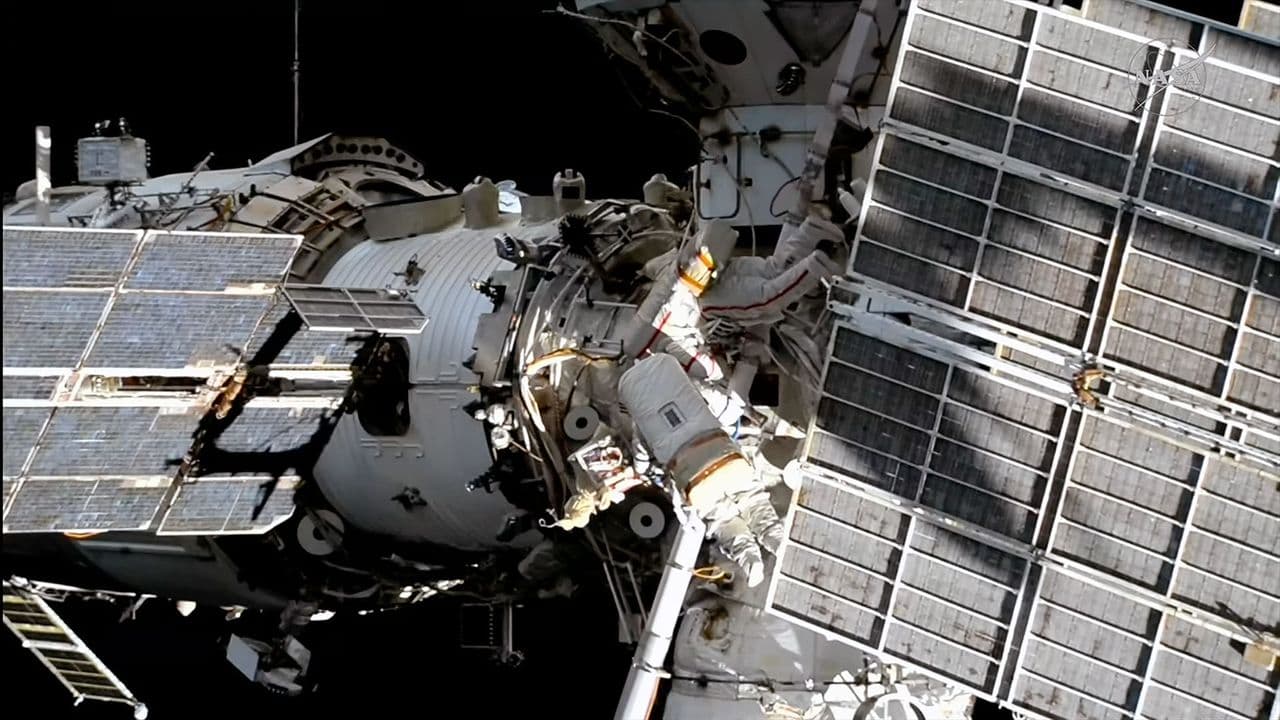
Russian cosmonauts Sergey Kud-Sverchkov (at center top) and Sergei Mikaev conduct a spacewalk outside the International Space Station on Wednesday, May 27, 2026. (Expedition 74 commander Sergey Kud-Sverchkov and flight engineer Sergei Mikaev spent 6 hours and 5 minutes outside the space station, conducting an extravehicular activity (EVA) that ran from 10:18 a.m. to 4:23 p.m. EDT (1418 to 2023 GMT). The two spacewalkers installed a solar radiation experiment on the exterior of the Zvezda service module and removed science hardware from the Poisk and Nauka modules on the station's Russian segment.The Solntse-Teragerts telescope that the duo mounted outside Zvezda was designed to observe and collect data about strong solar flares emanating from the sun. The instrument will help scientists improve their prediction models and better understand solar flare activity at different frequencies. The device is expected to operate through 2028. Russian cosmonaut Sergey Kud-Sverchkov (at left) holds up a card with a logo celebrating the 80th anniversary of the design bureau RSC Energia as he and Sergei Mikaev pose for a photograph during a spacewalk outside of the International Space Station on Wednesday, May 27, 2026. (3-meter) remote manipulator, to retrieve a cassette holding semiconducting material produced by an experiment mounted outside the Nauka mini-research module. The Ekran-M molecular beam epitaxy (MBE) experiment uses gallium arsenide to form ultra-pure, ultra-thin films that can only be borne under the microgravity environment of space.The cosmonauts ran into some difficulty retrieving the cassette, including losing a pair of pliers and commands sent from the ground failing to move the experiment's interior mechanisms. However, with some workarounds, they were able to collect the sample for its return inside the station.Before moving on with their other tasks, Kud-Sverchkov and Mikaev took a moment to recognize the 80th anniversary of RKK (RSC) Energia, Roscosmos' design bureau founded in August 1946. The spacewalkers held up a card printed with a commemorative logo and posed for photographs.Not long after, Kud-Sverchkov asked Mikaev if he knew what day it was."The 27th," replied the flight engineer."Today is the birthday of St. Petersburg," said Kud-Sverchkov. "So, congratulations to all of the residents of St. Petersburg, on the day of the city. Our northern capital of Russia."The two cosmonauts then moved over to the Poisk module to inspect, photograph and secure one of the Kurs rendezvous antennas on the Progress MS-33 (ISS 94P) cargo spacecraft. The antenna failed to deploy when the vehicle launched to the space station in March, resulting in a manually controlled docking.Wrapping up the EVA, Kud-Sverchkov and Mikaev retrieved a Biorisk science container holding samples of bacteria, seeds and other organisms and then jettisoned a bundle of used window cleaners before heading back inside the space station. All the activities planned for the outing were successfully completed.The spacewalk on Wednesday was the second for Kud-Sverchkov and the first for Mikaev. Kud-Sverchkov now has logged 12 hours and 11 minutes working in the vacuum of space.It was the 279th spacewalk in support of International Space Station assembly, maintenance and upgrades since 1998. Robert Pearlman is a space historian, journalist and the founder and editor of collectSPACE.com, a daily news publication and community devoted to space history with a particular focus on how and where space exploration intersects with pop culture. Pearlman is also a contributing writer for Space.com and co-author of "Space Stations: The Art, Science, and Reality of Working in
Discussion (0)