
Loading dispatches...
← Return to NewsroomScience
Astronomers discover a giant, rocky 'mega-Earth' 23 times more massive than our planet
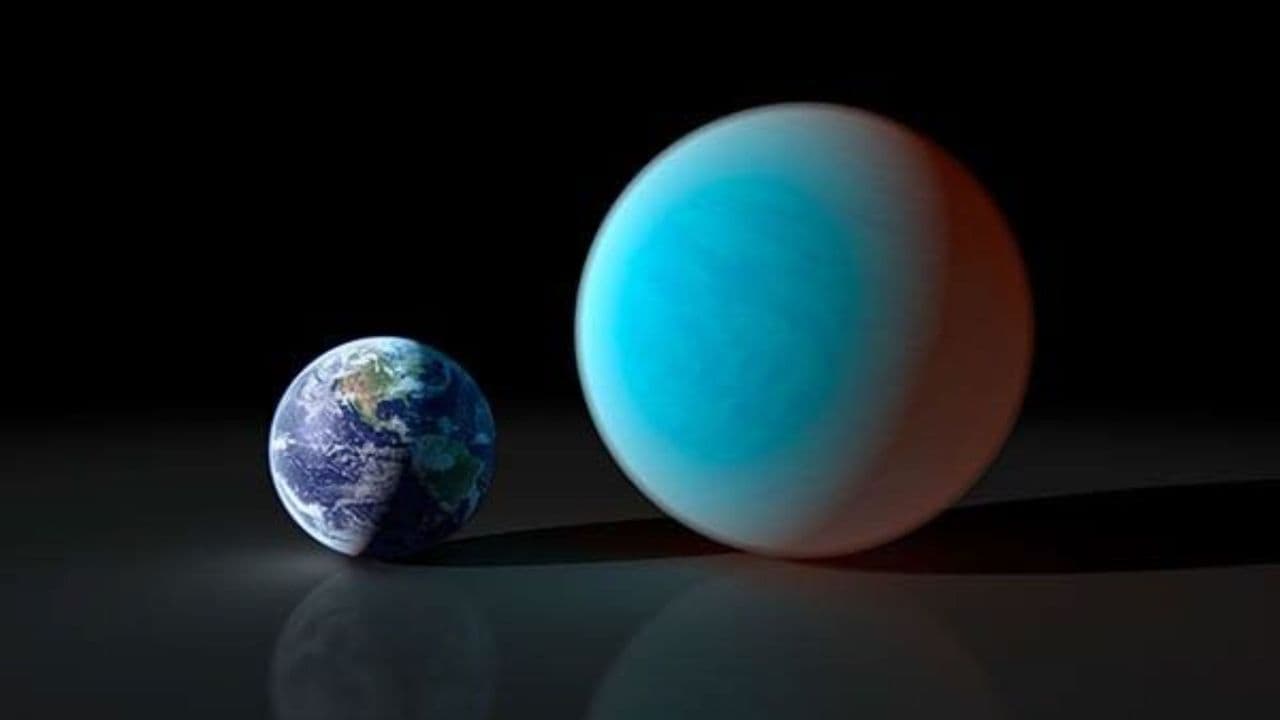
Astronomers have discovered an unusually massive, dense exoplanet that challenges conventional ideas about how rocky planets form.Called GJ 523b, the exoplanet is about 2.5 times wider than Earth but packs roughly 23 times our planet's mass into that relatively compact size. Worlds this large and dense are sometimes referred to as "mega-Earths," an informal term for unusually massive, predominantly rocky planets. GJ 523b's high density suggests it contains relatively little atmosphere despite being large enough that astronomers would normally expect it to have accumulated a substantial gaseous envelope, according to a statement from the University of Wisconsin–Madison."This isn't what we expected at all," Max Kroft, lead author of the study, said in the statement. "Dense planets like this aren't uncommon, but they're usually small rocky planets similar to Earth or Mercury. This planet is two and a half times bigger than the Earth."GJ 523b was initially identified as a candidate by NASA's Transiting Exoplanet Survey Satellite (TESS), which searches for periodic dips in starlight caused when planets cross, or transit, their host stars. Researchers followed up with observations from the ground-based WIYN 3.5-meter Telescope at Kitt Peak National Observatory in Arizona, using a spectrograph to measure the planet's gravitational tug on its star.Combining those observations, the team calculated that GJ 523b has a mass about 23.5 times that of Earth, a radius 2.55 times larger and a density of about 126.82 grams per cubic inch. It circles its star every 17.75 days. The planetary system is also relatively young, at an estimated nearly 170 million years old, according to the study.That combination of size, mass and youth poses a puzzle for planet formation models. Planets begin by building cores of rock and metal, which can then pull in hydrogen and helium from the disk of gas and dust surrounding a young star. In our own solar system, giant planets such as Jupiter and Saturn are thought to have begun rapidly accumulating their massive gaseous envelopes once their growing cores reached roughly 20 times Earth's mass.GJ 523b is already about 23 times Earth's mass, putting it beyond that threshold. Yet instead of developing into a gas-rich world, its unusually high density suggests it has relatively little gas and remains predominantly rocky — raising the question of why it followed such a different path."The question is, why didn't this planet do that, if it's 20 times the size of Earth?" Kroft said in the statement.One possibility is that GJ 523b initially formed with a thick atmosphere that was later stripped away. Another is that it formed through a collision between two planets, creating a larger rocky world while blasting much of their gaseous envelopes into space, according to the statement.Astronomers have used the term "mega-Earth" for more than a decade to describe exceptionally massive rocky worlds, though it has never represented a formally established class of exoplanets. Finding more examples like GJ 523b could help reveal whether these unusual worlds are rare exceptions or part of a broader population."It's hard to infer things about planet formation in general from a sample size of one," Kroft said in the statement. "We're not going to get to 10,000 of these overdense planets, but if we can get to 20 or 30, maybe some trends might pop out."The findings have been submitted to The Astronomical Journal and are currently available on the preprint server arXiv and have not yet been peer reviewed.
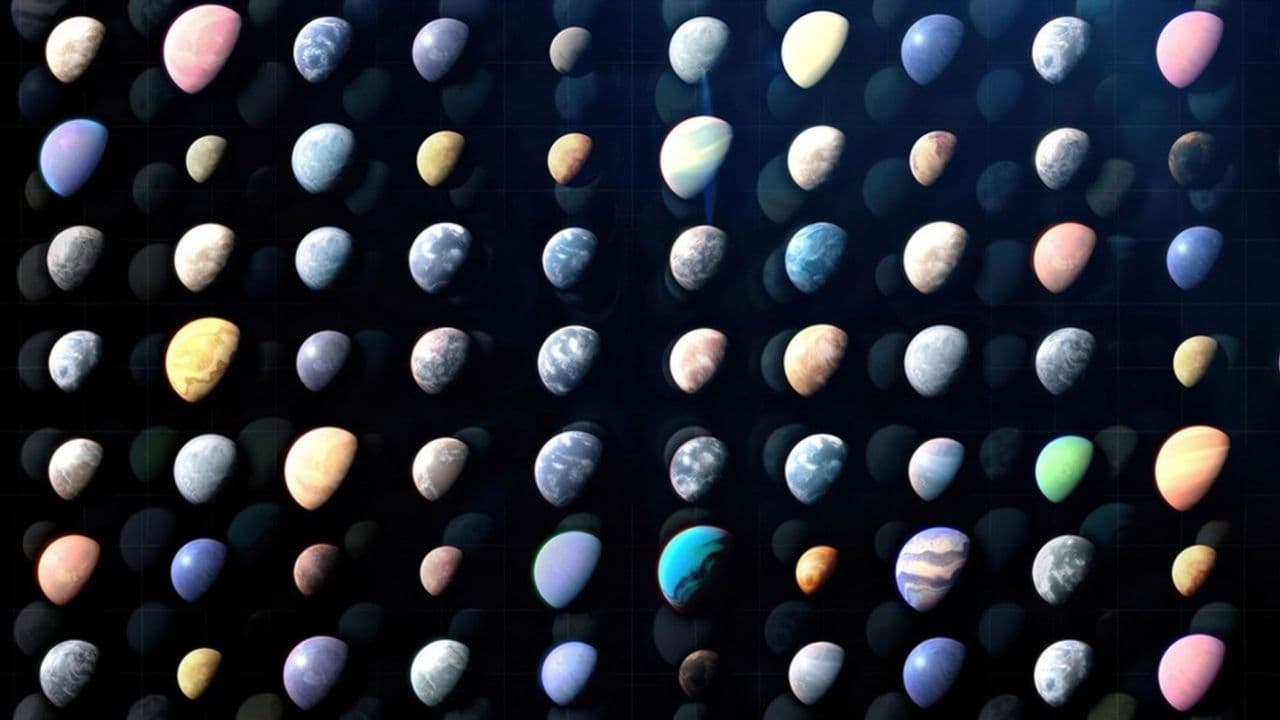
An artist's illustration of various exoplanets found so far. (So, we may wonder: How much smaller Earth could be and still have its delightfully breathable atmosphere? How small could an exoplanet be to sustain life as we know it?With these questions in mind, University of California Riverside planetary scientist Michelle Hill and her colleagues recently simulated what happens to the atmospheres of different sizes of rocky worlds. The worlds tested were similar to Earth and orbited in the habitable zones around sun-like stars. It turns out for a world to maintain an atmosphere long enough for life to gain a foothold (a few billion years at minimum), it needs to be at least as big as Mars.Narrowing down the search for lifeThe habitable zone — the area around a star where temperatures are right for liquid water to exist on a planet's surface — is prime real estate in the hunt for alien life. It's also a tough neighborhood for exoplanet atmospheres, because the closer a planet is to a star, the more ways in which radiation and stellar wind will try to strip away an atmosphere.This is why Hill and her colleagues recently simulated how long it would take rocky, Earth-like planets of various sizes, in the habitable zone of a star like our sun, to lose their atmospheres. In other words, how much smaller could Earth, or a similar planet, be and still keep an atmosphere?The answer turns out to be that an atmosphere-sustaining planet needs to be about 80% as wide as Earth, but could technically be as small as 60%. This offers astrobiologists a clue about which planets to focus on in the search for habitable worlds and signs of alien life."The plethora of exoplanets creates an interesting challenge in the search for potentially habitable planets," wrote Hill and her colleagues. "Of the many targets in the habitable zones of their star, which are the best candidates for follow-up observations with the aim of detecting biosignatures?" In other words, astrobiologists now have almost too many planets to choose from and not enough telescope time to search them all. So, it's time to narrow the search.One way to do that is to figure out which planets are most likely to be habitable — and for life as we know it, that habitability means having an atmosphere. New exoplanets, like those orbiting TRAPPIST-1, are being discovered with staggering frequency. ( Some of the simulated worlds are exactly like ours but smaller, with the same chemical makeup and the same proportions of core, mantle and crust. Others have slightly different amounts of carbon, larger or smaller cores, or different starting temperatures. The model traces what happens to these worlds over a few billion years, based on two things: how quickly stellar wind and radiation strip away gas from the planet's atmosphere and how quickly volcanoes pump out gas (mostly carbon dioxide) to replace it.The model is how the team realized a scaled-down version of Earth needs to be at least 80% as wide as true Earth (0.8 Earth radii) to maintain an atmosphere in the long run. Smaller planets tend to lose gas faster than volcanic eruptions can replace it.That's because smaller planets have less gravity and weaker magnetic fields with which to hold onto their thin envelopes of gas. They also don't usually release enough gas from within to make up for the loss. Their mantles — the churning layer of magma beneath the crust — tend to release less volcanic gas over time, and their upper layers cool and harden much faster. The latter process cuts off volcanic eruptions much earlier in a planet's lifespa
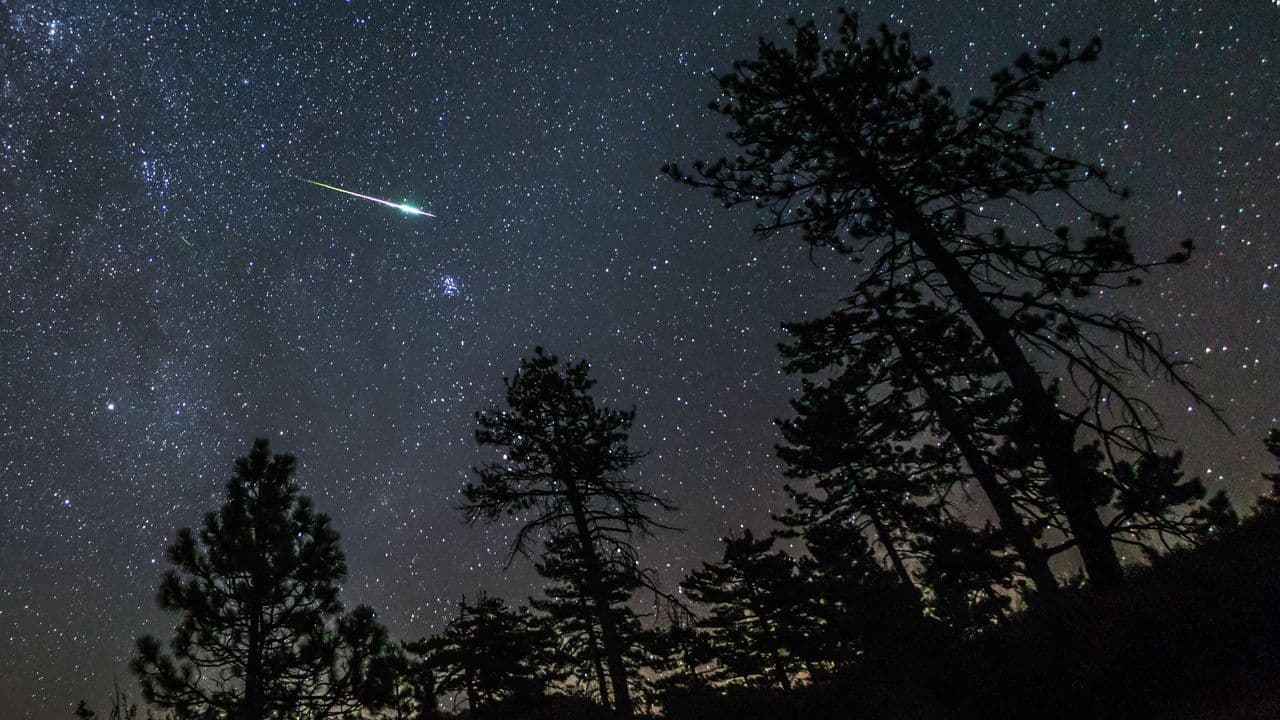
Picture it: A slash of vivid green light splits the starry sky. There for a moment and then gone, leaving nothing but a short-lived glowing trail and a moment of pure joy. You've finally caught it, your first Perseid shooting star of the season.What you saw was the final moment of a story billions of miles and thousands of years in the making. A story that began with that same shooting star locked inside the icy body of the wandering comet 109P/Swift-Tuttle.The 16-mile-wide (26 kilometer) giant of a comet spends its life journeying back and forth between the outer and inner solar system, where its frigid body is heated by the sun, triggering dramatic outbursts of activity. While in close proximity to our star, ice near to the surface of the comet is transformed into gas, skipping the water stage entirely as it escapes out into the vastness of interplanetary space.Embedded within that ice was once a micrometeoroid no larger than a grain of sand, destined to become the Perseid shooting star you saw.The violence of the newborn micrometeoroid's exile was followed by an epoch of utter silence, as its orbit was subtly influenced by the unseen forces of the solar system. It would be easy to think of this as a lonely existence, but we'd be wrong.Our cosmic pebble was joined by millions of others, all shed in the wake of Swift-Tuttle. A great stream of primordial material that threads through the inner solar system, crossing the path of Earth before extending in a great swarm that messily traces the elliptical orbit of their comet progenitor, below the plane of the solar system. Beyond the orbit of Pluto.Each follows its own unique path. Trajectories are shaped by the force of a micrometeoroid's expulsion from the comet's nucleus, along with the gentle push of radiation from the sun and the gravitational tug of the planets. A perseid blazes earthward over Hubei province in China. ( Was it hundreds or many thousands of years? How many times might it have journeyed around the sun before its fateful rendezvous with our Blue Marble?We can never know. What we do know is how its journey ended.Civilizations could have risen to their zenith and crumbled in the time our micrometeoroid spent traversing the unfeeling expanse of interplanetary space, but its demise lasted but a fraction of a second. It collided with our planet's gaseous shell at 132,000 miles per hour (212,433 kmph), cutting a brilliant green trail through the summer sky as atmospheric friction vaporized the cometary shard.It's that fiery demise that you spotted tonight — an experience that will repeat hundreds of times each and every hour at the height of the Perseid meteor shower, as Earth passes through the densest part of the debris stream cast off by comet Swift-Tuttle.Nikon Z8 ( It features a full-frame 45.7MP sensor, 8K video capabilities and excellent low-light performance. Check out our Nikon Z8 review for more!The Perseid meteor shower is active from now until Aug. 24, with the best viewing window occurring in the early hours of Aug. 13, as the shower's radiant rises to its highest point on the night of the shower's peak.This year's peak will be particularly spectacular, unfolding as it does in the pristinely dark skies surrounding the Aug. 12 new moon, which will also cause a spectacular total solar eclipse to be visible across parts of Spain, Iceland and Greenland. If you find yourself in the path of totality and have luck on your side, then you might just spot a Perseid fireball brightening the false twilight that falls as the moon hides the face of the sun at the crescendo of the eclipse!Want to capture a shooting star that will stay with you f
What's next for our exploration of Red Planet skies? (On July 20, 1976, the Viking 1 lander touched down in the western reaches of Chryse Planitia (the "Golden Plain"), a large circular landform that lies 22.5 degrees north of the Martian equator.It was the first-ever Mars landing for NASA. Viking 1, along with its twin Viking 2, went on to conduct the first fully successful mission on the Red Planet's surface. (The Soviet Union's Mars 3 probe survived its touchdown attempt on Dec. 2, 1971 but died less than two minutes later.) And those missions have left a rich and intriguing legacy. The first color image ever captured on the surface of Mars. NASA's Viking 1 lander took this photo on July 21, 1976. ( 3, 1976 — were sent to the surface to search for signs of life on Mars. (Each mission also featured an orbiter, which studied the planet from above.)The landers did this using three different experiments, two of which returned negative results. But the third, called Labeled Release (LR), was different. LR observed a steady stream of carbon dioxide gas coming from dirt into which it had introduced nutrients — a possible sign of microbial metabolism.Some scientists deemed the LR results a likely life detection. But most disagreed, ascribing them to abiotic reactions and stressing that, overall, the Viking data paint a picture of a dead planet.That disagreement illustrates one of the main legacies of the Viking program: It showed researchers that hunting for extraterrestrial life is a complicated business, and they needed to learn more about Mars before attempting the search again on the Red Planet.NASA didn't send a surface craft to Mars for another two decades, a hiatus caused in part by the Vikings' ambiguous results and high price tag, as well as a shifting of funds to the nascent space shuttle program.The dry spell was broken in July 1997, when the agency's Pathfinder lander touched down in Chryse Planitia, about 530 miles (850 kilometers) from Viking 1. The main goals of Pathfinder's mission were to demonstrate a new "faster, better, cheaper" method of Mars exploration, prove out a new airbag-based landing system and get a mobile robot onto the red dirt.Pathfinder achieved all of these objectives, notching the third by deploying a small rover named Sojourner. The little wheeled robot stumbled across rounded pebbles — strong evidence that they had been exposed to flowing water.This discovery helped shape a new NASA Mars exploration strategy, one that aims to make an informed search for alien life after "following the water." Life as we know it depends on water, so the agency built rovers designed to hunt for signs of past liquid water and potentially habitable environments.The twin golf-cart-sized rovers Spirit and Opportunity landed in 2004, and the car-sized Curiosity followed suit in August 2012. Then came Perseverance, which landed inside Mars' Jezero Crater in February 2021.All of these wheeled explorers found evidence of past aqueous environments. Curiosity and Perseverance — with their more extensive and sophisticated scientific payloads — delved even deeper, discovering complex organic molecules that may have been produced by life as we know it.The two latter rovers are continuing their work; both remain active on the Red Planet. (Pathfinder and Sojourner operated for about three months; Spirit was declared dead in 2010 and Opportunity fell victim to a Mars dust storm in 2018.)Perseverance has collected a variety of Mars samples, which NASA wants to return to Earth for detailed study. As the Vikings' experience suggests, such a level of intense scrutiny may be necessary to make a definitive detection of life on Mars, if it indeed exists. (Getting those samples home is not a foregon
Discussion (0)