
Loading dispatches...
← Return to Newsroomgeneral
Twisha’s husband approaches court: ‘Prosecution story is imagination and presumptions’

In his petition, Samarth argued that the allegations of dowry demand were inherently doubtful because he and his mother had allegedly transferred more than Rs 7 lakh to Twisha’s account. (File Photo)The legal battle following the death of actor and model Twisha Sharma is set to move to the Madhya Pradesh High Court, with her husband Samarth Singh challenging a lower court’s rejection of his anticipatory bail plea, and Twisha’s family preparing to seek cancellation of the anticipatory bail granted to his mother Giribala Singh. Samarth, against whom police have announced a reward after describing him as absconding, has approached the High Court, arguing that the sessions court wrongly denied him anticipatory bail despite granting relief to his mother in the same case.In his petition, Samarth argued that the allegations of dowry demand were inherently doubtful because he and his mother had allegedly transferred more than Rs 7 lakh to Twisha’s account. “The WhatsApp chats presented by the complainant are edited and incomplete. The same being tampered cannot be relied upon,” the plea states, adding that “more than Rs 7 lakh has been transferred online to the account of Mrs Twisha by the applicant and his mother in a complaint of dowry harassment for a demand of Rs 2 lakh.” The petition argued against the trial court’s reasoning for rejecting bail, calling the order “completely arbitrary and without any logical reason”. Samarth further argued that the investigation so far had not produced any material directly linking him to Twisha’s death. “No material till today has been collected to display any involvement of the applicants in the sad demise of Late Mrs Twisha. The entire prosecution story being constructed and built is based on imagination and presumptions,” the petition claimed. The plea also claimed that Twisha suffered from “drug addiction and related complications of withdrawal symptoms”, asserting that psychiatric and psychological prescriptions had been filed before the court. It additionally contended that “no custodial interrogation is required in the instant case”. The sessions court, however, had drawn a distinction between the allegations against Giribala Singh, a retired judge, and those against her son while deciding the earlier anticipatory bail pleas.Story continues below this ad While granting anticipatory bail to Giribala Singh, the court had observed that the allegations against her appeared “formal in nature” and that prima facie material suggested the deceased’s “principal grievance” was against her husband. The court also noted that custodial interrogation of the retired judge did not appear necessary at that stage. In contrast, while rejecting Samarth Singh’s anticipatory bail plea on May 18, the court cited the fact that Twisha had died “within six months of marriage under abnormal circumstances”. The court also relied on statements given by Twisha’s family members, along with WhatsApp chats placed on record, observing that these materials prima facie pointed against Samarth. The court further noted that the investigation remained incomplete and that custodial interrogation could not be ruled out at that stage. Twisha’s family is now expected to challenge the anticipatory bail granted to Giribala Singh before the High Court, arguing that the sessions court failed to properly appreciate the allegations of influence over the investigation and postmortem process.Story continues below this ad The case has snowballed into one of the most closely watched criminal investigations in Madhya Pradesh, with allegations of dowry harassment, disputed forensic findings, demands for a second postmortem, and calls for a CBI probe. Earlier this week, Chief Minister Mohan Yadav said the state government would write to the CBI seeking an investigation into the matter, while Bhopal Police Commissioner Sanjay Kumar maintained that the probe so far “points towards suicide and not murder

A magistrate court in Bengaluru last week acquitted a man accused by his estranged wife of having forceful unnatural sex with her and subjecting her to cruelty before and soon after their marriage.The court acquitted the woman’s husband of all charges, citing discrepancies between her statements to the police and before the magistrate, material lapses in the police investigation, and a delay of about three years in lodging the complaint, among other reasons.Additional Chief Judicial Magistrate Girish Chatni acquitted the husband, a research scholar from IIT Mumbai, on May 15 and said, “The case of the prosecution, when examined in its entirety, does not meet the standard of proof required in criminal law. The prosecution has failed to establish penetration and absence of consent beyond reasonable doubt.” The order added, “The evidence produced is characterized by delay, embellishment, absence of contemporaneous medical and forensic corroboration, lack of any independent witnesses and investigation that does not demonstrate an independent application of mind.” The woman’s complaint Before getting married in 2015, the man and the woman developed a relationship during their tenure as research scholars at IIT Mumbai. In a 2017 complaint, the woman alleged that her husband abused her in filthy language and forcefully subjected her to unnatural sex after marriage. In the woman’s absence, her husband allegedly sent her private photos to her father and friends on Facebook and WhatsApp without her consent. The photos were later deleted, as per the complaint. In 2017, the woman lodged a zero FIR in Chhattisgarh, which was transferred to the Viveknagar police station in Bengaluru. In 2019, the police filed a chargesheet against her husband only for offences punishable under Indian Penal Code (IPC) section 498A (cruelty from husband or his relatives). On a petition filed by the woman, the Karnataka High Court ordered a reinvestigation into the case in 2022. The police then filed an additional chargesheet against her husband under IPC sections 498(A) (cruelty), 377 (unnatural sex), 201 (causing disappearance of evidence) and Information Technology Act sections 67 and 66(E). The prosecution examined 12 witnesses. IPC section 377 requires proof of specific and distinct ingredientsStory continues below this ad The magistrate court noted that to sustain a conviction under IPC section 377, the prosecution must establish beyond a reasonable doubt that there was carnal intercourse and that the act was non-consensual in cases involving adults. Judge Chatni opined, “Each of these ingredients is indispensable. Failure to prove even one of the above ingredients would be fatal to the charge.” The prosecution relied heavily on the woman’s testimony to prove its case. However, the court said, “The prosecution has not produced any independent eyewitness, no contemporaneous disclosure forming part of the transaction and no surrounding circumstance or objective material lending assurance to the allegation.”Story continues below this ad “There are material alterations, inconsistencies, improvements between the complainant’s initial version and her oral testimony, affecting the core narrative of the alleged offence. The variations in the narrative are not cosmetic; they strike at identification, sequence, and manner of commission,” the court said. The court underlined that in a medical examination conducted on the complainant in 2017, the doctor had opined that no definite opinion could be given about anal sex. The court said, “Notwithstanding these assertions, no contemporaneous medical consultation was undertaken in 2015. No hospital visit, no clinical examination, no prescription and no treatment record from the period of alleged repeated painful acts form part of the prosecution record.” The woman claimed she had suffered a lot of pain after the alleged anal sex. No evidence linking husband to alleged actStory continues below this ad The court noted that
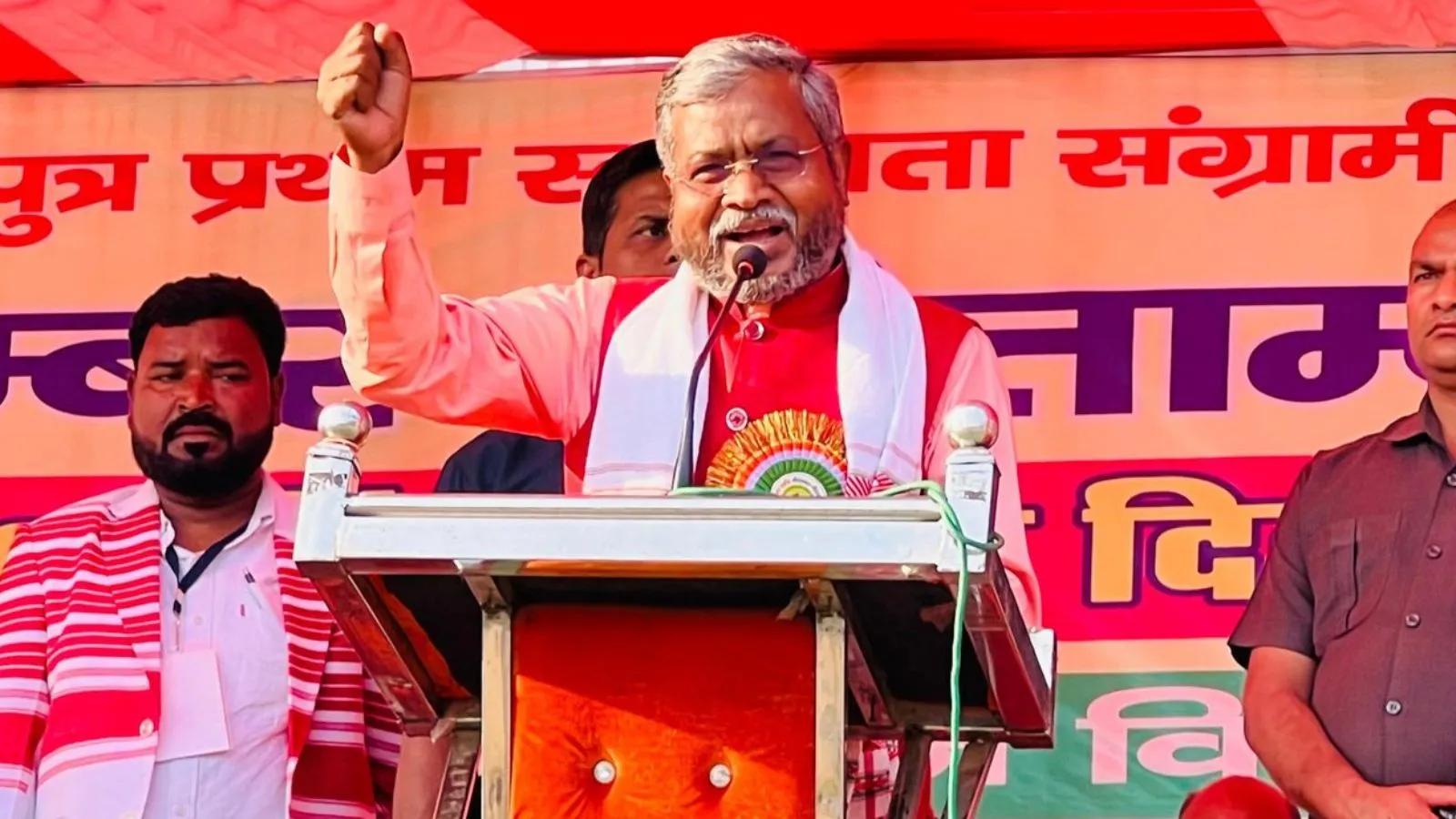
RanchiUpdated: May 18, 2026 03:26 PM IST LoP Jharkhand Babulal Marandi alleged that a woman inmate inside the Ranchi jail had been subjected to “continuous mental and physical exploitation” by the jail superintendent and had subsequently become pregnant. (Photo Credits: Babulal Marandi/X)The alleged sexual exploitation of a woman inmate at Ranchi’s Birsa Munda Central Jail has kicked up a political storm in Jharkhand, with Leader of Opposition Babulal Marandi accusing state officials of a cover-up and demanding an independent probe into the allegations. In a letter to Chief Minister Hemant Soren, Marandi alleged that a woman inmate inside the Ranchi jail had been subjected to “continuous mental and physical exploitation” by the jail superintendent and had subsequently become pregnant. Calling the allegations a “grave institutional crime”, Marandi alleged that senior prison officials — including the Inspector General (Prisons) — were trying to shield the accused officer and suppress evidence related to the case, and accused the state administration of attempting to suppress the matter.Marandi also alleged that the pregnant inmate was being repeatedly taken outside the prison premises to hospitals and undisclosed locations under the guise of medical treatment in an “attempt to destroy biological and forensic evidence”. He further claimed that key witnesses and prison staff aware of the alleged incident had been transferred or removed overnight to prevent information from leaking. Calls and texts to the jail superintendent and the Inspector General (Prisons) went unanswered. However, according to sources, the alleged incident came to the prison administration’s notice in April. Supporting Marandi’s letter, BJP women spokesperson Rafiya Naz termed the alleged incident “shameful” and alleged that the administration was trying to hide it. “We support Babulal Marandi ji and want strict action against all officials involved in the incident, from the SP level to the IG,” she said. Meanwhile, speaking to The Indian Express, BJP Mahila Morcha state president Arti Singh said the allegations raised serious concerns over the safety of women inmates and reflected the state government’s approach towards women’s issues in Jharkhand. “It is a serious matter that a woman inmate had to face such an incident inside a jail itself. This raises questions over security arrangements and the seriousness of the government towards women in the state,” she said.Story continues below this ad Singh further alleged that the absence of a functional State Women’s Commission reflected the “carelessness” of the government. “There is no Mahila Aayog in the state and many files related to women’s issues are pending. We do not know why it has not been constituted yet,” she added. Responding to the allegations, Jharkhand Mukti Morcha (JMM) spokesperson and general secretary Supriyo Bhattacharya said that an investigation would provide a clearer picture and that “action would be taken if a crime was found committed”. For his part, Ranchi Deputy Commissioner Manjunath Bhajantri told The Indian Express that the district administration became aware of the matter only after reports surfaced in the media and the Opposition raised the issue. “Whatever allegations have been made, the facts need to be properly verified and ascertained,” he said. The DC added that while the prison department had already initiated a probe, the district administration was also conducting its own inquiry into the matter. “From the police administration side, the IG has initiated an investigation. From the district administration side too, we are initiating an inquiry. The SDM (Law and Order) and SDO will look into the matter from our side,” he said. Shubham Tigga is a Correspondent at The Indian Express, presently based in Pune, where he covers the intersections of infrastructure, labor, and the modern economy. His reporting focuses on civil aviation, urban mobility, the gig economy,
The court further held that bypassing mandatory judicial inquiries and replacing them with executive processes amounted to “administrative lawlessness”. The Jharkhand High Court on Thursday termed custodial deaths a “profound failure of the constitutional machinery” and pulled up the state government for bypassing mandatory judicial inquiries in more than half of the custodial death cases over the past several years. Hearing a PIL filed by Md. Mumtaz Ansari, a Division Bench led by Chief Justice M S Sonak observed that “the occurrence of a fatality within the coercive control of the State, legally categorised as a ‘custodial death’, represents a profound failure of the constitutional machinery.”The court made the observations while examining data submitted by the Jharkhand government, which showed that 427 custodial deaths were reported in Jharkhand between 2018 and 2026. According to the state’s own affidavit, inquiries in 262 of these cases were conducted by Executive Magistrates instead of Judicial Magistrates despite a statutory requirement mandating judicial probes in custodial death cases. After examining the data, the Bench said this was “shocked beyond words” and accused the state of displaying “utter disregard for legal procedures” in handling custodial deaths. “By their own admission, 262 inquiries were conducted by Executive Magistrates, even though the law had unequivocally stripped the executive of this prerogative two decades ago,” the court observed. The court also ordered fresh judicial inquiries in all custodial death cases since 2018, where only Executive Magistrate inquiries had been conducted. The High Court noted that section 176(1-A) of the Code of Criminal Procedure, introduced in 2006 and now continued under Section 196(2) of the Bharatiya Nagarik Suraksha Sanhita (BNSS), makes it mandatory for custodial death inquiries to be conducted by Judicial Magistrates. The Bench said, “The right to life is not a mere biological concept; it is an expansive guarantee that inherently encompasses the right to live with human dignity.” The court further observed that prisoners, undertrials and other accused retain their constitutional protections. “Even when an individual is accused of an offence or stands as a convicted prisoner, her entitlement to a dignified and peaceful life remains inviolable,” it said. Referring to the state’s handling of custodial death cases, the Bench said the violations, if left unchecked, would “increase custodial unnatural deaths, embolden the perpetrators, and promote lawlessness”.Story continues below this ad The court also called the government’s data into question, saying it was mathematically irreconcilable that the state reported 427 custodial deaths while the number of inquiries conducted by Executive and Judicial Magistrates together totalled 487. “This discrepancy not only reflects a systemic disregard for the law but also casts serious doubt on the state’s veracity and diligence in maintaining these records,” it observed. The court further held that bypassing mandatory judicial inquiries and replacing them with executive processes amounted to “administrative lawlessness”. While relying on several Supreme Court rulings on custodial violence and prisoners’ rights, the HC also cited earlier observations that deaths in police custody are among the “worst kind of crimes in civilised society” and that “men in khaki are not above the law”. The court directed the state government and district judiciary to identify officers responsible for the lapses. Shubham Tigga is a Correspondent at The Indian Express, presently based in Pune, where he covers the intersections of infrastructure, labor, and the modern economy. His reporting focuses on civil aviation, urban mobility, the gig economy, and workers' unions, providing critical insights into how transit and commercial sectors impact the daily lives of citizens. Expertise & Background Before mov


Discussion (0)