
Loading dispatches...
← Return to NewsroomPolitics
J&K CM Omar Abdullah backs efforts to resume dialogue with Pakistan

Jammu and Kashmir Chief Minister Omar Abdullah. File | Referring to the joint open letter signed by over 100 individuals from India and Pakistan, Mr. Abdullah said, “A request is being made to the Prime Minister via a letter to find a way to improve relations between the two countries. No one should have any objection to this. Recently, RSS chief Mohan Bhagwat stated that India and Pakistan should talk to each other and establish friendly ties. No one objects when the RSS says it.”Recalling the statement made by former Prime Minister, the late BJP leader Atal Bihari Vajpayee, Mr. Abdullah said, “Mr. Vajpayee would say ‘one can change friends but not neighbours’. We also want relations between neighbours to improve.”He said cross-border tensions between India and Pakistan had persisted for decades and worsened after the Pahalgam terror attack last year.“Our position on dialogue with Pakistan is not new. It has been consistent for decades. But when we speak, we are accused of being anti-national. Why do similar remarks by leaders from Jammu and Kashmir invite sharp criticism, while statements favouring dialogue by senior RSS leaders do not?” he added.“The recent appeal by over 100 prominent citizens from both countries reflects a sentiment that has long been expressed across the political spectrum. If calls for peace and engagement are welcomed from some quarters, they should not become controversial when voiced from Jammu and Kashmir,” he said.Mr. Abdullah added there should be no objection to advocating dialogue and normalisation of relations between India and Pakistan. Published - July 03, 2026 01:49 am IST
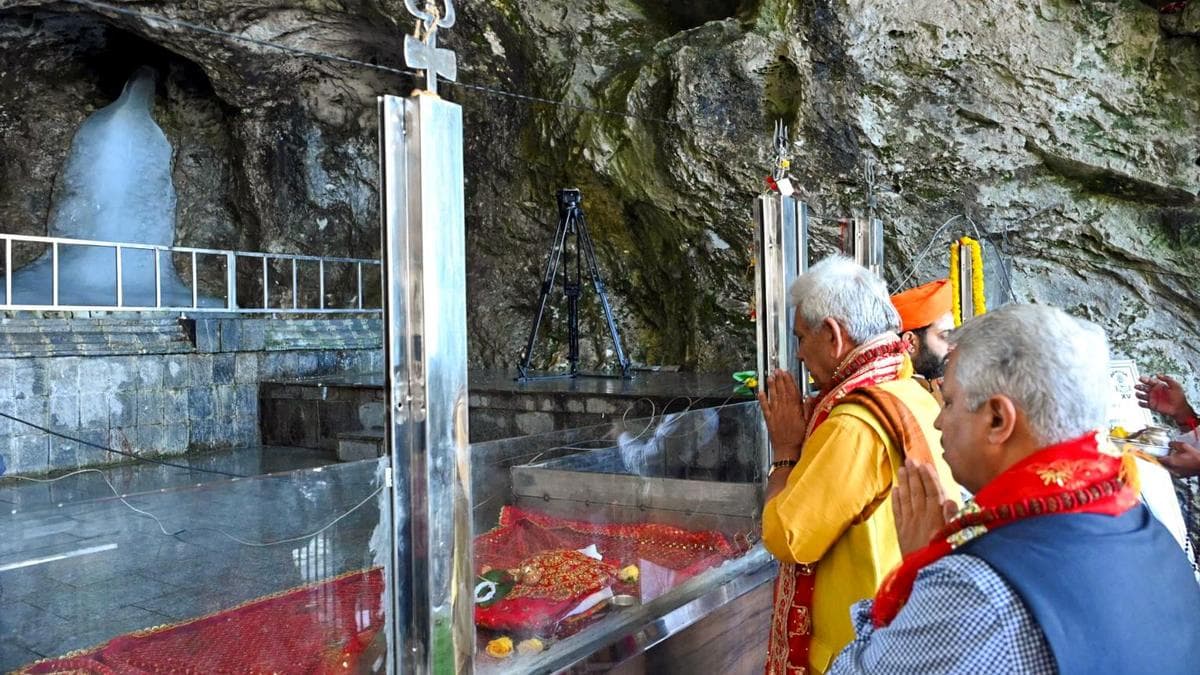
Jammu and Kashmir Lieutenant Governor Manoj Sinha offers prayers to the Amarnath Ice Lingam (Baba Barfani) at the Holy Cave Shrine of Shri Amarnath Ji (or Amarnath Temple), in Anantnag on June 29, 2026. | Mr. Sinha sought the divine blessings of Baba Barfani and prayed for the peace, prosperity, health and well-being of all, an official statement said.He also urged the devotees of Baba Barfani to join the pilgrimage in great numbers and experience the spiritual journey.Mr. Sinha said the administration, the Amarnath shrine board, Army, police, security forces, local communities, service providers and volunteers are working in complete synergy to ensure a safe, hassle-free and a memorable pilgrimage for devotees.With significantly upgraded infrastructure, enhanced facilities and invaluable support of people, the authorities are fully prepared to welcome the devotees for a spiritually fulfilling journey, he said.The Shri Amarnath Ji Shrine Board (SASB) organises the ‘Pratham Puja’ at the cave shrine on Jyeshtha Purnima annually.The 57-day Amarnath Yatra will formally commence on July 3 via two traditional routes — the Pahalgam axis in Anantnag district and Baltal in Ganderbal district.The Yatra will culminate on August 28 on Raksha Bandhan.DGP Nalin Prabhat, Special DG (coordination) S.J.M. Gillani, SASB CEO Mandeep Bhandari and Kashmir Divisional Commissioner Anshul Garg accompanied Mr. Sinha to the cave shrine. Published - June 29, 2026 01:27 pm IST
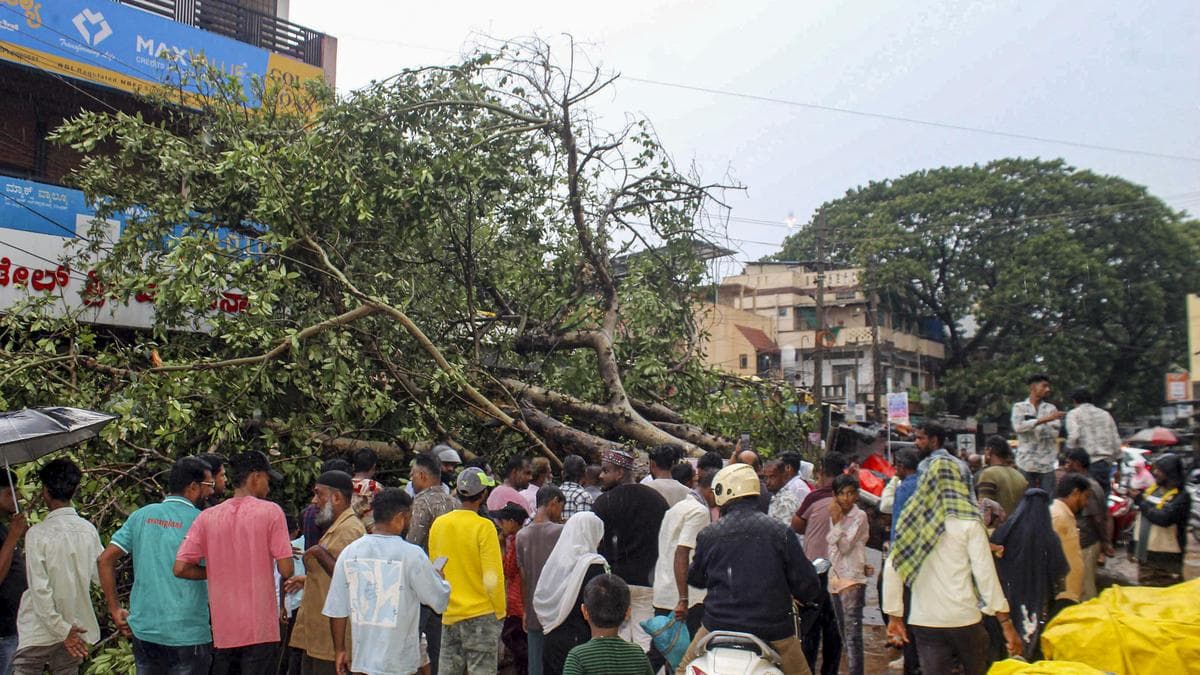
People gather after a tree fell following heavy rain and gusty winds in Hubballi on Monday evening. | What has angered the people most is the fact that helplines are continuously engaged and even the local officials have gone incommunicado.Meanwhile, even on the second day after Monday’s rain havoc, the broken branches of trees remained scattered on roads in various localities and the municipal authorities have not yet bothered to clear them.The downpour and strong winds have exposed the unpreparedness of the authorities for facing the monsoon and consequently, several localities remained in darkness for the second day in succession.Several major residential localities, including various localities on either side of Gokul Road, did not have power supply for the second day.The areas affected included Green Garden, Rajdhani Colony, Shivapur Colony, Manjunath Nagar, Basaveshwar Nagar, Anand Nagar, Vidyanagar, Lohia Nagar, Manjunath Nagar, Mayur Nagar, Surabhi Colony, RN Shetty Road, ART Nagar and Morarji Nagar.Water tanks remained empty as electricity pumps stopped functioning and the scheduled water supply in the 24 x 7 supply network areas also did not happen because of the power shutdown.Families struggled without drinking water. Elderly residents and children were forced to endure humid nights without fans or cooling systems. Mobile phones and laptops ran out of charge, cutting off communication and work. A few then visited their relatives and friends in localities where power supply was restored on Tuesday.Prolonged power outage also affected several businesses especially those selling perishable goods like milk, paneer and other such items.Residents ringing up HESCOM helplines had to wait for several minutes only to hear a recorded voice saying that “their call is most valuable to them”.Those who managed to connect to the operators were given a ready answer that the staff is working on it and they did not know when power supply will be restored.According to a rough estimate, around 30 localities in the city lost power supply after the downpour. Although the field staff reportedly worked continuously through the night, with repair teams operating until early morning hours, power supply is unlikely to be restored till Wednesday afternoon. Published - May 19, 2026 08:56 pm IST

Energy Minister Gottipati Ravi Kumar. | During a teleconference with the CMDs of DISCOMs on Monday, Mr. Ravi Kumar instructed them to take steps to ensure uninterrupted power supply to domestic, commercial and industrial consumers throughout the season. The Minister stated that despite the rising electricity demand during summer, consumers should not face any inconvenience and officials must ensure continuous and reliable power supply. Mr. Ravi Kumar further directed that in the event of any technical fault leading to power interruptions, consumers should be informed immediately and restoration works should be taken up on a war footing to resolve issues at the earliest. Considering the prevailing weather conditions and extreme temperatures, he cautioned that incidents such as transformer failures might occur at several places. He also reviewed the progress of key Central and State government schemes, including PM Surya Ghar, PM Kusum, and RDSS, and instructed officials to achieve the targets within stipulated timelines. Published - May 18, 2026 11:24 pm IST
Jammu and Kashmir CM Omar Abdullah. File photo: Special Arrangement The Jammu and Kashmir Cabinet, headed by Chief Minister Omar Abdullah, has approved ₹93 crore power infrastructure projects for the summer capital, a spokesperson said on Friday (May 16, 2026).The project aims to enhance transmission capacity and reduce power interruptions in the city.The Chief Minister-headed Council of Ministers approved the augmentation of the Grid Sub Station at Zainakote from 450 MVA to 780 MVA at a cost of ₹67.66 crore, the spokesperson said.He said the cabinet also approved the upgradation of the 132 KV Pampore-Rawalpora and Rawalpora-Bemina transmission lines of ₹25.47 crore.The approval was accorded during the sixth meeting of the Council of Ministers, he said.The projects are aimed towards significantly strengthening the power infrastructure in Srinagar and adjoining areas by enhancing transmission capacity, reducing power interruptions and ensuring a more reliable and efficient electricity supply to consumers, the spokesperson said.The augmentation of the Zainakote Grid Sub Station, along with the transmission line upgrades, is expected to improve overall grid stability and help meet the growing electricity demand in the region, particularly during peak load periods, he said. Published - May 16, 2026 06:41 am IST


Discussion (0)