
Loading dispatches...
← Return to NewsroomScience
3 bright planets light up June's night sky — Here's where and when to look
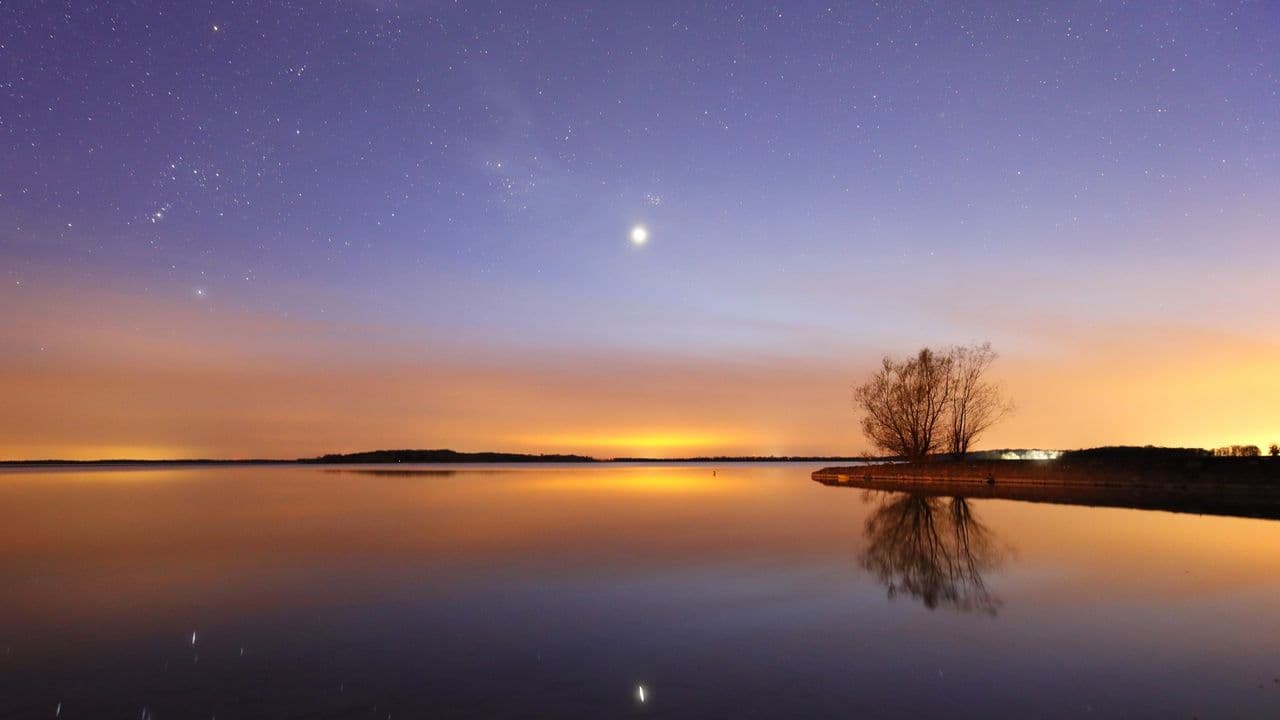
Venus shining bright in the early evening sky above Lac du Der-Chantecoq, France. ( ( The stars (Pollux and Castor) and planets (Venus, Jupiter and Mercury) will be arrayed across the west-northwest sky during the first half of the month, with the moon moving in to join them during the evenings of June 16 and June 17. The most amazing sight will be provided by Venus and Jupiter as they approach each other on a nightly basis, before finally arriving at a close conjunction, less than two degrees apart, on the evening of June 9.Meanwhile, the early hours of the morning belong to Saturn and Mars. Saturn rises well after midnight most of this month, but is well placed in the southeast sky at the break of dawn. Using a telescope magnifying 30x or more will bring out its beautiful ring system, a big improvement compared to a year ago, when they appeared virtually edgewise to our line of sight. Meanwhile, Mars is becoming easier to sight, after being enmeshed in the bright twilight glow for nearly a year. It becomes evident, low in the east-southeast, a couple of hours before sunup. Shining now at first magnitude, it will brighten, but very slowly, during the second half of this year.In our schedule, remember that when measuring the angular separation between two celestial objects, your clenched fist held at arm's length measures roughly 10 degrees. Here, we present a schedule below which provides some of the best planet viewing times, as well as directing you as to where to look to see themThe sunThe sun at 4:25 a.m. EDT on June 21, arrives at that point where it is farthest north of the celestial equator (the solstice). Summer officially begins in the Northern Hemisphere, and winter begins in the Southern Hemisphere.MercuryMercury during the first three weeks of June makes its highest vault into twilight for mid-northern observers this year. Each night, this shy planet comes into view at almost the same time and place in the west-northwest sky. During the first half of this month Mercury is about 18 degrees up at sunset (as seen from latitude 40 degrees north) and perhaps 12 degrees high when the sky has darkened enough for us to spot it.On the evening of June 15, it's positioned about 7 degrees to the lower right of Jupiter and for the next few evenings, we'll have a "planet trifecta" with Venus, Jupiter and Mercury aligned diagonally from upper left to lower right.On June 16, a thin waxing crescent moon joins the evening planet trio and sits about 3 degrees above and slightly to the left of Mercury and about 5 degrees to the right and slightly below Jupiter. By June 22 Mercury is still 23 degrees from the sun, 2 degrees less than at greatest elongation, but even fainter at magnitude +1.2. It will be lost from view soon after. Approximate location of Venus, Jupiter, Mercury and the moon on June 16. ( But for viewers at mid-northern latitudes, June is the month when Venus appears highest right after sunset. This is true because the planet is moving rapidly south relative to the sun.This dazzling world (magnitude -4.0) is now more than 25 degrees high at sunset for observers around 40 degrees north latitude. It sets about 2½ hours after the sun at the start of June and maintains this interval throughout the month. Of course, for the first nine days of June, the big attraction will be to follow Venus as it marches a bit closer each evening toward Jupiter. They will be closest together on the evening of June 9, just 1.6 degrees apart. As darkness deepens, another set of "twins" comes into view just a fist-width to the right of the p
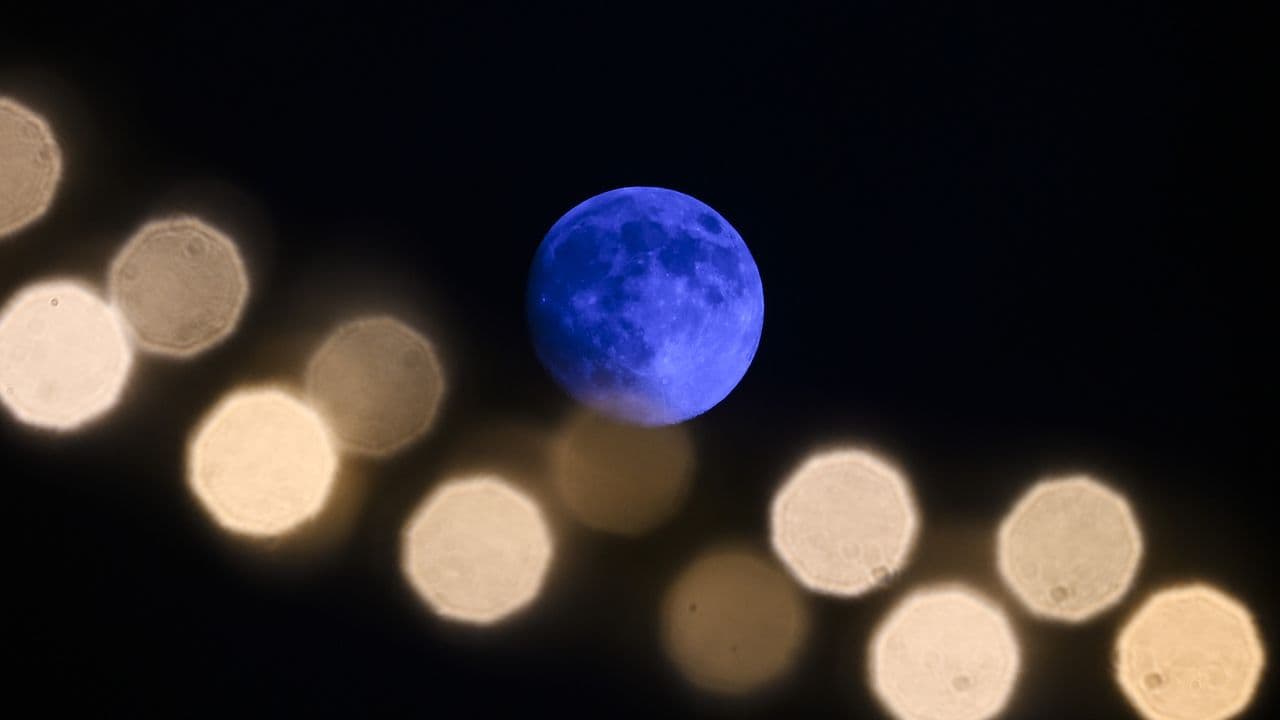
A rare "Blue Moon" takes to the eastern sky at sunset tonight! Here's what to expect from the second full moon of May 2026, as it rises close to the red star Antares in the constellation Scorpius.When to see the Blue MoonThe Blue Moon reaches peak illumination at 4:45 a.m. EDT (0845 GMT) on May 31, as it sits opposite the sun in Earth's sky. Viewers in the U.S. will get their first glimpse of the full moon as it rises above the eastern horizon around sunset on May 30. You can check exact timings for your location using Time and Date's moonrise tracker.Look out for the red light of the supergiant star Antares glowing close to the lower left of the moon. At the same time, Jupiter, Venus and Mercury team up to form a line above the western horizon in the glow of the setting sun.What is a Blue Moon?Celestron UpClose G2 10x50 ( 10x is enough for a closer look without worrying about excessive shakes during handheld observation._Celestron UpClose G2 10x50 reviewExciting name aside, you shouldn't expect the Blue Moon to undergo any dramatic transformations in color this weekend — other than the mesmerizing orange-red hues seen around moonrise and moonset, as its light passes through the densest part of Earth's atmosphere.Instead, we use the term "Blue Moon" to describe the second full moon that rises in a single calendar month. This rare event occurs roughly once every 2.5 years, as a result of the difference in time between a month of the Gregorian calendar and the 29.5 days it takes the moon to cycle through its first quarter, full, third quarter and new moon phases.You may also like: How to catch the perfect moonrise — just in time for the Blue Moon show on May 30.To make things a little more complicated, Blue Moon is also the nickname given to the third full moon in a single season featuring four full moons — though this definition doesn't apply for the May 31 event.Interested in capturing stunning photos of the moon? Then read our guide detailing how to capture the lunar disk, along with our roundups of the best cameras and lenses for photographing the night sky.Editor's Note: If you would like to share photography of the full Blue Moon with Space.com's readers, then please send your image(s) and comments, along with your name and location to spacephotos@space.com.
Manhattanhenge is a popular spectacle in New York City. This photo captures the May 29, 2025 event unfolding. (In 2026, Manhattanhenge will occur on May 28-29 and on July 11-12. The best views are typically along 14th, 23rd, 34th, 42nd and 57th Streets looking west toward New Jersey.But why does Manhattanhenge happen in the first place? The answer lies in the unique layout of Manhattan's streets and the changing position of the setting sun throughout the year.Let's face it. If you live in New York City, where light pollution is among the worst in the United States, there aren't too many celestial sights that you can look forward to seeing. And yet, twice each year, people not only from in and around New York, but from across the country and even perhaps from around the world come to Manhattan to be mesmerized by an uncommon phenomenon that occurs near sunset.Around Memorial Day and again for a day or two around July 12, New Yorkers become intrigued by an unusual circumstance that allows the setting sun to be seen on many of Manhattan's east-west cross streets simultaneously, provided you have a clear view down to the New Jersey horizon. Indeed, it is not unusual on those special evenings to see people clustered on the corners of favored cross streets watching the setting sun as it aligns with Manhattan's canyons of brick, glass and steel, creating dramatic vistas. In recent years, the Manhattanhenge term has become very popular in pop culture, even being used for the title of a 2009 episode of the television series "CSI: NY," as well as official clips for the TV Land series "Younger" (Season 3).Enigma of StonehengeOf course, there are other places on Earth where the sun aligns with certain landmarks at specific times of the year. The most famous is Stonehenge, the Neolithic monument at Wiltshire in the Salisbury Plain of England, where on the day of the summer solstice, as seen from inside Stonehenge, the sun appears to rise directly above the so-called Heel Stone. It's an event that attracts thousands each year.Although we are certain that the massive upright stones that comprise Stonehenge took about 1,500 years to construct and that it probably once served as a burial ground, many mysteries about it still abound. More than half a century ago, British astronomer Gerald S. Hawkins (1928-2003) and co-author John B. White published a book, "Stonehenge Decoded" (Doubleday, 1965), which claimed that Stonehenge was used to predict a wide number of astronomical occurrences. While attracting a large following, the book also attracted some reputable scientific scholars who scoffed at its findings. All these years later, the issue remains a contentious one and the true nature of Stonehenge may forever be a mystery.The Gridiron of ManhattanSo far as Manhattanhenge is concerned, its origins are not nearly as mysterious. It is based on a design for Manhattan outlined in "The Commissioners' Plan of 1811" — for a rectilinear grid, or "gridiron" of straight streets and avenues which intersect each other at right angles. This design extends from north of Houston Street in lower Manhattan to just south of 155th Street in upper Manhattan. Most cross streets in between were arranged in a regular right-angled grid that was tilted 30 degrees east of true north to roughly replicate the angle of Manhattan Island.And it is because of this 30-degree tilt in the grid that the magic moment of the setting sun aligning with Manhattan's cross streets does not coincide with the June solstice, but rather with specific dates in late May and early July.While we say that the sun sets in the west, most times that's not exactly the case! Like the popular axiom, "A broken clock is correct twice a day," the
Discussion (0)