
Loading dispatches...
← Return to NewsroomPolitics
Quad Foreign Ministers meet LIVE: Amid West Asia turmoil, Quad Foreign Ministers gather to reinforce Indo-Pacific stability
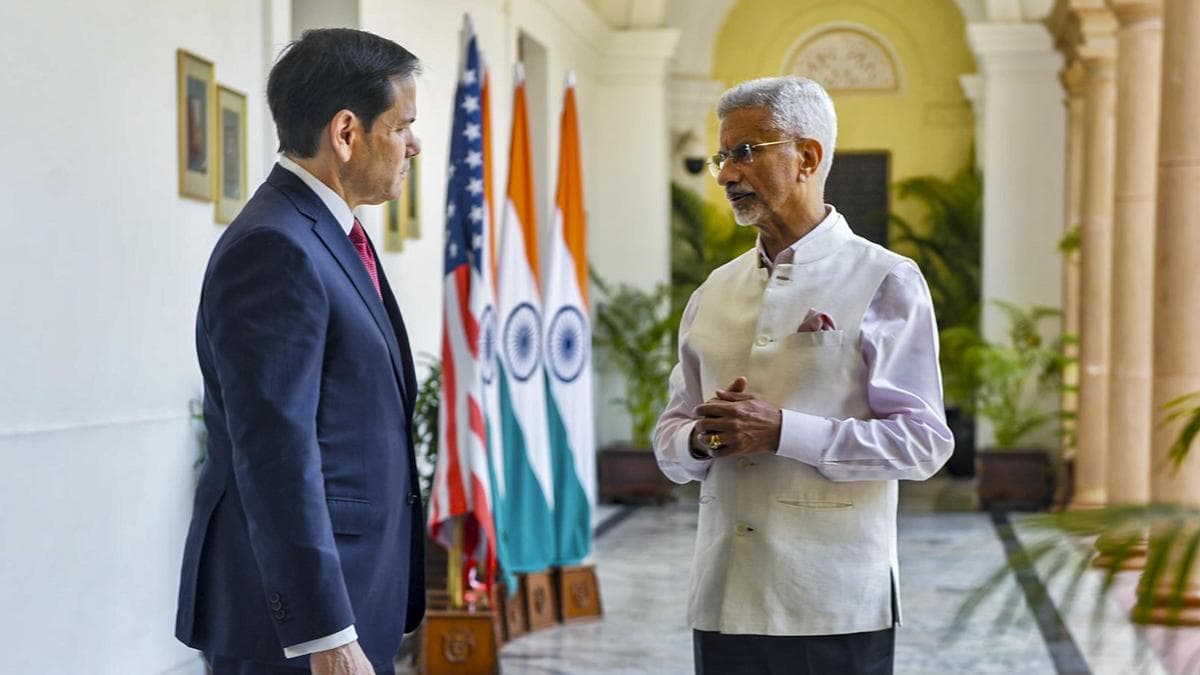
Home News India The New Delhi meeting will be attended by U.S. Secretary of State Marco Rubio, Australian Foreign Minister Penny Wong and Japanese Foreign Minister Toshimitsu Motegi, with External Affairs Minister S. Jaishankar presiding over it Updated - May 26, 2026 08:20 am IST In this image posted on May 24, 2026, External Affairs Minister S Jaishankar during a meeting with U.S. Secretary of State Marco Rubio, in New Delhi. File photo: @DrSJaishankar/X via PTI Photo | S. Secretary of State Marco Rubio, Australian Foreign Minister Penny Wong and Japanese Foreign Minister Toshimitsu Motegi, with External Affairs Minister S. Jaishankar presiding over it.The Ministers last met on July 1, 2025, when they updated the goals for the quadrilateral grouping, simplifying them to four areas: maritime and transnational security, economic prosperity and security, humanitarian assistance and emergency responses, and the launch of the Quad Critical Minerals Initiative. However, rapid developments, including the U.S.-Israel strikes on Iran and other actions by the Donald Trump administration, have posed questions over the viability of the grouping, and the Ministers will have their task cut out for them as they seek to renew their mandate.Follow live updates here: May 26, 2026 08:20 Watch: Marco Rubio departs from Jaipur to attend Quad Foreign Ministers meet in DelhiMay 26, 2026 08:19 Quad remains ‘vital’, says Japanese Foreign MinisterThe Quad remains a “vital framework”, Japanese Foreign Minister Toshimitsu Motegi said, responding to concerns that the four-nation grouping had lost its relevance, and indicated in an interview that ‘Cooperation over Critical Minerals’ needed for green energy and hi-tech would be at the top of the agenda for the Quadrilateral Foreign Ministers’ Meeting (FMM) on Tuesday (May 25, 2026). Japan is working on critical minerals’ projects in India, Mr. Motegi also said, but called for improved infrastructure, more tax subsidies, and protection for intellectual property rights.“The Quad remains a vital framework among countries that share fundamental values and strategic interests. It has delivered concrete results across a wide range of areas, including maritime security, economic security, and cybersecurity,” Mr. Motegi said, in written responses to questions from The Hindu ahead of the FMM, but side-stepped queries on why the mechanism finds little mention in the strategy documents.Click here to read more...May 26, 2026 08:03 As Quad Foreign Ministers meet, India-U.S. tensions, U.S.-China re-engagement and Iran war pose challenges Foreign Ministers of the Quad will meet for the first time in nearly a year, as External Affairs Minister S. Jaishankar hosts U.S. Secretary of State Marco Rubio, Australian Foreign Minister Penny Wong, and Japanese Foreign Minister Toshimitsu Motegi in Delhi on Tuesday (May 26, 2026) at Delhi’s Hyderabad House. The Foreign Ministers will also call on Prime Minister Narendra Modi, a Ministry of External Affairs advisory said.Suhasini Haidar writes on today’s Quad Foreign Ministers meeting: As Quad Foreign Ministers meet, India-U.S. tensions, U.S.-China re-engagement and Iran war pose challengesQuad Foreign Ministers meet to address India-U.S. tensions, U.S.-China relations, and the Iran conflict on May 26, 2026. Published - May 26, 2026 08:01 am IST0 / 0Sign in to unlock member-only benefits!Access 10 free stories every monthSave stories to read laterAccess to comment on every storySign-up/manage your newsletter subscriptions with a single clickGet notified by email for early access to
Image used for representational purposes. File | Overseas travel spending by Indians, including holiday trips, declined by $212.43 million to $1.09 billion in March compared to February, according to the Reserve Bank data.The outward remittances for travel were at $1.3 billion in February and $1.65 billion in January this year.The RBI data on 'Outward Remittances under the Liberalised Remittance Scheme (LRS) for Resident Individuals' shows overseas spending by Indians under different categories, including travel, maintenance of close relatives, studies abroad, investments in equity and debt.Under the LRS, resident individuals, including minors, are allowed to freely remit up to $2,50,000 per financial year (April-March) for any permissible current or capital account transaction or a combination of both.Against the backdrop of the West Asia conflict pushing oil prices higher and pulling down the rupee to record lows, Prime Minister Narendra Modi has urged people to reduce foreign travel and opt for carpooling, among other measures.With lesser overseas travel, foreign exchange outgo will reduce, and that can help in curbing rupee depreciation.The RBI data showed that total outward remittances stood at $2.59 billion in March 2026, of which travel accounted for the largest share at $1.09 billion.The travel category under the LRS has been classified into business travel, pilgrimage, medical treatment, travel for education, and 'other travel'.The data showed that Indians spent $623.05 million under the 'other travel' category, which includes holiday trips and international credit card settlements, during March. It accounted for nearly 57% of the total travel outgo of $1.09 billion.Spending on education-related travel (including fees, hostel expenses) totalled $450.16 million in March, while expenditure on overseas business travel, pilgrimage and medical treatment totalled $21.39 million.The RBI data also showed that outbound remittances under the LRS towards maintenance of close relatives stood at $389.78 million in March, higher than $266.18 million in February.Further, the overseas spending under the head 'studies abroad', which includes transaction when an individual avails education services remotely without travelling abroad, such as fees for correspondence courses abroad, stood at $151.71 million in March, lower than $175.68 million in February and $267.42 million in January.Total outward remittances under the LRS during 2024-25 stood at $29.56 billion, of which travel accounted for the largest share at $16.96 billion.The data also showed that Indians invested $440.22 million in equity and debt instruments in March, significantly higher than $265.99 million in February.Spending on the purchase of immovable property overseas stood at $38.68 million, down from $51.36 million in February. Published - May 24, 2026 04:22 pm IST
According to a circular, reviewed by The Hindu, the Department of Financial Services asked the heads of its regulated entities to cut costs along two broad heads: reduction in travel, and the adoption of electric vehicles (EVs). File | According to a circular, reviewed by The Hindu and titled ‘Implementation of austerity measures for rationalisation of expenditure’, the Department of Financial Services asked the heads of its regulated entities to cut costs along two broad heads: reduction in travel, and the adoption of electric vehicles (EVs).The circular does not mention the West Asia crisis, but it comes a little more than a week after Prime Minister Narendra Modi exhorted the nation to adopt similar austerity measures. The circular specified that “all meetings, reviews, consultations and presentations” are to be conducted via videoconferencing unless physical meetings are specifically required. It added that foreign travel by the chairpersons, managing directors and CEOs, whole-time directors, and whole-time members of the boards of these institutions “may be kept below the prescribed limits” as laid out in the existing guidelines. It added that, as far as possible, such engagements should be attended through videoconferencing. “All organisations may aim at replacing the petrol and diesel cars hired by them in their head offices and branch offices with electric cars as far as possible,” the circular added. “Existing fleets shall be progressively transitioned to EVs in a phased manner.”The government has, in the past, adopted such austerity measures as well. However, the ones adopted on Monday are likely the most drastic since the steps taken in 2020 in reaction to the COVID-19 pandemic. Published - May 18, 2026 10:18 pm IST


Discussion (0)