
Loading dispatches...
← Return to Newsroomgeneral
After BJP victory, the saffron that Bengal must remember
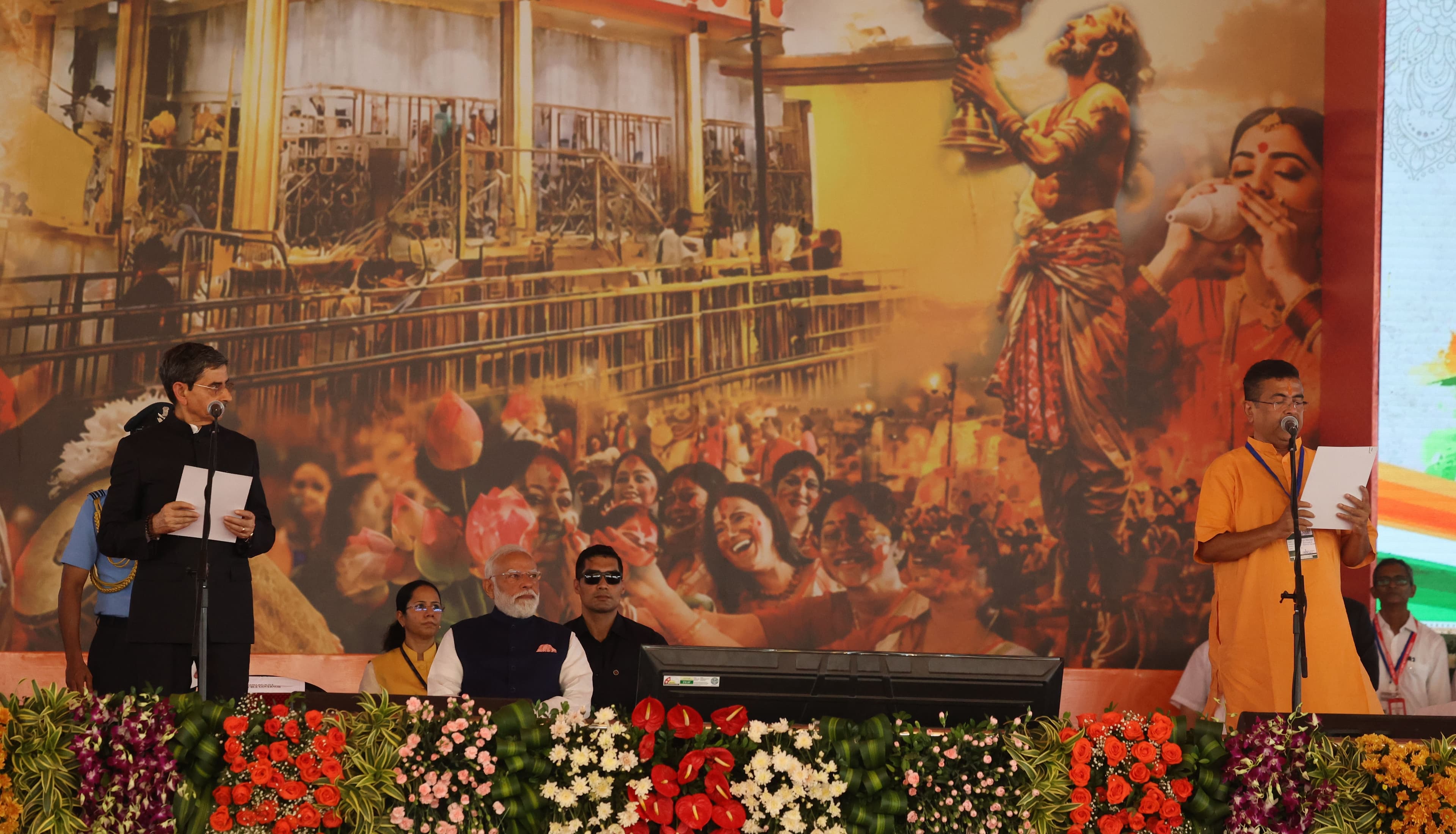
NewsOpinionColumnsAfter BJP victory, the saffron that Bengal must remember The new BJP government of Bengal has a historic opportunity. It can reduce saffron to electoral symbolism, or it can elevate saf fron into governance with character. The second path is harder, but nobler If Bengal has chosen a new path, that path must serve every Bengali — Hindu, Muslim, Christian, Buddhist, Sikh, believer, non-believer, rich, poor, rural, urban, tribal, refugee, worker, farmer, student, mother, teacher, and child. 3 min readMay 20, 2026 06:20 AM IST First published on: May 20, 2026 at 06:20 AM IST For Bengal, saffron is not merely the colour of a flag, a party, or a political season. It is the colour of tapasya, sacrifice, learning, courage, surrender and service. With the formation of Bengal’s first BJP government, there is a need to welcome this moment with dignity, maturity, and hope. If Bengal has chosen a new path, that path must serve every Bengali — Hindu, Muslim, Christian, Buddhist, Sikh, believer, non-believer, rich, poor, rural, urban, tribal, refugee, worker, farmer, student, mother, teacher, and child. The true saffron spirit does not humiliate. It uplifts. It does not divide society into enemies. It awakens it to duty. For too long, the word “saffron” has been misunderstood in Bengal. To speak of Hindu identity was often called communal. But history tells another story. Bengal was one of the great saffron centres of India. It was the land of Sri Chaitanya Mahaprabhu, Nader Nimai of Navadvipa, who carried the message of bhakti through naam-sankirtan. Bengal was the land of Sadhak Ramprasad Sen, whose songs to Maa Kali entered the heart of every Bengali home. Bengal was the land of Bama Khyapa of Tarapith, the wild lover of Maa Tara, who reminded society that spirituality is not always polished, polite, and comfortable. Bengal was the land of Sri Ramakrishna Paramahamsa, whose life at Dakshineswar became a living commentary on the harmony of religions. From Sri Ramakrishna came Swami Vivekananda, who carried Bengal’s saffron to the world. His saffron was not escapism. It was strength, service, and character. This is the saffron Bengal must remember.Bengal also gave India Bankim Chandra Chattopadhyay, whose Vande Mataram transformed the motherland into a sacred presence. Rabindranath Tagore later gave this civilisational spirit a universal voice. He drew from the Upanishadic depth of India and carried it into literature, music, education, and global humanism. Tagore warned against narrowness, but he never denied the soul of Bharat. Netaji Subhas Chandra Bose’s saffron was sacrifice. In him, one sees the fire of Vivekananda transformed into political action. “Jai Hind” was a national mantra. Sri Aurobindo, born in Calcutta, added another luminous dimension. Revolutionary, philosopher, poet, yogi — he moved from the struggle for national freedom to the deeper vision of human evolution. His Integral Yoga did not reject life. It sought to transform life. In him, Bengal’s political aspiration and spiritual destiny met at a higher plane. Swami Pranavananda, founder of Bharat Sevashram Sangha, brought saffron into disciplined service. He showed that spirituality must enter the field — relief work, education, pilgrimage service, social protection, character-building, and national reconstruction. His saffron was not only meditation; it was organised compassion. The new BJP government of Bengal has a historic opportunity. It can reduce saffron to electoral symbolism, or it can elevate saffron into governance with character. The second path is harder, but nobler. Samajdar is a clinical pharmacologist and diabetes and allergy-asthma therapeutics specialist in Kolkata. Joshi is a Mumbai-based endocrinologist
Students wearing burqa protest against the Karnataka High Court's verdict on hijab in 2022 (PTI, File photo) 4 min readMay 19, 2026 12:26 PM IST First published on: May 19, 2026 at 12:26 PM IST Written by Saina Ismailee On May 15, The Indian Express reported stories of four women — Aliya, Almas, Resham, and Muskan — who challenged the Karnataka Government Order of 2022, which banned hijab in classrooms. While Aliya and Almas managed to continue their education through open learning, Resham and Muskan dropped out. Several others dropped out. Some got married. On May 13, the Karnataka government withdrew its 2022 Order, effectively reversing the hijab ban. BJP national spokesperson Shehzad Poonawalla called it Muslim appeasement and demanded to know why saffron shawls were not given the same treatment. Notably, the new order allows limited religious symbols of multiple faiths, including hijab, turban, sacred thread (janeu), shivdhara, and rudraksha. Yet, Poonawalla’s question on the parity of hijab and saffron shawls deserves attention. It assumes a blanket prohibition on both is comparable. They are not, and the reason has nothing to do with who constitutes the majority or minority.A neutral-looking law that prohibits all religious symbols in classrooms does not equally impact everyone. It disproportionately burdens some more than others, leading to unequal costs. In the Karnataka case, the cost for hijab-wearing Muslim girls was education. The saffron shawl became a specific symbol of political counter-protest to resist hijab in 2022. Consider what a student loses when she cannot wear a saffron shawl to college. She loses a form of expression or cultural preference. She can still enter the building, appear for her exams, and collect her degree. The restriction stings, but it does not take away her education. That is because the saffron shawl is not constitutive of her identity. Removing the garment at the gate does not cost her education. It can be removed and set aside without any loss to the person wearing it. This, however, is not the case for a hijab-wearing Muslim woman. Hijab is a manifestation of one’s deeply held religious way of life, not merely a cultural preference. For a hijab-wearing woman, it is constitutive of her identity. Removing the hijab and entering the classroom are not two separable acts. They constitute a single forced choice between her faith and her future. The ban makes religious identity and education mutually exclusive. It forces a hijab wearing woman to surrender her identity to access education. In 2022, the state removed an option that these women actually had: Accessing education while practising their faith. Unlike someone who wore a saffron shawl during protests, the same ban cost a hijab-wearing Muslim woman her education. The unequal impact is so different that it cannot be equated. In other contexts, like France, studies demonstrate how the hijab ban negatively impacted Muslim women’s educational attainment and life outcomes, reducing their economic independence. The People’s Union for Civil Liberties-Karnataka’s 2023 report Closing the Gates to Education cites the Karnataka government’s own figures, which show that 1,010 Muslim women aged 16-18 dropped out of college following the ban. On January 8, 2023, The Indian Express reported that enrolment of Muslim students in government colleges in Karnataka had dropped by half since 2022. The broader national picture explains why this matters. The ‘Rethinking Affirmative Action for Muslims in Contemporary India report’ (Ahmed, Alam, Parveen, 2025) finds that Muslim girls have the lowest educational participation rate of all socio-religious groups in India. In the 18-25 age group, only 12.7 per cent of Muslim girls are in education, as opposed to 27.6 per cent for Hindu Forward Castes. At the age of 14-17, only 64.3 per cent of Muslim girls are currently in education, as opposed to 91.7 per cent for Hindu Forward Castes. A study based on the


Discussion (0)