
Loading dispatches...
← Return to NewsroomEconomy
Weather today: Rainfall alerts issued for Bengaluru, Kerala, Tamil Nadu as monsoon advances; Delhi forecast here
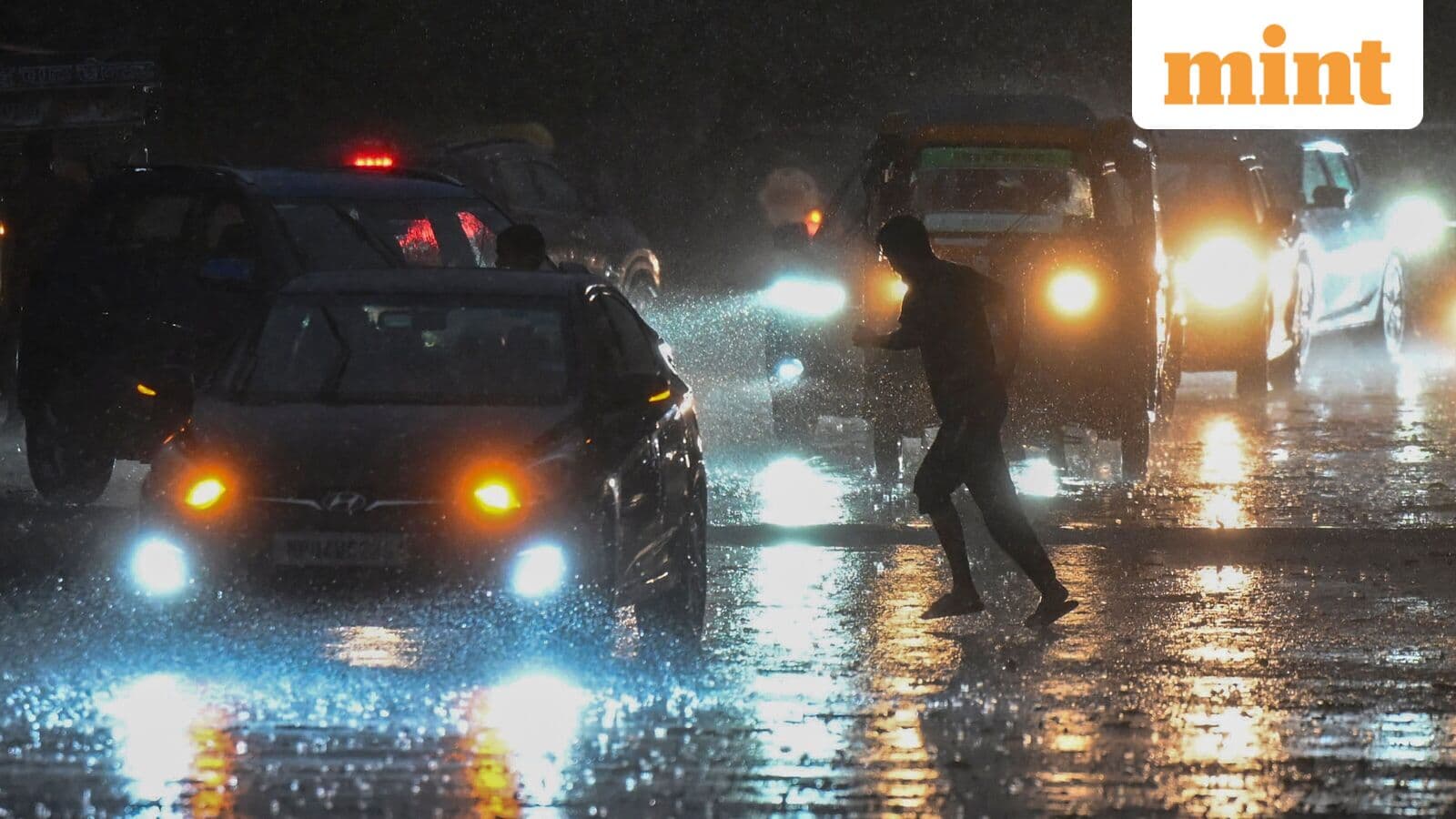
The southwest monsoon, which entered Kerala three days later than usual, is set to bring heavy rainfall and active weather conditions to several parts of India. The monsoon is expected to maintain its momentum on Friday, advancing further across the southern peninsula. The India Meteorological Department (IMD) has forecast heavy rainfall over Kerala, Karnataka, Telangana, and Tamil Nadu during the coming week.The northeastern region, particularly Arunachal Pradesh, Assam and Meghalaya, is expected to remain under the influence of heavy to very heavy rainfall. In contrast, northwestern and central India are likely to experience a volatile mix of thunderstorms and emerging heatwave conditions.Weather outlookThe IMD has forecast moderate rainfall accompanied by thunderstorms, lightning and gusty winds across Telangana, where six districts have been placed on heavy rainfall alert. Heavy rainfall is likely at isolated places in Rangareddy, Sangareddy, Medak, Kamareddy, Mahabubnagar and Nagarkurnool districts.Most parts of Karnataka, including the capital Bengaluru, have been placed under a yellow alert, while Dakshina Kannada district is under an orange alert, indicating the possibility of very heavy rainfall.Isolated heavy rainfall is also likely over Tamil Nadu, Puducherry and Karaikal from 8 to 10 June; Lakshadweep on 5 and 6 June; and Coastal Andhra Pradesh and Yanam on 5 June and again from 9 to 10 June.The Northeast is expected to continue witnessing wet weather, with heavy rainfall likely over Arunachal Pradesh, Assam, Meghalaya, Nagaland, Manipur, Mizoram and Tripura. Isolated areas in the region could also receive very heavy rainfall.Meanwhile, parts of northern and central India are likely to experience thunderstorms accompanied by lightning and gusty winds of 50-60 kmph. The weather activity is expected to affect Delhi, Haryana, Punjab, Uttar Pradesh, Madhya Pradesh and Chhattisgarh, with some locations at risk of intense thunderstorms and brief squalls.Light rainfall is expected during the morning and forenoon, followed by another spell in the evening and at night. Wind speeds may reach up to 60 kmph during thunderstorm activity. Maximum temperatures are likely to remain between 38°C and 40°C, close to the seasonal average.Delhi weatherRain and thunderstorms have triggered a sharp fall in temperatures across the national capital, with the mercury dropping by as much as 19°C in some areas.The weather agency has also forecast thunderstorms and lightning accompanied by gusty winds of 40-50 kmph at isolated places across Delhi, Haryana and Chandigarh.Light rainfall is expected in Delhi during the morning and forenoon, followed by another spell in the evening and at night. Wind speeds may reach up to 60 kmph during thunderstorm activity. Maximum temperatures are likely to remain between 38°C and 40°C, close to the seasonal average.Mahesh Palawat, Vice-President of private forecasting agency Skymet Weather, said: “A fresh western disturbance and cyclonic circulation over central Pakistan, Haryana and northwestern Rajasthan are expected to trigger rain and thunderstorm activity across the region over the next three days.”View full ImageHeavy rain alerts for North and South India.(IMD)While no heatwave warning has been issued for Friday, the IMD has cautioned that heatwave conditions could develop over isolated parts of Bihar from 6 June. The hot weather is expected to extend into eastern Uttar Pradesh from 7 June.About the AuthorKanishka SinghariaKanishka Singharia is a Senior Content Producer at Mint with a passion for news, trends, and the stories shaping the digital world. She specialises in spotting viral narratives by constantly tracking social media platforms and turning them into engaging, reader-friendly stories. Her work ranges from fast-paced breaking updates to sensitive human-interest features, blending speed with clarity. With over four years of experience in news and trend reporting, Kanishka has worked

New Delhi: India's economic growth is projected to slow to 6.3% in fiscal 2027 from 7.6% last financial year, reflecting the impact of higher energy prices due to the Middle East conflict, according to the Organisation for Economic Co-operation and Development (OECD).Higher energy costs, gas rationing, weaker global demand and increased production expenses are likely to weigh on investment and exports, it said on Wednesday.Despite the anticipated slowdown, India is expected to remain among the world's fastest-growing major economies.Gross domestic product growth is expected to edge slightly up to 6.4% in FY28, according to the Paris-based institution. India imports more than 85% of its crude oil requirements, with about half passing through the Strait of Hormuz, which has remained largely blocked since the start of the Iran war on February 28."Rising inflation is expected to weigh on private consumption, while investment slows amid higher oil and gas prices and gas rationing," said the OECD. Private consumption growth is expected to moderate to 6.8% in FY27 from 8.2% in FY26, it noted. Growth in gross fixed capital formation, an indicator of investment, is also projected to ease to 6% from 7.1%.Inflation is forecast to accelerate to 4.8% in FY27, driven by higher food and energy prices as well as currency depreciation. It is expected to ease to 4% in FY28 as commodity prices stabilise and monetary policy tightens.The OECD anticipates a small rate hike in mid-2026, likely to be reversed in early 2027, leaving interest rates close to neutral levels. The Reserve Bank of India's monetary policy committee entered its June 3-5 meeting with the repo rate at 5.25% and a neutral policy stance.India's current account deficit is expected to widen to 2.1% of GDP in FY27, reflecting higher energy import costs and weaker external demand.Globally, the OECD expects GDP growth to slow to 2.8% in 2026 from 3.4% in 2025. In a scenario of prolonged disruption from the Middle East conflict, growth could weaken to 2.1% this year. "The global economy entered 2026 with robust momentum, but the outlook has weakened significantly since the start of the conflict in the Middle East, with effects likely to be felt for some time. The longer the disruptions last, the larger the economic and social costs become," OECD secretary-general Mathias Cormann said.

A new forecast by the India Meteorological Department (IMD) on Tuesday suggests the monsoon will arrive late this year, in contrast to its earlier prediction that it may arrive early.According to the IMD, the Southwest monsoon normally sets in over Kerala on June 1, with a standard deviation of about seven days. It marks the beginning of the southwest monsoon season (June-September).In its latest press note, the IMD said, “Southwest monsoon is likely to set in over Kerala around 4th June, 2026.”The IMD said the conditions are favourable for the advance of southwest monsoon into some more parts of southwest and southeast Arabian Sea, Lakshadweep Islands, some parts of Kerala and Tamil Nadu, some more parts of southwest, westcentral, eastcentral & northeast Bay of Bengal, and remaining parts of southeast Bay of Bengal around June 4.View full ImageSouthwest monsoon delayed, likely to set in over Kerala around June 4(IMD)Earlier, on May 15, the weather department had claimed that the southwest monsoon may "set in over Kerala on 26th May with a model error of ± 4 days.” However, it got delayed and the department, on May 29, stated that the onset could happen in the following week.Expect below normal rainfallThe IMD said on May 29 that India could witness "below normal rainfall" overall during the monsoon season (June to September) in 2026. Citing data to support the forecast, it said, "...the southwest monsoon seasonal rainfall over the country as a whole is likely to be 90% of the Long Period Average (LPA) with a model error of ±4%."It's rainfall prediction for June states that average rainfall for country as a whole during June 2026 is most likely to be below normal (<92% of LPA).LPA refers to the rainfall recorded over a particular region for a given interval, such as a month or a season, averaged over a long period of time, typically 30 to 50 years. If the monsoon season sees less than 90 per cent of LPA rainfall, the IMD classifies it as "deficient".The statement added that the southwest monsoon seasonal rainfall is most likely to be normal over Northeast India and below normal over Central & South Peninsular India and Northwest India.El Nino to be blamed?One reason for the below-normal rainfall could be the emergence of El Niño conditions, which lead to less rain during the monsoon in the country.In its press note on May 29, the IMD noted that neutral El Nino-Southern Oscillation (ENSO) conditions are transitioning towards El Nino conditions over the equatorial Pacific region."The latest climate model forecasts indicate that the El Nino conditions are likely to develop during the southwest monsoon season," it said.The IMD said El-Nino conditions are likely to be weak in June, and moderate to strong in September.The US' National Weather Service had said last month that El Niño is likely to emerge soon (82% chance in May-July 2026) and continue through Northern Hemisphere winter 2026-27 (96% chance in December 2026-February 2027). But the release suggests much uncertainty in its peak strength.However, latest projections suggest this year's El Niño could become a strong event, potentially comparable to some of the most impactful episodes in recent decades, the UK's Met Office said.While many termed this phenomenon as “super El Niño”, the World Meteorological Organization says it does not use the term “super El Niño”, saying that "it is not part of standardised operational classifications."Why is it important to understand monsoon's changing behavior?The IMD says understanding the changing behaviour of the Indian Monsoon is crucial for agriculture, water management, disaster preparedness, and climate adaptation.The department shared a research paper on south-west monsoon from MAUSAM (Formerly Indian Journal of Meteorology, Hydrology & Geophysics) journal, and said, “This study revisits and redefines the 'normal' onset and withdrawal dates of the monsoon using updated long-term climatological data and modern statistical analysis.”
India is expected to roll out a mandate for blending isobutanol with diesel as early as this year. According to Road Transport and Highways (MoRTH) Secretary V Umashankar, this initiative could have a greater effect on the country’s energy security than ethanol blending in petrol, as diesel consumption is almost double that of petrol.Speaking on Friday, MoRTH Secretary V Umashankar said the proposed measure would support efforts to decarbonise highways and transportation while decreasing dependence on conventional fossil fuels.Addressing the 'CII Multimodal Transportation and Logistics Summit', Umashankar further said that the highways ministry may soon bring a draft notification on truck-trailer interchangeability to build an ecosystem that requires battery swapping and charging for electric heavy-duty commercial vehicles.“Blending of diesel has been looked into with great seriousness. Bharat Petroleum is already undertaking strategic research for isobutanol blending with diesel. And the results are very encouraging,” PTI quoted the official as saying.“It is quite likely that the blending mandate will start coming in somewhere later this year,” he said.Umashankar said that since diesel consumption is almost twice that of petrol, the impact of diesel blending on India's energy security will be far greater than even petrol blending.The transport secretary said the blending programme, which has taken off in the last 10-12 years, is further being expanded, and the ministry has issued a draft notification for E85 (a blend of 85 per cent ethanol with petrol) and E100 (which would allow vehicles to run on nearly pure ethanol) vehicle manufacturing requirements."There have been some concerns about blending at the lower level (E20), but here it is a little different because the vehicle is manufactured differently. It will have a separate (fuel) dispenser also at the petrol pumps for dispensing E85 or E100 fuel, unlike normally blended petrol, which is done through a common dispenser," Umashankar said.What is Isobutanol? What you need to knowIsobutanol is a four-carbon alcohol (C₄H₁₀O), making it a higher alcohol compared to ethanol, which contains only two carbon atoms. It can be produced from renewable sources such as biomass, agricultural waste, or through processes linked to ethanol or sugarcane production.Apart from its use as an industrial solvent in products like paints and coatings, it is increasingly being explored as a potential biofuel for transportation.It is considered suitable for blending with diesel because ethanol faces several limitations when mixed with diesel, including phase separation, a low flash point that raises safety concerns, corrosion issues, and poor compatibility with engines.Isobutanol helps overcome many of these challenges. It blends more uniformly with diesel without the need for additional additives, has a higher energy content closer to diesel, offers a higher flash point that makes it safer and less volatile, and is less corrosive, making it more compatible with existing engines and fuel infrastructure.Diesel is a chemically different fuel from petrol, and blending additives into it requires careful consideration of engine tolerance and compatibility.While petrol engines have been operating on ethanol-blended fuel for years with relatively few issues, diesel engines, particularly older models, can be much more sensitive to changes in fuel composition.This is mainly because diesel engines rely on compression ignition, unlike petrol engines, which use spark ignition. As a result, the chemical properties of diesel fuel have a more direct impact on combustion timing, efficiency, and overall engine performance.Research currently being carried out at Bharat Petroleum is aimed at ensuring that isobutanol–diesel blends satisfy the combustion behaviour and lubricity standards required by existing diesel engines used in vehicles across Indian roads, according to a Hindustan Times report.About the AuthorMausa


Discussion (0)