
Loading dispatches...
← Return to NewsroomScience
Scientists may have finally solved the mystery of the sun's missing silver
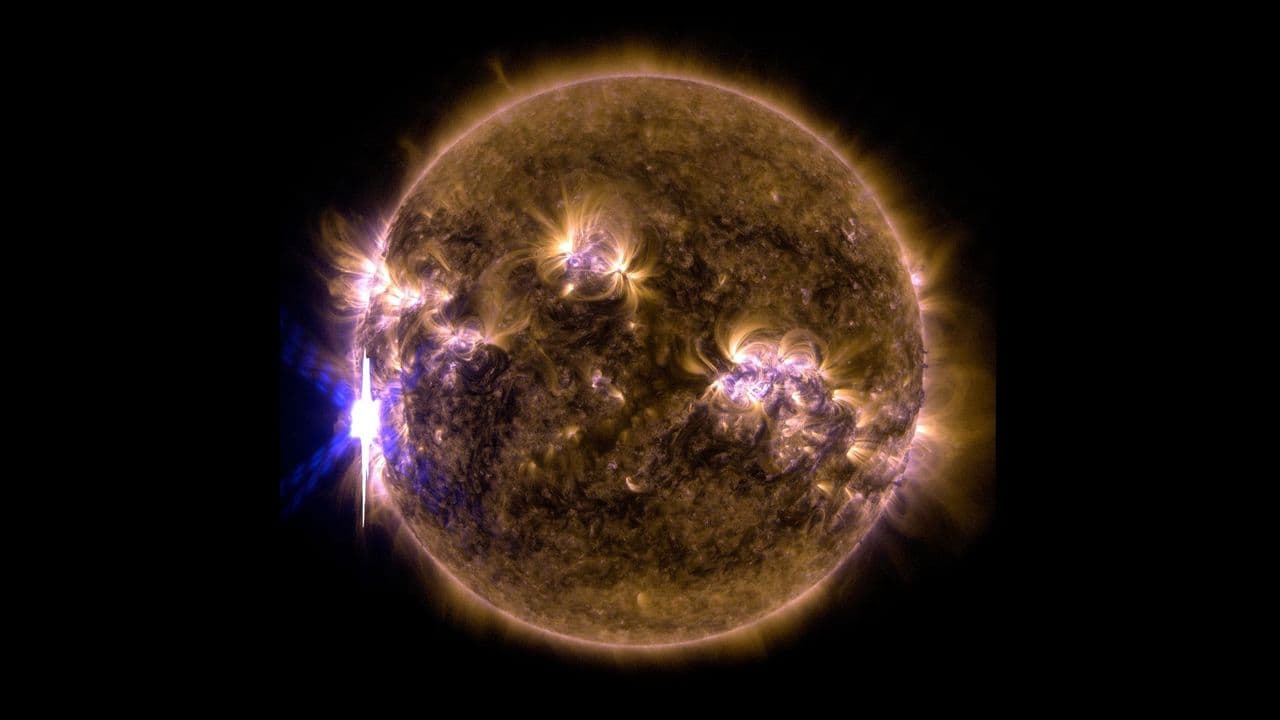
An X-class solar flare erupted on the left side of the sun on the evening of Feb. 24, 2014. This composite image, captured at 7:59 p.m. EST, shows the sun in X-ray light with wavelengths of both 131 and 171 angstroms. ( Whenever scientists examined the sun's outer layers, they've seen significantly less silver than they've expected to find.Where, then, did the missing silver go?As it turns out, this mystery may finally be solved. Newly published research suggests that the sun's missing silver may have been hiding in plain sight all along.At first, the real mystery might seem to be why you'd seek silver in the sun at all. After all, 98.5% of the sun's mass is made from lightweight hydrogen and helium. Silver is just a tiny fraction of the remaining 1.5%, which also includes traces of other heavy elements like iron and copper.These trace elements can illuminate the history of the cosmos. Silver is thought to form when dying stars violently explode in supernovas. When astronomers find silver in the sun and other stars, they can retrace the silver's origins and how stars have evolved over the eons."By studying the light of stars of different types and ages, we hope to understand where silver is formed in the universe, and how it has been distributed throughout the Milky Way over time," says Sema Caliskan, the lead author of the research and now a postdoc at the University of Liège in Belgium, in a statement.Silver is particularly interesting because it's also found in utterly ancient meteorites called CI chondrites. These meteorites formed from the same primordial matter that created the sun, 4.6 billion years ago. As a result, when scientists break into CI chondrites that have fallen to Earth, they expect to find silver levels that match those they see in the sun. ( As light streams out from the sun's heart, it crashes into the atoms of our star's outer layers, which absorb the light at certain wavelengths. Look at a spectrum of sunlight, and you'll see dark lines where light has been absorbed. Atoms of different elements absorb different wavelengths, so each element leaves a distinct fingerprint.Scientists can pore over these spectral fingerprints to reconstruct what elements created them and in what quantities. Therein lies the mystery: The sun seemed to contain much less silver than CI chondrites would indicate. This missing silver is a source for confusion in the sun's history.Caliskan and her colleagues wondered if astronomers were missing something. They could not visit the sun in person, but they could still find where the silver might be hidden by simulating the sun's atoms on a computer. If they could create a high-silver model that still spawned the low-silver spectral lines, that model could be a good guess for the silver's whereabouts.Other scientists had tried this before to limited success, but their simulations had been relatively simple. As light strikes an atom, the light has all sorts of intricate effects on the atom's innards. These effects can alter how the atom absorbs the light and, therefore, change how astronomers see that light.Past models hadn't accounted for many of these tricky "non-equilibrium effects", because simulating them is far easier said than done. They're messy and complex and they vary a great deal from atom to atom.In fact, no known scientists had ever tried to simulate a silver atom with non-equilibrium effects before Caliskan and her fellow investigators took on the challenge. They tried with their best guesses and the power of the Tetralith supercomputer in Linköping, Sweden.Indeed, these non-equilibrium effects seem to explain the silver mystery. Based on their model, Caliskan and colleagues calculated that the su
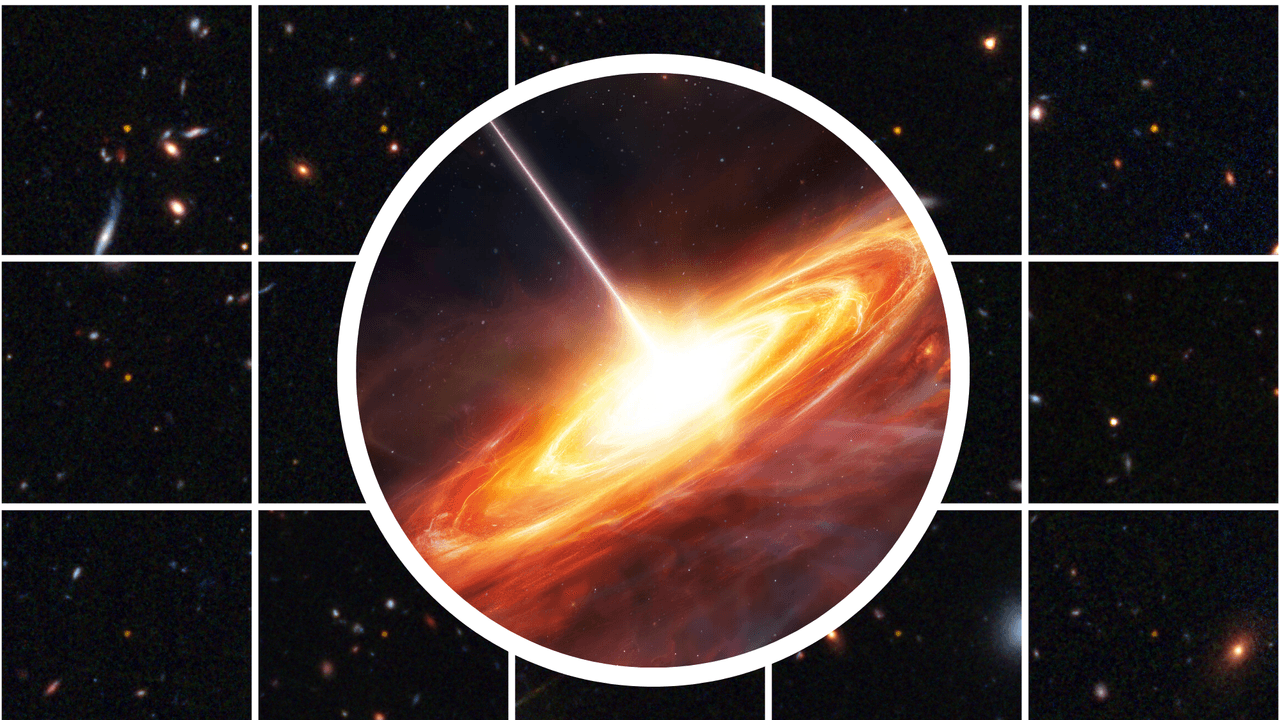
An illustration of an ancient quasar. ( The most impressive of these new discoveries is the most ancient and distant quasar ever seen, shining with the light of a trillion suns just 670 million years after the Big Bang.Quasars occur when supermassive black holes with masses millions or even billions of times that of the sun are surrounded by swirling disks of matter called accretion disks. As accretion disks gradually feed these central cosmic titans, the immense gravity of the black holes generates intense friction, causing this matter to glow so brightly that their luminosity can exceed the combined light of every star in their host galaxies.Despite this, quasars can still be difficult to spot at vast cosmic distances, with their light difficult to distinguish from the light of much more proximate stars. Thus, the hunt for the earliest quasars has been on for decades, with scientists hoping that the discovery of these bodies could help explain how supermassive black holes grew so rapidly so shortly after the Big Bang. Launched in 2023, Euclid has fulfilled its promise in its mission to discover early quasars, with this hitherto unprecedented haul of 31 of these black hole engines."These early quasars date back to the Universe's infancy," team leader Daming Yang of Leiden University in the Netherlands said in a statement. "By finding and studying them, we can better understand how these enormous systems formed and grew so quickly — one of the greatest mysteries in astrophysics."Previously, astronomers took around a decade to discover the first ten or so quasars at distances like this, which makes it incredibly impressive that Euclid has managed to detect more than three times that many ancient black hole engines in just a single year of observations.The tip of the icebergThanks to this new treasure trove of quasars discovered when the 13.8 billion-year-old universe was merely 5% of its current age includes not just the brightest examples of these objects, but also some fainter quasars. That now means scientists can finally study these objects as a population."Euclid is a true game-changer," Yang continued. "Before, we could only find a handful of the very brightest ancient quasars, but Euclid lets us search far more efficiently across huge areas of sky to capture much fainter light. It’s a unique tool for quasar hunting."Of the 31 new quasars, 12 existed when the universe was around 770 million years old, but the two that really stand out are the quasars designated EUCL J172902.75+641018.1 and EUCL J125308.55+705432.3, which are around 13 billion light-years away and existed just 670 million years after the Big Bang. That makes them the most ancient quasars ever documented. 18 of the quasars discovered by the ESA mission Euclid. ( "The Euclid team has taken a true 'census' of quasars at the dawn of the Universe for the first time. It's a big step towards understanding these fascinating objects on a more fundamental level."The quasars date back to a period of the cosmos known as the epoch of reionization, which lasted from around 680 million years after the Big Bang to 1.1 billion years after the Big Bang. During this period, the universe's "dark ages" drew to a close with photons, particles of light, suddenly free to traverse the cosmos. Thus, these 31 quasars offer a unique opportunity to study this vital period in cosmic history."Ancient quasars are rare discoveries," ESA Euclid Project Scientist Valeria Pettorino said in the statement. "They're interesting in themselves, but also time machines that enable us to explore the early universe a

( Scientists think that the minerals in clay could be the key to finding signs of ancient life on the Red Planet.The European Space Agency is still working toward launching its ExoMars Rosalind Franklin rover to Mars to search for signs of life. And, according to a statement from the space agency, the rover is now aiming to land at Oxia Planum, a depression on the Martian surface where it's thought that water was once plentiful. There, scientists think that they might find major clues in the hunt for life in the basin's clay, according to a new paper."We will use the instruments on board to ground truth the discoveries made from orbit, learn about the ancient environment in which they formed, and if they preserve any evidence of Martian life. Warmth and nutrients on an early martian seabed could have provided habitats for early life," ExoMars deputy project scientist Elliot Sefton-Nash added in the statement.Scientists have spent years searching for signs that life once existed on Mars. It's thought that water on Mars evaporated around three billion years ago, but before then the planet likely had a more substantial atmosphere and water flowing in rivers and into lakes all across its surface. Because of the planet's history, many scientists think that it's most likely that at some point in the ancient past, the planet must have supported life. While this has yet to be confirmed, last year scientists found what is currently thought of as the strongest possible biosignature, or physical evidence of life, on Mars. This image, captured by the HiRISE camera on NASA's Mars Reconnaissance Orbiter shows the location of clay on Mars. ( They found this clay to reach roughly 186 miles (300 kilometers) outward from Oxia Planum, stretching as far as a Martian valley called Mawrth Vallis. To spot the clay, they first studied the planet from orbit.Researchers used the OMEGA instrument on ESA's Mars Express orbiter and NASA's Mars Reconnaissance Orbiter to explore the minerals and rock layers on Mars between Oxia Planum and Mawrth Vallid, finding mineral layers at both sites as well as markers showing changes in water chemistry over time. These observations add to other studies pointing to water on ancient Mars.With ESA's upcoming rover, some scientists think that the clues to life on Mars could be hiding in this clay in the Oxia Planum region."By landing at Oxia Planum, we’ll uncover a large-scale process that shaped ancient clays across Mars," lead author Inés Torres Auré of the University of Lyon in France said in the statement.Scientists think that it's possible that the area of Oxia Planum could have once been home to a body of water as big as an ocean or the region could possibly have experienced incredible flooding some four billion years ago, according to the statement."Because the area is so large, we are not talking about a localised occurrence, but rather a regional or global process that would have required immense amounts of water. We are targeting the oldest deposits in the sequence, which makes the potential implications for the geology and early climate of Mars very relevant for the Rosalind Franklin mission in its search for life," ExoMars project scientist Jorge Vago explained in the statement.While we have never confirmed life off-Earth and it could be different from the life we know, as far as life on Earth is concerned, water is a necessary ingredient.ESA's Rosalind Franklin rover is projected to launch to the Red Planet in 2028. The rover will be part of ESA's ExoMars program alongside the agency's Trace Gas Orbiter which is already traveling around Mars. Rosalind Franklin will have a drill, allowing it to explore below the planet's surface as the pair work together from orbit and on the Martian surface to hunt for sign
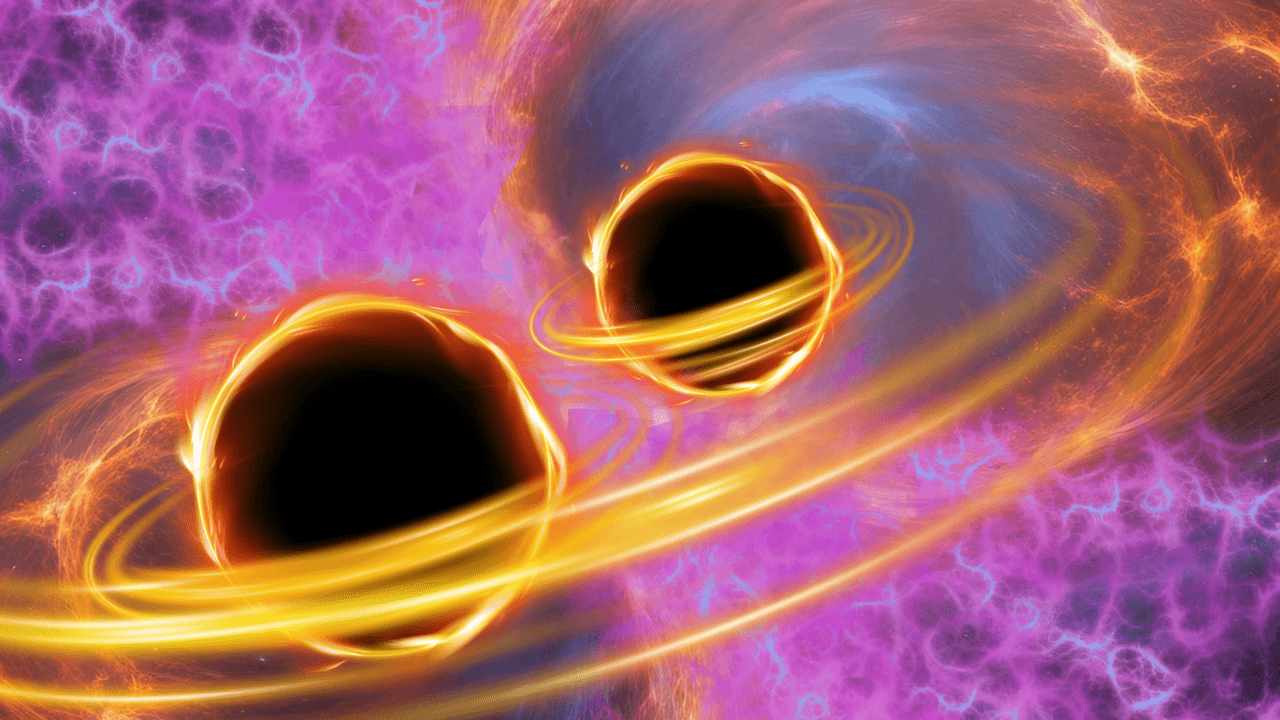
An illustration shows two colliding black holes flanked by dark matter. (Today, this relatively young country leads the way in our understanding of the universe. It's where many major players in space science, like NASA, the California Institute of Technology (Caltech), the Massachusetts Institute of Technology (MIT), and Northwestern University, to name just a few.And to celebrate 250 years of the U.S. as an independent nation, Space.com takes you on a journey through some common misunderstandings of the universe through the years and the roles American scientists played in clearing up that cosmic confusion.By 1776, Sir Isaac Newton's laws of motion had been around for about 89 years since the publication of Philosophiæ Naturalis Principia Mathematica (Mathematical Principles of Natural Philosophy) in 1687. Five of the solar system planets had been discovered by the Ancient Greeks long before the birth of the U.S. Also, after a long struggle and many attempts to stifle this knowledge, humans were made aware that the Earth orbits the sun rather than the other way around, with the final nail in this coffin of misunderstanding laid by Polish astronomer Nicolaus Copernicus in 1543 and Galileo Galilei in 1610, receiving an extra hammer blow from Newton in 1687.Galileo had also delivered us to the understanding that not only was Earth's place in the solar system unique, but it wasn't even the only planet to possess moons, with the moons of Jupiter, Io, Europa, Ganymede and Callisto discovered in 1610.Clearly, by the time the U.S. was born we were already beginning to understand the universe and our place within it, but some major misunderstandings still persisted. One of the largest of these surrounded the nature of the sun itself.The sun as a burning lump of coal America was formed during the "steam age," a period of industrialization that lasted from 1770 to 1914. This revolution was driven by coal, powering locomotives, ships, and factories, changing the shape of industry, transportation, and manufacturing. At this time, coal was the densest and most powerful fuel source known to humanity, so it is perhaps little wonder that many early scientists theorized the sun was actually a tremendously massive lump of burning coal.Then, one of the oldest and most prominent scientific periodicals in the world, the U.S.-based Scientific American, wrote a 1863 article that first began the pushback against the sun as a burning lump of coal."If the sun were composed of coal, it would last at the present rate only 5,000 years. The sun, in all probability, is not a burning, but an incandescent, body. Its light is rather that of a glowing molten metal than that of a burning furnace. But it is impossible that the sun should constantly be giving out heat, without either losing heat or being supplied with new fuel," the Scientific American article stated. "Assuming that the heat of the sun has been kept up by meteoric bodies falling into it, it is possible from the mass of the solar system to determine approximately the period during which the sun has shone. The limits lie between 100 millions and 400 millions of years."Though this estimate was still miles out, we now understand that the sun is around 4.6 billion years old; this development came at a time of a geological revolution that was uncovering evidence that our planet was much older than theological estimates of just a few thousand years. A NASA image of the sun. ( The idea was published by Eddington in his 1926 book, "The Internal Constitution of the Stars." Twelve years after this, nuclear physicis
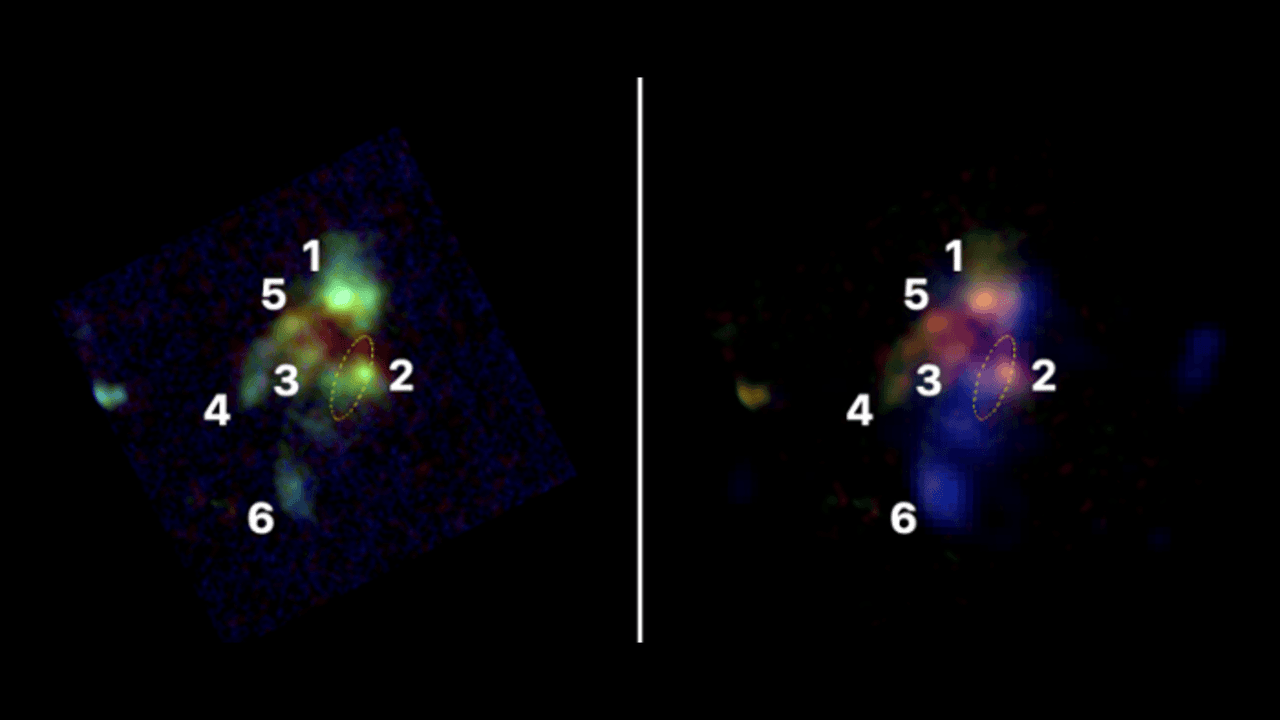
An intense demolition derby of at least six galaxies smashing into one another has been found lurking in the early universe by the James Webb Space Telescope. This merger is also expected to fuel the growth of a supermassive black hole and trigger the formation of what will eventually become one of the most massive galaxies in the cosmos."What makes this special is that we can follow both the build-up of a giant galaxy and the growth of the black hole at its center," Huub Röttgering, an astronomer at the Netherlands' Leiden Observatory, said in a statement.The discovery came after a tip-off from radio astronomers who had noticed emissions that seemed to be coming from an undiscovered active black hole. When the James Webb Space Telescope (JWST) looked closer, it found a surprise."We didn't find a single galaxy, but an entire complex of at least six galaxies," said Aayush Saxena of the University of Oxford.These six galaxies sit at a redshift of 4.0, which equates to a time about 12 billion years ago, just 1.8 billion years after the Big Bang.Through the vision of the JWST's Near-Infrared Camera the six galaxies appear fuzzy, reminiscent of a faraway version of Stephan's Quintet, which is a collection of five galaxies, four of which form a compact group that are on course to merge to become a giant elliptical galaxy.Similarly, the six galaxies spotted by the JWST, and collectively termed TGSSJ1530+1049, will undergo a series of rapid mergers to become what is known as a 'brightest cluster galaxy,' which is an enormous elliptical galaxy of the kind found at the center of galaxy clusters."We call structures like this protoclusters: the precursors of the vast collections of galaxies we see today," said Leiden's Roderik Overzier. "These are places where matter came together very early on. We think we are seeing a rare moment when several massive galaxies still exist separately, but are already in the process of forming one much larger galaxy."Already a supermassive black hole has formed at the heart of this galactic maelstrom, and radio observations with the European VLBI (very long Baseline Interferometer) Network and the U.K.'s e-MERLIN (enhanced Multi-Element Remotely Linked Interferometer Network) at a resolution on the scale of a 100 milliarcseconds have identified radio lobes and hotspots typical of an active black hole's jet interacting with the gas surrounding it."Using a network of connected radio telescopes, we were able to produce a very sharp image of TGSSJ1530+1049," said Krisztina Gabányi of Eötvös Loránd University in Budapest, Hungary. "The radio emission is produced as material falls into the black hole, while some of it is expelled again at high speed."The jet doesn't seem to extend as far as all the galaxies in TGSSJ1530+1049 yet, implying that the black hole is still fairly young.The six galaxies of TGSSJ1530+1049 span a volume only a few tens of thousands of light-years across, which is smaller than our Milky Way galaxy — and yet, they pack in a humungous amount of stars, equivalent to hundreds of billions of solar masses and a star-formation rate somewhere between 70–163 solar masses per year. That's a frenetic pace compared to the Milky Way, which produces much less than ten solar masses per year.TGSSJ1530+1049 is one of the densest collections of heavyweight galaxies found in the early universe so far, and is giving exciting clues as to how the most massive galaxies, clusters and black holes in the universe formed.The JWST observations are reported in The Open Journal of Astrophysics, while the radio measurements are described in a paper in Astronomy & Astrophysics.
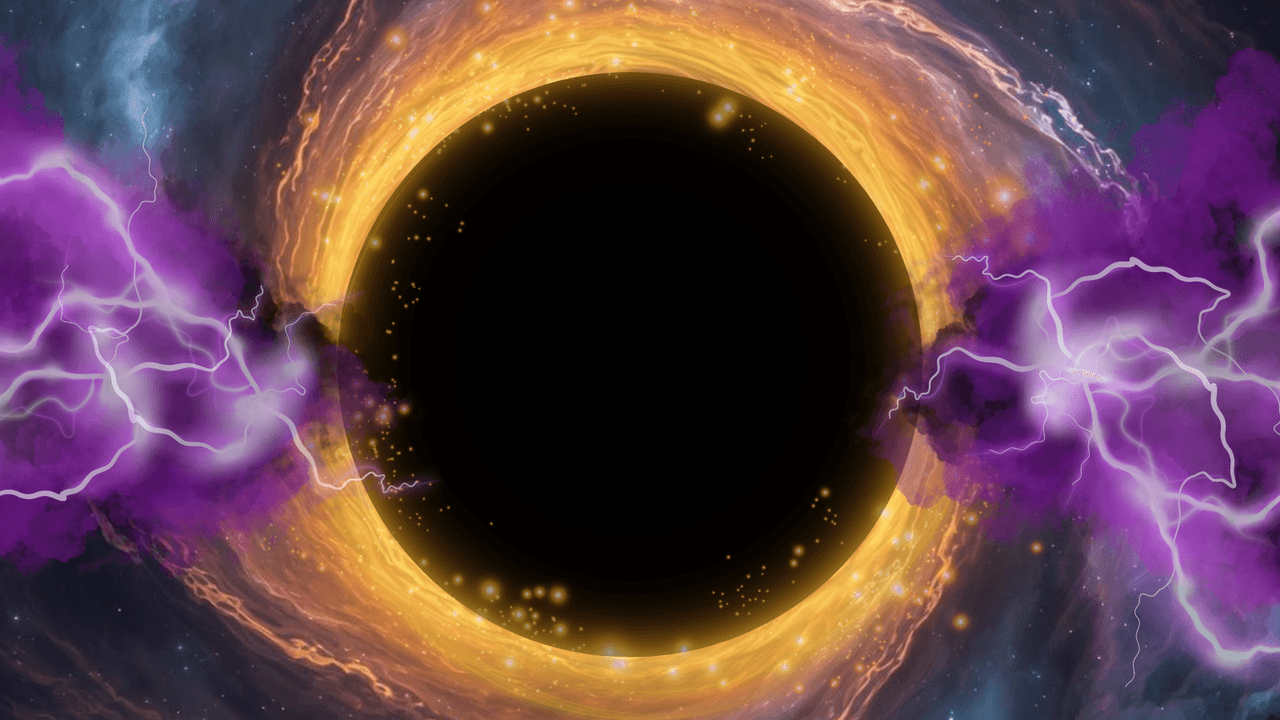
Astronomers have used a technique called echo mapping to detect hints that supermassive black holes, such as the cosmic titan at the heart of the Milky Way, known as Sagittarius A* (Sgr A*), are surrounded by dense clouds and clusters of dark matter. The research could teach us more about this mysterious substance and the environments around supermassive black holes.Dark matter is the universe's most mysterious stuff, outweighing ordinary matter in the cosmos by a ratio of five to one — but remaining effectively invisible because it doesn't interact with electromagnetic radiation, including the light we use to see. The only way scientists can even infer the presence of dark matter is via its interaction with gravity, and the impact that this interaction has on objects made of traditional matter like stars. For instance, the gravitational effect of dark matter allows stars at the edges of galaxies to whip around at much greater speeds while not flying loose than the visible matter of those galaxies would allow.This team decided to test the gravitational influence of dark matter at the hearts of galaxies, environments dominated by supermassive black holes which can have masses millions or even billions of times that of the sun. Ordinary matter around these supermassive black holes is often very visible, especially when spiraling into the maw of one of these cosmic titans from a flattened cloud called an accretion disk. This is because the gravitational influence of those black holes generates immense amounts of friction, causing them to grow brightly. That wouldn't work for dark matter; it can't feel friction because it doesn't interact with itself or with ordinary matter, and it can't glow because it doesn't absorb or emit light.Clearly, dark matter can't be spotted around supermassive black holes even using the most advanced telescopes such as the Event Horizon Telescope (EHT), which has captured glowing rings of material around Sgr A* and around a more distant supermassive black hole that rules the heart of the galaxy Messier 87 (M87).While discussing the problem of detecting dark matter around supermassive black holes, Mayank Sharma, a physics graduate student at Virginia Polytechnic Institute and State University (Virginia Tech), hit on an interesting solution."We could actually test this prediction using a technique in astronomy, which allows you to measure the distance to the surrounding gas by looking for echoes of light," Sharma said in a statement. The technique Sharma refers to is "reverberation mapping," and it has become a trusted method of determining the mass of black holes.Echoes of dark matterReverberation mapping is based upon the fact that as matter falls into a black hole, it releases a burst of energy that causes the accretion disk it comes from to pulse. This pulse of light travels from the accretion disk to gas in the wider environment of the black hole. This gas absorbs that light and also pulses, with this secondary pulse serving as an echo of the first.Because we know the speed of light, when astronomers see the first pulse of light and then its echo, they can use the time between pulses to estimate the distance between the black hole and the gas on the outskirts of its environment. The size of a black hole and the distance between it and outer gas clouds can be used to determine its mass, and could also be used to determine the mass of dark matter clustered around it.The team applied their method to 14 different galaxies, finding in five cases that mass increases moving away from the central black hole in a way that couldn't be accounted for by visible matter alone. Despite the early success of this research, it far from proves that supermassive black holes are indeed gathering places for dark matter. The team's findings do point an interesting way forward for the investigation into the universe's most mysterious substance and its most mysterious regions."These galaxies are definitely showing a hint th
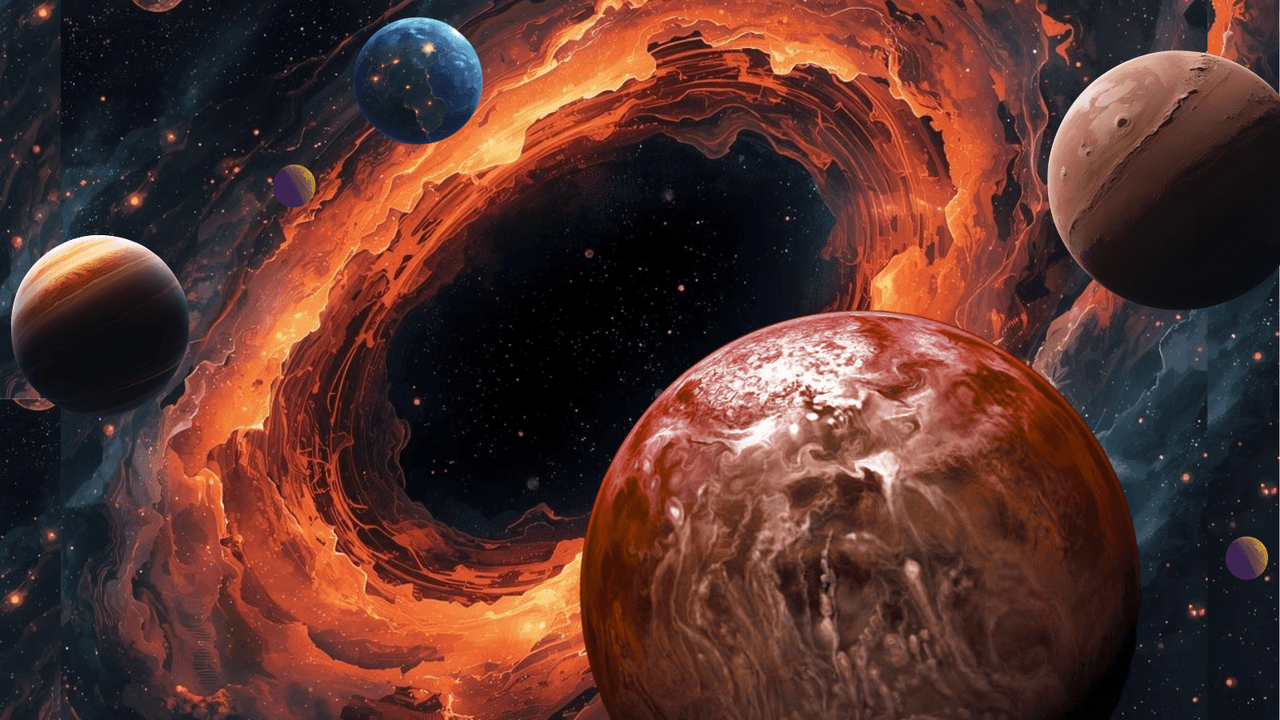
A team of scientists is astounded to have discovered that bright and turbulent regions of galaxies — called active galactic nuclei, which are powered by feeding supermassive black hole engines — could be the birthplace of millions of planets. And these regions are brilliant. They often outshine the combined light of every star in their wider home galaxy.Active galactic nuclei (AGNs) occur when supermassive black holes are surrounded by vast amounts of gas and dust that swirl around them in flattened, platter-shaped clouds called accretion disks. These accretion disks gradually feed some matter to the black hole. Meanwhile, other matter is channeled to the poles of the black hole, from where it is blasted away as high-energy plasma jets travelling at near-light speeds. The immense gravity of the central supermassive black holes, which have masses of millions or even billions of times that of the sun, generates intense friction in the gas and dust within accretion disks, causing them to glow brightly across the electromagnetic spectrum.The discovery is so surprising because even though AGNs are rich with gas and dust — the building blocks of planets — the turbulent conditions within the disks wouldn't generally be considered ideal for forming planets. However, the edges of these disks may have temperatures and conditions akin to the planet-forming protoplanetary disks found around infant stars. Over time, could enough dust clump together and grow into planets?To investigate this possibility, these scientists created a computer model of a supermassive black hole and its accretion disk and added data about the conditions at the edges of these disks. They then observed how rapidly dust clumped together and how the budding planets grew over millions of years."We discovered millions of Jupiter-mass planets could form at a distance of tens of parsecs [one parsec is around 3.3 light-years] from supermassive black holes, which are also AGNs," team member and University of Colorado Boulder researcher Bhupendra Mishra told Space.com. "These are dust giants exceeding Jupiter's mass. They will look like lava balls."Mishra added that because the disk around an AGN supermassive black hole is more gas-rich compared to those that would exist around a star like the sun during its infancy, the potential of planet formation is enhanced from a few possible worlds around stars to maybe millions of planets around a supermassive black hole. He explains that the underlying mechanism of planet formation around supermassive black holes would be a phenomenon called "streaming instability" that allows multiple large filaments of dust to form. These are the birthplaces of vast amounts of planets. That eventually leads to millions of planets lurking in the outskirts of an AGN disk.However, such planets may fly the nest quite quickly. The team's estimate confirms that these are stable planets — but while these planets will survive, they will likely migrate radially away from the supermassive black hole and the edge of the AGN."We were astonished! This has not been found in AGN disk context before using a streaming instability model," Mishra said. "My colleague Wladimir Lyra, an astronomy professor at New Mexico State University (NMSU), is world-renowned in the field of planet formation, and we both were totally amazed when we noticed this mass and size range of planet formation." An illustration showing the anatomy of the supermassive black hole and AGN at the heart of NGC 4151. ( Of course, it is early days for the team's theory, and the detection of planets around supermassive black holes would be a helpful confirmation of the team's conclusion. A useful tool in this investigation would be the curvature and the a
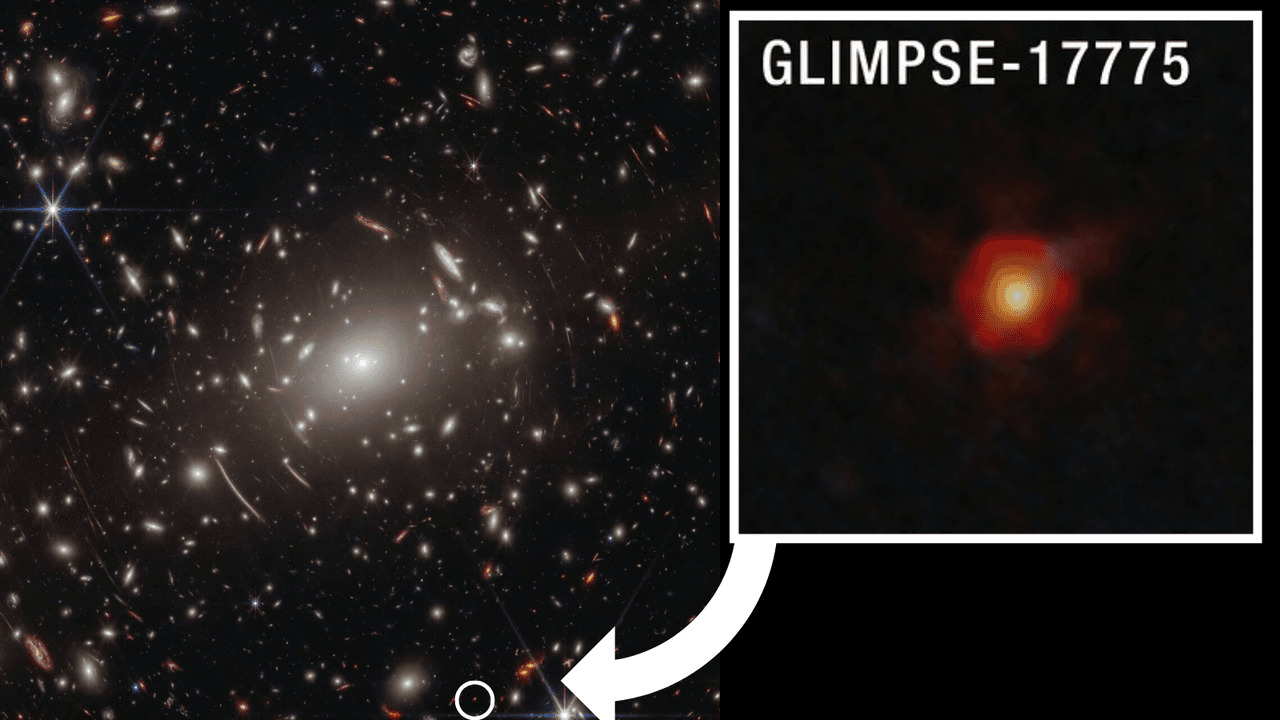
An image of the galaxy cluster Abell S1063 and the little red dot known as GLIMPSE-17775. ( Kokorev (University of Texas at Austin), A. Pagan (STScI)) Astronomers using the James Webb Space Telescope may be close to solving the mystery of "little red dots" in the early universe. The team has studied one of these strange objects, designated GLIMPSE-17775, finding evidence it is a black hole star — a ravenously feeding, growing supermassive black hole cocooned in a dense cloud of partially ionised gas.Little red dots first started to turn up when the James Webb Space Telescope (JWST) began sending data back to Earth in the summer of 2022. They were said by some scientists to have "broken cosmology" because they appear in large numbers around 600 million years after the Big Bang, but they appear to disappear before the universe reaches 2 billion years old. Several explanations for little red dots have been proposed, but one that has emerged as a frontrunner is the concept of black hole stars. If black hole stars exist, the little red dot disappearance would be the result of their intense, short-lived growth spurts that cause them to burn out — or, because the growing supermassive black holes at their centers eventually clear away the dense gas and dust obscuring them, changing their appearance as they evolve into more typical active galaxies.The problem is, however, that astronomers have been unable to gather observational evidence that little red dots are indeed black hole stars. That was until the JWST imaged little red dot GLIMPSE-17775, seen as it was just 1.8 billion years after the Big Bang, while making observations of the gravitational lens galaxy cluster Abell S1063. This data represents the deepest spectrum of light from a little red dot collected to date and, according to this team, contains multiple lines of evidence pointing to a black hole star."I think part of the scientific community is converging on a singular picture — that little red dots can be explained by black hole star models. But none of the previous little red dots have all of the pieces of evidence in the same place," Vasily Kokorev at the University of Texas at Austin said in a statement. "With GLIMPSE-17775 we can test these models because of how deep and amazing this source's spectrum is."Solving the little red dot puzzle with a hand from EinsteinThe JWST caught a glimpse of GLIMPSE-17775 while searching for the first generation of stars in our universe, somewhat confusingly called "Population III" stars. The telescope searched for these particular stars in the galaxies that comprise galaxy cluster Abell S1063.Separately, Abell S1063 is a gravitational lens, meaning its massive gravitational influence actually curves the fabric of space and time (united as a single, four-dimensional entity called spacetime). This, in turn, means an object "behind" the galaxy cluster that's emitting light toward our vantage point would have its light path curved in tandem with the spacetime curve. This can create a magnifying effect.The concept of gravitational lensing was first predicted by Albert Einstein in his theory of general relativity, and it's how scientists were able to observe GLIMPSE-17775 — essentially turning 30 hours of observing time into just about 80."When we saw the spectrum for the first time, it was like having all the pieces of a puzzle scattered on the floor," Kokorev said. "We picked up each piece of the puzzle, measured the lines, and started combining the different pieces into a mosaic. Maybe a few pieces looked like nothing at first, but then a couple of them came together, and we realized that there was something there." The galaxy cluster Abell S1063, a gravitational lens seen by the JWST. ( Kokorev (University of Texas at Austin), A. Pagan (STScI))The team identified several lines of evidence in the JWST observations that indicate "little red dot" GLIMPSE-17775 is indeed a
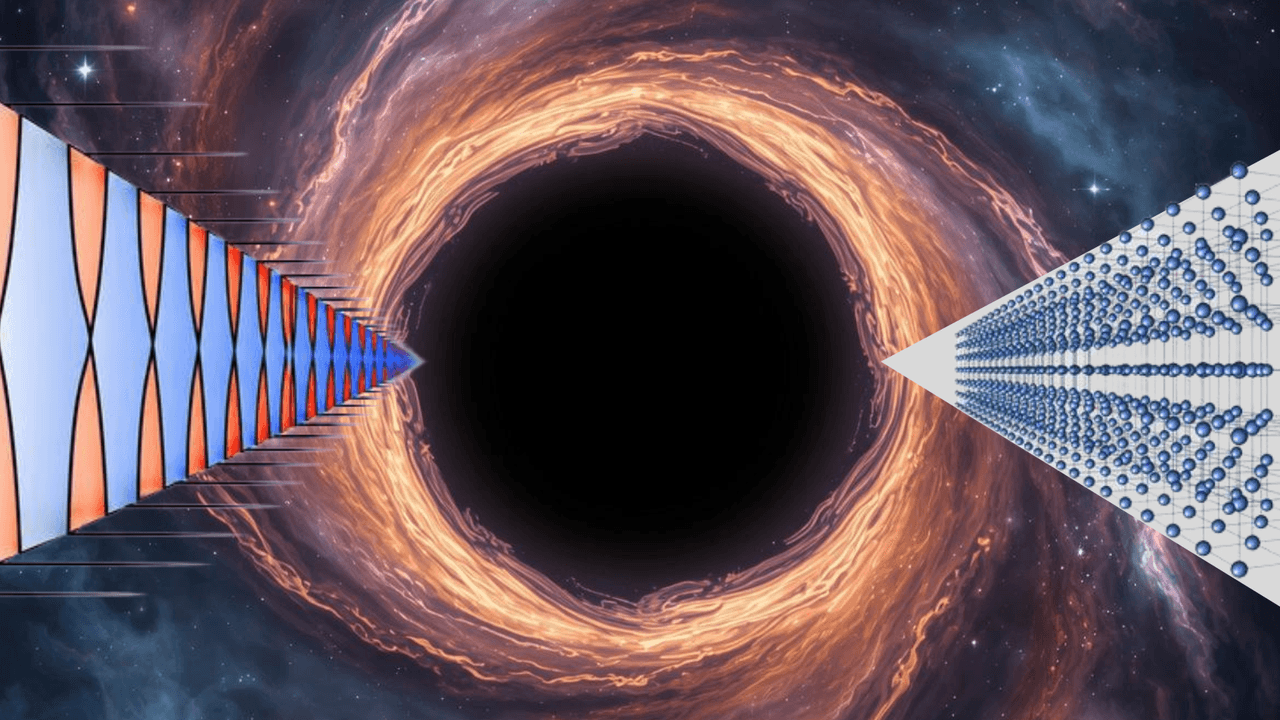
An illustration shows the fabric of spacetime "crystalizing" to birth a critical collapse black hole ( Thinking deeper, we probably imagine this ravenous cosmic beast forming from the explosive collapse of the core of a massive star. Maybe we even picture a supermassive black hole at the heart of a galaxy, formed from a multitude of mergers between smaller black holes and reaching masses millions or even billions of times that of the sun.However, as accurate as this picture is, many scientists have long suspected that it is only the tip of the black hole iceberg, representing a single class of "astrophysical black holes" alone. These researchers theorize that black holes can also form at much more diminutive sizes that do not require the existence and death of massive stars or prior pairs of black holes. In particular, many scientists think that tiny black holes, with masses as small as that of a medium-sized asteroid, could have formed directly from density fluctuations in the hot and dense matter that filled the cosmos moments after the Big Bang. These objects have remained hypothetical as evidence of their existence has proved elusive. That hasn't stopped researchers thinking about non-astrophysical black holes and the routes to their formation, however.One example is new research from scientists from Goethe University, Frankfurt, and the Vienna University of Technology (TU Wien), which suggests that minuscule black holes could form when the very fabric of space and time, united as a four-dimensional entity called "spacetime," undergoes critical collapse and organizes itself into a regular crystal-like arrangement. Though the idea isn't entirely new, the team has become the first to mathematically describe this transformation. And what is most staggering, they did it with nothing more than a pen and paper!While astrophysical black holes form from some of the universe's most titanic and violent events, like core-collapse supernovas or black hole mergers, that set the very fabric of spacetime ringing with gravitational waves that can be "heard" from millions and even billions of light-years away, the team found these critical collapse black holes could be born with only a tiny nudge. "Sometimes a tiny, seemingly insignificant cause is enough to trigger a huge and dramatic change," team member Daniel Grumiller of TU Wien told Space.com. "These microscopic black holes would form if you have a spacetime crystal and you inject an arbitrarily small amount of energy - a bit like what you get when you have undercooled water and you shake it so that it crystallizes."Grumiller explained further that when liquid water is at its freezing point, only a small change is required to cause water molecules to spontaneously arrange themselves into a regular pattern and form an ice crystal. Even a tiny change in the structure of spacetime can allow a repeated pattern to develop, resulting in the emergence of a spacetime crystal, the team theorizes. This can kick-start the process of critical collapse."You can think of the critical spacetime crystal as water at freezing point; even though it is still water, it already 'knows' about ice, and small perturbations can convert water at 0 Celsius into ice, or vice versa," Grumiller said.Enter stage left spacetimeEinstein suggested in his 1915 theory of gravity, general relativity, that particles of mass causethe very fabric of spacetime to curve. That means when particles move through spacetime, they affect the fabric of spacetime itself. That was the revolutionary thing about Einstein's rethink of gravity: to Newton, space and time were merely a stage upon which the actors of the universe, energy and matter, play their roles. To Einstein, spacetime was part of the production. It's that active role t
An illustration shows a black hole before and after transforming into a white hole. ( In fact, these tiny primordial black holes may live long enough to become energy-spewing white holes with the mass of a human eyebrow hair.Primordial black holes are proposed to have formed through fluctuations in the incredibly hot and dense matter that filled the universe moments after the Big Bang. This is in contrast to stellar-mass or "astrophysical" black holes that are familiar to us the collapse of massive stars like the. Primordial black holes remain undetected and therefore hypothetical.Many scientists believe that the failure to detect astrophysical black holes is because they have evaporated and therefore no longer exist in the 13.8 billion year-old cosmos. This is possible because black holes are proposed to "leak" a type of thermal radiation called "Hawking radiation" proposed by Stephen Hawking in the 1970s. The smaller the mass of a black hole, the hotter it is, and thus the faster it leaks Hawking radiation and the more rapidly it evaporates, a process speculated to end with an explosive finale.Stellar-mass black holes, with up to hundreds of times the mass of the sun, are massive and cool enough to leak slowly enough to outlive the universe itself many times over; primordial black holes with masses way smaller than this, on the other hand, aren't so lucky — or so we thought. Eberly College of Science researcher Daniel Paraizo and colleagues suggest there is a way that primordial black holes of just the right mass could survive this process to undergo a startling transformation."We found that the lifetime of black holes is much longer than previously thought," Paraizo told Space.com. "The phenomena that we identify are relevant for black holes possibly formed in the early universe. These objects have not been observed yet, but their search is a topic of intense interest as dark matter candidates. Black holes start to die by emitting thermal Hawking radiation. The puzzle is what happens once they reach the Planck mass, which is around 20 micrograms."A black hole the size of a flea eggThe Planck mass of around 0.000000022 kilograms is a fundamental unit of mass in physics considered fascinating because it is the point at which the rules that govern subatomic particles and quantum physics as well as those that govern gravity and general relativity as a whole become equally important. Physicists consider this the upper limit for the mass of any single elementary particle, with any particle above this collapsing to birth a microscopic black hole.In everyday terms, the Planck mass is about equivalent to a human eyebrow hair, or a flea egg, which is about one-fifty-thousandth as heavy as a jelly bean.Paraizo explained that once a primordial black hole has evaporated to the Planck mass, becoming a so-called Planckian black hole, there are several proposed fates it could encounter. This includes the disappearance of the outer boundary that defines what a black hole is, the light or electromagnetic radiation trapping region known as the event horizon. "The mechanism that we study for the death of this Planck-sized black hole is the gradual disappearance of the horizon that traps radiation," Paraizo said.The team performed mathematical calculations that revealed a primordial black hole formed with the initial mass of a medium-size asteroid, around 1 billion tons, decays in about a billion years and emits thermal Hawking radiation until it reaches the Planck mass. However, a primordial black hole born with a mass of just 1 ton would immediately explode, instantly reaching the Planck mass. It is what happens next that sets the team's findings apart from previous research. "It is then that our results predict something new: previous arguments indicated that the remaining 20 microgr
Discussion (0)