
Loading dispatches...
← Return to NewsroomScience
China plans to double the size of its Tiangong space station while the ISS nears its end
China's Tiangong space station.
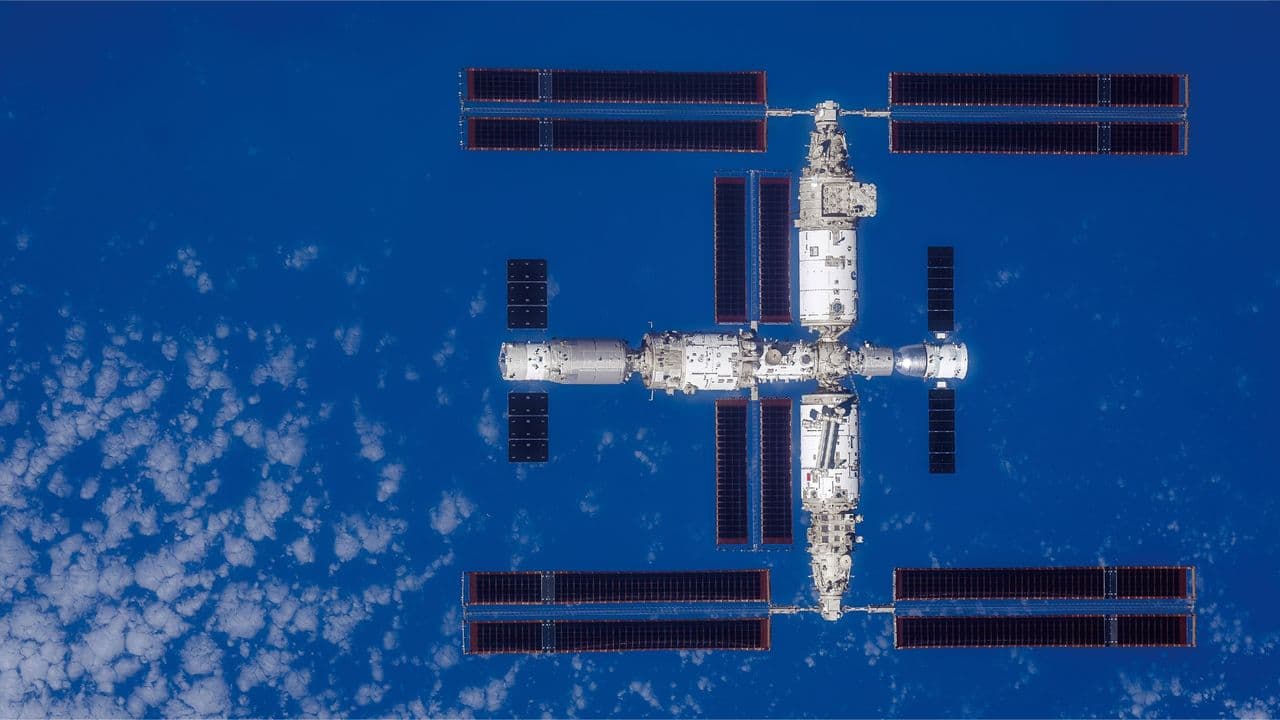
China's Tiangong space station.
China's Tiangong space station. (The three-module, T-shaped Tiangong space station was assembled in orbit across 2021 and 2022 and has hosted numerous three-astronaut Shenzhou crews, but China is now set to expand the orbital outpost with new modules, citing growing research demands and more frequent crew and cargo missions. As previously reported by Space.com, the planned expansion will see Tiangong grow into a "double-T" shape, with the addition of the multipurpose module and two new experiment modules, and allow China to extend the scale of operations aboard the station."This expansion has always been part of the original plan," Qian Hang, a researcher with China Aerospace Science and Technology Corporation (CASC), told Chinese media. State media Xinhua reported that the first phase of the expansion will see the launch of a new 20-ton-class multifunctional module, which will dock with Tiangong's Tianhe core module.Additional docking ports on the new modules will allow Tiangong to welcome more spacecraft and provide greater operational flexibility when needed. "If the missions get more intensive, we risk 'queuing' for docking ports and lack sufficient emergency buffer space," Qian said.China is developing new, low-cost cargo options for Tiangong, while its new Mengzhou spacecraft, which could debut later this year, can carry seven astronauts to low Earth orbit. The Shenzhou spacecraft, which is currently used for China's crewed missions, can carry three astronauts to Tiangong.Before the arrival of a new module, however, the first new addition to Tiangong is expected to be Xuntian, a bus-sized space observatory with a 2-meter (6.6 feet) diameter primary mirror, slightly smaller than that of the Hubble Space Telescope.Xuntian is scheduled for launch in 2027 and boasts a field of view around 300 times larger than that of Hubble, meaning it will be able to study and map around 40% of the heavens during its planned 10-year lifetime using its 2.5-billion-pixel camera. Xuntian will share a similar orbit with Tiangong, meaning it will be able to dock with the space station for maintenance, refueling, repairs and potentially upgrades. Screenshot from an animation showing Chinese astronauts servicing the Xuntian Space Telescope outside the Tiangong Space Station. ( The agency plans to launch the SpaceX-developed U.S. Deorbit Vehicle (USDV) in the coming years, and drag the ISS into the atmosphere over the Pacific Ocean in late 2030 or early 2031.While the U.S. is mulling a variety of plans for commercial stations that host astronauts in orbit after the ISS is retired, China would have the largest permanent outpost in orbit with Tiangong. According to Yang Hong, chief designer of the space station system, the planned expansion would take Tiangong from a mass of 90 tons to 180 tons. Andrew is a freelance space journalist with a focus on reporting on China's rapidly growing space sector. He began writing for Space.com in 2019 and writes for SpaceNews, IEEE Spectrum, National Geographic, Sky & Telescope, New Scientist and others. Andrew first caught the space bug when, as a youngster, he saw Voyager images of other worlds in our solar system for the first time. Away from space, Andrew enjoys trail running in the forests of Finland. You can follow him on Twitter @AJ_FI.
This composite image uses NISAR data to show vegetation in the area around South Africa. ()A rainbow blanket of patchwork colors sprawls across South Africa in this new composite image created using data from NASA's latest Earth-observing mission.This image incorporates information from NISAR (NASA-ISRO Synthetic Aperture Radar), a satellite developed jointly by NASA and ISRO (the Indian Space Research Organisation), to show details of land use down here on Earth.What is it? NISAR launched on July 28, 2025 on an Earth-observing mission. It tracks natural disasters and studies ecosystems, agriculture, glaciers and other facets of our planet's surface.In this image, you can see the region along the Vetrivier (Vet River, or "fat river") in South Africa. This area includes a wide-reaching agricultural region north of Bloemfontein. The data captured by NISAR in this image was used to create color-coded blocks that point to details like crop type.The Vetrivier flows through the Free State and North West provinces. This river feeds local agriculture, supporting crops across the wider Maize Triangle region, a major agricultural area in the country.Why is it incredible? This image is equal parts beauty and science. NISAR and other Earth-studying satellites are key players in our constantly evolving understanding of our planet.In the pretty abstract color blocks overlaid on this image, green points to an area with vegetation, red means an unvegetated area, and shades of blue depict how quickly a vegetated area changed within the recent season."It’s a pretty picture, but there are also important things that it communicates to us," Paul Siqueira, a scientist at the University of Massachusetts Amherst and the ecosystems lead of the NISAR science team, said in a statement. "With NISAR, crops like maize and sunflower appear differently than forests because of their size differences and period of growth." Chelsea Gohd served as a Senior Writer for Space.com from 2018 to 2022 before returning in 2026, covering everything from climate change to planetary science and human spaceflight in both articles and on-camera in videos. With a M.S. in Biology, Chelsea has written and worked for institutions including NASA JPL, the American Museum of Natural History, Scientific American, Discover Magazine Blog, Astronomy Magazine, and Live Science. When not writing, editing or filming something space-y, Gohd is writing music and performing as Foxanne, even launching a song to space in 2021 with Inspiration4. You can follow her online @chelsea.gohd and @foxanne.music
Discussion (0)