
Loading dispatches...
← Return to Newsroomgeneral
Art and Culture with Devdutt How Southeast Asia adapted Indian ideas to local needs
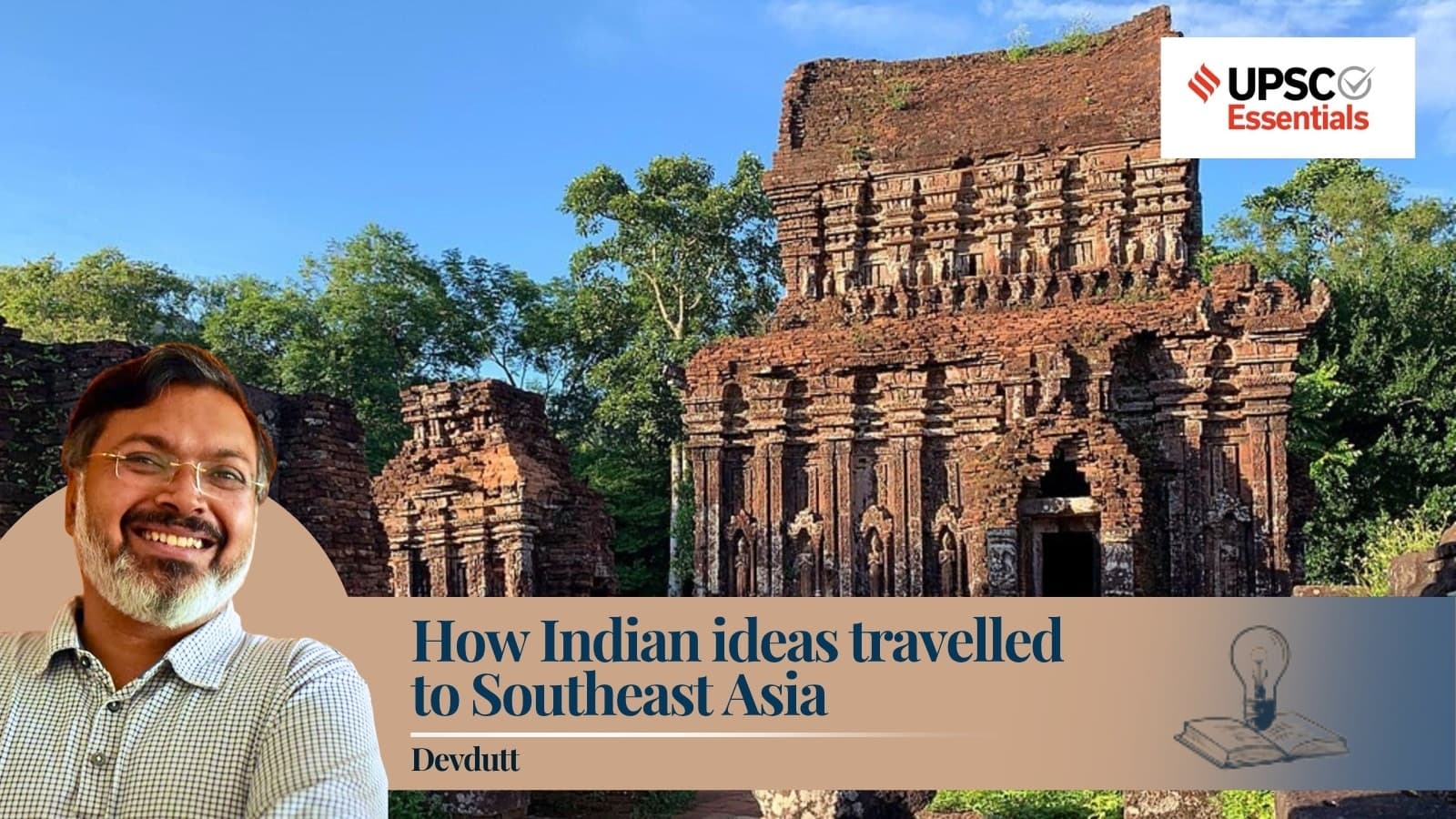
Across Southeast Asia, from the Mekong Delta (in present-day Vietnam and Cambodia) to Java island of Indonesia, major archaeological sites reveal how Indian ideas travelled not through conquest but through trade, pilgrimage, and court patronage between 500 AD and 1500 AD. These sites show a layered interaction of Buddhism and Hinduism, reshaped by local ecology, politics, and economy.In Vietnam, the Cham civilisation built temple complexes like My Son Sanctuary between the 4th and 13th centuries. These brick temples were dedicated primarily to Shiva. Sanskrit inscriptions and linga worship clearly show Hindu influence. Yet the architecture, with its distinct tower forms and decorative motifs, was regionally unique. The Cham economy relied on maritime trade along the South China Sea, which connected its ports to Indian, Arab, and Chinese merchants. The adoption of Shaivism linked them symbolically to Indian cosmology, strengthening their political authority in a competitive trade environment. Angkor Wat temple complex of Cambodia In Cambodia, the monumental complex of Angkor Wat stands as the most famous example. Built in the 12th century by King Suryavarman II, it was originally dedicated to Vishnu, reflecting Hindu royal ideology. Nearby, Angkor Thom and the Bayon temple later expressed Buddhist influence under Jayavarman VII, who adopted Mahayana Buddhism. The scale of Angkor revealed a hydraulic civilisation, where massive reservoirs (baray) supported wet rice agriculture. Religion here legitimised kingship. The king was seen as devaraja, or god-king, echoing Indian ideas but adapted to local political needs. Over time, the shift from Hinduism to Buddhism indicated changing patterns of power and patronage, not a rupture. Inscriptions in Sanskrit and Khmer further showed how local scribes blended cosmologies with administrative realities. Buddhism, kingship, and Thai identity In Thailand, early sites like Dvaravati (6th–11th century) reflected a strong Buddhist presence, especially Theravada traditions, with distinctive Mon-style sculpture and dharmachakra symbols. Later, Khmer influence introduced Hindu imagery, as seen in places like Phimai. The site of Sukhothai Historical Park (13th–14th century) marked the rise of Thai identity with Theravada Buddhism as state ideology. Story continues below this ad Unlike Angkor’s grand temple-mountain model, Sukhothai emphasised serene Buddha images and monastic institutions. Economically, this reflected agrarian consolidation rather than vast hydraulic systems associated with the Khmer Empire. Buddhism here supported a moral kingship model rather than divine kingship, where rulers were guardians of the dharma rather than gods. Theravada, Mahayana, and Hindu traditions in Bagan In Burma (Myanmar), the vast plain of Bagan (11th–13th century) contained thousands of temples and stupas. Bagan was primarily a Buddhist centre, especially Theravada, though earlier layers included Mahayana and Hindu elements. The kings of Bagan patronised monastic institutions, linking political power with merit-making. The Irrawaddy river system supported agriculture and trade, enabling temple construction on a massive scale. Pali scriptures, imported from Sri Lanka, shaped religious learning. Unlike the war-driven narratives of the Mahabharata, Bagan’s landscape emphasised the accumulation of merit through donation. Borobudur and Prambanan of Indonesia In Java, Indonesia, two major sites stood out. Borobudur (8th–9th century) was a massive Buddhist monument built by the Sailendra dynasty. Its mandala structure represented the Buddhist cosmos, guiding pilgrims symbolically towards enlightenment through carved galleries while depicting the path of the Bodhisattva. Story continues below this ad Nearby, Prambanan is a Hindu temple complex dedicated to Shiva, Vishnu, and Brahma, built by the Sanjaya dynasty. The coexistence of these two monuments indicated political competition, as well as religious plural

Discussion (0)