
Loading dispatches...
← Return to NewsroomEconomy
E25 petrol rollout reports 'absolutely false', testing still underway, says Govt amid backlash
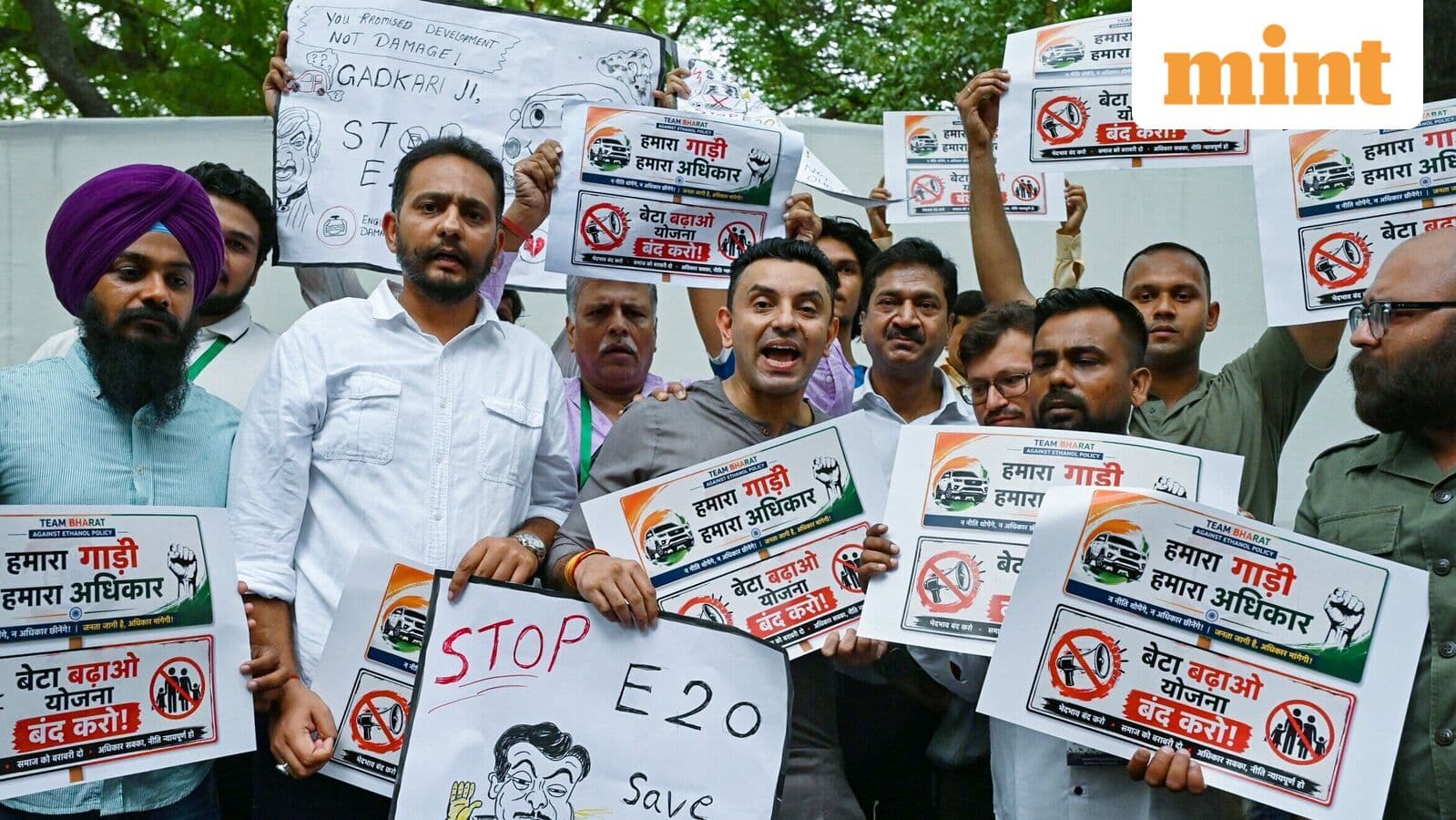
The clarification came amid reports suggesting the government could introduce E25 petrol in phases as part of its ethanol-blending programme. This had led to concerns among vehicle owners about engine compatibility and long-term performance.New Delhi, Jul 05 (ANI): Political Analyst & Consultant Tahseen Poonawalla with others stages a protest on ethanol blending in fuel at Jantar Mantar, in New Delhi on Sunday. (ANI Photo/Jitender Gupta)(Jitender Gupta)The Union government has dismissed reports about plans to roll out E25 petrol. The government has said that no such decision has been taken and that testing for the higher ethanol blend is still underway across multiple vehicle models, according to multiple media reports on 7 July.The claims of an E25 rollout are ‘absolutely false’, a News18 report said. The fuel (E25) has not yet completed the extensive scientific and technical evaluation required before any policy decision can be made, the report said, quoting a government source saying, “How can E25 be scheduled when testing itself is still underway?"The clarification came amid reports suggesting the government could introduce E25 petrol in phases as part of its ethanol-blending programme. This had led to concerns among vehicle owners about engine compatibility and long-term performance.Transition to ethanol-blended fuelAny decision surrounding E-25 will depend on scientific testing and technical validation, not policy speculation, NDTV said, quoting unnamed sources. There is "absolutely no need to worry" about E-20 petrol, which has been in use for over two-and-a-half years after extensive testing, the NDTV report said, quoting officials.The transition to ethanol-blended fuel has been made gradually, the reports said. The E-15 blending was done in April 2023, followed by E-19, which was introduced in April 2024, and E-20 has been in use from April 2025, the report said, adding that testing and evaluation were conducted at each stage.As things stand today, as many as 20 crore two-wheelers and 20 lakh four-wheelers running on petrol are already using ethanol-blended petrol, officials were quoted by multiple media outlets.In its 10-point clarification last week, the Ministry of Petroleum and Natural Gas said that petrol containing up to 20% ethanol is supported by scientific studies, international experience, and regulatory safeguards.An earlier Indian Express report suggested that the government is now mulling delaying its plans to launch E25 fuel, amid backlash following its mandate to increase the ethanol content in petrol from 10 to 20 per cent.The IE report reveals that a meeting was held last week at the upper levels of the government, in which it was decided that there is a need to use scientific approach in addressing some of the complaints regarding ethanol-blended fuels.The report cited sources to reveal that the government has agreed that it needs to give sufficient time for the ecosystem to get ready, and thus they must, for now, avoid pushing for the transition to E25 fuel, given that the E20 transition was not taken well by the Indian consumer.The fears regarding the impending launch peaked in the wake of two moves by the central government: one waiving the central excise tax on fuel containing 22 to 30% ethanol, followed by the Bureau of Indian Standards (BIS) notifying the fuel standards for such mixtures.Protest against ethanol blend in New DelhiA number of motorists registered their protest against the E20 ethanol blend on Sunday, claiming that this fuel is damaging engines and driving up costs. The protest in New Delhi was the first such significant protest against the government's 20% ethanol-blended petrol directive.Motorists claimed that the Indian govt's push for self-reliance through this is resulting in worse fuel efficiency and higher maintenance costs, which are being borne by the Indian consumer.“A car is the second-most expensive thing that the middle class buys,” political analyst Tehseen Poonawall
What is the difference between Indian nationality and citizenship? How can one know if they are an Indian national or a citizen? How is citizenship decided? What documents are required to prove your nationality or Indian citizenship? These questions have become relevant, especially after the Ministry of External Affairs clarified that a passport is a travel document, not proof of citizenship.Citizenship vs NationalityMany use citizenship and nationality interchangeably, but legally, they are different.Nationality is a broader concept. It is acquired by birth or adoption, marriage, or descent. Citizenship, meanwhile, is a specific legal relationship between a state and a person, bestowing certain rights and responsibilities. It does not have to accompany nationality, according to the Centre for Development Policy and Practice.Quick answers to key questions•5 QUESTIONSIndian nationality is a broader concept tied to birth or descent, while citizenship specifically refers to the legal status granted by the government, which confers specific rights and responsibilities.You can determine your Indian citizenship based on criteria such as birth in India, descent from Indian parents, or through legal registration or naturalization processes.There is no single definitive document. However, documents related to date and place of birth, such as voter IDs, birth certificates, and government-issued documents, may be used to support claims of citizenship.A passport is primarily a travel document and serves to establish nationality abroad; it does not confirm citizenship as individuals who are not citizens can also be issued passports under specific circumstances.Documents like Aadhaar, PAN cards, and driving licenses are not considered proof of citizenship, as they relate more to residency or identity rather than establishing citizenship status.Nationality is a cultural and ethnic bond to a country where a person was born or has heritage. If you were born in India or trace your roots there, your nationality is Indian.However, a person acquires citizenship only after fulfilling legal prerequisites. It is the legal status granted by the government. It grants specific rights such as voting and holding a passport.Regarding passports as proof of citizenship, the Ministry of External Affairs officials said that a passport's primary legal purpose is to facilitate international travel and establish the holder's nationality abroad, according to the New Indian Express.Here are the key differences between citizenship and nationality.NationalityCitizenshipThe place or country where a person was born is referred to as their nationalityWhen a person meets all of the legal conditions, the government of the country will issue them citizenshipNationality can be viewed as a moral or racial idea.Citizenship is a legal term that refers to a person's legal statusBirth and Inheritance are two ways to get nationality. Birth, Inheritance, Naturalization, Marriage, and other methods can all be used to get citizenshipOne's nationality cannot be changedIt is possible to change one's citizenshipA person can only be a national of one countryA person can acquire citizenship of multiple countriesCan not be reverseCan be reversedExample: A person with Indian roots born in the UKExample: One Indian receiving US citizenship after passing a citizenship test.How are citizenship and nationality decided?One's nationality is determined by the place of birth or by ancestral roots (or inheritance). Meanwhile, an Indian citizenship is decided by:Birth: If you have been born in IndiaDescent: If you have been born to Indian Parent(s) outside IndiaRegistration/Naturalization: Any foreigner, on becoming eligible, can acquire citizenship by registration or by naturalisation irrespective of his country or community.How can you prove your citizenship and nationality?There is no single document to prove Indian citizenship. Even, the government is not clear about what all documents would be
In a move to shed yet another colonial relic, the Indian Army has discontinued the use of ceremonial pouch belts in several dress categories and made it optional for reviewing officers to carry swords during parades.The changes, detailed in a new 174-page manual, Army Uniforms-2026, issued eight years after the previous edition and accessed by the Hindustan Times - authorise the use of closed-neck bandi jackets in formal settings. The Army has also introduced a new winter uniform, known as Dress 3B, for personnel of all ranks. The outfit comprises an angola shirt, battle jacket and beret.“In keeping with the nation’s sentiments and evolving sovereign identity, a number of deliberate refinements have been incorporated. Collectively, these refinements represent a progressive review of residual colonial-era vestiges while preserving the dignity, functionality and enduring traditions of the Indian Army,” the document stated in a section titled “Indigenisation and Alignment with National Ethos.”Grooming standardsThe revised manual also sets out detailed appearance and grooming standards, covering tattoos, body piercings, hairstyles, moustaches and the use of cosmetics.For the first time, officers have been authorised to wear bandi jackets as part of the formal dress code. The option is available alongside existing formal attire such as the bandhgala, lounge suit, combination dress, or a full-sleeved shirt paired with a tie and formal trousers.“A closed neck coat (bandi jacket) may be worn over a full sleeved shirt. The bandi jacket may be with or without the neck hook fastening (both patterns are authorised) and will be of solid, sober colour only. Matching formal trousers of sober design and formal closed footwear will be worn,” the manual stated.Cosmetics, piercings and religious symbols face tight restrictionsWomen officers are permitted to wear sarees in sober colours, or kurta-salwar and ankle-length straight trousers with a dupatta. However, sleeveless kurtas and casual lower garments such as palazzos and cigarette pants are not permitted.Among the notable changes, the pouch belt has been removed from Mess Dress No. 5 and No. 6. These dress categories are typically worn at state functions, formal receptions and ceremonial events. However, pouch belts will continue to be authorised for officers up to the rank of colonel in select arms and regiments, including the Armoured Corps, Mechanised Infantry, Regiment of Artillery, Rifle Regiments, Maratha Light Infantry, Jammu and Kashmir Light Infantry, and Corps of Signals.“Pouch belt will not be worn with Dress No 5 and 6. However, it may be worn with ceremonial dresses during regimental/corps functions,” the manual stated.The regulations also remove colonial-era terminology, including references to the word “royal”.In the foreword to the manual, Adjutant General Lt Gen VPS Kaushik wrote that the new edition “reflects a considered step towards aligning the army’s dress regulations with contemporary Indian ethos through the progressive removal of residual colonial-era practices, accoutrements and terminology.”The changes are part of a broader indigenisation push within the armed forces. The effort gathered pace after Prime Minister Narendra Modi, during the Combined Commanders’ Conference in Kevadia, Gujarat, urged the military to eliminate colonial customs and adopt more Indian approaches in its doctrines, procedures and traditions.The new manual also reinforces strict grooming standards. Tattoos and body piercings remain prohibited, while personnel are not allowed to wear bracelets in uniform, except for a single sacred thread on the wrist on the day of a pooja. Religious symbols and markings are generally not permitted, with exemptions for Sikh personnel.Moustaches must not exceed 12 cm in length. The regulations also prohibit the use of deodorants and perfumes while in uniform, although aftershave lotions remain allowed.Women personnel are subject to specific cosmetic guidelines.

The Indian Army recently carried out a sting operation in Uttar Pradesh's Shahjahanpur and detained a 21-year-old man who was allegedly impersonating a brigadier by wearing a military uniform and carrying forged documents.File image of an Indian Army personnel(PTI)The Indian Army recently launched an elaborate sting operation in Uttar Pradesh's Shahjahanpur and detained a 21-year-old man who was allegedly posing as a high-ranking military official and wearing a military uniform.The Hindustan Times on Saturday reported that Indian Army personnel laid an elaborate trap to catch the fake brigadier, who would allegedly travel around Shahjahanpur and nearby districts posing as a senior Army official in a Brigadier's uniform.Here's what we knowThe accused has been identified as Aryan Verma. Citing officials, the report added that there had been several inputs about his movement in military uniform in and around the city, and Army officials had been tracking him since April. Verma, who was always keen to present himself as a high-ranking official dressed as a Brigadier, was invited by Army officials, who posed as civilians, to speak to young candidates preparing for recruitment exams and motivate them. A fake programme was also organised at the Shaheed Museum located in the Shahjahanpur Cantonment area.On Friday morning, the 21-year-old showed up at the venue and donned his Brigadier uniform in an SUV, following which he was detained immediately. According to officials, Verma's uniform was adorned with military stars and flags associated with senior officers.Accused had a driver and bodyguardsVerma's arrest revealed the extent of the deception he had allegedly maintained. Authorities recovered a forged government identification card from his driver at the time of his detention. Investigators also discovered that he routinely travelled with two bodyguards, whom he is accused of presenting as National Security Guard (NSG) commandos. By portraying himself as a senior military official, Verma allegedly claimed he had been assigned special security protection.Along with his uniform, the 21-year-old also carried a fake pistol and a regimental cane to complete his ruse, all of which were seized from him. He even carried an ID card, which purportedly had the seal of the dean of the Armed Forces Medical College. Officials suspect the ID card was also forged.What did the officials find out?After recovering his documents, officials found that Verma was 21 years old and had been staying in Delhi. He had reportedly been preparing for the National Eligibility-cum-Entrance Test (NEET), the entrance examination for medical studies, and had allegedly failed the test multiple times.However, the motive behind Verma's act of posing as an Army official remains unclear. An Army intelligence team from Bareilly has now taken over the investigation and is trying to ascertain the same. They are also trying to understand the extent of Verma's ruse, how he acquired a fake ID and a uniform, and whether more people were involved in the act.Verma is currently being questioned by Army officials. After the interrogation is completed, he will be transferred to police custody, where a First Information Report (FIR) will be registered and a detailed investigation initiated, Superintendent of Police Saurabh Dixit said.Officials said Verma's father works in the horticulture department, while his mother is employed as a school teacher.About the AuthorSwati GandhiSwati Gandhi is a digital journalist with over four years of experience, specialising in international and geopolitical issues. Her work focuses on foreign policy, global power shifts, and the political and economic forces shaping international relations, with a particular emphasis on how global developments affect India. She approaches journalism with a strong belief in context-driven reporting, aiming to break down complex global events into clear, accessible narratives for a wide readership. Previously

In the last few months, the Indian Rupee has been hitting new lows regularly. Yields on the Government securities (G-secs) have been climbing. Foreign Institutional Investors (FIIs) have been withdrawing money out of India and taking US Dollars back to their home countries. The Government has been taking various steps to stop the FIIs from selling Indian securities and instead encourage them to invest fresh funds in India. On 5th June 2026, the Government announced tax relief for FII investments in G-secs. In this article, we will understand the details of this move.In a strategic move to attract Foreign Institutional Investors (FIIs), the Indian Government has announced tax exemptions on investments in Government securities (G-secs).Tax exemptionThe Government announced the Income Tax (Amendment) Ordinance, 2026, to amend the Income Tax Act, 2025. As per the amendment, the Government has made the following changes.Tax exemption on the interest incomeInterest income earned by FIIs from Government securities (G-secs) is exempt. Earlier, this interest income was subject to a 20% withholding tax.2. Tax exemption on the capital gainsThe short-term and long-term capital gains earned by FIIs on G-secs are exempt. Earlier, the short-term capital gains (STCG) were taxed at 30%. The long-term capital gains (LTCG) were taxed at 12.5%.A listed G-sec is categorised as a long-term capital asset if it is held for more than 12 months, and an unlisted G-sec is categorised as a long-term capital asset if it is held for more than 24 months. Similarly, a G-sec is categorised as a short-term capital asset if held for 12 months or less, and an unlisted G-sec is categorised as a short-term capital asset if it is held for 24 months or less.The Ordinance changes can be summarised as follows.Income typeTaxation as per OrdinanceTaxation before OrdinanceInterest income from G-secsNil20%Short-term capital gains taxNil30%Long-term capital gains taxNil12.5%Along with the FIIs, the above exemptions apply to the Bank for International Settlements (BIS). The BIS is an international financial institution owned by central banks. It acts as a banker and asset manager for central banks and international organisations.The Ordinance is deemed to have come into force from 1st April 2026.Impact of Government measuresThe Government's decision to exempt FIIs and BIS from taxation on income from G-secs, along with its other reforms, is to strengthen India's standing as a leading destination for global investment. The Government expects these measures to attract long-term foreign capital and deepen the G-sec market by broadening and diversifying the investor base.With these measures, the Government expects to attract long-term institutional investors, such as pension funds, insurance companies, sovereign wealth funds, etc., to invest in India’s G-secs. These investors are expected to bring stable, sustained foreign capital flows into India, which can reduce the Government’s borrowing costs. Foreign capital inflows will boost the RBI’s forex reserves and also help stabilise the Indian Rupee against the US Dollar and other global currencies.Other reform measures for FII investments in G-secsThe Central Government and the RBI acted in coordination on 5th June 2026 to announce steps to attract foreign capital into Indian G-secs. While the Government announced the Ordinance, the RBI Governor, in his Monetary Policy Statement, announced that for G-secs under the Fully Accessible Route (FAR), the universe of ‘specified securities’ will be expanded.All new issuances of G-secs of 15, 30, and 40-year tenures will be included in the FAR. The FPIs invest in Indian G-secs through the FAR and General Route. The move will broaden investment opportunities for foreign investors across a wide range of G-secs. The availability of higher-maturity options will encourage greater participation in long-duration G-secs.Inclusion of Indian G-secs in global indicesThe Central Government and RBI re

MEA condemned the attack on the commercial vessel Settebello off the coast of Oman. The Indian Embassy in Muscat also mentioned that it was aware of an incident involving a vessel off the coast of Oman and was 'closely monitoring' developments.MEA condemns attack on commercial vessel off the coast of Oman amid Iran crisis. (REUTERS/Stringer)(REUTERS)India's foreign ministry on Wednesday condemned the attack on commercial tanker Settebello off the coast of Oman. It confirmed that three Indian seafarers remain unaccounted, while 21 other Indian crew members were successfully rescued amid Iran crisis.The Ministry of External Affairs (MEA) expressed concern over the continued attacks on shipping in the region, saying they were a consequence of the ongoing conflict. It urged all sides to immediately reduce tensions and work towards a diplomatic resolution through ongoing negotiations to restore peace and stability.The ministry also stressed that attacks on commercial vessels and civilian infrastructure should cease and called for the early restoration of free and unhindered navigation and trade through international waterways in accordance with international law.“We condemn the attack on the commercial vessel Settebello off the coast of Oman, earlier today. Our embassy in Oman is closely monitoring the situation and proactively coordinating with the Omani authorities in the ongoing search and rescue operation,” the ministry stated.What did Indian Embassy in Muscat say?The Indian Embassy in Muscat also mentioned that it was aware of an incident involving a vessel off the coast of Oman and was "closely monitoring" developments."We have learnt of an incident involving a vessel off the coast of Oman. We are closely monitoring the situation and in close touch with the local authorities. We shall update soon," it said.Meanwhile, the UK Maritime Trade Operations (UKMTO) reported receiving information about an incident approximately 20 nautical miles northeast of Sohar, a coastal city in Oman located near the entrance to the Strait of Hormuz."Local authorities have reported a tanker has experienced a fire in their engine room and are on the scene assisting with the evacuation of the crew," it stated.The vessel reported one fatality and two missing crew members, according to the report, which also stated that no environmental damage had been detected.24 Indians aboard a Palau-flagged merchant tanker MT Marivex rescuedThe incident occurred a day after the Indian Coast Guard (ICG) announced that 24 Indian sailors aboard a Palau-flagged merchant tanker MT Marivex had been rescued in a joint operation with Omani authorities following a reported "missile attack" on the vessel off the Omani coast, according to PTI.According to the MEA, the tanker caught fire after being struck during an attack off the coast of Oman, prompting a rescue operation. The vessel was hit by a US missile on Monday, leading to the blaze."Our embassy, for the rescue purpose, contacted the Omani authorities, who swung into action. We are grateful to the Omani government for its excellent support in rescuing the crew and ensuring their safety. Our mission continues to be in touch with the seafarers," MEA spokesperson Randhir Jaiswal said.The latest developments come amid escalating tensions in the Gulf region, where the United States has carried out airstrikes on Iran and Tehran has responded by launching missiles at countries in the Gulf.About the AuthorGarvit BhiraniGarvit Bhirani is a journalist based in Gurugram. He is a Deputy Chief Content Producer at LiveMint, where he covers national and international news stories, focusing on accuracy and compelling storytelling for readers. With a total of six years of experience in journalism, he has previously worked with Vaco Binary Semantics for Google, taking on the role of news curation lead, and reported from the field on health, education, and agriculture stories for 101reporters and News9. He has also served as a
The United States Justice Department announced on Tuesday, June 9, that it has filed for denaturalisation actions against one Neeraj Sharma, the owner of a New Jersey-based staffing company Magnavision LLC, for allegedly signing and filing 11 fraudulent H-1B visa petitions. During his naturalisation interview, Neeraj had also lied about his past criminal conduct.He became a US citizen in December 2017 but was later convicted of fraud and misuse of visas.The letters submitted by Neeraj Sharma as supporting documents for H-1B petitions carried fake signatures of executives of the global financial institution, the justice department said. According to the charges filed against him, Neeraj Sharma “signed and filed eleven fraudulent H-1B visa petitions with US Citizenship and Immigration Services (“USCIS”).”Quick answers to key questions•5 QUESTIONSNeeraj Sharma is accused of signing and filing 11 fraudulent H-1B visa petitions, using fake signatures from executives of a global financial institution and making false employment claims for visa beneficiaries.Neeraj Sharma is facing denaturalization because he allegedly illegally procured his citizenship by failing to disclose his past criminal conduct, providing false testimony, and misrepresenting material facts during his naturalization process.Neeraj Sharma became a US citizen after his application was approved by USCIS, which was based on the false assertions he made about his criminal history and the fraudulent H-1B visa petitions he filed.Illegally procuring US citizenship can lead to denaturalization and revocation of citizenship, as stipulated under the Immigration and Nationality Act, if the naturalization was obtained through fraud or misrepresentation.The US Justice Department emphasizes that American citizenship is a privilege that must be earned honestly, and that individuals who break laws and lie in their immigration proceedings forfeit that privilege.The department said that each petition that Neeraj Sharma filed included “false representations that the visa beneficiaries would be employed with a particular global financial institution, and also included letters on official corporate letterhead with forged signatures of the executives.”Neeraj Sharma, the charges read, also “falsely asserted that he had never committed a crime or crime for which he was not arrested.” He also emphasised he had never “given any US Government officials any information or documentation that was false or misleading, and lied to any US government official to gain immigration benefits.”As these assertions were filed by him, the US Citizenship and Immigration Services (USCIS) approved his application and he became a US citizen.During verification, the department found that Neeraj Sharma had falsely made these assertions, and filed for denaturalisation actions.“The United States seeks to revoke Defendant’s naturalization, pursuant to 8 USC § 1451(a), as an alien who illegally procured his naturalization by: (1) failing to disclose unlawful acts; (2) providing false testimony; and (3) concealment of a material fact and willful misrepresentation,” it said.“American citizenship is a privilege, and it must be earned honestly. If you come here break our laws, and lie in your immigration proceedings, you forfeit that privilege,” said DHS Secretary Markwayne Mullin.Under the Immigration and Nationality Act, “a naturalized US citizen’s citizenship may be revoked, and certificate of naturalization canceled, if the naturalization was illegally procured or procured by concealment of a material fact or by willful misrepresentation.”Along with Neeraj Sharma, proceedings to revoke citizens have been initiated against 16 more persons who are accused of serious offences.(With agency inputs)About the AuthorLivemintFor about a decade, Livemint—News Desk has been a credible source for authentic and timely news, and well-researched analysis on national news, business, personal finance, corporates, politics and geo

Discussion (0)