
Loading dispatches...
← Return to NewsroomEconomy
Indian Navy warships: Dunagiri, Sanshodhak, Agray - all you need to know about indigenous vessels commissioned by Modi

The commissioning of three indigenously built naval ships underscores India's focus on self-reliance in defense, enhancing maritime capabilities. PM Modi emphasized strong maritime prowess as essential for nation's economic and strategic influence, with over 75% indigenous content in these vessels.The commissioning of these vessels highlights the collaborative efforts of the Government of India, the Indian Navy, public sector shipyards, private industry and MSMEs in advancing the objectives of Aatmanirbhar Bharat and strengthening India's maritime capabilities.(PMO India)Prime Minister Narendra Modi on Sunday commissioned three indigenously built naval ships at the Syama Prasad Mookerjee Port in Kolkata. The three indigenously built frontline platforms -- stealth frigate Dunagiri, survey vessel (large) Sanshodhak, and anti-submarine warfare shallow water craft Agray-- represent key operational capabilities across maritime combat, hydrographic surveying and anti-submarine warfare.Three indigenously built naval ships commissionedPM Modi said that strong maritime capabilities are the deciding factor for a country's economic and strategic influence, and India understands this well and is preparing for it.In his address after commissioning three indigenously built naval ships, the PM said India does not want to remain only a buyer country in the defence sector and the nation's armed forces cannot become just a market for the world."The recognition of our capabilities lies in our self-reliance and not in becoming a market for the world," he said.Modi said India demonstrated its maritime capabilities a few years ago by commissioning aircraft carrier INS Vikrant.He said over 40 warships and submarines have been commissioned in the last few years, and 45 large naval platforms are under construction."No nation can become a big power without maritime prowess. Development, security and prosperity are tied to the seas," he said.He said the frontline platforms represent key operational capabilities across maritime combat, hydrographic surveying and anti-submarine warfare.Designed by the India Navy's Warship Design Bureau as well as by Garden Reach Shipbuilders & Engineers (GRSE), Kolkata, and constructed by GRSE, the vessels represent key operational capabilities across maritime combat, hydrographic surveying, and anti-submarine warfare.These platforms have indigenous content exceeding 75 per cent, with extensive participation by the Indian industry, including more than 200 MSMEs, in their construction.Together, they reflect the Navy's balanced approach to capability development, strengthening blue-water operations, enhancing maritime domain awareness, and securing coastal waters against evolving threats.DunagiriDunagiri, the fifth Project 17A stealth frigate, is equipped with advanced weapons and sensors, including BrahMos surface-to-surface missiles and the Medium Range Surface-to-Air Missile system, significantly enhancing the Navy's combat capability.SanshodhakSanshodhak, the fourth Survey Vessel (Large), is designed for coastal and deep-water hydrographic surveys and collection of oceanographic and geophysical data for defence and civil applications, and is equipped with advanced survey systems including Autonomous Underwater Vehicles and Remotely Operated Vehicles.AgrayAgray, the fourth of the Arnala-class Anti-Submarine Warfare Shallow Water Craft, is equipped with lightweight torpedoes, indigenous rocket launchers, and shallow-water sonar systems to detect and engage underwater threats in littoral waters.The three platforms demonstrate the growing maturity of India's indigenous shipbuilding ecosystem, with indigenous content exceeding 75 per cent.According to the Ministry of Defence, the commissioning of these vessels highlights the collaborative efforts of the Government of India, the Indian Navy, public sector shipyards, private industry and MSMEs in advancing the objectives of Aatmanirbhar Bharat and strengthening India's maritim
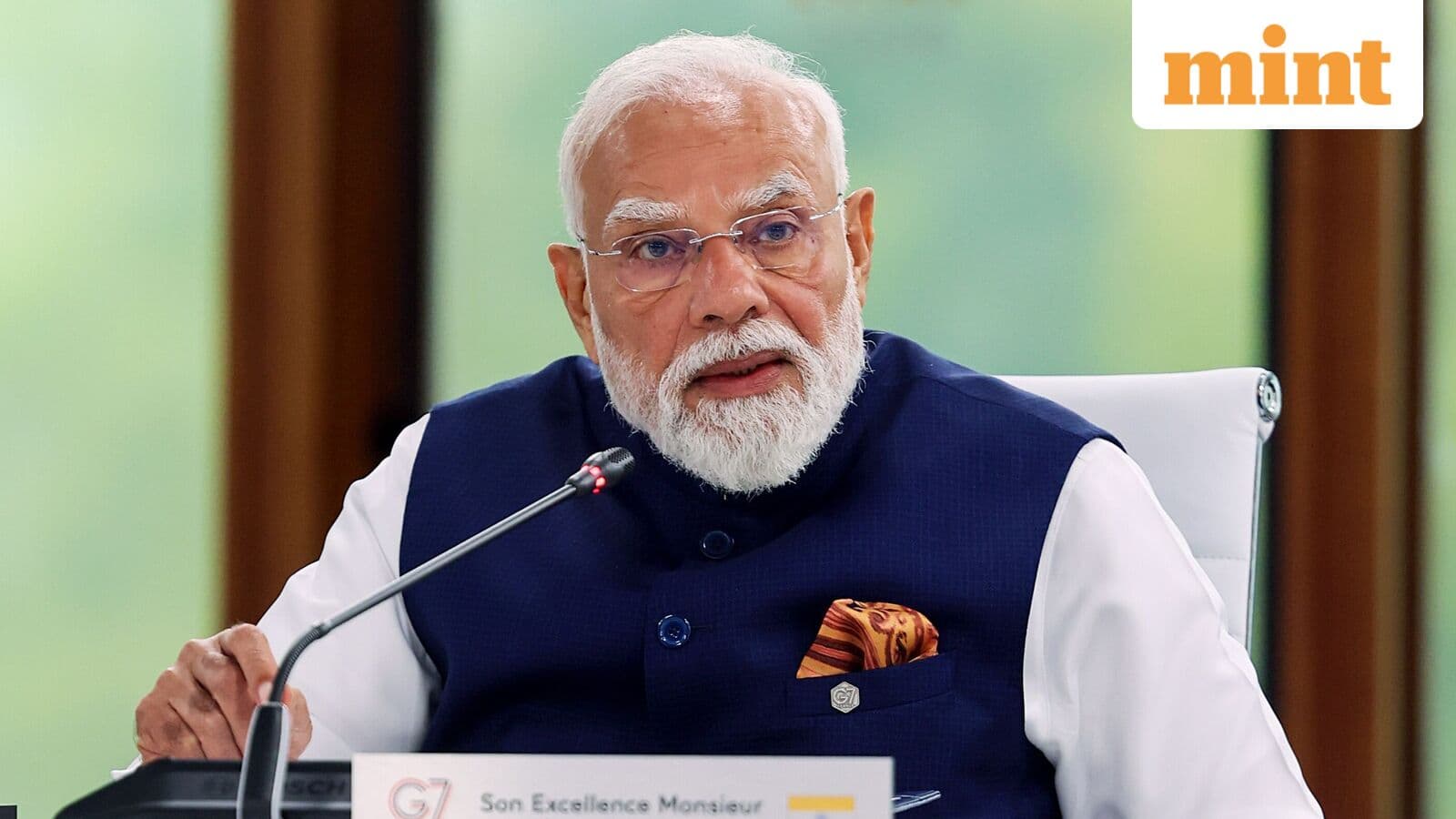
Prime Minister Narendra Modi on Tuesday (June 16) called for a new framework of international cooperation based on "trust," solidarity and equality while addressing the Outreach Session of the 52nd G7 Summit in Evian, France.Speaking during the session themed "Forging New Partnerships and Rebuilding International Solidarity," PM Modi emphasized that global engagement must move beyond traditional donor-recipient relationships and evolve into partnerships among equals.According to the Ministry of External Affairs (MEA), the Prime Minister "underscored the importance of 'trust' in building international partnerships, especially in an increasingly interconnected world."Quick answers to key questions•5 QUESTIONSPM Modi emphasized the need for partnerships based on trust, solidarity, and equality, moving beyond traditional donor-recipient relationships.India's 'humanity first' philosophy underpins various initiatives like the International Solar Alliance and the Coalition for Disaster Resilient Infrastructure, showcasing its commitment to addressing global challenges.'Vasudhaiva Kutumbakam,' meaning the world is one family, reflects India's vision for international cooperation and promotes sustainable and inclusive development globally.India's participation underscores its role as an outreach partner in addressing critical global issues and enhancing international collaboration among major economies.Following the G7, India aims to strengthen trade ties, notably through ongoing discussions for a Comprehensive Economic Partnership Agreement (CEPA) with several countries, including Canada."He said that the world should move from donor-recipient to partnerships based on solidarity and equality," the MEA said in a post on X.India's 'Humanity First' approach highlightedDuring his address, PM Modi showcased India's contribution to addressing global challenges through a range of international initiatives.The Prime Minister highlighted India's "humanity first" philosophy, pointing to projects such as the International Solar Alliance, Coalition for Disaster Resilient Infrastructure, Global Biofuel Alliance, Mission LiFe, and the 'Ek Ped Maa Ke Naam' campaign."PM highlighted that India has always followed a 'humanity first' approach reflected in India-led International Solar Alliance, Coalition for Disaster Resilient Infrastructure, Global Biofuel Alliance, Mission LiFe and Ek Ped Maa Ke Naam initiatives," the MEA stated.'Vasudhaiva Kutumbakam' at the core of India's visionReiterating India's long-standing diplomatic philosophy, Modi said the country's approach to international engagement is rooted in the principle of "Vasudhaiva Kutumbakam" — the belief that the world is one family."India's vision of international partnership is rooted in the timeless philosophy of 'Vasudhaiva Kutumbakam' — the world is one family," the MEA said.The Prime Minister further conveyed that India remains committed to promoting sustainable and inclusive development across the globe."PM conveyed that India remains firmly committed to advancing sustainable and inclusive global development," the ministry added.India's 13th participation at the G7PM Modi arrived in the French city earlier in the day at the invitation of French President Emmanuel Macron. This marks India's 13th participation in the G7 Summit as an outreach partner and Modi's seventh consecutive appearance at the gathering.Upon arriving at the summit venue, Modi was welcomed by Macron before joining fellow leaders for the traditional family photograph.The group photograph featured several prominent world leaders, including US President Donald Trump, UK Prime Minister Keir Starmer, German Chancellor Friedrich Merz, Italian Prime Minister Giorgia Meloni, European Commission President Ursula von der Leyen, European Council President Antonio Costa, Brazilian President Luiz Inácio Lula da Silva, and Egyptian President Abdel Fattah el-Sisi.Brief PM Modi-Trump interaction draws attentionAhead of the outreach se
India's Chief Economic Adviser (CEA), V. Anantha Nageswaran, has called on young Indians to reassess traditional ideas about education and employment, warning that degrees alone may no longer be enough to secure long-term career success.Speaking on an ANI podcast, Nageswaran said many students continue to follow a predictable educational path—completing graduation, pursuing higher studies or preparing for competitive examinations such as UPSC—without fully considering whether those qualifications will translate into sustainable employment opportunities in the future.According to the CEA, the changing nature of work and advances in technology require a different approach, one that places greater emphasis on practical skills, human capabilities and adaptability.Why The CEA Says The 'MBA Era' Is OverDuring the conversation, Nageswaran reflected on advice he has given not only to his own children but also to the children of friends.He argued that India has historically placed greater value on academic credentials while overlooking vocational professions and skilled trades.Countries such as Switzerland, Germany, Japan, South Korea and China, he said, have traditionally shown greater respect for occupations involving practical skills."The globalising world gave a certain advantage to software, computer science and MBA education, but that era is over," Nageswaran said.Rather than relying solely on conventional professional degrees, he suggested that young people should focus on developing skills that remain valuable even as technology transforms industries.Trade Skills Could Become More ValuableNageswaran pointed to professions such as welding, plumbing, carpentry and electrical work as examples of occupations that deserve greater recognition.He argued that these fields often provide practical expertise that cannot easily be automated or outsourced.The CEA's comments come amid growing discussions worldwide about how artificial intelligence and automation may reshape employment across sectors.According to him, future opportunities may increasingly favour occupations that combine technical skills with human judgement and hands-on experience.The Jobs AI Cannot Easily ReplaceTo illustrate his argument, Nageswaran recounted a conversation with a young chef who felt discouraged after comparing his career progress with that of friends working in other professions.The economist said he advised the chef not to measure success through social media comparisons."You have learnt a skill that technology cannot easily replicate," he said.According to Nageswaran, careers involving personal interaction, creativity and human presence may become even more valuable in the years ahead.He specifically highlighted counselling, caregiving and hospitality as sectors where human judgement and emotional intelligence are likely to remain important despite advances in technology.The broader message, he suggested, is that employability in the future may depend less on formal qualifications alone and more on the ability to provide value that machines cannot easily replace.Why Health Matters As Much As EducationBeyond education and career choices, Nageswaran also emphasised the importance of physical and mental well-being.He said discussions about India's future often focus on whether the country will become old before it becomes rich. However, he believes a different concern deserves more attention.According to the CEA, India must consider whether it is becoming unhealthy before it becomes prosperous.Referring to findings from the National Family Health Survey (NFHS), he noted that obesity rates have risen across income groups despite improvements in several other health indicators.Sedentary lifestyles, insufficient physical activity and late-night eating habits are among the factors contributing to this trend, he said.Economic Growth Needs Healthy CitizensNageswaran argued that economic progress cannot be measured solely through technology adoption, infrastructur

Discussion (0)