
Loading dispatches...
← Return to NewsroomEconomy
Ethanol blending is safe and globally accepted; use of E20 won’t invalidate vehicle insurance, says govt
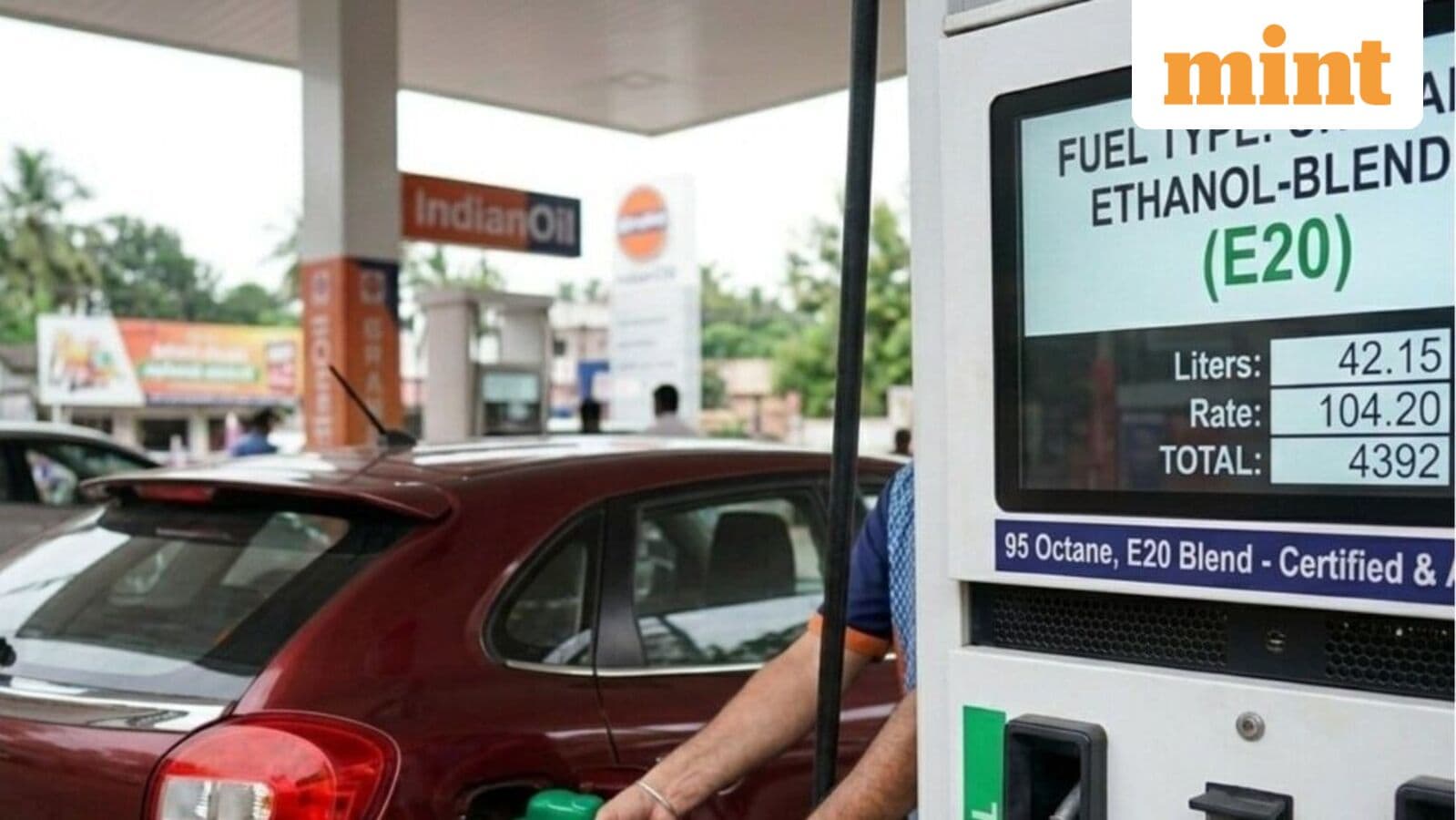
Ministry of Petroleum reassured vehicle owners that Ethanol Blended Petrol does not invalidate insurance claims. Misleading social media claims linking ethanol to pests and vehicle problems are unfounded, with no reported issues since E20 petrol's introduction.Ethanol Blending Programme has helped save the country over ₹1.4 lakh crore in foreign exchangeMinistry of Petroleum and Natural Gas has reassured vehicle owners that the use of Ethanol Blended Petrol (EBP) will not make their insurance claims invalid. "Ethanol blending is a globally accepted practice and is successfully implemented in several countries, including the United States, Brazil, and Japan," the ministry said in an official release.Ethanol Blended Petrol is not sugarcane juiceThe Petroleum Ministry also cautioned against other misleading claims on social media, including sugarcane juice as being mixed directly with petrol. “Such content is misleading and baseless. Ethanol used for fuel blending is produced through established industrial processes and conforms to stringent quality specifications before blending with petrol,” it said.“Ethanol is made from a variety of feedstocks, such as sugarcane juice, molasses, broken rice and maize, but the properties of ethanol are vastly different from the input feed stock as it has undergone a series of processes, including fermentation, which leads to fermentation of the sugars present in the feedstocks,” it added.No sugar in EBPRegarding a recent viral video showing ants near a vehicle fuel tank, the ministry said Bharat Petroleum Corporation Limited (BPCL) clarified that fuel-grade ethanol used for petrol blending is produced through fermentation and distillation processes that eliminate residual sugars from the final product.“Fuel ethanol contains denaturants that are repellent to insects. There is no identifiable attractant associated with E20 fuel that would cause ants or other insects to congregate around vehicle fuel caps. Therefore, claims suggesting a link between E20 fuel and ant attraction have no scientific basis and are not supported by scientific evidence,” it explained.No widespread issues of engine failureOn claims that E20 petrol is affecting vehicle performance and engine failure, the ministry said the government continuously monitors the implementation in consultation with oil marketing companies, automobile manufacturers, fuel testing agencies and other stakeholders.“Since the introduction of E20 petrol, no widespread issues of engine failure or vehicle breakdown attributable to ethanol blending have been reported,” it said.“It is common knowledge that the entry of water into the fuel tank is undesirable for any fuel, whether ethanol blended or otherwise. Modern vehicles are equipped with design features and safeguards to prevent water entry into fuel tanks,” the ministry said.EBP saved ₹1.4 lakh croreThe Petroleum Ministry also said that the Ethanol Blending Programme has helped save the country over ₹1.4 lakh crore in foreign exchange through reduced crude oil imports. The programme has also created sustained demand for agricultural feedstocks used in ethanol production, thereby supporting farmers' incomes and strengthening the rural economy.Ethanol blending plays an important role in enhancing India's energy security, reducing carbon emissions and advancing the country's transition towards cleaner mobility. The Government remains committed to implementing the programme in a safe, transparent and consumer-centric manner, guided by scientific evidence and continuous stakeholder engagement.Get Latest real-time updatesStay updated with the latest Trending, India , World and US news. HomeNewsEthanol blending is safe and globally accepted; use of E20 won’t invalidate vehicle insurance, says govtMore
Political analyst Tehseen Poonawalla questioned the government's fuel policy, and he asked why greater emphasis was not being placed on promoting electric vehicles (EVs) through incentives and discounts.Referring to earlier remarks by Union Minister for Road Transport and Highways, Nitin Gadkari, he noted that petrol blended with ethanol had once been projected to cost as little as ₹15 per litre, but claimed that promise had failed to materialise.He argued that consumers should at least receive discounts on ethanol-blended fuel rather than face high prices for conventional petrol.Raising concerns over the lack of progress on EV adoption, he also questioned the status of the government's EV policy and described the ₹15-per-litre petrol claim as a “jumla.”What was Gadkari's statement?Earlier in July 2023, Gadkari, had said that if an average of 60% ethanol and 40% electricity is taken, then petrol will be available at the rate of ₹15 per litre and the people will benefit.While addressing the public in Pratapgarh, Rajasthan, Gadkari said, “If an average of 60% ethanol and 40% electricity is taken then petrol will be available at the rate of ₹15 per litre and the people will be benefitted. Pollution and import will reduce. The import is of ₹16 Lakh Crores, this money will go to the homes of farmers instead.”India introduced its Ethanol Blended Petrol (EBP) Programme in January 2003 to encourage the use of cleaner transportation fuels, reduce dependence on imported crude oil, and provide a reliable domestic market for ethanol, benefiting sectors such as the sugar industry.The programme initially mandated the sale of petrol blended with 5 per cent ethanol in select states and Union territories.More than two decades after its launch, the ethanol blending programme has made substantial progress. By 2026, India had exceeded its target of achieving 20 per cent ethanol blending in petrol, while the government proposed changes to motor vehicle regulations to facilitate the use of higher ethanol blends, including E85 and E100 fuels.Govt waives excise duty on ethanol-blended petrolEarlier, on June 11, the government had exempted several ethanol-blended petrol variants from excise duty, according to a notification issued by the finance ministry.The exemption applies to E22, E25, E27, and E30 petrol, containing 22 per cent, 25 per cent, 27 per cent, and 30 per cent ethanol, respectively. The notification stated that the excise duty on these fuel variants has been reduced to zero.The measure is intended to promote the adoption of ethanol-blended fuels and encourage consumers to shift away from conventional petrol.The decision comes amid a sharp increase in fuel prices, with petrol and diesel rates rising by nearly ₹7.50 per litre during the latter half of May.Earlier, in March, the government reduced excise duty on petrol and diesel by ₹10 per litre, a move that resulted in an estimated annual revenue loss of more than ₹1 lakh crore. The tax cut was aimed at cushioning consumers from soaring global crude oil prices triggered by the conflict in West Asia.(With inputs from agencies)About the AuthorLivemintFor about a decade, Livemint—News Desk has been a credible source for authentic and timely news, and well-researched analysis on national news, business, personal finance, corporates, politics and geopolitics. We bring the latest updates on all the listed companies on BSE and NSE, startups, mutual funds, Union ministries, geopolitics, and untapped human interest stories from around the world, helping our readers to stay informed on the latest developments around the globe. Our Coverage Areas 1. Companies: Comprehensive news and analysis on listed and unlisted companies, corporate announcements, corporate chatter, C-suite, business trends, hiring alerts, layoffs, work-life balance, world's top billionaires and richest and more. 2. Personal finance: Insights into mutual funds, small savings schemes like - PPF, SSY, post office savings sch


Discussion (0)