
Loading dispatches...
← Return to Newsroomgeneral
What are the three ships with three different strategic roles that Navy is inducting on Sunday
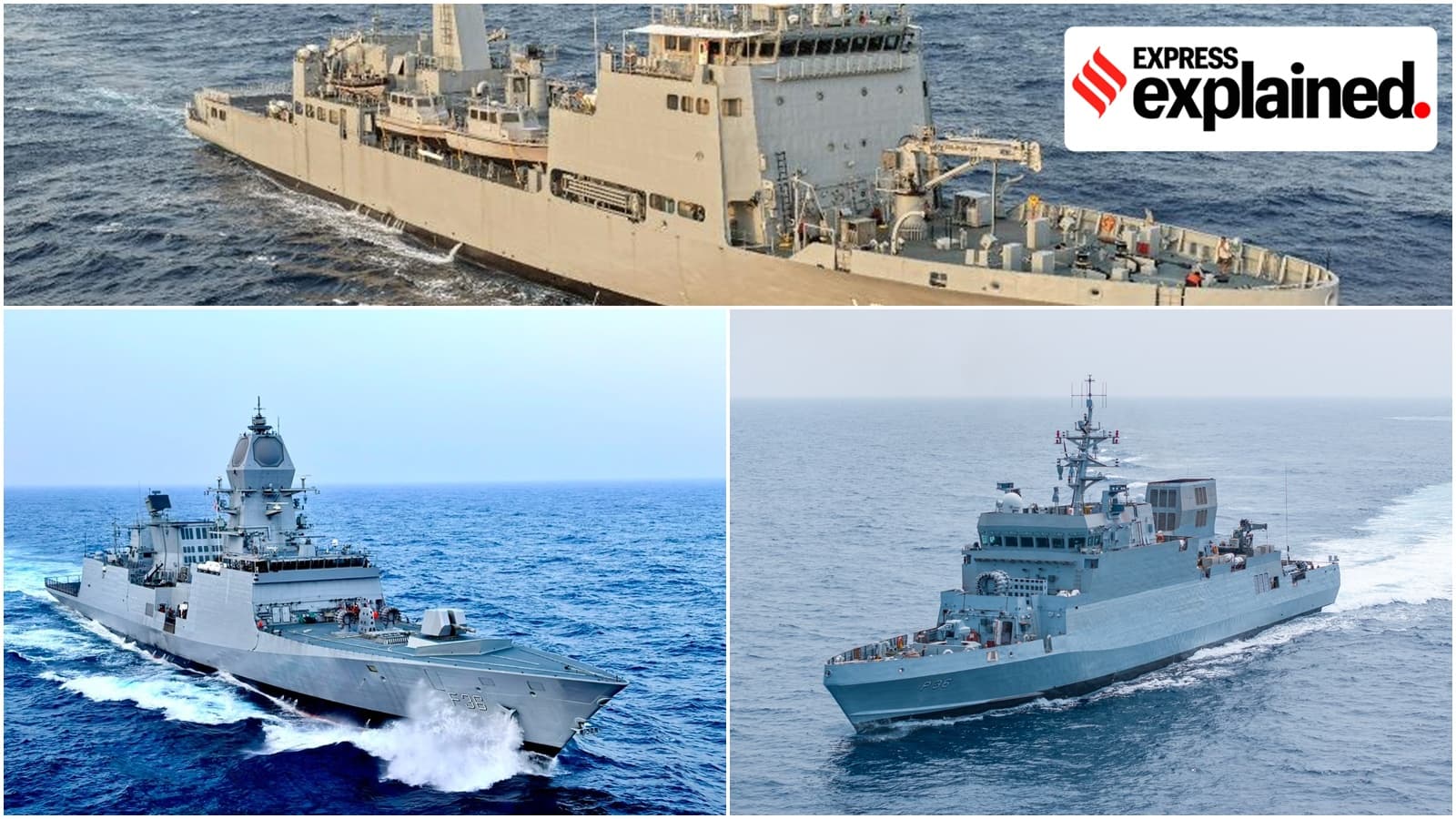
Prime Minister Narendra Modi on Sunday presided over commissioning of three versatile and strategically diverse Indian Naval Ships at Kolkata, including one that can fight far out at sea, one that can map the sea, and one that can hunt submarines close to the coast.In the last yearp-and-a-half, the Indian Navy has seen a steady run of new inductions with over a dozen seagoing platforms having been commissioned since January 2025 — from destroyers and frigates to submarines, survey ships, anti-submarine craft and varied specialist support vessels.The three vessels — Brahmos-armed stealth frigate INS Dunagiri, deep water survey vessel INS Sanshodhak, and submarine hunter Arnala-class Anti-Submarine Warfare Shallow Water Craft (ASW SWC) INS Agray — have been built by Garden Reach Shipbuilders & Engineers (GRSE) in Kolkata. The Ministry of Defence has said that the three together have more than 75 per cent indigenous content and involve over 200 MSMEs. Here is a closer look at why this ‘tri-commissioning’ — as the navy has called it — is significant and why these three platforms are crucial. What are these three ships? INS Dunagiri: The largest and most heavily armed of the three is INS Dunagiri. It is a frigate, which is a medium-to-large warship. In simple terms, a frigate is smaller than a destroyer but large enough to operate far from the coast, escort bigger ships, launch missiles, defend itself against adversary aircraft and missiles and hunt submarines. Dunagiri is about 149 metres long, roughly one-and-a-half football fields, and displaces about 6,670 tonnes. It can sail at about 28 knots, or nearly 52 kilometers per hour. It is part of the Navy’s Project 17A — the Nilgiri-class stealth frigates. Project 17A is the Navy’s programme to build a new generation of stealth guided-missile frigates in India. The ‘stealth’ here does not connote complete invisibility, but means that it is harder to detect on radar and other sensors. This guided-missile ship carries modern missiles that can be directed towards targets at sea or in the air. Dunagiri carries weapons such as BrahMos surface-to-surface missiles and a medium-range surface-to-air missile (MRSAM) system, along with sensors including Multi-Function Surveillance, Track And Guidance Radar (MFSTAR), sonar, electronic warfare systems and anti-submarine weapons. Project 17A is a follow-on of the Shivalik class or Project 17 frigates active in service. “At the strategic level, these multi-mission frigates are capable of operating in a ‘blue water’ environment — deep sea far from shore — dealing with both conventional and non-conventional threats.” A serving Navy officer said. The newly designed class of ships are also being built using ‘integrated construction’ philosophy, which involves extensive pre-outfitting at the block stages to reduce the overall building periods. These ships can play a crucial role in anti surface warfare, anti-air warfare and anti submarine warfare, with their versatile weapons and capabilities. Other vessels in the class are INS Nigiri, Himgiri, Taragiri, Udaygiri and Vindhyagiri.Story continues below this ad INS Sanshodhak: The second vessel being commissioned, INS Sanshodhak, is not meant to fight in the same way. It is a Survey Vessel — Large (SVL). Its job is to measure and map the sea: the depth of waters, seabed features, approach channels to ports, navigational routes, and oceanographic data. Sanshodhak is about 110 metres long, roughly the length of a football field, and has a displacement of around 3,300 tonnes. It has a top speed of about 18 knots, or around 33 kmph. It is equipped with systems such as autonomous underwater vehicles, remotely operated vehicles and multi-beam echo sounders. These help the ship collect data from the surface and underwater. A survey ship may appear less dramatic than a missile-armed frigate, but it performs a foundational military role. “Warships and submarines do not operate in an empty blue space. They move thr



Discussion (0)