
Loading dispatches...
← Return to Newsroomgeneral
Ranveer Singh shares a message as Dhurandhar releases in Japan, eyes RRRs Rs 139 cr record

MumbaiUpdated: Jul 2, 2026 11:57 AM IST Dhurandhar will be releasing in Japan on July 10. After setting the box office on fire, Aditya Dhar’s Dhurandhar is now gearing up for its theatrical release in Japan on July 10. Announcing the release, Ranveer Singh recorded a special message for Japanese audiences, highlighting the film’s scale and cinematic experience. “A warm hello to everyone in Japan. Dhurandhar will be releasing in Japan, bringing with it an immersive cinematic experience packed with drama, intensity, scale, emotion and storytelling at its thrilling best. I warmly invite you to come and experience the biggest Indian movie of all time on the big screen. Lots and lots of love, and I hope to see you at the movies,” he said.Highest grossing Indian movies in Japan Over the past few years, Japan has emerged as a key overseas market for Indian cinema, with several Indian films enjoying successful theatrical runs. According to industry tracker Sacnilk, the highest-grossing Indian film in Japan remains RRR, which earned an impressive ¥2.42 billion (Rs 139.79 crore), making it the first and only Indian film to cross the ¥2 billion mark in the country. The second-highest spot is held by Rajinikanth’s Muthu, which collected ¥405 million (Rs 23.39 crore), followed by Prabhas’ Baahubali 2: The Conclusion with ¥305 million (Rs 17.61 crore), Aamir Khan’s 3 Idiots with ¥170 million (Rs 9.81 crore), and Sridevi’s English Vinglish with ¥160 million (Rs 9.24 crore). Other Indian films that performed well in Japan include The Lunchbox (¥150 million/Rs 8.66 crore), Saaho (¥131 million/Rs 7.56 crore), Magadheera (¥130.1 million/Rs 7.51 crore), Enthiran (Robot) (¥109.6 million/Rs 6.4 crore), and Pushpa 2: The Rule (¥106 million/Rs 6.2 crore). About Dhurandhar Released in India last December, Dhurandhar went on to become a massive box office success, grossing Rs 1,307.35 crore worldwide. Of this, the film earned Rs 1,007.85 crore in India alone. The film features an ensemble cast led by Ranveer Singh alongside Akshaye Khanna, Sanjay Dutt, R. Madhavan, Arjun Rampal, Rakesh Bedi and Sara Arjun. It follows the journey of an Indian spy who infiltrates terror networks in Pakistan while carrying out a high-stakes mission.
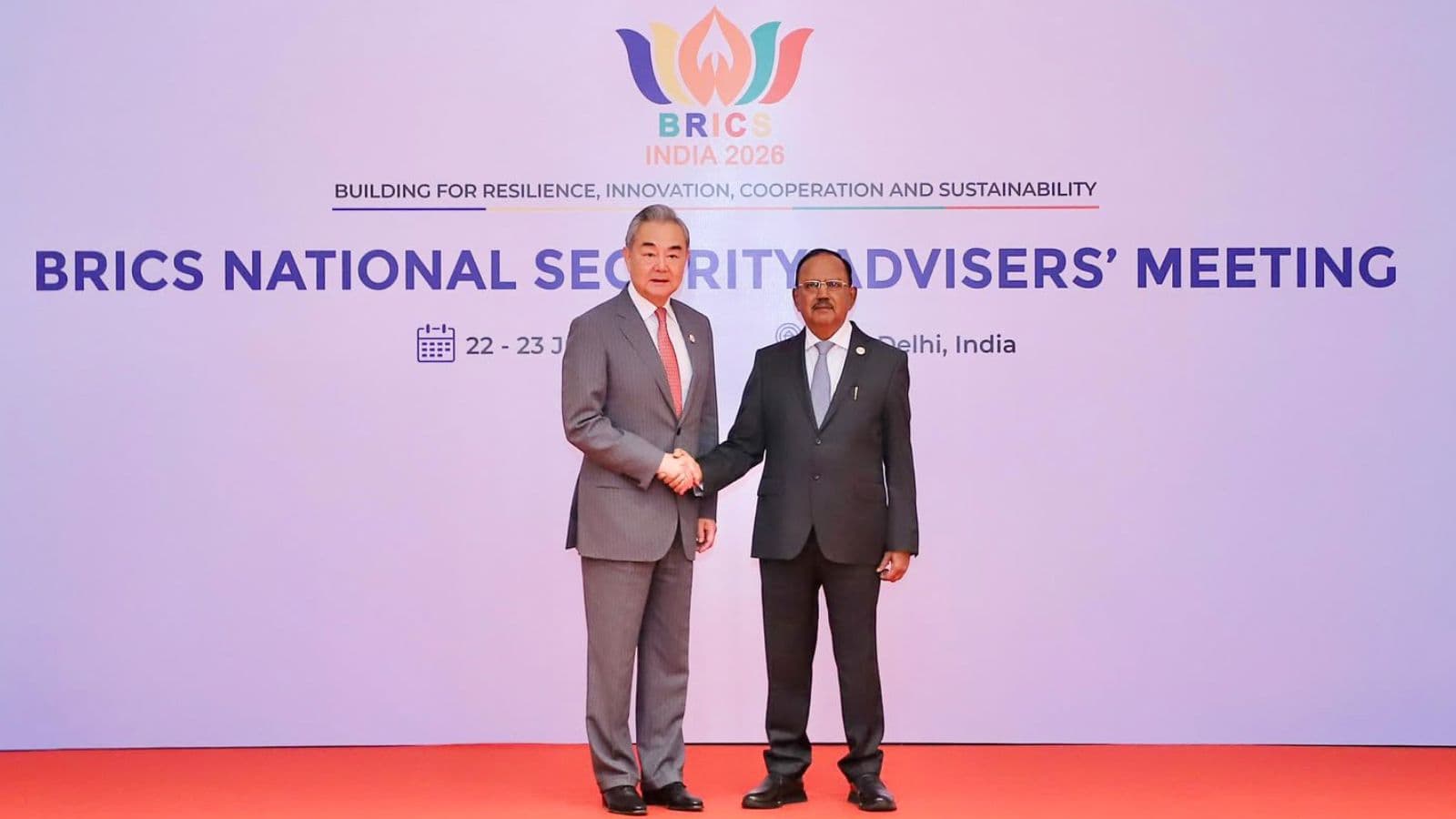
National Security Advisor (NSA) Ajit Doval with Foreign Minister of the People's Republic of China Wang Yi at the 16th BRICS National Security Advisers' Meeting. (ANI Photo) 3 min readJun 26, 2026 06:20 AM IST First published on: Jun 26, 2026 at 06:20 AM IST On June 22, NSA Ajit Doval met Chinese Foreign Minister Wang Yi on the sidelines of the 16th BRICS NSA meeting in New Delhi. The divergences in worldviews were hard to miss. Delhi spoke of “stable, predictable and constructive bilateral relations” and “gradual normalisation” since Galwan. Beijing, by contrast, scaled the same meeting up to a “Global South” moment: Wang declared that “the Global South, including China and India, is collectively rising”, and that the two countries must “accelerate the modernisation process of the Global South” together. Five days earlier, that exact vocabulary had been packaged into China’s new White Paper on global governance. The White Paper articulates three approaches to the Global South. First is its revitalisation of an idea that a Global South that excludes China is a pseudo-proposition. Second is its emphasis on China’s “win-win” and “harmonious” approach to the perceived grouping. Third is its usurpation of Delhi’s preferred metaphor on acting as a bridge between the “Global North” and the “Global South”. Only, the White Paper frames it as China seeking to “synergise” North-South cooperation.China has viewed India and the West as promoters of exclusive blocs that undermine its Global South identity. The White Paper’s most prominent thesis formalises that proposition — “China will always be a member of the Global South.” It contends that the monopolisation of international affairs by “a small number of countries” is no longer acceptable to Beijing, and so it will emerge as the force promoting inclusion and accessibility for the economies of this perceived grouping. India’s decision to conduct three “Voice of Global South Summits” without China’s participation has irked Beijing the most. It was right before the second summit that Global Times popularised the idea that such a summit without China was a pseudo-proposition. Through the White Paper, Beijing attempts to set itself apart in its approach to the Global South by calling for “win-win cooperation,” pitting it against the West’s, or even India’s, “opportunism”. The example Chinese analysts like retired PLA officer Zhou Bo have cited is Delhi wrangling with Colombo to halt the docking of Chinese vessels at Sri Lanka’s ports. Zhou argued in 2024 that while India “forced [Sri Lanka’s] government to ban Chinese ships”, China welcomed it into BRICS and the SCO. In his conception, that India is an equal in BRICS, or that it acted in its national interest when dealing with Colombo, are unacceptable realities. Zhou also advanced the framing that India and China should function as “Global South anchors”, not power competitors. That has now travelled from a retired PLA officer’s op-ed to Wang Yi’s talking points. The precedent, however, as evident from Sri Lanka’s debt restructuring around Hambantota or the suspension of the BRI-financed CPEC’s signature projects under fiscal stress in Pakistan, does not reflect the conduct of the magnanimous actor that China presents itself as. Delhi’s goal should hence be not to compete with Beijing’s rhetoric word-for-word, but to showcase its empirical record in Global South fora. The writer is staff research analyst, geostrategy programme, Takshashila Institution
Rongbin Han’s recently released Make China Great Again: Online Alt-History Fiction and Popular Authoritarianism is an excellent book that examines the workings of historical imagination in China’s present-day digital landscape.After carefully analysing web novels, he demonstrates that alternate history has become one of the most popular genres in China’s online fiction landscape, in which protagonists travel back in time to intervene at pivotal moments in Chinese history. Narratives in these novels are not just imaginative entertainment but a unique cultural field in which one can feel the constant reinvention of the Chinese nation and its collective aspirations. Han argues that the alt-history fiction in Chinese culture operates through a process of explicit historical divergence in that the characters go back in time and change key outcomes in history, creating alternative trajectories for the Chinese nation. However, the underlying narrative structure remains similar whether in the form of imperial China’s imagined industrial modernisation, the occurrence of a communist revolution in a much earlier period, or the making of China into a capitalist country. In such a retelling, history is treated as malleable and national decline is reconfigured into a problem that could and should be technically and politically fixed. There is a desire for “counterfactual repair” of history, which also resonates with the dominant state narratives of national rejuvenation and with widespread yearning for China’s greater global visibility and power. The rise of ‘pop hegemony’ and state-sponsored nationalism What stands out in this emerging genre is that it is not blatantly propagandist in nature, yet finds common ground with state-sponsored nationalist discourses. Han shows that even the most radical and institutionally challenging aspects of these narratives echo official accounts of national rejuvenation. The legitimacy of the Communist Party is hardly ever contested. On the contrary, it gets strengthened by imaginative enactment of alternative routes to Chinese greatness. In this sense, this alt-history fiction is a site of popular creativity interspersed with state-defined nationalism. Han stresses that these stories are not subversive or anti-establishment. Instead, they often stabilise political imagination by reducing historical complexity into actionable clarity. The intelligible causal chains take the place of structural failures, contingency and randomness, with informed agents able to alter the course of history. Since many Chinese believe that national revival is imminent under the leadership of the Communist Party, they willingly tolerate authoritarian rule. Entertainment and popular culture foster public consent or “pop hegemony” by making authoritarian rule appear appealing through narratives of national revival. At this level, one may find an interesting parallel with the recent two-part Hindi blockbuster Dhurandhar. While the political and cultural contexts are certainly different, there still lies in Dhurandhar a version of a similar narrative. It does not seek any displacement in time or a literal alternate history. Instead, it creates what can be termed “the parallel present,” a re-imagination of what happens in the present world, but in a far more strategic fashion than the actual world out there. From Chinese web novels to ‘Dhurandhar’: Mapping the ‘parallel present’ Unlike standard alt-history narratives, which have an obvious departure from known histories, the divergence in Dhurandhar is implicit and structural. A shift in the past does not change the present; rather, it is a reorganisation of the presentation of causality itself. Geopolitical situations, which include intelligence operations, tensions with neighbouring countries and internal bureaucratic bargaining, are streamlined into linear and legible sequences. This creates a compressed picture featuring more causal agency and predictability than is actually the



Discussion (0)