
Loading dispatches...
← Return to NewsroomScience
Scientists create largest 2D map of the universe with 5.6 trillion pixels and nearly 4 billion cosmic objects
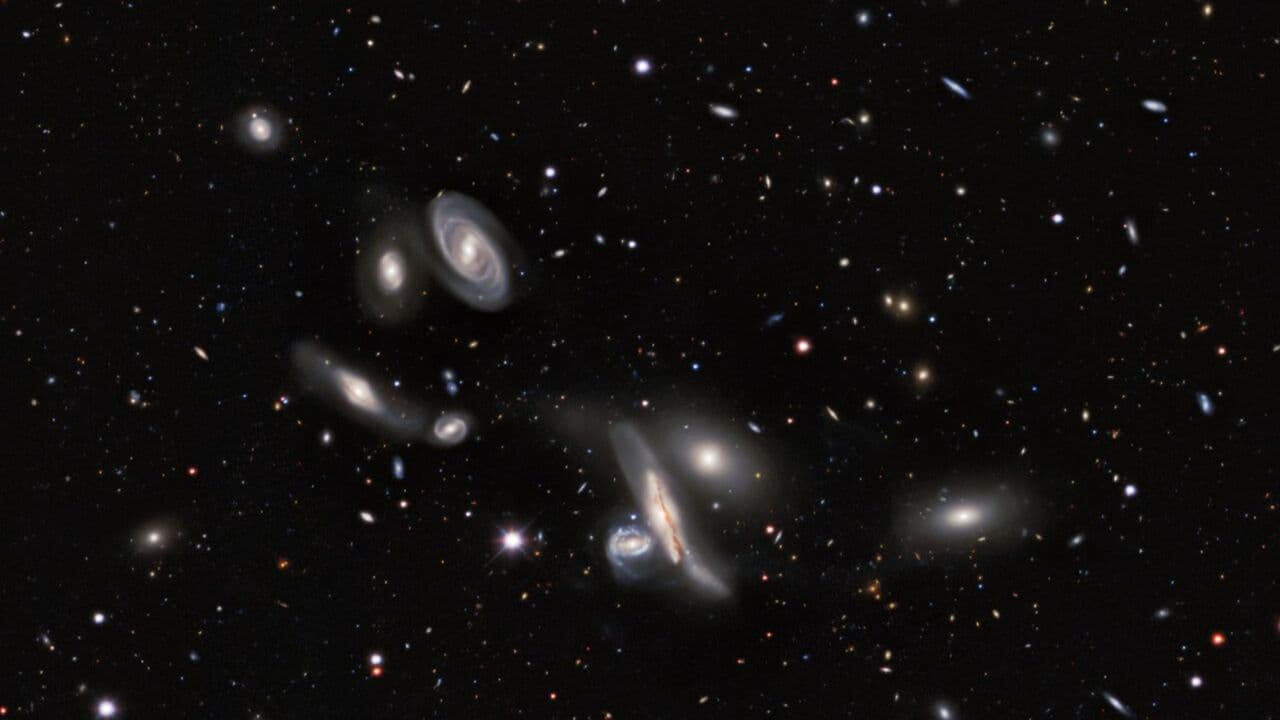
A group of galaxies nicknamed the Copeland Septet, in the constellation of Leo. This is part of a huge map of the universe. (The new map, created by the Dark Energy Spectroscopic Instrument (DESI) Legacy Imaging Surveys team, contains a staggering 5.6 trillion pixels and combines more than 263,000 telescope exposures collected over more than a decade. The observations span visible and near-infrared wavelengths, providing an enormous portrait of stars, galaxies and other cosmic phenomena across the sky, according to a statement from the National Science Foundation (NSF) NOIRLab. (You can explore the full data here.)"It's part of the fabric of astronomy research now," David Schlegel, co-lead of the Legacy Surveys and a scientist at the U.S. Department of Energy's Lawrence Berkeley National Laboratory, said in the statement. "When you're working with astronomical objects today, you often start by pulling up the Legacy Imaging Viewer to see what you're looking at."The latest 2D cosmic map represents the culmination of 13 years of observations and data processing. The Legacy Imaging Surveys were originally designed to help DESI determine where to point its thousands of robotic optical fibers, essentially creating the 2D foundation for DESI's much larger effort to map the universe in three dimensions.Installed on the Nicholas U. Mayall 4-meter Telescope at Kitt Peak National Observatory in Arizona, DESI measures the spectra of galaxies and quasars. By determining their redshifts — how much their light has been stretched as the universe expands — astronomers can calculate their distances and transform a flat view of the sky into a 3D map of the cosmos.DESI began its main survey in 2021 with the goal of tracing how the universe has expanded over billions of years and, in turn, helping scientists better understand dark energy, the mysterious phenomenon thought to be driving that expansion.The project has since far surpassed its original targets. By April 2026, DESI had mapped more than 47 million galaxies and quasars, creating the largest high-resolution 3D map of the universe to date. Previous DESI results have also provided intriguing evidence that dark energy may evolve over time rather than remain constant, as predicted by the standard model of cosmology. Among the nearly four billion objects in the DESI Legacy Imaging Surveys' map is Messier 96 (NGC 3368), a majestic spiral galaxy nestled in the constellation Leo approximately 35 million light-years from Earth. ( Earlier this year, astronomers with the Hobby-Eberly Telescope Dark Energy Experiment (HETDEX) created a different kind of 3D map using faint Lyman-alpha emission from hydrogen between galaxies. That effort illuminated previously hidden structures dating to between 9 billion and 11 billion years ago, when the universe was experiencing a peak in star formation.The new Legacy Imaging Surveys map, meanwhile, will have uses well beyond DESI. Previous versions of the dataset have already been referenced in more than 1,800 scientific papers, while the latest release could help astronomers search for rare objects and phenomena, study galaxy evolution and train artificial intelligence systems to analyze the enormous volumes of data expected from next-generation observatories."Explorations of our universe always start with images of the night sky. The DESI Imaging Legacy Surveys are just one step in this venerable human tradition," Arjun Dey, co-lead of the Legacy Imaging Surveys and an astronomer at NSF NOIRLab, said in the statement. "For our team, these data are
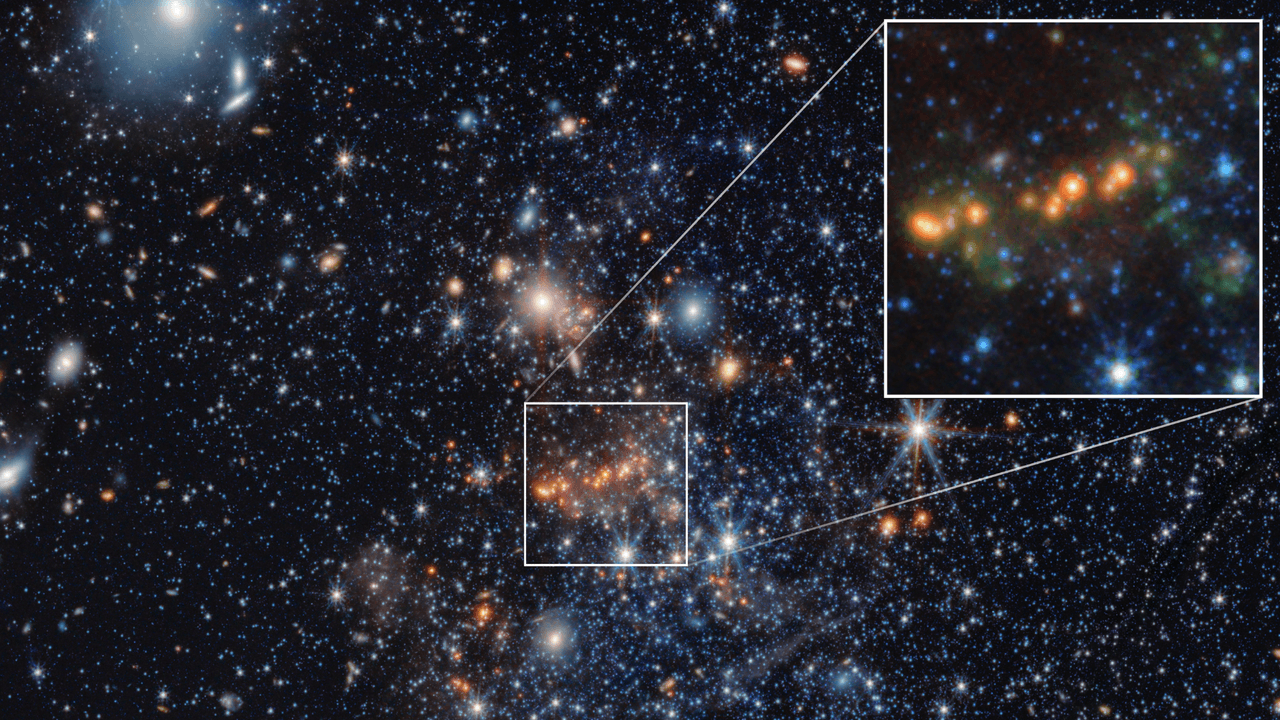
The dwarf galaxy Sextans A observed by the James Webb Space Telescope. ( Image processing: Alyssa Pagan (STScI).) Using the James Webb Space Telescope (JWST), astronomers have discovered the secrets of early galaxies that pumped the infant cosmos full of dust, which would become vital for the birth of new stars and the growth of galaxies.However, while the JWST is powerful enough to see many of these early galaxies, it is still limited when it comes to delving into them in great detail. So, the team at the heart of this research worked around this by studying a much closer and more modern galaxy with many characteristics that resemble the universe's first galaxies.In lieu of being able to study the processes that occurred in the early universe that allowed galaxies to be seeded with "metals, (the term astronomers use to describe elements heavier than hydrogen and helium), the researchers turned their attention to a dwarf galaxy just 4.6 million light-years away."Directly studying the galaxies that populated the early universe is still very difficult, which is why observing a nearby galaxy like Sextans A, which presents similar chemical conditions, offers us a precious opportunity to understand how the first generations of stars evolved and what role they played in transforming the interstellar medium," team leader Claudio Gavetti of the National Institute for Astrophysics (INAF) said in a statement.How does Sextans A impersonate ancient galaxies?The early universe was a pretty dull place in terms of chemistry. That is because it was dominated by the lightest element, hydrogen, with some helium and a tiny smattering of heavy elements, or metals. That means that the first generation of stars, so-called POP III stars, were correspondingly metal-poor.During their lives, however, POP III stars fused hydrogen and helium in their cores to forge heavier elements. When these original stars reached the ends of their lives, they exploded in supernova explosions that dispersed these metals into the interstellar medium, the vast clouds of dust and gas between stars.Eventually, dense and cool patches in these vast clouds collapsed under their own gravity, birthing the next generation of stars, POP II stars, which, thanks to the supernova deaths of their predecessors, were richer in metals. The dwarf galaxy Sextans A observed by the James Webb Space Telescope. ( Image processing: Alyssa Pagan (STScI).)Our own star, the sun, is classed as a POP I star, meaning it is even richer in metals than these second-generation stars. However, not all modern galaxies are so metal-rich; this is especially true for dwarf galaxies like Sextans A, even though it lies at the outer edge of our cosmic backyard, known as the "local group."Sextans A is so metal-poor that it is estimated to contain only between 1% and 7% of the heavy elements found in the sun. That makes it a great proxy for the study of metal-poor early galaxies.Using the JWST's NIRCam (Near-InfraRed Camera) and MIRI (Mid-Infrared Instrument) instruments, Gavetti and colleagues obtained high-resolution observations of Sextans A that allowed them to map the dwarf galaxy's entire population of stars during an evolutionary phase known as the "asymptotic red giant branch."This phase occurs when stars larger than the sun exhaust helium in their cores, creating an inert carbon heart, but nuclear fusion continues in outer alternating helium- and hydrogen-burning layers. These stars "puff out" as a result of this and can undergo thousandfold increases in brightness. An image of the galaxy Sextans A where Red indicates the infrared emission of dust, blue the emission of atomic hydrogen gas, and green the far-ultraviolet emission created by newly formed stars. (
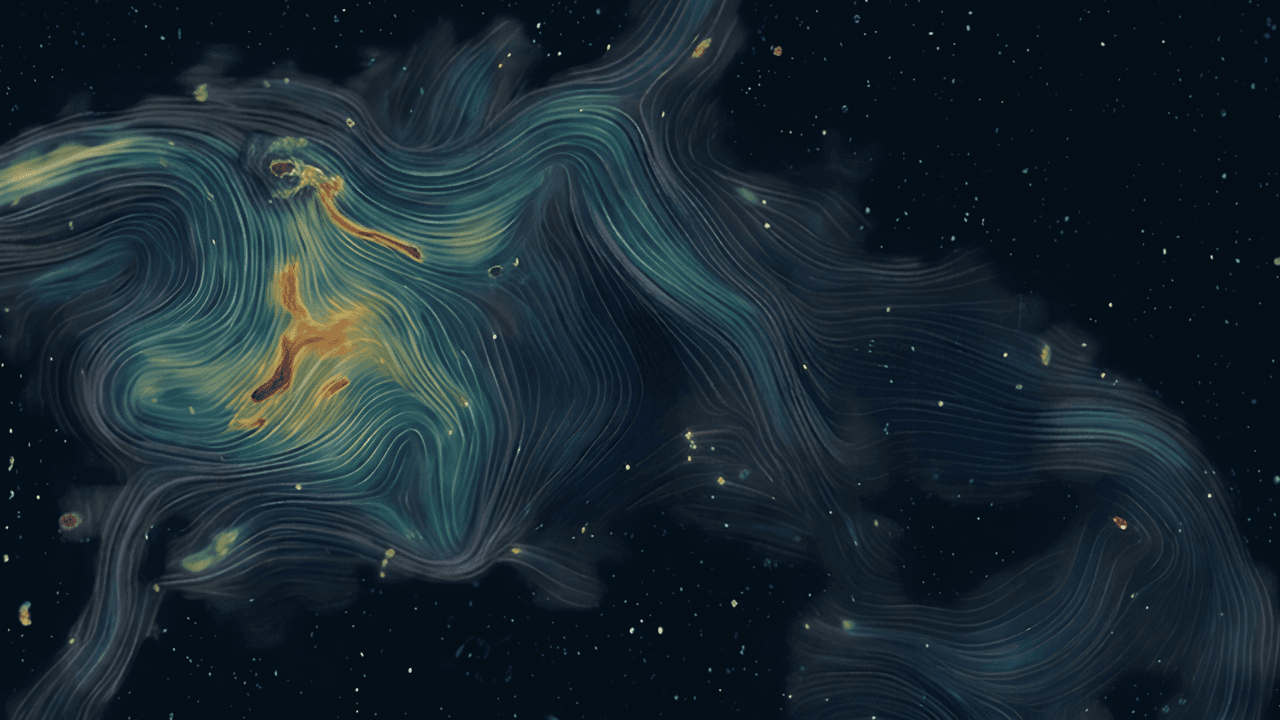
The invisible texture of the magnetic field in the central region of the galaxy cluster Abell 2255. ( Botteon et al. (INAF), A&A 2026) For the first time, astronomers have reconstructed the magnetic field of an entire cluster of galaxies, from its central nucleus to its outer limits.The record-breaking achievement is the product of the deepest-ever observations of the galaxy cluster Abell 2255, located around a billion light-years away — and those observations are thanks to the European radio telescope LOFAR (Low Frequency Array).Abell 2255 has long been known for its complexity in radio waves. Its vast, diffuse radio emissions are created by particles called electrons racing at near-light, or relativistic, speeds and interacting with magnetic fields of galaxies in the cluster. Thus, using Abell 2255 as a cosmic laboratory to study the universe in radio waves could lead scientists to a better understanding of how magnetic fields come about and evolve. These observations could also help paint a picture of the dynamics of hot gas in galaxy clusters. This could reveal how the largest structures in the universe are constructed.As part of the LOFAR Galaxy Cluster Ultra-Deep Field project, this team used 224 hours of radio image collection to discover that the distribution of large-scale magnetic fields throughout Abell 2255 (which itself stretches out for several million light-years) are not randomly distributed. Instead, these magnetic fields seem to be organized by the motion of gas that occurred during the formation of this galactic cluster."Obtaining very sensitive images of galaxy clusters at radio wavelengths is crucial to understanding how electrons are accelerated to relativistic speeds and magnetic fields are amplified on large cosmic scales," team leader Andrea Botteon, of the Italian National Institute for Astrophysics (INAF), said in a statement. "The complexity of these studies is due to the elusiveness of the radio signal from electrons moving in very weak magnetic fields. We believe that the mechanism that 'turns on' these gigantic radio emissions is linked to the formation process of galaxy clusters."Botteon added that for this research he and his colleagues combined the deepest radio observations ever made with an innovative data analysis technique that allowed them to reconstruct the shape of a galaxy cluster's magnetic field for the first time. "The coherence of the magnetic field lines observed in some regions of the cluster suggests that the morphology of the field is intimately linked to the dynamics of the gas in which it resides, where it can be 'stretched' or 'compressed' by the motions associated with the formation of the cluster itself," Botteon said. The invisible texture of the magnetic field in the central region of the galaxy cluster Abell 2255. ( Botteon et al. (INAF), A&A 2026)This analysis revealed that, in some regions, the magnetic fields follow very specific directions, stretching radially along extended radio emissions. In contrast to this, in regions dominated by shock waves, magnetic fields are orientated at tangents. This suggests magnetic fields in Abell 2255 are carved out by the same dynamics that allow clusters to accrete gas and grow. This serves as the first observational evidence that the same mechanisms that allow galaxies to grow and cluster, creating the largest structures in the universe, also shape their magnetic fields.The team's research has been accepted for publication in the journal Astronomy & Astrophysics and is available as a pre-peer-reviewed paper on the repository site arXiv. Robert Lea is a science journalist in the U.K. whose articles have been published in Physics World, New Scientist, Astronomy Magazine, All About Space, Newsweek and ZME Science. He also writes about science communication for Elsevier and the European Journal of Physics. Rob holds a bachelor of science degree in physics and astronomy from the U.K.’s Open Universit
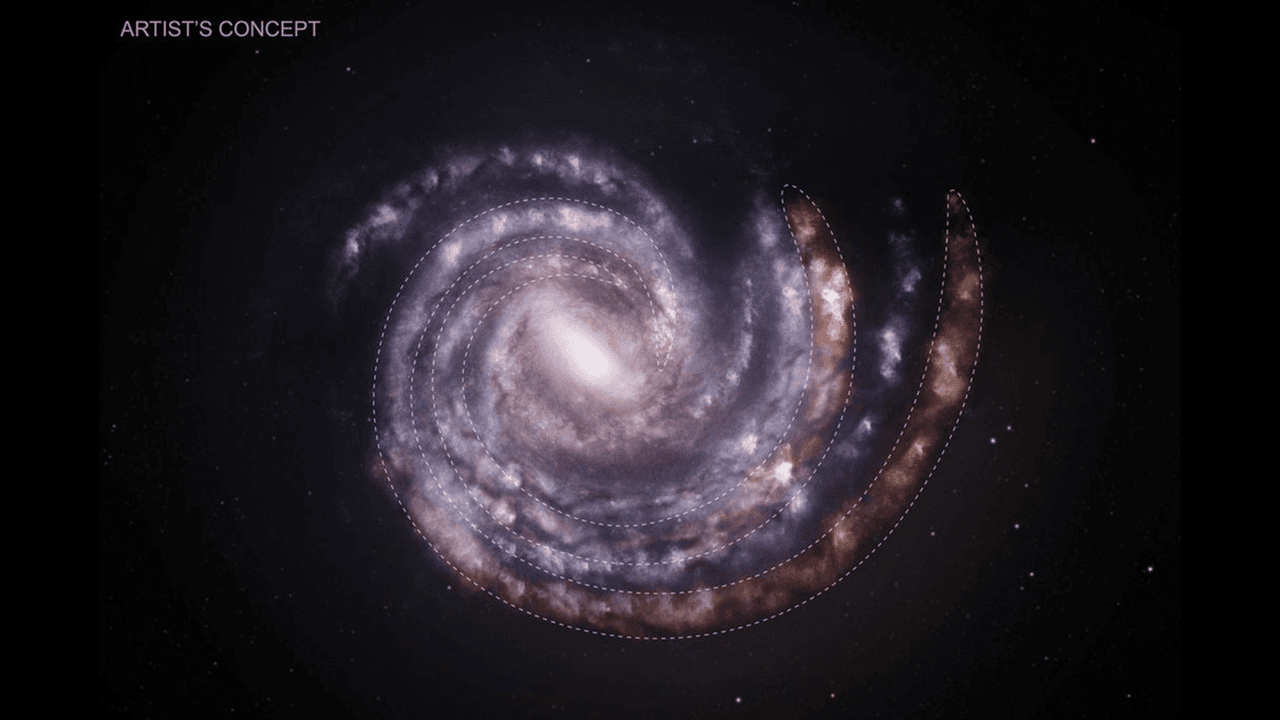
(Weiss) Is the Milky Way even bigger than we thought? New observations have revealed that our galaxy's spiral arms could stretch farther and wider than we previously concluded.The Milky Way's spiral structure was discovered over 175 years ago in 1850. But new information could completely change our understanding of our cosmic home. Astronomers have taken a new look at our Milky Way galaxy using data from NASA's Chandra X-ray observatory and the European Space Agency's XMM-Newton observatory and have pieced together new, precise measurements of the galaxy's spiral arms. And what they found is that its spiral arms stretch out farther than we once thought, a discovery that could change our understanding of our galaxy's structure."The differences are small, but any revision of these distances is important because they are so fundamental for understanding our galaxy," co-author Ilaria Fornasiero said in a statement. "For example, this could mean that astronomers have to revise estimates of the mass of the galaxy, because that affects how wide the arms stretch."To make this new galactic measurement, researchers had to get a little creative with the data. They measured these cosmic distances by observing X-ray light scattered by the dust in the Milky Way's arms as it echoed out from around gamma-ray bursts, or the most powerful explosions across the universe that happen either when massive stars collapse or neutron stars collide and merge. These massive bursts of energy are happening far beyond our galaxy, but their X-ray light is so powerful that it can reach and bounce off of dust clouds in the Milky Way's arms. This artist's concept shows where the Milky Way's spiral arms are now thought to extend to and how that compares to previous estimations. (Weiss)By studying the diameters of the rings of light as they expand away from these explosions and observing how and where they reflect off of the Milky Way's dust, the team was able to precisely point to where the galaxy's arms extend."This is a very direct way – relying only on geometry – to precisely measure distances to the Milky Way's spiral arms," lead author Beatrice Vaia, who led this research as a PhD student, said in the statement. "Most other methods rely on assumptions about how the Milky Way rotates, which become increasingly uncertain in the outer regions of our galaxy."The team used the X-ray light from three different gamma-ray bursts to look at three of the Milky Way's spiral arms: the Perseus, the Outer, and the Outer-Scutum-Centaurus arms. According to these new measurements, both the Outer and the Outer Scutum-Centaurus arms are about ten percent more distant than was previously thought.With this data, the team was also able to measure the thickness of the Milky Way's most distant arm, which they found to be about 3,500 light-years wide. By incorporating the arm's width, the team ensured that they were measuring the full extension of the arm and not just one particular dust cloud, further bolstering their findings. This composite image shows X-ray rings created by a gamma-ray burst bouncing off of the dust clouds in the spiral arms of the Milky Way galaxy. ( Vaia et al.; Optical: Pan-STARRS; Image processing: NASA/CXC/SAO/N.Wolk & P.Edmonds)While it's interesting that the Milky Way's arms extend out a bit farther and wider than we previously thought, these new findings could have larger implications. Based on these new measurements, astronomers may have to reinvestigate our understanding of our galaxy's mass distribution, rotation and overall structure. This evolving understanding could ripple out and impact how we view not just the structure but the evolution of our galaxy and beyond.But this study isn't one that can be replicated too easily. That's because gamma-ray bursts don't happen all of the time. Even more rare are bursts that we can see clearly through our galax
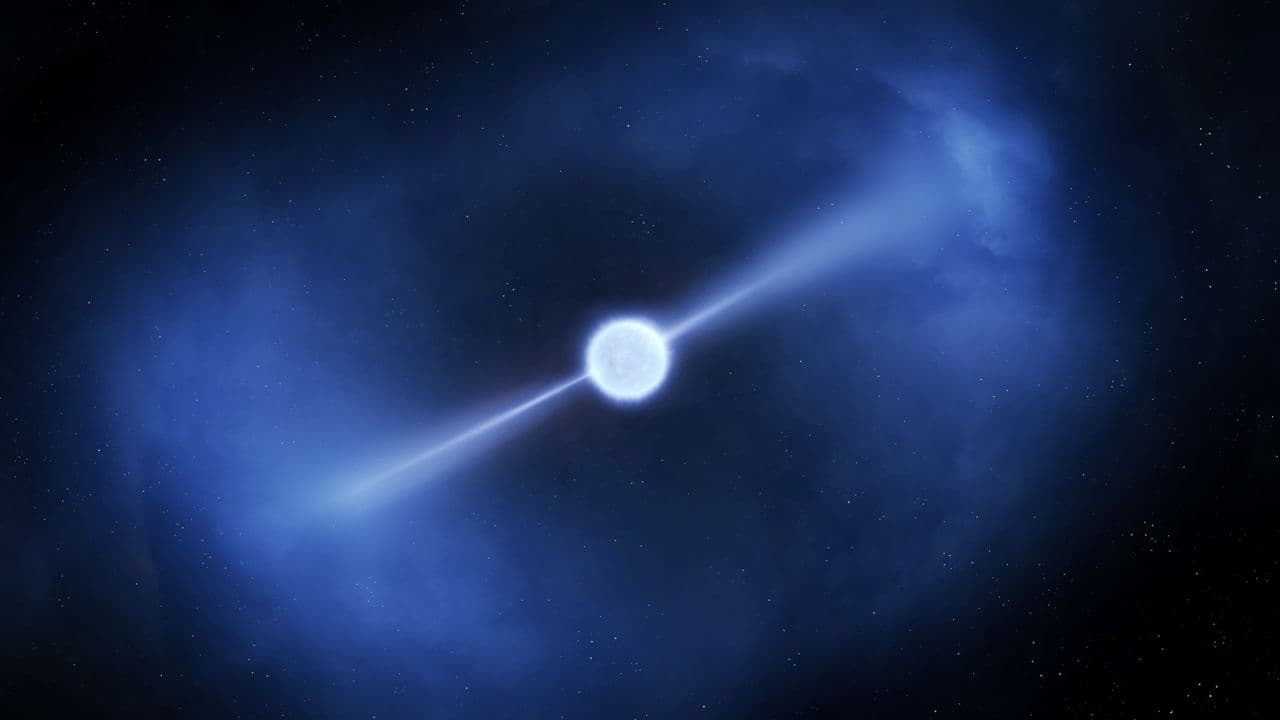
An artist's depiction of a pulsar emitting radio waves. ( The discovery raises the prospect that there could be many more pulsars in our galaxy than we thought.When a massive star explodes as a supernova, the devastation leads to the star's core collapsing under its own gravity to form either a neutron star or a black hole. When a neutron star is formed, it is born spinning and its magnetic field is usually powerful enough to whip up charged particles and beam them away in a jet moving at close to the speed of light. This jet emits radio waves, and as the neutron star spins we see this radio jet flashing in our direction. This makes it seem like the neutron star is pulsing, hence we call it a pulsar.Puzzlingly, not all neutron stars at the center of supernova remnants are pulsars. About a dozen discovered so far have been dead quiet in radio waves, and astronomers call these quiet neutron stars 'central compact objects', or CCOs. One possible explanation for CCOs is that their magnetic fields are too weak to produce detectable radio jets. For decades, astronomers have tuned into them, finding only radio silence — until now.A team led by Zhang Lei of the National Astronomical Observatories of the Chinese Academy of Sciences tuned into one particular CCO, named 1E 1207.4-5209 with the MeerKAT radio telescope in South Africa. They discovered that the CCO is pulsing with radio waves after all, but very faintly, once every 424 milliseconds. This matches the known spin period of the pulsar – it's a veritable whirling dervish.Found at the center of a supernova found 10,000 light years away within our Milky Way galaxy, 1E 1207.4-5209 has been nicknamed the "Blue Eye Pulsar" by Li Di, a professor of astronomy at Tsinghua University in China. Its name is a virtue of the fact that when the faint radio emission is combined with X-ray images that show the neutron star shining brightly, it looks like a blue eye.The Blue Eye Pulsar has an intriguing history. The supernova that formed it exploded over 4,100 years ago. In 2015, X-ray observations noted that the pulsar had experienced a 'spin glitch', which is a small increase in rotation of a neutron star probably caused by some kind of disruption or shifting of material within the neutron star's dense interior.Lei's team propose that this glitch either strengthened or reoriented, or both, the magnetic field of the Blue Eye Pulsar sufficiently to trigger radio emissions, or at least make feeble radio waves that were already there detectable.Following a glitch, a neutron star's rotation rate gradually slows back down to its original rate, at which point we might expect the Blue Eye Pulsar's radio emission to switch back off. Lei's team suggests that continued monitoring of the Blue Eye Pulsar could answer this question. The Blue Eye Pulsar presented in the style of the classic painting "Five Horses" from the Song dynasty, back to which the first complete human record of a supernova explosion dates. ()If that answer is what Lei's team think it to be, then it could mean that there is a large population of very feeble pulsars that remain undetected in the galaxy. Old pulsars, which persist long after the supernova remnant they were born in has dissipated, are also fairly quiet radio emitters because they are slowing their spin rate over time. However, it is possible that we have misidentified some of these pulsars as being old when they could in fact be relatively young but softly radio emitting.The findings may also explain why some supernova remnants seem to be missing pulsars. Key among them is the expanding cloud of debris formed from the explosion of supernova 1987A in the Large Magellanic Cloud. Altho
This Pococo Galaxy star projector boasts swappable disks, which are reasonably priced. ( I still don't have an answer. It started with a blue, Northern-Lights style projector, then one capable of projecting actual stars, albeit not in the right color. Now I'm eyeing up these Prime Day star projector deals, finger over the 'Buy Now' button, and I'm inviting you to join me.Not all star projectors are the same, mind you; some are there purely to create a relaxing display, aiding meditation or lulling a child to sleep. Meanwhile, others are more scientifically accurate, designed to educate rather than relax. It's a sad fact that, thanks to light pollution, the displays these projectors put out can be prettier and clearer than the ones you'll see in your own back garden.Chris is a freelance journalist who, when not writing, skywatching, playing games or building Lego, indulges his taste for horror, sci-fi and the post-apocalyptic. As well as Space.com, you can find his work at GameSpew (where he’s the weekend editor).Check out our Prime Day hub, where we bring you the best deals of Prime Day 2026, including early Prime Day deals. We've also got you covered with reviews and rankings of the best telescopes, binoculars, star projectors, cameras, drones, Lego, streaming and more. Breaking space news, the latest updates on rocket launches, skywatching events and more! Chris is a freelance journalist who, aside from covering games and gaming-related tech, has a taste for horror, sci-fi and the post-apocalyptic. As well as Space.com, you can find his work at The Escapist, GameSpew (where he’s the morning news writer) and more. You can follow him on Twitter @MarmaladeBus.


Discussion (0)